
蓝色经济

Search documents
首创!我国科学家实现海水中二氧化碳变生物塑料,可拓展多种生物制造产品
合成生物学与绿色生物制造· 2025-10-10 07:41
Core Viewpoint - The article discusses the development of an "artificial ocean carbon cycling system" that integrates electrocatalysis and biocatalysis to capture CO₂ from seawater and convert it into valuable chemical products, addressing both climate change and the need for sustainable materials [2][4][5]. Group 1: Research and Development - The research team from Shenzhen Advanced Institute of Technology and University of Electronic Science and Technology has developed a system that captures CO₂ from seawater and converts it into intermediates for biomanufacturing [2][4]. - The system aims to provide a new pathway for utilizing ocean carbon sinks, contributing to the national "dual carbon" goals and the development of a green low-carbon materials industry [4][5]. Group 2: Technical Innovations - The "artificial ocean carbon cycling system" creates a complete chain from "seawater CO₂ capture" to "material and molecular output," utilizing a collaborative approach of electrocatalysis and synthetic biology [5]. - A new electrolysis device was designed to operate continuously in natural seawater for over 500 hours, achieving a CO₂ capture efficiency of over 70% at a cost of approximately $229.9 per ton [8]. Group 3: Biochemical Processes - The research includes the development of a "supercell" that efficiently utilizes formic acid, derived from captured CO₂, to produce biodegradable plastic monomers [10]. - The engineered bacteria can convert formic acid into succinic acid and lactic acid, which are core monomers for biodegradable plastics [10]. Group 4: Industrial Applications - The research team has successfully synthesized fully biodegradable PBS and PLA from the produced monomers, demonstrating the potential for industrial applications [11]. - Future plans include establishing integrated "green factories" along coastal areas to continuously capture CO₂ and convert it into green plastic materials, contributing to a sustainable production model [11].

【科技日报】科研团队首创人工海洋碳循环系统 实现“海水变生物塑料”
Ke Ji Ri Bao· 2025-10-09 02:04
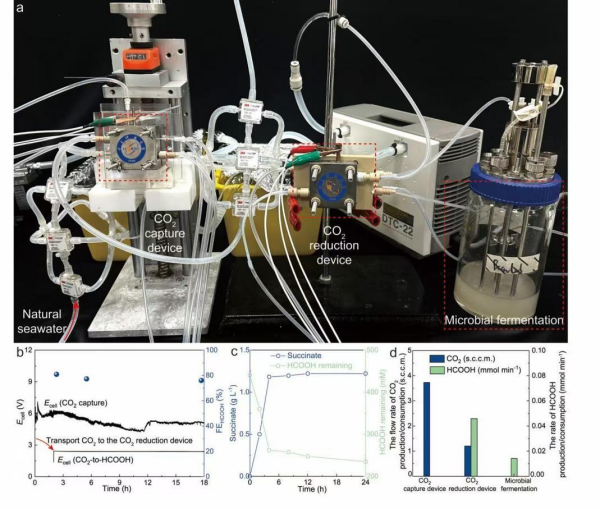
Core Insights - The article discusses the development of an "artificial ocean carbon cycling system" that integrates electrocatalysis and biocatalysis to capture and convert CO2 from seawater into valuable chemical products, addressing both ocean acidification and carbon reduction goals [3][4][6]. Group 1: Research Overview - The research was conducted by a collaboration between the Shenzhen Institute of Advanced Technology and the University of Electronic Science and Technology of China, resulting in a system that captures CO2 from seawater and converts it into intermediates for biomanufacturing [3][4]. - The system demonstrates a complete chain from CO2 capture to the production of materials and molecules, showcasing a scalable platform for interdisciplinary integration [4]. Group 2: Key Technological Innovations - The electrocatalysis team developed a novel electrolytic device that operates continuously for over 500 hours in natural seawater, achieving a CO2 capture efficiency of over 70% and producing hydrogen as a byproduct [6]. - The cost of capturing one ton of CO2 is approximately $229.9, indicating a promising economic outlook for practical applications [6]. Group 3: Biocatalysis Development - The biocatalysis team created a "supercell" capable of efficiently utilizing formic acid, derived from captured CO2, to produce biodegradable plastic monomers [7][8]. - The engineered bacteria can convert formic acid into succinic acid and lactic acid, which are core monomers for biodegradable plastics [8]. Group 4: Industrial Applications and Future Plans - The research has led to the synthesis of fully biodegradable PBS and PLA, demonstrating the potential for industrial applications in converting seawater into green materials [9]. - Future plans include establishing integrated "green factories" along coastal areas to continuously capture CO2 and convert it into green plastic raw materials, contributing to sustainable production models and supporting the "blue economy" [9].
海水“变”生物塑料 中国科研人员联合破解海水捕碳难题
Zhong Guo Xin Wen Wang· 2025-10-07 08:10
Core Insights - Chinese researchers have developed an "artificial marine carbon cycle system" that captures CO₂ from seawater and converts it into intermediates for biomanufacturing, addressing climate change and supporting the development of green low-carbon materials [1][2] Group 1: Research and Development - The research was conducted by a team from the University of Electronic Science and Technology of China and the Shenzhen Institute of Advanced Technology, with results published in the journal "Nature Catalysis" [1] - The system integrates "electrocatalysis + synthetic biology" to create a complete chain from "seawater carbon capture" to "material and molecular production," demonstrating a scalable platform for interdisciplinary collaboration [1][2] Group 2: Technical Achievements - The electrocatalysis team achieved over 70% CO₂ capture efficiency in natural seawater using a newly designed electrolytic device that operates continuously for over 500 hours [2] - The research team plans to establish integrated "green factories" in coastal areas to continuously capture CO₂ and convert it into formic acid, which will then be transformed into green plastic materials using engineered bacteria [2] Group 3: Economic and Environmental Impact - This research aligns with China's "dual carbon" goals and the development of a blue economy, providing a new pathway for utilizing marine carbon sinks and contributing to high-value utilization of marine carbon resources [1]
内陆省份,正在悄咪咪变成「海鲜」大省
36氪· 2025-10-03 13:37
Core Insights - Xinjiang, an inland province, is emerging as a significant player in the seafood industry despite its geographical distance from the sea [4][6] - The total aquatic product output in Xinjiang has increased from 85,000 tons in 2006 to 192,500 tons in the previous year, establishing it as a leader in the fishing industry among the five northwestern provinces [6][11] Water Resources and Conditions - Xinjiang has a water area of 11.45 million acres, ranking fourth in the country, which provides a foundation for its aquatic farming [6] - The province's unique salt-alkali land allows for the cultivation of marine species through artificial adjustments to water salinity and temperature, making it suitable for species like the South American white shrimp [7] Challenges in Seafood Production - The variety of fish species in Xinjiang is limited, but efforts have been made to introduce 32 different species, including those from major rivers and international sources [8] - Transportation remains a significant challenge, with live seafood requiring air transport to minimize loss, which increases costs [10] - Distribution channels for seafood from Xinjiang to other regions are still underdeveloped, affecting market access for individual farmers [10] Industry Growth and Future Potential - The number of enterprises in Xinjiang's aquaculture sector has been increasing, with over 300 new fisheries-related companies established between 2023 and 2024 [11] - The influx of investment and technology from coastal regions indicates a promising future for the development of Xinjiang's blue economy [11]

全景东盟双周报(2025年第9期):东博会引领数智+绿色合作破局升级-20250930
Yin He Zheng Quan· 2025-09-30 13:56
Collaboration Framework: Building a Multi-Dimensional Cooperation System Centered on Digital Intelligence and Innovation - The China-ASEAN Expo (CAEXPO) has become a significant platform for cooperation between China and ASEAN, with the 22nd CAEXPO held in Guangxi from September 17-21, 2025, focusing on "Digital Empowerment for Development, Innovation Leading the Future" [5][6] - The expo featured over 3,260 enterprises from 60 countries, marking a historical high in scale and participation, with a significant emphasis on high-level political and business engagement [6][7] - The CAEXPO showcased a dedicated AI pavilion with over 1,200 exhibits, where AI-related products accounted for more than 50% of the total exhibits, highlighting the integration of advanced technology into various sectors [12][13] Capital Market: Major Indices Rise, Bond Market Shows Moderate Volatility - From September 1 to 19, 2025, ASEAN major stock indices exhibited a mixed performance, with gains ranging from -1.35% to +4.07%, led by Indonesia (+4.07%) and Thailand (+3.88%) [19][20] - The ASEAN currencies strengthened against the US dollar during the same period, with notable appreciation in the Thai Baht (1.40%) and Malaysian Ringgit (0.44%) [28] - The bond markets in ASEAN showed moderate fluctuations, with Malaysia's 10-year government bond yield remaining stable between 3.39% and 3.43%, reflecting market confidence in its economic stability [32][33] Cooperation with China: Upgrading Institutional Framework and Expanding Diverse Industries - The China-ASEAN Free Trade Area 3.0 agreement is set to be signed in October 2025, marking a significant institutional upgrade in bilateral economic cooperation [37][39] - High-level interactions between Chinese and ASEAN leaders have intensified, enhancing political trust and paving the way for practical cooperation in trade, security, and cultural exchanges [39][40] - The focus of cooperation is shifting towards digitalization and green development, with practical measures in cross-border e-commerce, smart manufacturing, and educational collaboration being implemented [41][42]
广东“海”挺好,解锁蓝色经济新丰景
2 1 Shi Ji Jing Ji Bao Dao· 2025-09-30 10:03
Group 1 - The article highlights the transformation of Guangdong's marine industry, emphasizing a shift from traditional fishing to modern marine farming and technology integration [1][2] - Guangdong's marine fish seedling production reached 6.796 billion tails in 2024, accounting for approximately half of the national output, maintaining the top position in China for seven consecutive years [2] - The province has established 6,396 gravity-type deep-water cages, leading the nation in advanced marine farming equipment and technology [2] Group 2 - Guangdong's marine economy has surpassed 2 trillion yuan in production value, marking 30 consecutive years of being the national leader and representing 19% of the country's marine economic share [2]
第三届海上丝路共建国家海洋空间规划工作交流会暨海洋空间规划国际共同体大会举行
Ren Min Ri Bao· 2025-09-29 22:13
Core Points - The third Maritime Silk Road co-construction national marine spatial planning work exchange meeting and international community conference was held in Beijing, attended by over 300 guests from more than 60 countries and international organizations [1] - The conference aims to summarize work, exchange experiences, and continuously enhance the marine governance capabilities of countries involved in the Maritime Silk Road through technical support, public products, negotiation platforms, and cooperation opportunities [1] - The international community for marine spatial planning was officially launched during the conference, with over 60 coastal countries' marine institutions and more than 10 international marine organizations applying to join as the first batch of members by August this year [1] - Eight actions supporting the international community for marine spatial planning were announced by the China Ocean Development Foundation, along with the release of public products such as the compilation of marine spatial planning for "Belt and Road" countries [1]
海洋产业投融资路演在大连举行
Ke Ji Ri Bao· 2025-09-26 10:15
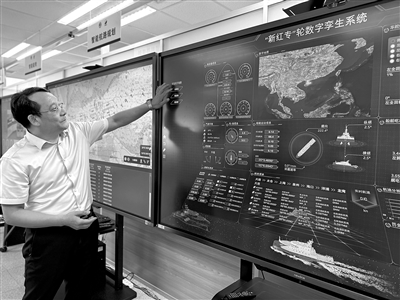
科技日报讯 (记者张蕴)由自然资源部海洋战略规划与经济司、深圳证券交易所联合主办的"2025 年蓝色信贷、海洋中小企业和科技成果投融资路演(大连站)"日前在辽宁省大连市举行。本次活动作 为第二届中国(大连)国际海洋商贸博览会暨第六届中国国际海洋牧场及渔业博览会的重要组成部分, 提供蓝色信贷和股权融资等多种融资类型,对接融资需求近10亿元。 图为大连海大智龙科技有限公司自主研发的国内首个全功能岸基智控中枢。科技日报记者 张蕴 摄 路演采取"现场路演+线上直播"方式,吸引沿海地区自然资源和海洋主管部门、金融机构、投资机 构、涉海企业广泛关注,线上线下累计参与达2000余人次,实现了跨区域、多层次的高效对接与资源整 合。 活动设置专题培训环节及"蓝色粮仓""海洋生物""数字海洋"3个专场路演。在路演现场,海洋领域 中小企业和科创团队展示了前沿项目和科技成果,覆盖现代海洋牧场、海参高值化利用、智慧渔业养 殖、海洋生物活性物质提取、南极磷虾开发、智慧海洋通信等热点领域,充分展现海洋科技创新与产业 应用新进展。点评嘉宾对路演项目给予充分肯定,并从产业化路径、商业模式、规模运营等方面提出专 业建议。项目团队与投资机构在现场 ...
深耕蓝色经济,开海千帆竞发飘动“浦发蓝”
Qi Lu Wan Bao· 2025-09-25 23:36
Core Viewpoint - The article highlights the role of SPD Bank's Qingdao branch in supporting the marine economy through innovative financial products and services, enabling the growth of marine-related enterprises in Qingdao [1][5]. Group 1: Support for Marine Enterprises - SPD Bank Qingdao branch has established a "financing task force" to address the financing challenges faced by marine enterprises, particularly small and medium-sized fishing companies [2]. - The bank introduced a "fishing vessel mortgage + sea area usage rights mortgage" combination guarantee model, which successfully provided credit to a key industry player, Rongyuan Fisheries, allowing for the upgrade of its fleet [2][3]. - The bank has served over 1,200 marine enterprises and issued loans exceeding 30 billion yuan by June 2025, demonstrating its commitment to the marine economy [5]. Group 2: Focus on Technology-Driven Marine Enterprises - SPD Bank Qingdao branch has developed a full lifecycle financial service system for technology-driven marine enterprises, supporting their growth from inception to maturity [3]. - The bank created a specialized product system called "Puketech," which includes five key products and seven financial service plans tailored for technology enterprises [3][4]. Group 3: Strengthening Supply Chain Financing - The bank has enhanced its online financing platform to provide supply chain financing solutions for marine enterprises, addressing issues related to collateral and traditional financing methods [4]. - The "N+1+N" financial service plan has been developed to support the upstream and downstream of marine enterprises, utilizing digital products for quick loan disbursement [4]. Group 4: Collaborative Ecosystem Development - SPD Bank Qingdao branch actively builds a "government-bank-enterprise" ecosystem to promote deep integration of blue finance, hosting events and discussions to foster collaboration among marine technology enterprises [6]. - The bank participated in various blue finance activities, including supporting the 13th China Innovation and Entrepreneurship Competition focused on marine technology [6]. Group 5: Long-term Commitment to Marine Economy - Since 2015, SPD Bank Qingdao branch has prioritized the marine economy as a strategic focus, establishing a blue economy financial service center and receiving recognition from national authorities for its initiatives [5][6]. - The opening of a specialized branch for marine finance in 2023 marks a new chapter in the bank's commitment to supporting the blue economy [5].

2025全球滨海论坛会议“可持续发展的滨海”平行论坛在盐城成功举办
Yang Zi Wan Bao Wang· 2025-09-25 15:33
Core Insights - The 2025 Global Coastal Forum focused on sustainable development and blue economy innovation, gathering representatives from government, international organizations, research institutions, and enterprises to discuss high-quality marine economic development paths [1][2]. Group 1: Key Themes and Discussions - Jiangsu Province is highlighted as the only province in China with diverse water bodies, emphasizing its commitment to marine development and ecological management [2]. - The forum featured a keynote speech by Shen Jun, outlining China's policy framework for high-quality marine economic development, stressing innovation, coordination, industrial upgrading, and open cooperation [2]. - Various specialized reports were presented, including ecological restoration for marine economic development, deep-sea technology advancements, marine biomedicine industry strategies, and smart shipyard construction [2]. Group 2: Collaborative Efforts and Agreements - A dialogue session titled "Chasing Dreams in the Deep Blue" involved discussions on marine information technology, tidal energy development, marine ranching, genetic technology applications, and blue finance support, emphasizing the need for technological innovation and cross-sector collaboration [3]. - A signing ceremony took place, where Jiangsu Coastal Private Equity Fund Management Co., Ltd. entered investment agreements with six marine-related companies, marking a significant step in Jiangsu's marine industry development [3]. - The forum served as a platform for showcasing blue economy innovations and fostering practical cooperation projects, contributing to international consensus on sustainable coastal management [3].