贸易不确定性

Search documents
特朗普关税“神助攻” 反让国际股市再次伟大
Ge Long Hui A P P· 2025-08-08 10:41
Core Insights - The tariff measures implemented by U.S. President Donald Trump are significantly boosting international stock markets while potentially ending the dominance of the S&P 500 index globally, at least for the time being [1] - International stock markets are expected to outperform the U.S. stock market benchmark for the first time since 2022, and this is also the first occurrence in a bull market environment since 2009 [1] - Concerns regarding the impact of tariffs and trade uncertainties on U.S. corporate profit growth are the primary reasons for this shift [1] Performance Comparison - The MSCI All Country World Index (excluding the U.S.) has significantly outperformed the S&P 500 index, rising by 18% so far in 2025, while the S&P 500 index has only increased by 7.8% [1]
货量萎缩、运价暴跌,跨境商家旺季备货期遇冷?
Hu Xiu· 2025-08-07 09:42
Core Insights - The average spot freight rates for container shipping from Asia to the U.S. West Coast and East Coast have plummeted by 58% and 46% respectively since June 1, indicating a significant decline in shipping demand despite the route being one of the most profitable for shipping companies [1][2]. Group 1: Market Dynamics - Overcapacity in shipping capacity, tariff changes, and geopolitical trade route adjustments are key factors contributing to the current freight rate collapse [2]. - The uncertainty surrounding U.S.-China trade negotiations has intensified market volatility [2]. - A brief increase in freight rates was observed from late May to early June due to shippers rushing to export during a temporary tariff suspension, but rates quickly fell as supply outstripped demand [3]. Group 2: Industry Expert Opinions - Experts predict that the severe overcapacity in global shipping will continue to impact the market, with shipping companies likely to implement sailing suspensions to maintain freight rates [4]. - DHL noted that the surge in shipping volume from Asia to North America has led to a decline in spot freight rates, as carriers rushed to increase capacity but are now facing an oversupply issue [4]. - Analysts expect freight rates to steadily decline in the second half of the year due to the influx of more vessels into the market and ongoing uncertainties related to tariff policies and global demand [5]. Group 3: Seasonal Trends and Implications - Traditionally, domestic supply chains in China sign contracts for production between March and June to prepare for the peak order season during the year-end shopping events [7]. - The ongoing decline in U.S.-China shipping rates may lower logistics costs for merchants, but it also indicates a weak demand for maritime freight during the critical inventory preparation phase, suggesting a contraction in overall cargo volume compared to previous years [8]. - Route adjustments, such as avoiding the Red Sea due to tensions in Yemen, are expected to absorb excess shipping capacity, providing some support for freight rates [8][9]. Group 4: Future Outlook - Analysts suggest that the diversion of shipping routes could absorb over 10% of container shipping capacity, maintaining a healthy utilization rate of 86%-87% [9]. - Despite a decline in exports from China to the U.S., shipments to other regions are reportedly increasing, indicating a potential shift in trade patterns [9].
7月份全球制造业PMI为49.3%
Zheng Quan Ri Bao· 2025-08-06 16:08
Group 1: Global Manufacturing Trends - The global manufacturing Purchasing Managers' Index (PMI) for July 2025 is at 49.3%, a decrease of 0.2 percentage points from June, indicating continued weak performance in the sector with five consecutive months below 50% [1] - The European manufacturing PMI has slightly increased to above 49%, suggesting a slow recovery, while the Americas' PMI has decreased, remaining below 49% [2] - The U.S. manufacturing PMI for July is reported at 48%, down 1 percentage point from June, marking a new low for the year and indicating ongoing contraction in the sector [2][3] Group 2: Regional Manufacturing Insights - Asian manufacturing PMI stands at 50.5%, a slight decline of 0.2 percentage points from June, but still indicates expansion, contributing significantly to global economic recovery [4] - The African manufacturing PMI has risen to 51.1%, an increase of 1.4 percentage points from June, indicating a strengthening recovery in the region [5] - The Asian Development Bank forecasts a 4.7% economic growth for 46 developing Asian economies in 2025, despite a slight downward revision due to U.S. tariff policies and global trade uncertainties [4] Group 3: Economic Factors and Predictions - The uncertainty surrounding U.S. tariff policies and weak employment data are increasing challenges for the U.S. economic recovery, with inflation pressures leading the Federal Reserve to maintain interest rates between 4.25% and 4.50% [3] - The International Monetary Fund (IMF) has raised its forecast for China's economic growth in 2025 from 4% to 4.8%, reflecting a positive outlook for the country's recovery [4]
经济学家:2026年进行的美墨加协定(USMCA)审查将使加拿大的贸易不确定性持续高企。
news flash· 2025-07-29 14:39
经济学家:2026年进行的美墨加协定(USMCA)审查将使加拿大的贸易不确定性持续高企。 ...
豆粕:隔夜美豆微跌,连粕调整震荡,豆一:调整震荡
Guo Tai Jun An Qi Huo· 2025-07-28 02:54
1. Report Industry Investment Rating - Not provided in the report 2. Core Views of the Report - Overnight US soybeans slightly declined, and Dalian soybean meal futures adjusted and fluctuated. Dalian soybeans also adjusted and fluctuated [1]. - On July 25, CBOT soybean futures closed lower due to trade uncertainties and concerns about export demand. The export sales data on Thursday was at the lower end of market estimates, and favorable weather in the US Midwest boosted soybean production prospects, putting pressure on soybean prices [3]. 3. Summary by Relevant Catalogs 3.1 Fundamental Tracking - **Futures Prices**: DCE soybean 2509 closed at 4224 yuan/ton during the day session, up 18 yuan (+0.43%), and at 4208 yuan/ton during the night session, down 15 yuan (-0.36%); DCE soybean meal 2509 closed at 3021 yuan/ton during the day session, down 20 yuan (-0.66%), and at 3007 yuan/ton during the night session, down 18 yuan (-0.60%); CBOT soybean 11 closed at 1021.75 cents/bushel, down 3.25 cents (-0.32%); CBOT soybean meal 12 closed at 281.7 dollars/short ton, down 1.5 dollars (-0.53%) [1]. - **Spot Prices**: In Shandong, the price of 43% soybean meal was 2900 - 2920 yuan/ton, down 40 yuan to unchanged compared to the previous day; in East China, it was 2830 - 2920 yuan/ton, down 10 yuan or unchanged; in South China, it was 2880 - 2940 yuan/ton, down 20 yuan to unchanged [1]. - **Industrial Data**: The trading volume of soybean meal was 8.15 million tons/day, compared with 20.15 million tons/day in the previous two trading days; the inventory was not available, compared with 90.83 million tons/week in the previous two trading days [1]. 3.2 Macro and Industry News - On July 25, CBOT soybean futures closed lower. Traders were trying to build positions before the August 1 tariff deadline set by the Trump administration, but were reluctant to significantly adjust their trading patterns due to ongoing Sino - US negotiations. The EU and the US may reach a trade framework agreement this weekend. Private exporters reported selling 142,500 tons of soybeans to Mexico for delivery in the 2025/26 season [3]. 3.3 Trend Intensity - The trend intensity of soybean meal is 0, and the trend intensity of soybeans is 0, referring only to the price fluctuations of the main - contract futures during the day session on the report day [3].
Graco(GGG) - 2025 Q2 - Earnings Call Transcript
2025-07-24 16:02
Financial Data and Key Metrics Changes - Graco reported second quarter sales of $572 million, an increase of 3% from the same quarter last year, with acquisitions contributing 6% growth while organic sales declined by 3% [5][12] - Reported net earnings decreased by 4% to $128 million, or $0.76 per diluted share, while adjusted non-GAAP net earnings were $127 million, or $0.75 per diluted share, a decrease of 3% [6] - The gross margin rate decreased by 200 basis points, with acquisitions accounting for nearly 80 basis points of the decline [6][7] - Operating expenses increased by 2%, driven by incremental expenses from acquisitions, while excluding these expenses, operating expenses declined by $7 million or 5% [7][8] - Cash provided by operations totaled $308 million for the year, an increase of $50 million or 19% [9] Business Line Data and Key Metrics Changes - The Contractor segment sales declined by 5% in the quarter, primarily due to softness in North America and reduced DIY demand [15][19] - The Industrial segment saw a decline of 1%, with growth in EMEA and Asia Pacific not enough to offset declines in The Americas [16] - Expansion markets were down 3% for the second quarter, although positive momentum in the semiconductor market continued [18] Market Data and Key Metrics Changes - The Americas market was particularly weak, contributing to the organic revenue decline, while EMEA and Asia Pacific showed growth across all segments [12][15] - The home center DIY channel faced challenges, down low double digits, but recent trends indicate stabilization [14][15] Company Strategy and Development Direction - Graco announced targeted price increases beginning in September to offset tariff impacts, focusing on key markets most affected [13] - The company is maintaining its 2025 revenue guidance of low single-digit sales growth on an organic constant currency basis, despite headwinds from the global trade environment [19] - The acquisition of ColorService is expected to enhance Graco's capabilities in precision dosing systems, broadening its portfolio [18] Management's Comments on Operating Environment and Future Outlook - Management noted that the current trade environment is uncertain, causing end users to delay project decisions [12][13] - Incoming order activity remained steady, with backlogs at normal levels across all segments, indicating potential for recovery [14][19] - Management expressed confidence in the second half of the year due to pricing actions and easier comparisons from the previous year [19] Other Important Information - Cash flow from operations less capital expenditures increased by $93 million or 51% year-to-date [10] - The adjusted effective tax rate was 20%, consistent with the expected full-year tax rate [9] Q&A Session Summary Question: Can you discuss the price increase announcement? - Management indicated that the price increases are targeted at geographies experiencing the most input cost pain, characterized as low single-digit increases [26][29] Question: What contributed to the strong free cash flow this quarter? - Management attributed the strong cash flow to improved inventory management and efficiency initiatives [30][31] Question: Can you elaborate on the ColorService acquisition? - The acquisition was driven by the desire to explore adjacent technologies and is expected to enhance Graco's growth potential [36][39] Question: What factors are necessary for customer confidence in the DIY market? - Management highlighted affordability as a key issue affecting new construction and remodeling activity [42] Question: How do you view the incremental margins for the year? - Management expects incremental margins to be in the mid to low thirties, depending on growth across different groups [96]

【拉加德不排除未来加息可能性】7月24日讯,欧洲央行行长拉加德在新闻发布会上被问及如果贸易不确定性消除,是否存在加息的可能性。对此她并未予以否认,而是表示,贸易紧张局势的缓解当然会消除压在消费者和企业身上的不确定性负担,至于这将带来何种影响,“未来自会揭晓”。
news flash· 2025-07-24 13:38
Core Viewpoint - The President of the European Central Bank, Lagarde, did not rule out the possibility of future interest rate hikes if trade uncertainties are resolved, indicating that easing trade tensions could alleviate uncertainty burdens on consumers and businesses, with future impacts yet to be revealed [1] Group 1 - Lagarde's response to the question about interest rate hikes suggests a cautious optimism regarding trade tensions [1] - The potential for interest rate increases is linked to the resolution of trade uncertainties, which could positively affect economic conditions [1] - The statement implies that the ECB is monitoring trade developments closely and their implications for monetary policy [1]
【环球财经】欧洲央行暂停降息 贸易不确定性令其回避前瞻指引
Xin Hua Cai Jing· 2025-07-24 13:34
Group 1 - The European Central Bank (ECB) decided to maintain interest rates unchanged after seven consecutive rate cuts, awaiting clearer signals regarding EU-US trade relations [1][2] - The deposit facility rate remains at 2%, while the main refinancing rate and marginal lending rate are held steady at 2.15% and 2.40% respectively [2] - The ECB emphasized a "data-driven, meeting-by-meeting" approach, avoiding preset interest rate paths, with decisions based on the latest data [2] Group 2 - Eurozone inflation has eased to the target level of 2%, prompting the ECB to adopt a wait-and-see stance due to the potential impacts of a US-EU trade agreement [2] - The Eurozone's business activity accelerated in July, with the composite PMI rising to an 11-month high of 51.0, driven by service sector growth and stabilization in manufacturing [3] - The strong Euro, which has appreciated over 13% against the US dollar this year, has raised concerns among ECB policymakers about its potential impact on inflation and export competitiveness [4] Group 3 - Market expectations suggest a potential rate cut of 22 basis points by the end of the year, with an 88% probability of a 25 basis point cut in upcoming meetings [4] - Analysts predict that the ECB may cut rates again in September, with some expressing concerns about the rapid appreciation of the Euro [4][5] - The International Monetary Fund reported a slight decrease in the dollar's share of global foreign exchange reserves, while the Euro's share increased to 20.1%, the highest since the end of 2022 [4]
市场分析师William Horobin:拉加德说经济增长的风险仍然倾向于下行。鉴于贸易不确定性并未发生太大变化,这并不令人意外。但这给了鸽派一个理由,认为欧元区可能还需要更多宽松政策的支持。
news flash· 2025-07-24 13:00
Core Viewpoint - The risks to economic growth are still tilted to the downside, as stated by Lagarde, which is not surprising given that trade uncertainties have not changed significantly [1] Group 1 - The dovish stance suggests that the Eurozone may still require additional support from accommodative policies [1]
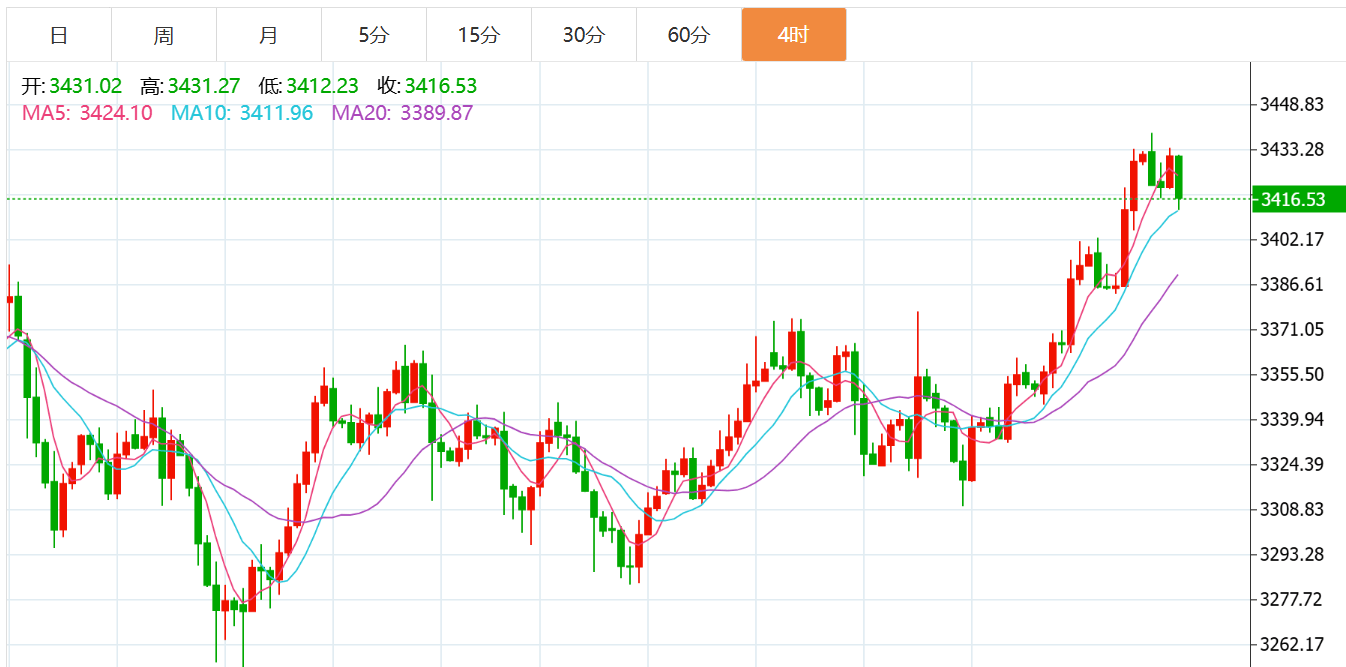
贺博生:7.24黄金高位下跌今日行情还会涨吗?原油最新多空操作建议
Sou Hu Cai Jing· 2025-07-24 00:27
Group 1: Gold Market Analysis - Gold prices experienced a significant drop, trading around $3390.53 per ounce after reaching a high of $3433.37, the highest since June 16, with a closing price of $3431.59, marking a 1% increase [2] - The decline in the US dollar, which fell 0.3% to 97.545, contributed to the rise in gold prices, supported by global trade uncertainties and a decrease in US Treasury yields [2] - The upcoming tariff negotiations and the Federal Reserve meeting at the end of the month are critical variables for gold price movements, with potential for a pullback if negotiations yield positive results [2][3] Group 2: Technical Analysis of Gold - Gold has shown a strong upward trend, with three consecutive days of gains, indicating robust short-term momentum [3] - The market is currently in an overbought state, suggesting a need for price correction, but the lack of orderly trading may suppress short-term demand [3][5] - Key resistance levels are identified at $3410-$3420, while support levels are at $3370-$3360, indicating a complex trading environment [5] Group 3: Oil Market Analysis - Brent crude oil prices rebounded to around $69 per barrel, while WTI crude hovered around $66, following positive developments in trade negotiations [6] - The optimism surrounding new tariff agreements has improved market sentiment, although concerns about global economic slowdown continue to weigh on oil demand [6] - The current rebound in oil prices reflects short-term trading sentiment rather than a substantial recovery in demand, with ongoing pressures from weak global consumption and geopolitical risks [6] Group 4: Technical Analysis of Oil - The mid-term outlook for oil remains upward, with the potential to test $78, although short-term momentum indicators suggest a weakening bullish trend [7] - Short-term price movements are expected to be volatile, with resistance levels at $67.5-$68.5 and support levels at $63.5-$62.5 [7]