
通胀指标

Search documents
美国5月PPI仅增0.1%,商品和服务成本温和增长
Xin Hua Cai Jing· 2025-06-12 13:28
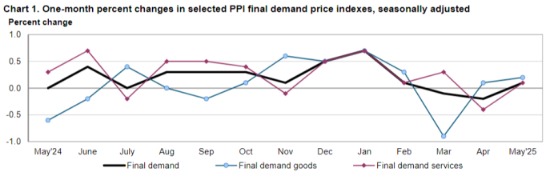
Core Insights - The Producer Price Index (PPI) for May in the U.S. showed a year-on-year increase of 2.6%, matching expectations, while the core PPI rose by 3.0%, slightly below the anticipated 3.1% [1] - Month-on-month, the PPI increased by only 0.1%, which was lower than the expected 0.2%, indicating a slowdown in price growth [1] - The report highlights that despite the current high tariff policies not significantly impacting consumers, there may be increased price pressures in the second half of the year as companies seek to maintain profit margins [1] Sector Analysis - **Services**: The service sector saw a month-on-month increase of 0.1%, primarily driven by a 2.9% rise in trade service margins, although transportation and warehousing services decreased by 0.2% [2] - **Goods**: Goods prices increased by 0.2% month-on-month, with notable increases in tobacco products (up 0.9%) and gasoline, while jet fuel prices fell by 8.2% [3] - **Core PPI**: Excluding food and energy, the core PPI rose by 0.1% month-on-month and 2.7% year-on-year, indicating stable underlying inflation trends [4] Intermediate Demand - **Processed Goods**: There was a month-on-month increase of 0.1% in processed goods, with processed materials (excluding food and energy) rising by 0.4%, while processed energy goods fell by 1.2% [5] - **Unprocessed Goods**: Unprocessed goods saw a significant month-on-month decline of 1.6%, primarily driven by an 18.7% drop in energy materials like natural gas, alongside a 1.4% decrease in non-food materials [6] Key Price Movements - **Price Increases**: Key items that saw price increases included tobacco (+0.9%), gasoline, diesel, and primary non-ferrous metals (+4.6%) [8] - **Price Decreases**: Items that experienced price declines included jet fuel (-8.2%), pork, carbon steel scrap, and natural gas (-18.7%) [9] - **Service Sector Prices**: In the service sector, air passenger transport prices fell by 1.1%, while furniture retail and securities brokerage services also declined, contrasting with increases in system software publishing [10]

美国5月PPI保持温和 关税效应或“后发制人”
news flash· 2025-06-12 12:52
Core Viewpoint - The May PPI data in the U.S. showed a mild impact from costs of goods and services, with core PPI figures falling short of expectations, indicating potential price pressures in the second half of the year due to high tariffs and corporate profit margin concerns [1] Group 1: PPI Data Insights - The May PPI data revealed an expansion in profit margins for wholesalers and retailers, particularly in the automotive and machinery sectors, following a decline in April [1] - Year-to-date profit margins have shown fluctuations, highlighting the uncertainty of trade policies on prices and demand [1] Group 2: Economic Indicators - Analysts are closely monitoring the PPI report as certain components are used to calculate the Fed's preferred inflation measure, the PCE data [1] - Areas of weakness in May included declines in airfare prices, investment management fees, and moderate healthcare costs [1] - The PCE report is expected to be released later this month, which will provide further insights into inflation trends [1]
特朗普大刀又来,砍向特斯拉,市值一夜蒸发2700亿元!再加关税!海外科技制裁加剧?美股巨震!知名投资大鳄清仓美股,发出警告
雪球· 2025-05-31 02:32
Group 1 - The U.S. stock market experienced significant volatility on the last trading day of May, with major indices showing a "V" shape recovery after a sharp decline triggered by Trump's announcement on tariffs and manufacturing policies [1][10] - Trump proposed to increase the import tariff on steel from 25% to 50% to protect the U.S. steel industry from foreign competition, which led to a rise in steel stocks post-announcement [4][5] - Trump also mandated that U.S. automakers, including Tesla, must produce entire vehicles and all parts domestically, causing Tesla's stock to drop over 3%, resulting in a market cap loss of approximately $38.6 billion [7][8] Group 2 - The S&P 500 and Nasdaq achieved their best monthly performance in nearly a year, with the S&P 500 rising over 6% and the Nasdaq nearly 10% in May [2][12] - The volatility in the market was exacerbated by increased policy uncertainty in the U.S., with notable investors like Jim Rogers and Michael Burry reportedly liquidating their U.S. stock holdings [3][26] - The U.S. personal consumption expenditure (PCE) growth slowed significantly in April, with core PCE prices at a four-year low of 2.5%, indicating potential economic challenges ahead [21][22]


特朗普突发,又加关税!美股巨震!
Zheng Quan Shi Bao Wang· 2025-05-30 23:50
Group 1: U.S. Tariff Policy Impact - The U.S. will increase the import tariff on steel from 25% to 50% to protect the domestic steel industry from foreign competition [1] - Following the announcement, U.S. steel stocks surged, with Cleveland-Cliffs seeing an increase of over 26% in after-hours trading [1] Group 2: Automotive Industry Developments - President Trump stated that U.S. automakers, including Tesla, must produce vehicles and all parts domestically rather than abroad, causing a significant drop in Tesla's stock by over 3% [2] - Several Chinese concept stocks experienced declines, with the Nasdaq Golden Dragon China Index falling by 2.69% [2] Group 3: Consumer Spending Trends - U.S. personal consumption expenditures (PCE) rose by 0.2% in April, a slowdown from the 0.7% increase in March, attributed to increased economic uncertainty from changing tariff policies [3] - The PCE price index is a key inflation indicator closely monitored by the Federal Reserve for monetary policy decisions [3] Group 4: EU-U.S. Trade Negotiations - The EU and U.S. are in critical trade negotiations, aiming for an agreement by July 9, amidst a complex global situation [4] - The EU remains committed to finding solutions to trade tensions, although the outlook for negotiations is uncertain [4]





美国4月个人消费支出增长放缓
news flash· 2025-05-30 23:23
Core Viewpoint - The U.S. personal consumption expenditures (PCE) showed a significant slowdown in April, indicating increased economic uncertainty and a shift towards saving among households [1] Economic Data Summary - In April, U.S. PCE increased by 0.2% month-over-month, a decrease from 0.7% in March [1] - The PCE price index rose by 0.1% month-over-month, while the core PCE price index, excluding food and energy, also increased by 0.1% [1] - Year-over-year, the PCE price index increased by 2.1%, and the core PCE price index rose by 2.5%, both slightly above the Federal Reserve's long-term inflation target of 2% [1] Consumer Sentiment Analysis - The latest data reflects potential anxiety among U.S. consumers regarding the economy, with the previous quarter showing the weakest consumption spending in nearly two years [1] - Despite the increase in tariffs on imported goods not yet being fully reflected in rising prices, consumer confidence has declined, and expectations for personal financial prospects have reached historical lows [1] Monetary Policy Implications - The PCE price index is a key inflation indicator closely monitored by the Federal Reserve, influencing its monetary policy decisions and thus attracting significant market attention [1]
见证历史!美国4月商品进口额环比大降近20%,原油、黄金下跌!美股三大指数下挫,服装零售巨头跌超20%
Mei Ri Jing Ji Xin Wen· 2025-05-30 16:16
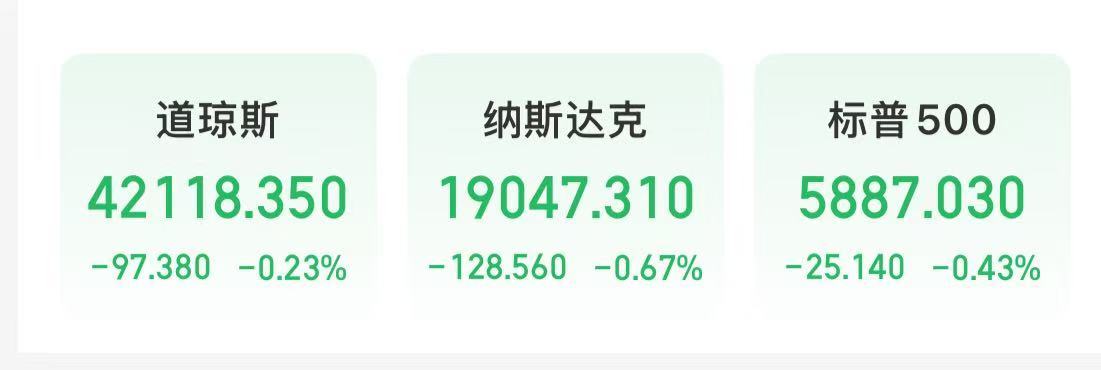
Market Overview - Major U.S. stock indices opened lower, with the Dow Jones down 0.23%, Nasdaq down 0.67%, and S&P 500 down 0.43% [1] - Large tech stocks mostly declined, with Nvidia down over 2%, Google down over 1%, and Amazon, Apple, and Meta showing slight declines, while Tesla and Microsoft experienced minor gains [3] Individual Stock Performance - Apple shares decreased by 0.59% to $198.780, while pre-market trading showed a slight decline of 0.31% [4] - Tesla shares increased by 0.44% to $360.025, but pre-market trading indicated a drop of 0.80% [4] - Meta's stock fell by 0.25% to $643.450, with a pre-market decline of 0.16% [4] - Amazon shares dropped by 0.82% to $204.020, with a pre-market decline of 0.39% [4] - Nvidia shares fell by 2.85% to $135.230, with a pre-market decline of 0.28% [4] - Google shares decreased by 1.20% to $169.790 [4] Sector-Specific News - Apparel retail giant GAP saw a significant drop of over 20% in its stock price, warning that tariffs would erode its annual operating profit [5] - The Nasdaq Golden Dragon China Index fell by 2.67%, with major Chinese stocks like Alibaba, Xpeng Motors, and NIO dropping over 3% [6] Commodity Market - Spot gold prices decreased by 0.73% [8] - International oil prices fell, with both Brent and WTI crude oil dropping over 1% [10] Economic Indicators - The U.S. Census Bureau reported a dramatic 19.8% month-over-month decline in April's goods imports, the largest drop on record, bringing the total to $2760.97 billion [13] - The trade deficit narrowed to $876 billion in April, significantly better than the market expectation of $1430 billion [13] - The core PCE price index rose by 2.5% year-over-year, matching expectations and marking the smallest increase in over four years [13][14]
今夜,见证历史!暴跌19.8%!
券商中国· 2025-05-30 15:33
Core Viewpoint - The article discusses the significant impact of U.S. tariff policies on trade data, inflation indicators, and market reactions, highlighting a notable decline in import values and changes in consumer spending patterns [1][2][3][4]. Trade Data Summary - In April, U.S. goods imports fell from $344.47 billion in March to $276.10 billion, marking a record decline of 19.8% [2][3]. - The trade deficit narrowed to $87.6 billion in April, significantly better than the expected $143 billion and down from $163.2 billion in the previous month [3]. Inflation Indicators Summary - The core PCE price index rose by 2.5% year-on-year in April, the smallest increase in over four years, aligning with expectations [3][4]. - The overall PCE price index increased by 2.1% year-on-year, slightly below the expected 2.2% [4]. Consumer Spending and Income Summary - Real personal spending grew by only 0.1% in April, a significant slowdown compared to a 0.7% increase in March [4][5]. - Personal income increased by 0.8%, the largest gain since January 2024, exceeding the forecast of 0.3% [5]. Market Reactions Summary - Following the release of macroeconomic data, U.S. stock indices experienced volatility, with the Dow Jones Industrial Average rising by 0.1% while the Nasdaq and S&P 500 saw slight declines [6]. - There was a notable outflow of $9.5 billion from global equities, marking the largest weekly net outflow of the year [6]. Currency and Investment Outlook Summary - Analysts suggest that the dollar is entering a bear market due to ineffective tariff policies and increasing U.S. debt, which may lead to a shift in investment towards emerging markets and gold [7].



5月22日电,英国将考虑季节性调整CPI以改善通胀指标。
news flash· 2025-05-22 12:46
Core Viewpoint - The UK is considering seasonal adjustments to the Consumer Price Index (CPI) to improve inflation metrics [1] Group 1 - The potential adjustment aims to provide a more accurate reflection of inflation trends [1] - Seasonal adjustments could help policymakers make better-informed decisions regarding monetary policy [1] - The move reflects ongoing concerns about inflation levels in the UK economy [1]
英国将考虑季节性调整CPI以改善通胀指标。
news flash· 2025-05-22 12:44
Group 1 - The UK is considering seasonal adjustments to the Consumer Price Index (CPI) to improve inflation metrics [1]
澳洲联储可能对降息前景持开放态度
news flash· 2025-05-20 03:06
Core Viewpoint - The Reserve Bank of Australia (RBA) is expected to adopt a dovish stance regarding interest rate cuts, with a 25 basis point reduction anticipated in the upcoming policy meeting, marking the first cut since February [1] Summary by Relevant Categories Monetary Policy - The RBA is likely to indicate that inflation indicators have returned to target levels, but due to global economic uncertainties and a robust Australian job market, a series of rate cuts is unlikely [1] - The option of a 50 basis point cut does not seem to be under consideration in the current calm financial market environment [1] Economic Indicators - The RBA's decision will be influenced by the active employment market and steady wage growth amidst weak productivity [1]