
自动驾驶

Search documents
对标Genie 3,蚂蚁灵波开源世界模型LingBot-World
Feng Huang Wang· 2026-01-29 03:15
Core Insights - Ant Group's LingBo Technology has released the LingBot-World model, which aims to provide a high-fidelity, high-dynamic, and real-time controllable "digital rehearsal space" for embodied intelligence, autonomous driving, and game development [1] Group 1: Model Capabilities - LingBot-World addresses the common "long-term drift" issue in video generation, achieving nearly 10 minutes of continuous stable lossless generation through multi-stage training and parallel acceleration [1] - The model can generate approximately 16 frames per second (FPS) and maintains an end-to-end interaction latency of under 1 second, allowing users to control characters and camera perspectives in real-time [1] Group 2: Interaction and Flexibility - Users can trigger environmental changes and world events through text commands, such as adjusting weather or changing visual styles, while maintaining relative consistency in scene geometry [1] - The model possesses zero-shot generalization capabilities, enabling it to generate interactive video streams from a single real photo or game screenshot without additional training or data collection [2] Group 3: Data Acquisition Strategy - To address the scarcity of high-quality interactive data for world model training, LingBot-World employs a hybrid data collection strategy, utilizing large-scale cleaned network videos and game captures combined with Unreal Engine (UE) synthesis pipelines [2] - This approach allows for the extraction of clean visuals without UI interference, while synchronously recording operational commands and camera poses to provide precise training signals for the model [2] Group 4: Community Engagement - The model weights and inference code for LingBot-World have been made available to the community, promoting collaboration and further development [3]
特斯拉2025年财报:全球生产电动车165.5万辆、交付163.6万辆
Xin Lang Cai Jing· 2026-01-29 02:56
Core Insights - Tesla reported production of approximately 1.655 million electric vehicles and deliveries of 1.636 million vehicles for the fourth quarter and the entire year of 2025, with the Model Y leading sales in multiple markets and achieving record electric vehicle deliveries in the Asia-Pacific region [1][3] - The energy storage installation reached 46.7 GWh, representing a year-on-year growth of 48.7%, with the fourth quarter alone contributing 14.2 GWh, a quarter-on-quarter increase of 13%, marking historical highs for both quarterly and annual energy storage installations [1][3] - Tesla's Shanghai Gigafactory delivered 851,000 electric vehicles in the year, accounting for over half of the global total deliveries, with the Model Y maintaining its position as the best-selling SUV in China [1][3] Company Strategy and Vision - Elon Musk stated that advancements in artificial intelligence and robotics will lead to a future of "extraordinary wealth for all humanity" rather than just "basic income," emphasizing Tesla's commitment to enhancing the safety of transportation and AI-related products while reducing costs [1][3] - The company aims to ensure that everyone can access what they need without compromise while maintaining a beautiful natural environment, envisioning a future where individuals can have everything they desire, including excellent healthcare services [1][3] - Tesla has over 9 million global owners and is evolving into a comprehensive technology company encompassing autonomous driving, humanoid robots, electric vehicles, and sustainable energy [2][4] - The company's mission was updated on January 21, 2026, to "build an extraordinary wealthy world," with a focus on the large-scale advancement of autonomous driving and the development of Tesla Robotaxi, which is expected to fundamentally change transportation [2][4]

东吴证券:维持曹操出行(02643)“买入”评级 配股加速全球Robotaxi布局
智通财经网· 2026-01-29 02:50
Core Viewpoint - Dongwu Securities maintains a "buy" rating for Cao Cao Mobility (02643), highlighting a clear commercialization path for its Robotaxi business and the establishment of a vehicle technology operation ecosystem [1] Recent Events - On January 28, 2026, the company announced a plan to place no more than 12 million shares, accounting for approximately 2.06% of the enlarged total issued shares, at a price of HKD 32.46 per share, raising a net amount of HKD 383 million, which is about 8.97% lower than the closing price of HKD 35.66 on January 27 [1] Financial Allocation - Approximately 67.7% of the raised funds will be invested in the development of domestic and international Robotaxi businesses, focusing on the procurement of customized Robotaxi vehicles, building matching operational systems, and ongoing core technology research and development [2] - About 22.3% will be used to expand enterprise services through operational investments, platform upgrades, and recent or ongoing acquisitions, such as Weixing Technology and Zhejiang Geely Business Services [2] - The remaining approximately 10% will be allocated for working capital and general corporate purposes [2] Strategic Importance - The company has positioned Robotaxi as a core strategic focus for long-term development, aiming to deploy a total of 100,000 fully customized Robotaxis by 2030, which is a key performance indicator in the new share incentive plan [3] - The company has developed a unique "smart customized vehicle + smart driving technology + smart operation" model, leveraging data, algorithms, and a nationwide service network accumulated over ten years of shared mobility [3] - The second-generation Robotaxi has entered the pilot operation phase, transitioning from human-monitored to unmanned operations, with fully customized models set to debut this year [3] - Internationally, the company has partnered with Abu Dhabi to promote the export of autonomous driving technology and battery swap systems [3]

速腾聚创20260128
2026-01-29 02:43
Summary of RoboSense Conference Call Company and Industry Overview - **Company**: RoboSense (速腾聚创) - **Industry**: Autonomous Driving and LiDAR Technology Key Points and Arguments Robotaxi Development - RoboSense has partnered with Didi and GAC to deliver new Robotaxi models, each equipped with 10 RoboSense LiDAR units, marking the transition from pilot testing to mass production and commercialization [2][4] - In 2026, RoboSense has initiated mass production collaborations with Didi, Pony.ai, WeRide, Momenta, and Baidu's Apollo Go, indicating a strong market presence [2][4] - The company is also collaborating with NVIDIA and its ecosystem clients in overseas markets [2] LiDAR Technology Advancements - The future direction for Robotaxi LiDAR technology focuses on digitalization, with main radars aiming for longer ranges, higher resolutions, and increased point cloud density [2][6] - L4 autonomous driving requires high line counts and dense point cloud data, which digital LiDAR achieves through 3D stacked chip technology, allowing for integrated reception, capture, transmission, and processing [7] - Didi's vehicles are equipped with over 10 LiDAR units to meet the precision and reliability demands of L4 autonomous driving, indicating a trend towards high sensor configurations [8] Market Trends and Projections - The logistics sector is expected to see a rise in small delivery vehicles, with projections of 100,000 to 150,000 units by 2026, each equipped with 2-4 LiDAR units [3][14] - The Robotaxi market is seeing an increase in LiDAR configurations, with standard setups now including 8 units, emphasizing safety and zero blind spots [8] - By 2030, Goldman Sachs predicts the Chinese Robotaxi market could reach 500,000 units, with expectations that actual numbers may exceed this due to rapid industry growth [24] Competitive Landscape - RoboSense claims a 100% market share in solid-state Flash LiDAR for blind-spot detection and over 90% in main radar, indicating a strong competitive position [21] - The company is the first to achieve mass production of SPAD chips for vehicle-mounted blind-spot LiDAR, maintaining a technological edge over competitors [12] Cost and Performance Considerations - The transition to higher line count LiDAR (500 lines) is driven by performance needs, with expectations that costs will decrease as production scales up [10][27] - RoboSense's EM4 LiDAR is expected to maintain a strong gross margin despite potential price reductions due to increasing demand [27] Sensor Fusion and System Integration - RoboSense's Robotaxi clients utilize LiDAR not just for redundancy but as part of a sensor fusion strategy, combining LiDAR with cameras to enhance safety and reliability [28] - The company emphasizes the importance of software capabilities in optimizing LiDAR performance, which is a key factor for clients when selecting suppliers [25] Future Product Development - RoboSense's current product lineup, including the EM4 and E1 digital combination, is designed to meet the needs of L4 autonomous vehicles, with ongoing iterations planned to enhance performance [29] - The company has made significant progress in developing its Spider chip, with expectations that competitors will require 3-4 years to catch up [30] Additional Important Insights - The shift from mechanical to solid-state LiDAR is becoming a global trend, with companies like Uber and Nuro adopting solid-state solutions [15] - The Robotaxi industry is moving towards exclusive partnerships with LiDAR suppliers to enhance operational efficiency and algorithm compatibility [16] - The integration of advanced algorithms and filtering techniques is crucial for addressing noise issues in LiDAR data, which is a common challenge in the industry [28]
马斯克亲手砍掉Model S/X车型,特斯拉交出最惨年报,重心转向自动驾驶和机器人
3 6 Ke· 2026-01-29 02:39
Core Viewpoint - Tesla's annual revenue has declined for the first time, with net profit hitting a five-year low, as CEO Elon Musk announces the discontinuation of the Model S and Model X to focus on robotics and AI initiatives [1][6][38]. Financial Performance - Tesla's total revenue for 2025 was $94.827 billion (approximately ¥6587 billion), a 3% decrease from $97.690 billion in 2024 [27][29]. - The automotive segment revenue fell by 10% to $69.526 billion (approximately ¥4830 billion) [31]. - Net income dropped by 46% to $3.794 billion (approximately ¥264 billion), marking a near five-year low [29][38]. - In Q4 2025, total revenue was $24.901 billion (approximately ¥1730 billion), down about 3% year-over-year, with net profit of $840 million (approximately ¥58 billion), a decline of approximately 61% [33][34]. Strategic Shifts - Musk announced the end of production for the Model S and Model X, with the Fremont factory transitioning to produce the Optimus humanoid robot [1][3]. - The focus of the earnings call was primarily on AI developments, including the Optimus robot, Robotaxi, and Full Self-Driving (FSD) software, rather than on automotive production and sales metrics [5][6]. Future Investments - Tesla plans to invest over $20 billion (approximately ¥1389 billion) in capital expenditures in 2026, emphasizing the importance of AI and robotics in its future strategy [7][9]. - The company is preparing for the production of the Cybercab and the next-generation Roadster, with the Cybercab expected to have a production capacity exceeding all other models combined [9][11]. Robotics and AI Development - The third-generation Optimus robot is set to be released in Q1 2026, with plans for a production capacity of 1 million units annually by the end of 2026 [11][25]. - Tesla's FSD software has gained approximately 1.1 million active users, but the company is still far from its target of 10 million users [36]. Competitive Landscape - Musk acknowledged that Chinese companies are likely to become significant competitors in the robotics sector, highlighting the rapid advancements in China's manufacturing capabilities [26][38].


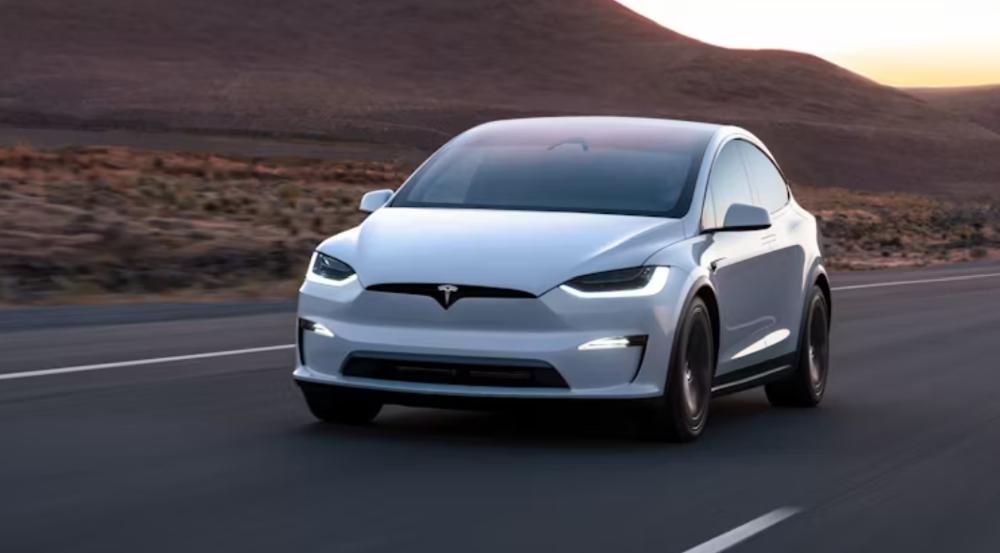
特斯拉2025年财报发布:全球生产电动车约165.5 万辆 交付163.6 万辆
Cai Jing Wang· 2026-01-29 02:35
Group 1 - Tesla delivered approximately 1.636 million electric vehicles in 2025, with Model Y being the best-selling vehicle in multiple markets and achieving record electric vehicle deliveries in the Asia-Pacific region [1] - The energy storage installation reached 46.7 GWh in 2025, representing a year-on-year growth of 48.7%, with Q4 installations at 14.2 GWh, a quarter-on-quarter increase of 13% [1] - The Shanghai Gigafactory delivered 851,000 electric vehicles in 2025, accounting for over half of Tesla's global deliveries, with Model Y leading the SUV market in China [1] Group 2 - Tesla has over 9 million vehicle owners globally and is evolving into a comprehensive technology company covering autonomous driving, humanoid robots, electric vehicles, and sustainable energy [2] - The company's mission was updated to "build a world of extraordinary abundance," emphasizing the transformative potential of autonomous driving and humanoid robots in enhancing societal wealth [2] - Elon Musk highlighted that the large-scale advancement of autonomous driving and the development of Tesla Robotaxi will fundamentally change transportation, while humanoid robots will free humans from monotonous labor [2]
马斯克冲刺机器人量产,果断停产特斯拉豪华车型!2026年资本支出将“非常大”
量子位· 2026-01-29 02:30
Core Viewpoint - Tesla is transitioning from a luxury car manufacturer to a robotics company, with plans to discontinue the Model S and Model X by Q2 2026 to allocate production resources for the Optimus robot [1][2][3]. Group 1: Transition to Robotics - The production lines for Model S and Model X will be repurposed for the Optimus robot, aiming for an annual output of one million units [5]. - The discontinuation of Model S and Model X is seen as a necessary step towards a future focused on autonomous driving [3][6]. - The core technologies developed for electric vehicles will be inherited by the Optimus robot, including actuators, power electronics, and AI algorithms [12][13]. Group 2: Sales and Financial Performance - In 2025, Tesla delivered approximately 1,636,129 electric vehicles, with Model S/X and Cybertruck accounting for only 50,850 units, representing about 3% of total sales, a 40.2% decline from 2024 [8]. - Tesla's Q4 2024 net income was $840 million, a 61% decrease year-over-year [10]. - Total automotive revenues for Q4 2024 were $19.798 billion, down 11% compared to the previous year [11]. Group 3: Future Investments - Tesla plans to invest $20 billion in xAI as part of its strategy to enhance AI capabilities for physical world applications [14][15]. - Capital expenditures for 2026 are expected to exceed $20 billion, more than double the $8.5 billion spent in 2025, focusing on ramping up production of humanoid robots [17].
股价年涨 164%,净利增 93%!“国产红外芯片第一股” 2025年财报超券商预期
Feng Huang Wang· 2026-01-29 02:29
Core Viewpoint - Raytron Micro-Nano has reported an impressive performance forecast for 2025, expecting a net profit of approximately 1.1 billion yuan, representing a year-on-year growth of about 93%, significantly exceeding previous estimates from domestic brokerages [1][4][5]. Financial Performance - The company anticipates a net profit of around 1.1 billion yuan for 2025, with a non-recurring net profit of approximately 1.01 billion yuan, reflecting a year-on-year increase of about 98% [4]. - For the first three quarters of 2025, Raytron Micro-Nano reported a main operating revenue of 4.086 billion yuan, up 29.72% year-on-year, and a net profit of 707 million yuan, an increase of 46.21% [4][5]. - The fourth quarter is projected to see a net profit of about 393 million yuan, marking a staggering year-on-year growth of 359.55% [7]. Market Position and Growth Drivers - Raytron Micro-Nano has become the global leader in the thermal imaging micro-measurement radiometer market, achieving a dual championship in both shipment volume and revenue, capturing 33% of global shipment volume and 26% of revenue [3][7]. - The company's stock price has surged over 160% in the past year, reflecting strong market demand and a robust growth trajectory [3][11]. - The company maintains a high R&D intensity of nearly 20%, which strengthens its technological barriers and supports the development of multi-dimensional perception technologies [3][11]. Business Strategy and Product Development - Raytron Micro-Nano focuses on infrared technology as its core business, while also expanding into microwave and laser technologies, forming a "three-in-one" collaborative development system [4][12]. - The company has invested heavily in R&D, with R&D expenses amounting to 812 million yuan in the first three quarters of 2025, accounting for 19.88% of its operating revenue [12]. - The company is actively expanding its market presence, driven by military demand and rapid penetration into civilian applications, utilizing a B2B direct sales model complemented by e-commerce channels [14]. Future Outlook - The company is expected to benefit from increasing regulatory requirements for infrared temperature measurement in Europe and the U.S., as well as a surge in demand for drone infrared applications [15]. - Raytron Micro-Nano is positioned to achieve steady and sustainable growth, bolstered by contracts with major automotive manufacturers and ongoing developments in satellite communication and laser communication modules [15].

特斯拉发布2025全年财报:营收首次下滑,四季度净利润暴跌61%
Xin Hua Cai Jing· 2026-01-29 02:12
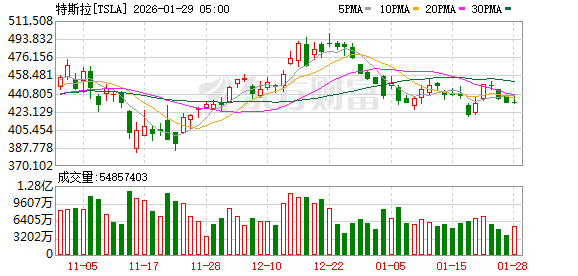
Core Viewpoint - Tesla's financial performance in 2025 shows a significant decline in revenue and profit, marking the first annual revenue drop in the company's history, while the company is transitioning towards becoming an AI-focused entity [2][3]. Financial Performance - In 2025, Tesla's GAAP total revenue was $94.827 billion, a 3% year-over-year decrease; Q4 revenue was $24.901 billion, also down 3% [2]. - The net profit for 2025 was $3.8 billion, a 46% decline year-over-year; Q4 net profit was $800 million, down 61% [2]. - Non-GAAP net profit for 2025 was $5.9 billion, a 26% decrease; Q4 non-GAAP net profit was $1.8 billion, down 16% [2]. - Operating cash flow for 2025 was $14.7 billion, with Q4 at $3.8 billion; free cash flow was $6.2 billion, with Q4 at $1.4 billion [2]. - Cash and investments increased by $7.5 billion to $44.1 billion in 2025 [2]. Business Developments - In January 2026, Tesla began eliminating safety drivers for its autonomous ride-hailing service in Austin [2]. - The fourth quarter and full year of 2025 saw record high energy storage installations, and the Asia-Pacific market achieved record electric vehicle deliveries [2]. - However, global electric vehicle deliveries for 2025 were approximately 1.64 million units, an 8.6% year-over-year decline, marking the second consecutive year of decline [2]. Strategic Transition - Tesla is focusing on transitioning from a hardware-centric business to an AI-driven company, emphasizing the development of smart assisted driving and launching the Tesla Robotaxi service [3]. - The company is also optimizing the design of humanoid robots and expanding AI training infrastructure [3]. - The launch of the refreshed Model Y and other derivative models completed the update of Tesla's vehicle product line, maintaining a streamlined product portfolio focused on long-range capabilities and advanced software [3]. Future Investments - In 2026, Tesla plans to increase investments in clean energy, transportation, and automation, including ramping up production capacity across six new production lines in vehicle, robotics, energy storage, and battery manufacturing [4]. - The company aims to leverage existing factories, charging networks, and service centers to support future growth [4].
特斯拉高管解读Q4财报:计划推出专为完全自动驾驶设计的、体量更大的CyberCab车型
Xin Lang Ke Ji· 2026-01-29 02:09
Core Viewpoint - Tesla reported its fourth-quarter earnings after the market close on Wednesday, with all data exceeding market expectations. However, the company's annual revenue declined by 3% year-over-year, marking the first annual revenue drop since its IPO [1]. Group 1: Earnings and Financial Performance - Tesla's fourth-quarter performance surpassed market expectations, but the annual revenue saw a decline of 3% compared to the previous year [1]. - The earnings call featured insights from key executives, including CEO Elon Musk and CFO Vaibhav Taneja, who discussed the implications of the financial results [2]. Group 2: Future Vehicle Strategy - Tesla's management anticipates that the Robotaxi (autonomous taxi) market will significantly alter global automotive sales, with predictions of millions in annual growth for this segment [3]. - The CyberCab, designed for two passengers, is expected to begin production in April, with a production ramp-up following an S-curve pattern [4]. - The company plans to introduce various models to cover different price ranges, aiming to expand its total addressable market (TAM) [5]. Group 3: Autonomous Driving and Market Position - Tesla's design philosophy for the CyberCab focuses on minimizing the cost per mile in fully autonomous driving, differing from traditional vehicle designs [7]. - The company expects that the majority of driving miles will be completed by autonomous vehicles, with human-driven miles potentially dropping to as low as 1% [6]. - Tesla's extensive charging network is seen as a critical advantage for scaling Robotaxi operations and addressing infrastructure needs [10]. Group 4: Software and Operational Insights - The company has been testing Robotaxi services in select cities to gather data and improve the "Full Self-Driving" (FSD) capabilities before broader deployment [9]. - Recent software updates have significantly enhanced the performance of the FSD, receiving positive feedback from users [10].