算力

Search documents
光模块CPO强势爆发!创业板人工智能ETF(159363)放量飙涨5%再创新高,最新“光”含量超56%!
Xin Lang Cai Jing· 2025-12-08 03:09
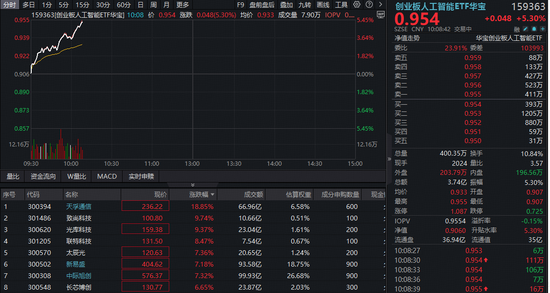
Group 1 - The core viewpoint of the news highlights a strong surge in the optical module sector, with companies like Tianfu Communication and Zhongji Xuchuang reaching historical highs in stock prices due to increased demand driven by AI computing power [1][4][6] - The AI computing power demand is accelerating the global optical module industry towards upgrades to 800G/1.6T, with optical isolators becoming a critical component due to a global supply shortage of Faraday rotators [1][4][6] - The first AI-focused ETF on the ChiNext market, which has over 56% exposure to optical modules, has also seen significant gains, reflecting the overall positive sentiment in the sector [1][2][4] Group 2 - Longcheng Securities emphasizes that the continuous implementation of AI applications will drive the rapid construction of computing infrastructure, creating investment opportunities in the optical module, PCB, and copper cable sectors [2][6] - The report suggests focusing on the first ChiNext AI ETF (159363) and its related funds, which are heavily invested in the optical module sector, indicating a strategic approach to capture AI-related market trends [2][6] - The optical module industry is expected to experience a "Davis double" effect, where both performance and valuation are anticipated to improve due to rapid demand release [2][6]





铜价暴涨2000美元,美疯狂囤铜,抢占全球AI核心资源
Sou Hu Cai Jing· 2025-12-07 21:37
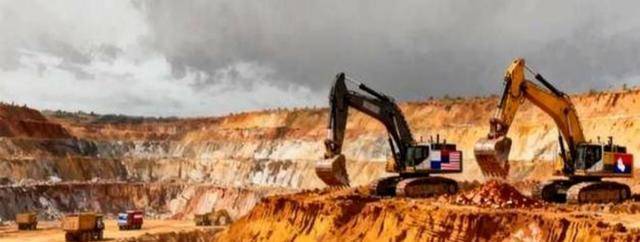
谁在把铜往美国口袋里搬?问题先摆着,别急着笑着点头,事情比你想的复杂得多,且让我们把这条线拽紧,慢慢拉扯。 AI数据中心,这个词值得重复,够形象——算力为王的时代,电要输得进来,数据要连得上去,铜是桥梁,是血管,是神经,用铜不是情怀,是物理需 求,一个大型AI中心用铜是传统的三到五倍,这数字不是吓人,是事实,读懂它,才能读懂这波购买的动因。 再往里看,美国在抢,抢的不只是铜,抢的是定价权,是产业链话语权,是未来算力部署的先手棋,金融亦配合其声势,美元降息窗口一开,资本找硬资产 避风,这硬资产里,铜站着,既能工业消耗,又能金融博弈,恰好合拍。 这合拍的结果显而易见,交易员开始押注,摩科瑞说价格可能上冲12000到15000美元一吨,听着像预测,更像励志,结果是下游要买单,家电、新能源车、 电子厂的账单会变长,消费者的口袋会被动摇,谁来负责这账本的增加,这才是问题。 这不是普通的涨价,这或是一场金融战的延伸,战术是用政策把资源圈起来,用资本把价格推高,再把高成本输出给别人,这逻辑冷冰冰,却也合乎经济学 的某些教科书——资源稀缺 需求垄断=利润重新分配,重分配的对象是制造业,是消费者。 2025年12月,铜价一夜暴 ...
【公告全知道】6G+商业航天+低空经济+人工智能+PCB+机器人!公司与客户在6G、低空卫星等通信领域进行相关PCB产品开发
财联社· 2025-12-07 15:50
Group 1 - The article highlights the importance of tracking major announcements in the stock market, including suspensions, shareholding changes, investment wins, acquisitions, performance reports, and unlocks, to help investors identify potential investment hotspots and mitigate risks [1] - The company is involved in the development of PCB products related to 6G, low-altitude satellites, and other communication fields [1] - The company provides infrastructure support for large commercial rockets associated with aerospace industry and is also engaged in humanoid robotics, low-altitude economy, and data centers [1] - The company plans to acquire equity in a commercial encryption enterprise, indicating a focus on computing power and artificial intelligence, particularly in collaboration with Huawei [1]

海通国际:政策窗口临近 市场反弹动能有望延续
智通财经网· 2025-12-07 12:34
Core Viewpoint - The market is expected to continue its rebound next week, driven by rising policy expectations, although the strength of the rebound will depend on the implementation of policies and potential interest rate cuts by the Federal Reserve [1][2] Group 1: Market Trends - The market experienced a volume contraction and fluctuations this week, with expectations for a rebound in the coming week [1][2] - The technology sector is anticipated to have rebound opportunities, particularly in the Hang Seng Tech Index and the upcoming IPO of Changxin [1][2] - The brokerage sector has a foundation for a rebound due to being oversold, while the real estate and consumer sectors, which have been declining, may also see policy support [1][2] Group 2: Key Events - The market will face three critical events next week: the Politburo meeting, the Central Economic Work Conference, and the Federal Reserve's interest rate meeting, which may increase market volatility [3] - The market has begun to price in expectations for loose monetary and proactive fiscal policies from the Politburo meeting [3] - Recent regulatory changes, such as the reduction of risk factors for insurance companies and proposed reforms in the securities industry, are expected to boost market confidence [3] Group 3: External Market Influences - The probability of a Federal Reserve rate cut in December remains at 86%, with the US dollar index falling below 99 [4] - The US has shifted its national security strategy, which may positively influence market sentiment in China [4] - Japanese bond yields have surged, impacting global risk-free rates and putting pressure on equity valuations [4] Group 4: Market Activity and Fund Flows - The market saw further volume contraction, with A-share average daily turnover dropping to below 1.7 trillion and Hong Kong stocks at 190 billion, marking a four-month low [5] - Stock ETFs have remained stable, with a net inflow of 27.6 billion since November, while margin financing has continued to see net inflows of 10 billion [5] - Southbound capital inflows have decreased to 11.3 billion HKD, with a slowdown in fund inflows to the internet sector [5]
【财联社早知道】OpenAI最快将于下周二发布GPT-5.2,机构称大模型跨越式发展推动算力需求持续攀升
财联社· 2025-12-07 12:03
Group 1 - OpenAI is expected to release GPT-5.2 as early as next Tuesday, with institutions noting that the leap in large model development is driving a continuous increase in computing power demand [1] - A new round of cold wave is anticipated, with institutions optimistic about the sustained high growth rate of electricity consumption; the company is recognized as one of the more specialized firms in the wind power industry in Fujian Province, focusing on clean energy generation [1] - The company has signed a cooperation agreement with Muxi Co., Ltd. to explore the localized application of domestic GPUs [1]

券商异动,A股要启动?还是“渣男”?
Sou Hu Cai Jing· 2025-12-07 06:17
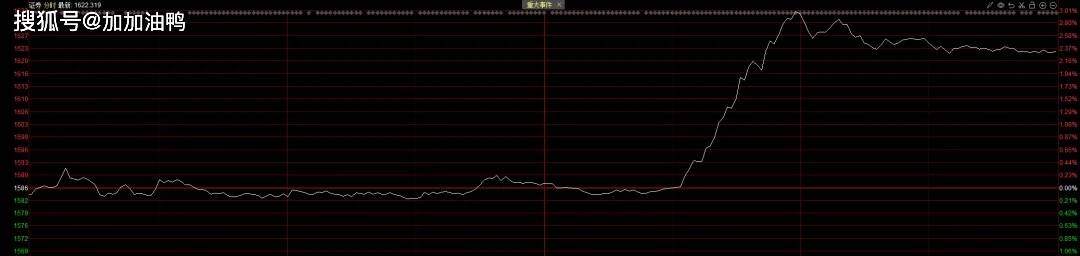
本周沪指最终收在3900之上,当然,重点是周五市场发生了一丝改变。 首先,是量能放大,我们此前反复强调过,1.5~1.6万亿是量能的冰点,这周多次验证。每当市场缩量至此,隔天都有放量,周五两市成交额回到1.73万 亿。 其次,周五是摩尔上市第一天。摩尔干的是芯片行业最难的CPU,对标的是英伟达。在A股那是属于极度稀缺的公司,市场非常的大方,上市第一天最高 直接干到5倍,成为A股历史上最快到3000亿市值的公司。打中一签,直接赚27万,赚钱效应直接拉满。给当下本就缺乏热点的市场增加了不少人气。 现在场子里比较热的是卫星+火箭,再加上通信,这其中也涉及到不少关于算力、芯片的事情。后面很有可能会迎来全产业链的全面启动,从而成为新一 轮的主线行情。这一点需要大家注意。 同步一下基本面消息。 周五晚间公布的美国9月PCE物价指数,录得2.8%,低于市场预期的2.9%,该数据公布之后,可以说为下周四的美联储议息会议铺平了降息路径。该数据 是议息会议之前最重要的数据。 最后,是券商的异动。一直在等券商拉出中阳线,结果这周五终于来了。 当然,随着下一任美联储主席的提名,鲍威尔的讲话市场愿意听多少,也会是此次议息会议的看点。 ...
计算机行业周报 20251201-20251205:计算机 2026 年策略!合合信息深度发布!-20251206
Shenwan Hongyuan Securities· 2025-12-06 12:23
2025 年 12 月 06 日 相关研究 《AI Infra:重点关注数据层软件及 MaaS——计算机行业周报 20251124- 20251128》 2025/11/29 《谷歌大模型超预期了吗? 国内 AI 2026 年策略! 华为容器热点! ——计算机行业 周报 20251117-20251121 》 2025/11/22 证券分析师 申万宏源研究微信服务号 本期投资后了 2026 计算机年度策略:算力聚沙成塔,应用乘风而起。 ● 黄忠煌 A0230519110001 huangzh@swsresearch.com 洪依真 A0230519060003 hongyz@swsresearch.com 刘洋 A0230513050006 liuyang2@swsresearch.com 研究支持 崔航 A0230524080005 cuihang@swsresearch.com 徐平平 A0230525080002 xupp@swsresearch.com 曹峥 A0230525040002 caozheng@swsresearch.com 陈晴华 A0230525100001 chenqh@swsres ...
计算机行业周报:计算机2026年策略!合合信息深度发布-20251206
Shenwan Hongyuan Securities· 2025-12-06 11:57
Investment Rating - The report maintains a positive outlook on the computer industry, highlighting key investment opportunities in AI computing, embodied intelligence, and AI applications [3][4]. Core Insights - The computer sector has seen an 18% increase from early 2025 to December 2, 2025, ranking 12th among all industries, driven by fundamentals and thematic investments [3][4]. - The gap between Chinese and American large models is narrowing, with expectations for further convergence and potential surpassing in certain areas by 2026 [3][20]. - The importance of AI infrastructure is increasing, with a focus on software layers that are rapidly expanding in market size and penetration [3][4]. - The report identifies key companies benefiting from AI advancements, including 合合信息, which is positioned as a leader in intelligent text recognition [3][4]. Summary by Sections 2026 Computer Annual Strategy - The strategy emphasizes the aggregation of computing power and the rise of applications, with AI being the main theme for 2026 [3][4]. - The report notes a significant rebound in revenue and net profit for the computer sector in 2025, confirming a fundamental turning point [9][10]. Large Models - The report discusses the acceleration of monetization for large models in 2025, with a focus on AI programming and multi-modal applications [20][23]. - It highlights that domestic models are catching up in performance and cost-effectiveness compared to their international counterparts [20][23]. Computing Power - The trend towards supernodes is clear, with domestic computing power achieving overall performance improvements [3][4]. - Quantum computing is beginning to move towards commercialization, with several breakthroughs expected in the second half of 2025 [3][4]. Applications - The report indicates that industry know-how serves as a competitive moat, with software entering an optimal layout period [3][4]. - It predicts that many companies will see AI revenue exceed 10%, marking a technological revolution in the software industry [3][4]. Key Companies and Investment Targets - The report lists several companies as key investment targets, including 金山办公, 海康威视, and 浪潮信息, among others, across various segments such as AIGC and digital economy leaders [3][4].
国新办外媒交流会︱国家能源局:推动算力基础设施就近消纳新能源
国家能源局· 2025-12-06 03:41
Core Viewpoint - The rapid development of artificial intelligence in China is driving a significant increase in computing power demand, which in turn requires a reliable and substantial electricity supply [2][3] Group 1: Computing Power and Energy Demand - The electricity consumption of computing power infrastructure is substantial, with a year-on-year increase of 43% in electricity usage for internet data services from January to October this year [2] - The total scale of computing power in China has been growing at an annual rate of approximately 30%, driven by the rapid advancement of artificial intelligence [2] - The demand for intelligent computing power is experiencing a rapid growth trend, necessitating higher requirements for electricity planning and energy development [2] Group 2: Energy Planning and Clean Power Integration - The ongoing "14th Five-Year" energy and electricity planning by the National Energy Administration takes into account electricity demand, integrating various applications of artificial intelligence and predicting electricity growth accurately [3] - The National Energy Administration has set a target for new data centers at national hub nodes to achieve an 80% clean electricity consumption ratio, which supports climate change mitigation efforts [3] - There is a significant potential for the collaborative development of computing power and electricity, which can support the rapid growth needs of artificial intelligence [3]

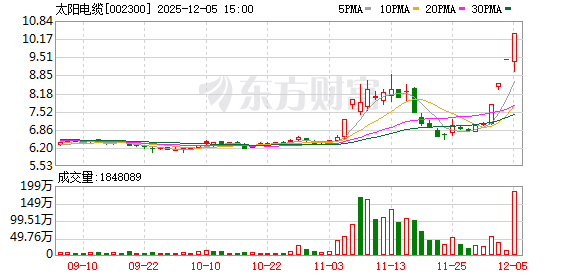
封单超7万手!“四连板”牛股,重要公告
Zhong Guo Zheng Quan Bao· 2025-12-06 00:42
Core Points - The China Securities Regulatory Commission (CSRC) is soliciting public opinions on the draft of the "Regulations on the Supervision and Administration of Listed Companies" [5] - The National Financial Regulatory Administration has adjusted risk factors related to insurance companies' investment in stocks and insurance businesses [2][3] Group 1: Regulatory Changes - The risk factor for stocks held by insurance companies for over three years in the CSI 300 index has been reduced from 0.3 to 0.27 [3] - The risk factor for stocks held for over two years in the Sci-Tech Innovation Board has been reduced from 0.4 to 0.36 [3] - The premium risk factor for export credit insurance and overseas investment insurance has been lowered from 0.467 to 0.42, and the reserve risk factor from 0.605 to 0.545 [3] Group 2: Company News - Sun Cable announced that its major shareholder, Yili Group, completed a share reduction plan, selling approximately 21.67 million shares, which is 3% of the total share capital [7] - The stock price of Sun Cable has increased by over 90% this year, and it has experienced a "four consecutive limit-up" in recent trading days [7] - Hai Tai Development has decided to terminate its cash acquisition of Zhixue Cloud Technology due to a lack of agreement on key transaction terms [8] - Bo Hai Chemical is planning a major asset sale and related transactions, with its stock set to be suspended from trading starting December 8 [8] - Wan Ke A has decided to forgo its redemption option on a bond with a balance of 1.1 billion yuan, citing current market conditions [10]