
创新药

Search documents
创新药ETF国泰(517110)涨超1.4%,行业多重积极信号获关注
Mei Ri Jing Ji Xin Wen· 2025-12-17 06:51
Group 1 - The pharmaceutical and biotechnology industry in China is expected to show multiple positive signals by 2025, with the market size projected to exceed 400 billion yuan in 2024, and 113 domestic innovative drugs approved during the "14th Five-Year Plan" period, which is 2.8 times that of the "13th Five-Year Plan" period [1] - The total amount of License-out projects for innovative drugs has reached a new record, with preclinical projects accounting for 68%, indicating that Chinese innovative drugs are gradually gaining global recognition [1] - The chemical pharmaceutical sector is leading the market driven by innovative drugs and AI healthcare, with the pharmaceutical sector's valuation approaching the historical average over the past 10 years, and public fund holdings showing a quarterly increasing trend [1] Group 2 - In the medical device sector, the bidding market size in Q3 2025 is expected to grow by 29.8% year-on-year, with revenue turning points emerging for medical device companies, driven by continuous demand release from equipment renewal policies [1] - The brain-computer interface field is accelerating development under policy support, with national and local governments expected to introduce supportive policies in 2025, and global companies like Neuralink driving technological iteration and clinical applications [1] - The industry is facing a transformation in the payment system, with significant growth potential for commercial health insurance, which is expected to promote the transition of innovative drug payments from a "single" to a diversified payment model [1] Group 3 - The Guotai Innovative Drug ETF (517110) tracks the SHS Innovative Drug Index (931409), which selects listed companies involved in the research and development of chemical and biological drugs from the Shanghai, Hong Kong, and Shenzhen markets to reflect the overall performance of the innovative drug sector [2] - The index consists of 50 constituent stocks, indicating a high industry concentration, focusing on innovative drug companies with growth potential and research-driven characteristics [2]
国元国际:给予康哲药业(00867)“买入”评级 目标价17.68港元
智通财经网· 2025-12-17 06:44
Core Viewpoint - Company has a rich pipeline of innovative drugs, with 40 products globally focused on FIC and BIC, including 5 approved innovative drugs accelerating commercial value [1][2] Group 1: Innovative Drug Pipeline - The company has 40 innovative drugs in its pipeline, with 5 approved drugs that are beginning to release commercial value [2] - 7 NDA applications are under review, and over 10 clinical trials are progressing [2] - The first-in-class injectable Y-3 has received NMPA acceptance for its new drug application, targeting stroke treatment and post-stroke depression and anxiety [2] Group 2: Market Potential and Clinical Trials - The market potential for injectable Y-3 is estimated at 3 billion RMB [2] - The oral JAK1 inhibitor Povorcitinib has received breakthrough therapy designation in China, targeting adult non-segmental vitiligo, with a large unmet treatment need [2] - There are approximately 10.3 million vitiligo patients in China, with 8.2 million being non-segmental [2] Group 3: Financial Performance - In the first half of 2025, the company achieved revenue of 4.67 billion RMB, a year-on-year increase of 8.9%, and a net profit of 930 million RMB, up 3.1% [3] - The skin health line generated revenue of 498 million RMB, a significant increase of 104.3%, accounting for 10.7% of total drug sales [3] - Brand and innovative products accounted for 2.9 billion RMB in sales, a 20.6% increase, representing 62.1% of total revenue [3] Group 4: Investment Recommendations - The company's performance is expected to recover, with a significant optimization of its product structure towards innovative drugs [4] - Projected revenues for 2025-2027 are 7.86 billion, 8.95 billion, and 10.02 billion RMB, with net profits of 1.667 billion, 1.941 billion, and 2.308 billion RMB respectively [4] - The target price is set at 17.68 HKD per share, implying a 32% upside from the current price [4]
医药板块窄幅震荡,恒生创新药ETF(159316)和医药ETF(512010)受资金关注
Sou Hu Cai Jing· 2025-12-17 04:56
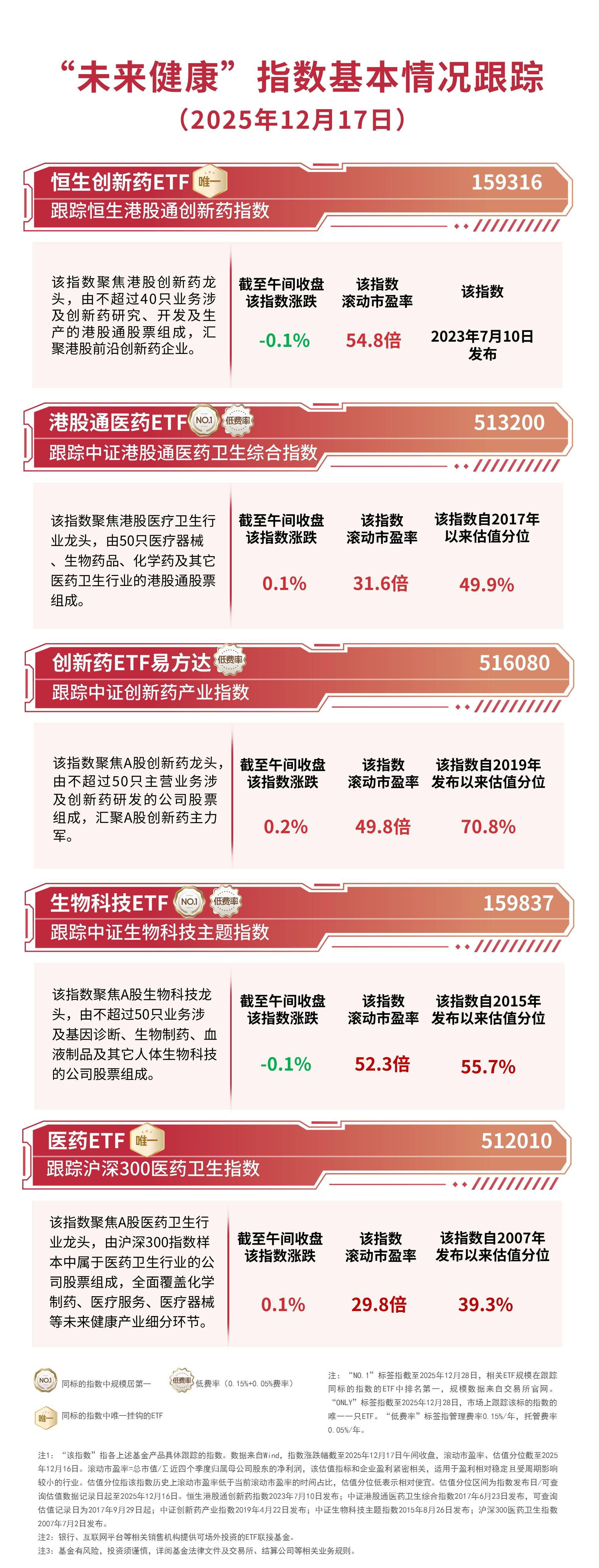
Group 1 - The pharmaceutical sector experienced narrow fluctuations, with the Hang Seng Innovative Drug Index down by 0.1%, while other indices such as the CSI Hong Kong Pharmaceutical and Health Comprehensive Index and the CSI Biotech Theme Index both rose by 0.1% [1] - The CSI Innovative Drug Industry Index saw an increase of 0.2%, indicating a positive trend in innovative drug stocks [1] - Recent fund inflows into ETFs indicate continued investment interest, with the Hang Seng Innovative Drug ETF and Pharmaceutical ETF receiving net inflows of 97 million yuan and 370 million yuan respectively over the past week [1] Group 2 - The index focuses on leading stocks in the Hong Kong medical and health industry, comprising 50 stocks from medical devices, biopharmaceuticals, chemical drugs, and other pharmaceutical sectors [3] - The Innovative Drug ETF tracks the CSI Innovative Drug Industry Index, which includes no more than 50 companies primarily engaged in innovative drug research and development [4][5] - The Biotech ETF tracks the CSI Biotech Theme Index, which consists of up to 50 companies involved in gene diagnostics, biopharmaceuticals, blood products, and other human biotechnology [6][8] Group 3 - The CSI Biotech Theme Index recorded a slight increase of 0.1% at midday [7] - The CSI Pharmaceutical and Health Industry Index, which includes companies from the CSI 300 Index in the pharmaceutical sector, also rose by 0.1% [12][13]

中国生物药十年:活下来,并熬出头
3 6 Ke· 2025-12-17 04:17
Core Insights - The Chinese biopharmaceutical industry has undergone a significant transformation over the past decade, shifting from a focus on generic drugs to a strong emphasis on innovative drug development, with domestic innovative drugs accounting for 93% of new approvals in the first half of 2025, a 59% year-on-year increase [1][7] - The industry faces geopolitical challenges, particularly from the U.S. government, which has implemented tariffs and regulatory barriers that could hinder the growth of China's biopharmaceutical sector [2] - The future positioning of China's biopharmaceutical industry will involve a "dual circulation" strategy, focusing on both domestic and international markets, with an emphasis on innovation and collaboration [3] Industry Development - The reform of the drug review and approval system initiated in 2015 has been a key driver of transformation, significantly shortening the approval cycle for innovative drugs [4][5] - By 2025, the approval time for clinical trial applications has been reduced to 30 working days, reflecting the ongoing policy support for the industry [5] - The shift from a model of "combination of imitation and innovation" to "source innovation" has been marked by increased R&D investment and a focus on original drug development [6][7] Capital Market Dynamics - The capital market has experienced volatility, with a "capital winter" affecting the biopharmaceutical sector since 2022, leading to reduced financing and cash flow pressures for many companies [8][9] - There is a need for "patient capital" to support the long-term nature of biopharmaceutical investments, which could be facilitated by relaxing investment restrictions for long-term capital sources [9] - The integration of national support for innovative drugs with capital market mechanisms is essential for creating a resilient ecosystem [9][10] Technological Advancements - The application of artificial intelligence (AI) in drug development has become a critical factor in addressing industry challenges, enhancing efficiency in clinical trials and drug discovery [11][12] - AI can streamline patient recruitment and optimize drug repurposing, thereby improving the overall drug development process [12] - The integration of AI in the payment system is crucial for balancing drug pricing, patient affordability, and sustainable healthcare financing [12] Future Outlook - The transition from a generic drug powerhouse to a leader in innovative drugs requires ongoing collaboration among policymakers, industry leaders, researchers, and capital markets [13] - Emphasizing clinical value and adopting a global perspective will be vital for providing innovative therapies to patients worldwide [13]

“东北药茅”转型创新药
Hua Er Jie Jian Wen· 2025-12-17 03:28
Core Viewpoint - Changchun High-tech has historically been perceived as a single-dimensional company focused on growth hormone, overshadowing its potential in innovative pharmaceuticals. The recent licensing deal with Yarrow Bioscience marks a significant shift, indicating the company's entry into the global innovative drug market [1][5]. Group 1: Transaction Details - Changchun High-tech's subsidiary, Gensai Pharmaceutical, licensed overseas rights for its SHR antibody GenSci098 to Yarrow Bioscience for a total of $1.365 billion, including an upfront payment of $120 million and milestone payments [1][2]. - The upfront payment includes a non-refundable $70 million and an additional $50 million for recent development milestones, highlighting the asset's value in the early clinical stage [1][2]. Group 2: Buyer Profile - Yarrow Bioscience, backed by the renowned RTW Investments, is not an unknown entity; it is known for its strategic investments in the biotech sector, including the early investment in Prometheus Biosciences, which was later acquired by Merck for $10 billion [2][3]. - The acquisition of GenSci098 as a core asset reflects Yarrow's confidence in its potential to disrupt existing treatment paradigms for thyroid eye disease [2][3]. Group 3: Product Potential - GenSci098 offers a novel mechanism by directly blocking the binding of pathogenic antibodies to the TSH receptor, potentially treating both the eye disease and the underlying hyperthyroidism, unlike the current market leader, Tepezza [2][3]. - The drug avoids the hearing toxicity risks associated with Tepezza and provides greater convenience through subcutaneous injection, positioning it as a best-in-class candidate [3]. Group 4: Strategic Implications for Gensai - This transaction signifies a major milestone for Gensai Pharmaceutical, validating its capability to produce globally competitive assets and demonstrating its ability to generate revenue through technology transfer [5][6]. - The $120 million influx will support further research and development, accelerating the advancement of other promising pipelines within the company [5][6]. - The deal is expected to reshape market perceptions of Changchun High-tech, transitioning it from a company primarily viewed through the lens of growth hormone to one recognized for its global intellectual property capabilities and comprehensive pipeline [5][7].

美联储年内第三次降息!影响多大
2025-12-17 02:27
Summary of Conference Call Records Industry Overview - The records primarily discuss the impact of the Federal Reserve's interest rate cuts on the global financial markets, particularly focusing on the A-share market in China and the technology sector. [1][2][3] Key Points and Arguments Federal Reserve's Interest Rate Cuts - The Federal Reserve has implemented three interest rate cuts in 2025, primarily due to easing trade tensions and a weakening job market. The expectation for 2026 is limited further cuts, with a focus on U.S. employment data. [1][2] - The third rate cut in 2025 faced unusual dissent within the Federal Reserve, indicating significant internal disagreements. [2] - The rate cuts are expected to enhance global liquidity, weaken the dollar's attractiveness, and boost Chinese exports, especially in the context of a recovering U.S. manufacturing cycle. [1][3] Impact on A-share Market - The Fed's rate cuts positively influence the A-share market through increased global liquidity and reduced dollar appeal, leading to a rebalancing of global financial assets. [3] - China's export growth, particularly to Asia, Africa, and Latin America, is highlighted as a key economic driver, benefiting from the U.S. economic pressures that prompted the Fed's actions. [3] Global Asset Price Fluctuations - The dollar's depreciation, which fell by 11% in the first half of the year, has led to significant volatility in global asset prices, particularly affecting dollar-denominated commodities like oil. [4] - Gold and silver have shown strong performance, with gold nearing historical highs at $4,300 per ounce. [4] Global Stock Market Performance - In 2025, global stock markets exhibited strong bullish trends across various regions, including A-shares, Southeast Asia, and major European markets, driven by the Fed's rate cuts and a weaker dollar. [5] - The Trump administration's strategy aims to leverage a weaker dollar to boost exports and manufacturing jobs, enhancing risk appetite in the market. [5] Technology Sector Outlook - The technology sector is expected to remain a market focus in 2026, driven by advancements in high-end manufacturing and new technologies like artificial intelligence that enhance productivity. [6][7] - Government policies are strongly supportive of technological innovation, with significant emphasis on AI and robotics as strategic emerging industries. [6] Investment Strategies - Investors are advised to focus on sectors with strong profit growth, particularly TMT (Technology, Media, and Telecommunications) and electronics, while considering a shift towards broad-based index funds as the year ends. [2][8][9] - The 中证 A500 index is recommended as a suitable investment option, offering broader exposure to emerging growth sectors compared to traditional indices like the 沪深 300. [10][11] Recommendations for New Investors - New investors are encouraged to consider the 中证 A500 ETF, which has a broad investor base and demonstrates stability during market fluctuations. [12] Additional Important Insights - The capital market's recovery in 2025 is attributed to a correction of previously undervalued assets rather than significant fundamental improvements. [7] - Future investment focus should be on sectors that show potential for growth and are supported by government policies, particularly in technology and cyclical industries. [7]
4500只个股下跌、资金却疯狂涌入这个板块、午后关注三大信号
Sou Hu Cai Jing· 2025-12-17 02:18
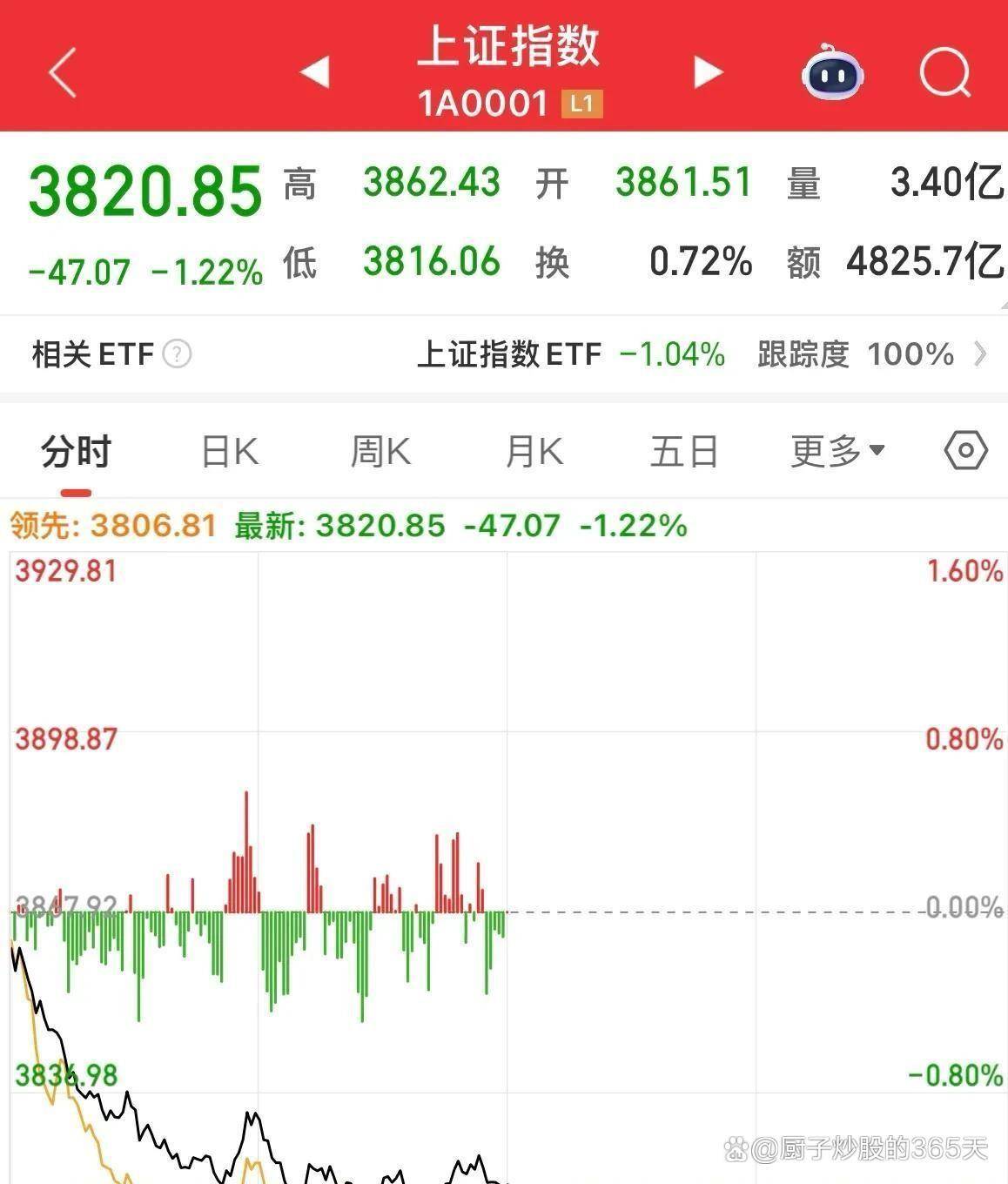
Core Viewpoint - The A-share market experienced a significant decline, with the Shanghai Composite Index dropping below 3820 points, reflecting a broader trend of nearly 90% of stocks declining, primarily driven by internal capital outflows and external market pressures [1][2]. Market Performance - The Shanghai Composite Index fell by 1.22%, while the ChiNext Index dropped by 2.35% and the Sci-Tech 50 Index decreased by 1.98% [1]. - Over 4500 stocks declined, with a half-day trading volume of 1.12 trillion yuan, down 606 billion yuan from the previous day, and a net outflow of 68 billion yuan in main funds [1]. - Retail and food & beverage sectors showed slight resilience, while small-cap stocks faced significant losses, with some indices dropping over 2.5% [1]. Global Market Influence - The decline in A-shares was exacerbated by a global market downturn, particularly in the U.S. tech sector, where major companies like Nvidia and Oracle saw declines exceeding 3% [2][3]. - The Bank of Japan's indication of a potential interest rate hike triggered a reversal of carry trade flows, leading to capital outflows from emerging markets like A-shares [3]. Sector Analysis - High valuation sectors such as CPO, semiconductors, and photovoltaic equipment faced severe sell-offs, with notable declines in stocks like Longi Green Energy and Zhongji Xuchuang [6]. - Defensive sectors, including consumer goods and tourism, showed gains, with stocks like Yonghui Supermarket and Kweichow Moutai experiencing price increases [6]. Investment Strategy Shifts - A significant shift in investment strategy was observed, with over 80% of industries declining, while sectors with stable cash flows became preferred choices for risk-averse investors [7]. - The market's trading volume dropped to a recent low, indicating a cautious sentiment among investors, with potential implications for liquidity and future market adjustments [7]. Future Outlook - The potential for market reversal hinges on three signals: recovery in tech stock sentiment, increased trading volume above 1.5 trillion yuan, and a return of foreign capital inflows [11]. - Despite the current downturn, there are structural opportunities in sectors like autonomous driving and innovative pharmaceuticals, supported by favorable policies [11].
2026科技投资怎么投?这场策略会拆解十大关键问题
中国基金报· 2025-12-17 01:51
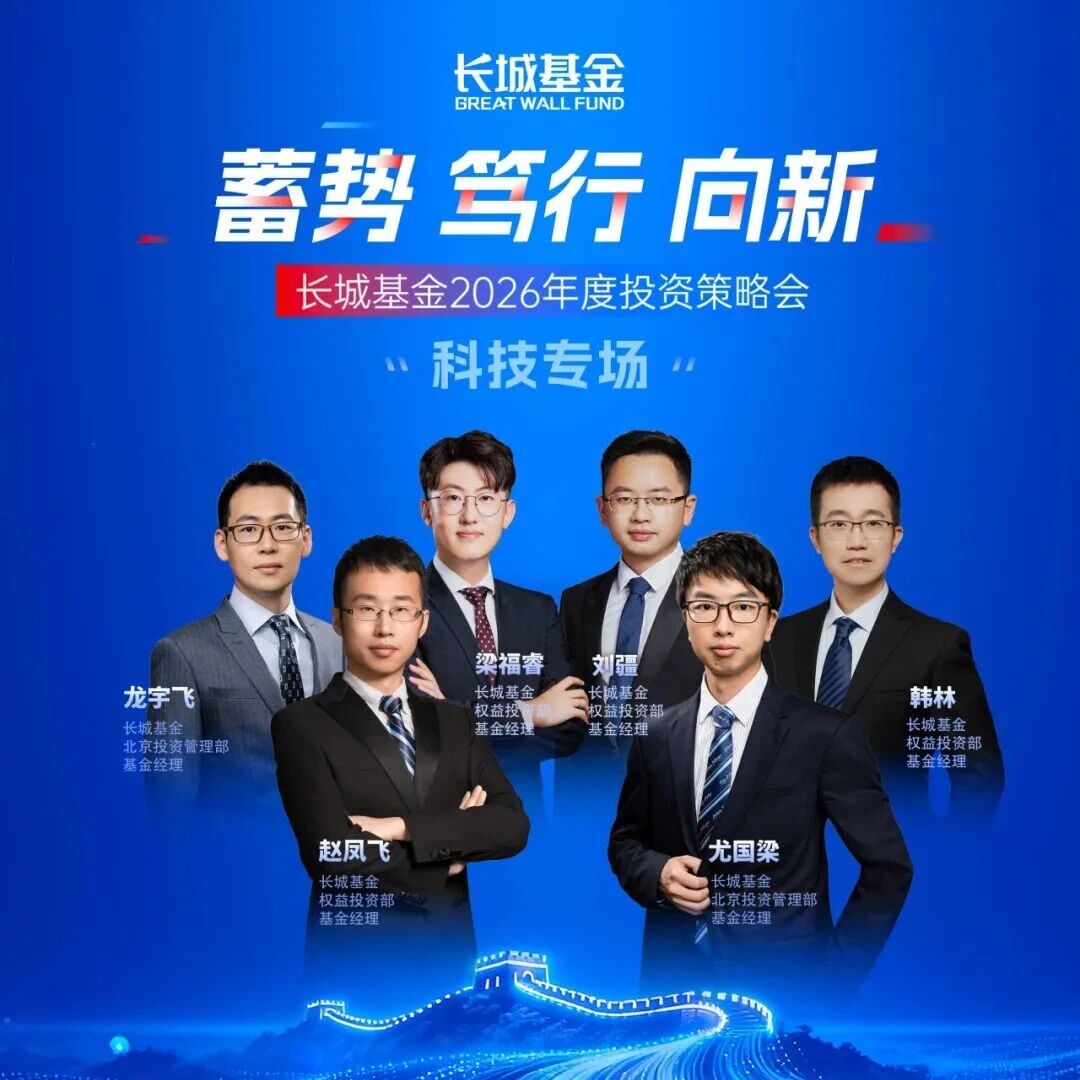
即将过去的2025年,科技产业历经诸多变革,助推科技股成为贯穿全年的行情主线。年末之际,人工智 能、芯片、新能源等科技主题的行情波动明显放大。随着AI泡沫之争再起,新一年的科技投资脉络成 为市场关注焦点。 迷雾之中, 长城基金2026年度投资策略会 如约而至。赵凤飞、尤国梁、梁福睿、龙宇飞、韩林、刘疆 等多位深耕"科技+"领域的基金经理,聚焦科技投资领域的热门问题展开深度探讨。 以下为本次策略会中长城基金"科技+"基金经理分享的部分精彩观点: 赵凤飞: 2026年的市场风格将更加均衡: 一是 算力板块内海外与国产算力趋向均衡, 二是 AI领域内 算力与应用趋向均衡, 三是 科技板块内AI与商业航天、量子计算等非AI赛道趋向均衡。 尤国梁: 前不久的可回收火箭发射相当于商业航天产业的"成人礼",直接为 卫星互联网、太空算力、 6G 等未来赛道铺好了运力底座,一个全新的万亿级市场正在被打开。 梁福睿: 面对国内集采、海外药价管控带来的全球医药通缩压力,只有具备 全球化能力、能迭代现有 治疗方式的创新药与器械企业,才能突破发展瓶颈 。 龙宇飞: 医药行业核心竞争力标准持续演进 :十几年前比拼商业化能力,5-10年前 ...
把握“成长+价值”双主线,兴业证券最新研判
Zhong Guo Ji Jin Bao· 2025-12-16 15:32
Group 1 - The core investment strategy for 2026 focuses on "growth momentum and value reconstruction dividends," emphasizing the importance of patience and stability in the Hong Kong stock market [2] - The AI wave is compared to the internet boom of 1996-1998, with expectations that macroeconomic conditions and Federal Reserve policies will differ significantly from the early 2000s [2] - The nominal GDP growth rate is expected to improve in 2026, with a moderate inflation recovery, indicating structural opportunities in the Chinese economy [2] Group 2 - Four key areas of opportunity are identified: 1) Growth momentum driven by AI, internet, and new consumption sectors; 2) High-yield assets like insurance and banking in a low-interest environment; 3) Value discovery in traditional industries benefiting from global supply chain restructuring; 4) Strategic assets such as gold and rare earths amid global order changes [3] - The A-share market is expected to benefit from limited negative external impacts, a global AI industry trend, and supportive liquidity conditions [4] - The recovery of corporate earnings is anticipated to be a major highlight, with a shift from a "淘汰赛" (elimination race) to a "竞速赛" (speed race) in industry performance as more sectors enter a recovery phase [4][5] Group 3 - Key sectors for investment in 2026 include AI, new energy, military industry, and innovative pharmaceuticals, with a focus on companies that can leverage global competitive advantages [5] - The trend of domestic wealth reallocating towards the stock market, along with the influx of long-term capital from various sources, is expected to create positive feedback in the market [4] - The selection of individual stocks may shift from stable dividend payers to those with strong free cash flow as overall corporate profitability improves [5]

顶级风投2026万字展望:全球创新药行业最关注中国
Xin Lang Cai Jing· 2025-12-16 14:05
Core Insights - The development of the biopharmaceutical industry in China and the U.S. appears to have a "time difference," with China experiencing a surge in activity while the U.S. market faces macroeconomic challenges [1][74]. Group 1: Market Trends - In the first three quarters of this year, particularly in the first half, the Chinese biopharmaceutical sector rapidly restored valuations due to a surge in business development (BD) activities, leading to a wave of IPOs in Hong Kong [2][74]. - The Chinese biopharmaceutical sector has seen a year-to-date increase of over 90%, with significant IPOs, including the successful listing of Heng Rui Medicine on the Hong Kong Stock Exchange [33][74]. - In contrast, the U.S. biopharmaceutical sector faced a downturn due to macroeconomic fluctuations, with a rebound occurring only in the fourth quarter as macro risks dissipated and strong earnings from pharmaceutical companies emerged [2][74]. Group 2: Key Issues in the Industry - The core issues affecting the global biopharmaceutical industry include the rise of China as a key player, the obesity epidemic, advancements in AI, the clustering of drug targets, and the emergence of new therapies [36][41][46]. - China has become a significant contributor to global clinical trials, with the proportion of trials initiated in China rising from 5% a decade ago to 30% today, matching the U.S. [37][74]. - The cost advantages in talent acquisition in China are notable, with CEO salaries in Chinese biopharmaceutical companies being significantly lower than their U.S. counterparts, leading to substantial cost savings for companies [39][74]. Group 3: Regulatory and Manufacturing Challenges - The U.S. faces challenges in drug pricing and manufacturing, with a historical trade deficit in pharmaceuticals reaching $140 billion this year and a commitment from the industry to invest $360 billion in domestic manufacturing [4][77]. - The FDA has experienced significant staff turnover, leading to instability and uncertainty in the regulatory environment, although recent statements from the new FDA director indicate a commitment to maintaining high standards for efficacy and safety [4][77]. - Concerns about the NIH budget cuts could adversely affect long-term industry development, particularly in terms of pipeline, talent, and foundational scientific progress [5][78]. Group 4: Financial Performance and Investment Trends - The biopharmaceutical sector's earnings remain robust, with a potential expansion in price-to-earnings ratios as the sector is currently at a 30-year low in valuation multiples [9][82]. - The industry has seen a significant milestone with 3.6 trillion defined daily doses (DDD) administered globally in 2024, indicating unprecedented coverage [12][74]. - The trend of increasing collaboration and partnerships in the industry is evident, with 63% of revenue coming from externally sourced assets, highlighting the importance of business development [16][58].
