区域一体化

Search documents
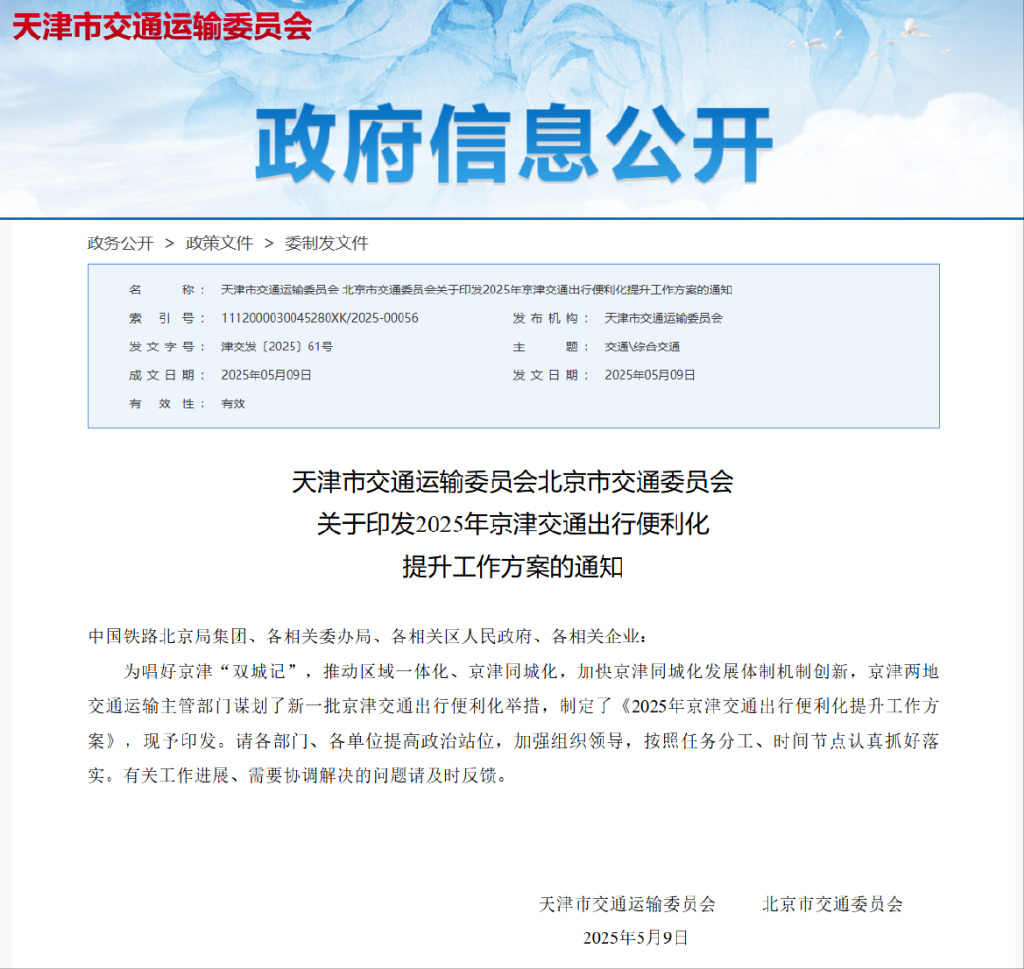
京津通勤将有大变化!涉高铁、地铁、旅游巴士
Bei Jing Ri Bao Ke Hu Duan· 2025-05-12 13:58
Core Viewpoint - The Beijing-Tianjin transportation authorities have jointly issued the "2025 Beijing-Tianjin Transportation Convenience Enhancement Work Plan" to promote regional integration and facilitate commuting between the two cities [1][3]. Group 1: Railway Network Layout - Completion of the rapid access channel renovation at Beijing South Station and continuous increase in the number of intercity trains between Beijing and Tianjin to alleviate peak capacity shortages [5][8]. - Construction of the Beijing Urban Sub-center Station to add more train services for the Beijing-Binhai and Beijing-Tang intercity lines [5][8]. - Research on increasing train stops at Wuqing Station and increasing ticket quotas to ease passenger flow and shorten commuting times [5][8]. - Additional trains from Beijing to Tianjin West during peak hours to meet the high demand for commuting [5][8]. - Accelerated construction of the Tianjin-Weifang high-speed railway and the northern section of the Beijing-Binhai intercity line to enhance travel service capacity [5][8]. Group 2: Urban Hub Functionality - Updating signage at Tianjin Station for better passenger navigation and installing sunshades at Tianjin West Station to improve the travel environment [5][9]. - Completion of the Beijing Daxing Airport Tianjin West Station urban terminal to provide check-in services for passengers traveling to Beijing Daxing Airport [5][9]. - Improvement of traffic order around key stations like Beijing South Station and Tianjin Station to ensure public safety and smooth travel [5][9]. - Opening of transportation hubs such as Beijing Wangjing West and Wansheng West to enhance connectivity between city centers and sub-centers [5][9]. Group 3: Rail Network Construction Acceleration - Accelerating the construction of the Beijing Metro M101 line to serve the urban sub-center station and facilitate intercity transfers [5][9]. - Opening of the middle section of Beijing Metro Line 17 and the southern extension of Line 6 to alleviate surrounding traffic pressure [5][9]. Group 4: Road Network Connectivity - Commencement of the G95 Capital Region Ring Road (Tangluo Expressway Phase II) project to improve the regional highway network [5][9]. - High-quality opening of the Beijing East Sixth Ring Road renovation project to ease traffic congestion in the urban sub-center [5][9]. - Completion of the expansion of the Jingping Expressway and commencement of the construction of the Jingqin Expressway to enhance cross-regional road infrastructure [5][9]. - Upgrading the Jinghu Expressway Wangqingtuo service area and building a supercharging station at the Baigutun parking area to improve electric vehicle charging efficiency [5][9]. Group 5: Road Passenger Transport Services - Optimization of the Yongle Comprehensive Inspection Station on the Jingjin Expressway to enhance traffic efficiency [5][9]. - Extension of customized commuter bus routes to surrounding areas based on operational conditions [5][9]. - Launch of the first inter-provincial tourist bus line from Tianjin to Universal Studios as a pilot for expanding more operational routes [5][9]. Group 6: Transportation Mode Connection Optimization - Increasing the transfer ratio of public transport within 50 meters of subway stations to 90% to improve transfer efficiency [5][10]. - Promotion of integration among subway networks, suburban railways, and bus networks to enhance urban transportation connectivity [5][10]. - Improvement of facilities at rail stations for seamless transfers among different transportation modes [5][10]. - Research on adding escalators to old subway stations and enhancing public transport accessibility for the elderly and disabled [5][10]. Group 7: Smart and Green Travel Promotion - Optimization of the 12306 ticketing system to offer various types of periodic tickets for intercity commuters [5][10]. - Completion of 30 urban congestion relief projects and smart traffic signal control to improve road traffic flow [5][10]. - Expansion of the MaaS green travel incentive program to encourage low-carbon travel [5][10]. - Launch of Robotaxi services from Beijing South Station to Yizhuang for seamless travel connections [5][10]. - Pilot program for integrating social security cards with railway travel for a unified travel experience [5][10].

“甜蜜贸易”背后的坚实根基
Ren Min Ri Bao· 2025-05-11 22:12
Group 1 - The core viewpoint highlights the revitalization of the "Sweet Road" connecting Chile and China, enhancing Chile's competitiveness and deepening trust and cooperation between the two nations [1] - Chile, as the first Latin American country to sign a bilateral free trade agreement with China, has seen a significant increase in exports of fruits and agricultural products, with cherries becoming a favorite among Chinese consumers during winter [1] - Infrastructure connectivity, such as roads and ports, is crucial for supporting the trade relationship, creating jobs, and facilitating regional economic development [1] Group 2 - According to the United Nations Economic Commission for Latin America, Chinese participation in infrastructure projects has significantly improved logistics efficiency in the region, injecting strong momentum into regional integration [2] - The cooperation between China and Latin America is transitioning towards high-quality development, expanding from traditional trade to emerging fields like digital economy, green energy, and technological innovation [2] - From 2000 to 2022, trade volume between China and Latin America increased 35 times, with expectations for further growth beyond the current $500 billion, especially through the Belt and Road Initiative [2] Group 3 - The mutually beneficial cooperation model between China and Latin America is likened to a fruitful orchard under the sun, indicating a promising future [3]
化相邻之利为聚合之力(评论员观察)——更好发挥高质量发展动力源作用②
Ren Min Ri Bao· 2025-05-05 21:47
Core Insights - The emergence of "Six Little Dragons" in Hangzhou has sparked interest in how other cities can cultivate similar successful enterprises, emphasizing the importance of innovation and high-quality development [1] Group 1: Regional Development Strategies - The Yangtze River Delta region is highlighted as a key area for economic growth, leveraging integration and collaboration among cities to enhance resource allocation efficiency [1][2] - Cities like Suzhou and Nanjing are focusing on their unique strengths, such as biomedicine and high-performance steel, to develop competitive industries and products [2] - The integration of industries like integrated circuits and new energy vehicles across the Yangtze River Delta showcases the benefits of differentiated specialization and collaboration [2][3] Group 2: Avoiding Homogenization and Fragmentation - The article stresses the need to avoid both homogenization and fragmentation in regional development, advocating for mutual support and leveraging each region's strengths [3] - A unified approach to industrial planning and technological innovation is essential for achieving a synergistic effect, where the whole is greater than the sum of its parts [3] - Cities are encouraged to focus on sustainable innovation in their unique fields rather than competing in saturated markets, fostering a collaborative environment for high-quality development [3]

IMF答南财记者:关税重压之下,亚太如何合作突围
2 1 Shi Ji Jing Ji Bao Dao· 2025-04-25 12:04
Group 1 - The core viewpoint emphasizes the importance of regional integration and sound policies in the Asia-Pacific region to address global uncertainties [1][2] - The IMF suggests three main recommendations for regional cooperation: maintaining an open global trade system, promoting regional integration, and ensuring prudent macroeconomic policies [1][2] - The IMF highlights that the current level of intra-regional trade integration in Asia is relatively low compared to other regions, indicating significant potential for growth through trade agreements and standardization [1] Group 2 - The IMF stresses that maintaining a sound macroeconomic policy framework is crucial for enhancing regional stability and is considered a "regional public good" [2] - Recent financial market volatility has had a relatively mild impact on Asia, reflecting improvements in the region's monetary policy framework [2] - The IMF's President pointed out that significant changes in trade policies have led to increased uncertainty, alongside tightening financial conditions and market volatility [2][3] Group 3 - The IMF's global policy agenda includes three priority items: resolving trade disputes, maintaining economic and financial stability, and promoting growth-oriented reforms to enhance productivity [3]
专访柬埔寨亚洲愿景研究院院长成金珑:东盟应加强对华合作,共同应对供应链风险
2 1 Shi Ji Jing Ji Bao Dao· 2025-04-23 09:30
Core Viewpoint - The political mutual trust between Cambodia and China has been further consolidated, indicating that small countries like Cambodia can collaborate with major powers like China to promote regional development and shared prosperity [1] Group 1: Economic Cooperation and Trade - ASEAN has become Guangdong's largest trading partner, with Guangdong's imports and exports to ASEAN reaching 349.43 billion yuan in the first quarter, a year-on-year increase of 6.9%, accounting for 16.3% of Guangdong's total trade [2][10] - The trade relationship between Guangdong and ASEAN is expected to enhance economic cooperation and bring more benefits to local residents [3][10] - Strengthening trade cooperation within ASEAN is crucial for enhancing the region's economic vitality and resilience, especially in response to the challenges posed by the U.S. "reciprocal tariffs" [5][6] Group 2: Regional Integration and Supply Chain - The U.S. "reciprocal tariffs" are expected to significantly impact ASEAN, making products from the region more expensive and reducing their competitiveness [6] - Cambodia and China can further support each other in building a comprehensive cooperative framework, focusing on six key areas: politics, capacity, agriculture, energy, security, and culture [7] - The Regional Comprehensive Economic Partnership (RCEP) provides a robust institutional framework that facilitates smoother economic cooperation between China and ASEAN [8][9] Group 3: Currency and Financial Cooperation - The cross-border RMB business between China and Cambodia reached 5 billion yuan in the first quarter, a year-on-year increase of 45%, indicating significant progress in currency settlement [7] - The use of local currency for trade and investment between Cambodia and China is expected to create a more favorable environment for cross-border commerce [7]
城市24小时 | 冲刺10万亿,山东“双子星”再联手
Mei Ri Jing Ji Xin Wen· 2025-04-21 09:36
Core Points - The meeting held on April 18 in Jinan emphasized the collaborative development of the Jinan and Qingdao urban agglomerations, focusing on infrastructure connectivity, modern industrial system construction, and high-level openness [1][5] - The integration of the Jinan and Qingdao urban circles is seen as a crucial strategy to enhance regional economic competitiveness, especially as Shandong approaches a GDP of 10 trillion yuan [2][4] - The two urban circles account for over 25% of Shandong's land area and more than 50% of its GDP, indicating their significant role in the province's development [4] Group 1 - The meeting proposed a framework for "inner circle," "dual circle," and "three-circle" development, aiming for coordinated growth among Jinan, Qingdao, and Zhengzhou urban areas [6] - The strategy includes establishing mechanisms for collaborative promotion, shared innovation resources, joint industrial systems, and interconnected infrastructure [5][6] - Experts suggest that this shift from individual to collective action will optimize resource allocation and enhance the efficient flow of factors within the Shandong Peninsula urban cluster [6] Group 2 - The Shandong provincial government has accelerated the dual-circle development layout, as highlighted in the 2025 government work report [5] - The emphasis on regional integration aligns with national trends of urban agglomeration and collaborative development seen in other major economic regions like the Yangtze River Delta and the Guangdong-Hong Kong-Macau Greater Bay Area [2][3] - The successful collaboration between urban circles is expected to create a more influential cultural and tourism brand while promoting equal access to public services [1][4]
RCEP实施三周年:石化贸易红利释放与挑战并存
Zhong Guo Hua Gong Bao· 2025-03-31 02:13
Core Insights - The implementation of the "14th Five-Year Plan" has positioned China's petrochemical industry for high-quality development, with petrochemical trade's share of total foreign trade rising from 13.6% in 2020 to 16% in 2023, despite a slight decline to 15.4% in 2024, indicating strong growth resilience [1][2] Trade Dynamics - From 2022 to 2024, RCEP has activated regional trade, with China's petrochemical imports from RCEP countries reaching $168.7 billion in 2022, a 5.7% increase, while exports surged by 30.7% to $124.1 billion, resulting in a total trade volume of $292.8 billion, a 15% growth [2] - In 2023, due to weak global demand and falling energy prices, imports decreased to $160.1 billion and exports to $113.7 billion, leading to a total trade volume of $273.8 billion. By 2024, exports further declined to $106.4 billion, while imports slightly rebounded, resulting in a total trade volume of $268.7 billion [3] Regional Trade Structure - RCEP's influence on China's petrochemical trade is evident, with trade volume within the region reaching $292.8 billion in 2022, accounting for 27.8% of China's total petrochemical foreign trade, and increasing to 28.3% in 2024 [4] - The trade contraction in the RCEP region was only 1.9%, significantly lower than the 6.1% decline in the Middle East and 4.3% in the EU, highlighting RCEP's role in regional economic stability [4] Challenges and Opportunities - The trade deficit in petrochemicals has been expanding, with a deficit of $55.9 billion in 2024, a 20.5% increase year-on-year, primarily due to high imports of energy resources and high-end chemicals, which constitute over 80% of total imports [5][6] - China's reliance on RCEP countries for high-end chemicals is notable, with imports reaching $23.95 billion in 2024, a 6.19% increase, while exports were only $1.139 billion, resulting in a significant deficit of $12.56 billion [6] Strategic Recommendations - To address these challenges, the industry should optimize energy layouts and export structures, enhance regional technological cooperation, and promote green transformation [7][8] - Long-term strategies include accelerating domestic substitution and establishing a carbon footprint accounting system for petrochemical products, while enhancing international certification standards to integrate domestic high-end materials into global supply chains [8]
新型城镇化系列之区域一体化篇:区域一体化的主线思路、建设进展及未来机遇
Zhao Shang Yin Hang· 2025-03-14 14:56
Investment Rating - The report does not explicitly state an investment rating for the industry Core Insights - The report emphasizes that regional integration is a key trend in optimizing urban spatial structures and is a driving force for regional economic development in China. It highlights the importance of accelerating regional integration as part of the new urbanization strategy [21][22]. Summary by Sections 1. Regional Integration Enters a New Stage - The report notes that the collaborative development of large, medium, and small cities has made progress, but there is still a gap in achieving deep integration. The urban development is characterized by a dual challenge of rapid expansion of large cities and insufficient development momentum in small cities [22][31]. - The focus is on modern urban agglomeration construction as a critical breakthrough for advancing regional integration [23][29]. 2. Progress and Trends in Major Urban Agglomerations - **Infrastructure**: The report states that infrastructure integration is a primary task, with significant improvements in transportation, energy, and communication networks. The average road network density in cities reached 19.7 square meters per person in 2023 [46][47]. - **Industrial Development**: Urban agglomerations are experiencing a layer-based diffusion of industries, with a clear trend of industrial gradient transfer from central cities to surrounding areas. The report highlights the strong momentum for building modern industrial clusters [60][63]. - **Ecological Environment**: The report indicates that ecological governance has improved, with urban agglomerations achieving a 100% waste treatment rate and a 98.84% sewage treatment rate by 2023 [71][74]. - **Market Elements**: The integration of market elements is still in the exploratory stage, with a focus on optimizing the flow of capital, technology, and labor within urban agglomerations [83][89]. - **Public Services**: The report notes that while public service capabilities are improving, there are still structural mismatches that need to be addressed, particularly in education, healthcare, and elderly care services [38][45]. 3. Key Driving Paths and Opportunities - The report identifies that the next five years will likely see breakthroughs in regional integration, driven by major projects, mechanisms, and platforms [4][5].
【招银研究|区域深度】新型城镇化系列之区域一体化篇——区域一体化的主线思路、建设进展及未来机遇
招商银行研究· 2025-03-12 09:43
Core Viewpoint - The article emphasizes the importance of accelerating regional integration as a key component of China's new urbanization strategy, highlighting the need for collaborative development among large, medium, and small cities to achieve deeper integration [1][3]. Group 1: Regional Integration Progress - Regional integration in China has entered a new stage, with significant achievements in collaborative development among cities, yet still facing challenges in achieving deep integration [1][5]. - The focus is on modern urban agglomeration construction as a breakthrough point, emphasizing the transformation of large cities and the acceleration of small cities [5][9]. - The article outlines five dimensions for promoting integration: infrastructure, industrial development, ecological protection, market factors, and public services, driven by both "hard connectivity" and "soft connectivity" [1][13][14]. Group 2: Urban Agglomeration Development - Different urban agglomerations show varying progress in integration, with strong efforts in infrastructure and industrial collaboration, while market factors and public services lag behind [2][15]. - Infrastructure integration has made early progress, with transportation and livelihood systems improving, but there is still significant room for enhancement, particularly in new infrastructure [2][16]. - Industrial development is characterized by a layer-circular diffusion pattern, with a clear trend of industrial gradient transfer from core cities to surrounding areas [2][25]. Group 3: Ecological and Environmental Protection - Urban agglomerations are actively implementing green development concepts, achieving significant improvements in ecological governance, with waste treatment rates reaching 100% and sewage treatment rates at 98.84% [2][32]. - However, challenges remain, particularly in air quality, with many cities exceeding the WHO's PM2.5 guidelines [2][33]. - Collaborative environmental governance across administrative regions is becoming a primary focus, with initiatives in key areas like the Yangtze River Delta and Beijing-Tianjin-Hebei [2][36]. Group 4: Market Factors and Public Services - The integration of market factors is still in its early exploratory stage, with barriers to the flow of resources and uneven distribution of public services across urban agglomerations [2][38][49]. - Public service integration is improving, with increased capacity in healthcare and education, but structural mismatches remain, particularly in densely populated areas [2][42][49]. - The article highlights the need for further focus on urgent public service demands, particularly in education, healthcare, and elderly care, to address existing gaps [2][50]. Group 5: Future Opportunities - The next five years are expected to see breakthroughs in regional integration, driven by major projects, mechanisms, and platforms [2][51]. - Major projects will continue to be a key focus, with significant investments in municipal infrastructure expected to exceed 8.1 trillion yuan from 2019 to 2023 [2][52]. - The establishment of smart governance systems and cross-regional collaboration mechanisms will be crucial for enhancing urban agglomeration integration [2][53].
中金 • 全球研究 | 国别研究系列之非洲篇:那一片“热土”
中金点睛· 2025-03-06 23:31
Core Viewpoint - Africa is poised for significant growth opportunities driven by the African Continental Free Trade Area (AfCFTA), which is expected to enhance regional integration and boost demand for consumer goods, industrial products, and infrastructure [4][6]. Economic Overview - Africa's GDP growth from 2018 to 2023 has been stagnant at a compound annual growth rate (CAGR) of 2.4%, matching global growth rates [5]. - The economic structure remains largely unchanged, with agriculture, industry, and services contributing 15%, 39%, and 46% to GDP respectively in 2023 [5]. - Africa's integration into the global value chain is low, with merchandise trade accounting for only 2.8% of global trade in 2022, down from 3.5% in 2012 [5]. Trade and Industry - AfCFTA has led to a CAGR of 11.8% in intra-African trade from 2021 to 2023, but intra-African trade still only accounts for 15% of total trade, significantly lower than Europe and Asia [6]. - The internal trade of Africa is characterized by a high proportion of intermediate and manufactured goods, which could foster industrial development and regional capacity integration [6]. - Africa's foreign direct investment (FDI) inflow in 2023 was only 4.0% of global FDI, indicating a need for improvement in attracting investment [20]. Resource Potential - Africa possesses vast mineral resources, holding approximately 8% of the world's oil reserves and over 90% of platinum group metals [7][41]. - The reliance on resource extraction can lead to economic vulnerabilities, as seen in countries like the Democratic Republic of the Congo, which has become overly dependent on mining [49][50]. - Botswana serves as a positive example, successfully utilizing diamond revenues to diversify its economy and improve social welfare [52]. Infrastructure Challenges - Africa faces significant infrastructure deficits, with an estimated investment gap of $1.7 trillion by 2040, representing 1.2% of cumulative GDP [8][59]. - Transportation costs in Africa are high, accounting for about 40% of final goods prices, due to inadequate road networks and high logistics costs [8][63]. - The energy infrastructure is also lacking, with nearly half of the population lacking access to electricity, despite Africa having 60% of the world's solar resources [8][60]. China-Africa Relations - China's direct investment in Africa reached approximately $4 billion in 2023, accounting for 2.2% of China's total outbound investment and 7.6% of Africa's FDI [9][10]. - China is Africa's largest trading partner, with trade volume expected to reach about $295.6 billion in 2024, reflecting a growing economic relationship [10][37]. - The trade pattern continues to be characterized by Africa exporting primary products in exchange for manufactured goods from China [39].