结构性货币政策

Search documents
加大结构性货币政策工具支持力度的八项举措
Xin Lang Cai Jing· 2026-01-15 19:28
Monetary Policy Adjustments - The interest rates for various structural monetary policy tools have been lowered by 0.25 percentage points, with the one-year relending rate decreasing from 1.5% to 1.25% [1] - The total relending quota for supporting agriculture and small enterprises has been increased by 500 billion, with a specific quota of 1 trillion dedicated to private enterprises [1] Support for Innovation and Technology - The relending quota for technological innovation and technological transformation has been increased from 800 billion to 1.2 trillion, expanding the support to high R&D investment private small and medium enterprises [1] - A combined management of the risk-sharing tools for technological innovation and private enterprise bonds has been established, providing a total relending quota of 200 billion [1] Green Transition and Consumption Support - The support areas for carbon reduction tools have been expanded to include energy-saving renovations and green upgrades, guiding banks to support comprehensive green transitions [1] - The support areas for service consumption and elderly care relending have been expanded to include the health industry, aligning with health industry recognition standards [1] Housing and Financial Services - The minimum down payment ratio for commercial property loans has been lowered to 30% in collaboration with the financial regulatory authority [1] - Financial institutions are encouraged to enhance foreign exchange risk management services and diversify foreign exchange risk management products for enterprises [1]
央行打出政策优化“组合拳” 八项措施加力支持经济 1月19日起,下调各类结构性货币政策工具利率0.25个百分点;明确今年降准降息还有空间
Zheng Quan Shi Bao· 2026-01-15 18:16
中信证券研究团队认为,本次会议主要落脚点在于优化结构性工具,考虑到当前的金融市场环境,央行 以结构性工具"降息"和对总量工具的积极表态,兼顾了稳定市场预期和避免推升金融泡沫的目标。 为继续实施适度宽松的货币政策,中国人民银行在2026年开年便先行打出结构性货币政策工具的"组合 拳"。1月15日,央行在国新办新闻发布会上宣布,自1月19日起,下调各类结构性货币政策工具利率 0.25个百分点,完善结构性工具并加大支持力度。 除聚焦一系列结构性工具外,央行对降准降息等总量工具的进一步宽松同样释放积极信号。央行新闻发 言人、副行长邹澜在会上表示,今年降准降息还有一定的空间。下一步,央行将综合考虑基础货币投放 需要、债券市场供求情况、收益率曲线形态变化等因素,灵活开展国债买卖操作,与其他流动性工具一 起,保持流动性充裕,为政府债顺利发行创造适宜的货币金融环境。引导隔夜利率在政策利率水平附近 运行。 发布会上,央行、国家外汇局有关负责人还就财政货币政策加强协同配合、人民币汇率、2025年社融信 贷结构特点等问题作出回应。 八项措施支持"十五五"开好局 为加大逆周期和跨周期调节力度,有效支持"十五五"开好局、起好步,发布会 ...
货币政策靠前发力 结构性工具“加量降价”
Shang Hai Zheng Quan Bao· 2026-01-15 18:01
1月15日,国新办举行新闻发布会,介绍货币金融政策支持实体经济高质量发展成效。 记者 史丽 摄 ◎记者 张琼斯 新年伊始,货币政策靠前发力。1月15日,中国人民银行宣布了一批货币金融政策,包括8项具体措施。 上海证券报记者注意到,这些增量措施主要聚焦于结构性货币政策工具的"加量降价"——或下调结构性 工具价格,或增加结构性工具额度、完善优化设计,最终精准直达支持民营中小微企业、科技创新、绿 色发展等重点领域与薄弱环节。 "结构性货币政策工具可以更精准地达成货币政策目标。"中国首席经济学家论坛理事长、广开首席产业 研究院院长连平对上海证券报记者表示,区别于全面、普遍实施的总量型政策,结构性工具针对性更 强,精准作用于具体的目标领域。 他进一步表示,结构性"降息"将直接降低银行从央行获取再贷款资金的成本,鼓励银行以更低利率向中 小微企业、科技创新等领域发放贷款,降低实体经济综合融资成本。而且,区别于全面降息,结构 性"降息"能将信贷资源精准引导向政策鼓励的领域,提高资金使用效率,同时传递出清晰的政策信号, 提振相关领域经营主体的信心,吸引更多社会资本进入这些行业、产业。 着眼于推动商办房地产市场去库存,中国人民银 ...

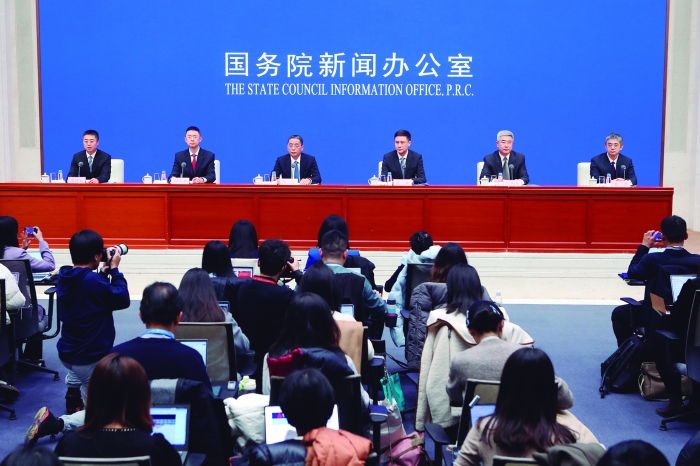
中国人民银行将推八项措施加大结构性货币政策工具支持力度
Zheng Quan Ri Bao· 2026-01-15 17:14
1月15日,国新办举行新闻发布会,介绍货币金融政策支持实体经济高质量发展成效。中国人民银行副 行长邹澜在发布会上表示,根据当前经济金融形势需要,中国人民银行将先行推出两方面政策措施:一 方面是下调各类结构性货币政策工具利率,提高银行重点领域信贷投放的积极性;另一方面是完善结构 性工具并加大支持力度,进一步助力经济结构转型优化。 东方金诚首席宏观分析师王青表示,今年中国人民银行将优化用好各类结构性货币政策工具,着眼于做 好金融"五篇大文章",引导金融资源更多支持科技创新、制造业转型升级、绿色发展、小微企业,以及 促消费、稳外贸等国民经济重点领域和薄弱环节。 八是鼓励金融机构提升汇率避险服务水平。丰富汇率避险产品,为企业提供成本合理、灵活有效的汇率 风险管理工具。 邹澜表示,以上相关措施的政策文件将于近日发布。按照国务院常务会议部署,在实施过程中,将与财 政贴息、担保和风险成本分担等财政政策协同配合,进一步放大政策效能,共同促进扩大有效内需。中 国人民银行还将继续加大流动性投放力度,灵活搭配公开市场操作各项工具,保持流动性充裕,引导隔 夜利率在政策利率水平附近运行。 将与财政政策协同配合 据邹澜在发布会上介绍,中 ...
银行业点评:精准滴灌,稳定银行息差预期
Guoxin Securities· 2026-01-15 15:32
核心观点 锚定经济结构性矛盾,精准落地结构性货币政策工具。此次结构性货币政策利率调整,既是对中央经济工 作会议精神的快速响应,也是破解我国当前经济结构性矛盾的关键抓手。结构性货币政策多年来持续加码, 以抵押补充贷款(PSL)利率调整为例,自 2022 年以来其利率已累计调降过 3 次,从最初的 2.80%逐步降 至 2025 年 5 月的 2.00%,此次再次调降至 1.75%。这一持续调降的背后,是政策对重点领域支持的连贯性, 以增强市场预期稳定性。这既畅通了货币政策传导机制,缓解了重点领域与薄弱环节的融资压力,又从根 本上防范总量宽松可能带来的风险积累,充分彰显结构性货币政策在平衡稳增长与调结构中的核心作用。 证券研究报告 | 2026年01月15日 银行业点评 精准滴灌,稳定银行息差预期 | 行业研究·行业快评 | | | 银行 | 投资评级:优于大市(维持) | | --- | --- | --- | --- | --- | | 证券分析师: | 田维韦 | 021-60875161 | tianweiwei@guosen.com.cn | 执证编码:S0980520030002 | | ...
银行股年内跌幅居首
Di Yi Cai Jing Zi Xun· 2026-01-15 15:30
2026.01.15 本文字数:2237,阅读时长大约4分钟 作者 |第一财经 陈君君 开年以来,A股市场整体表现回暖,但银行板块却未能延续此前涨势,走势明显偏弱。Wind数据显示, 截至1月15日收盘,银行指数(WI.882115)年内下跌3.36%,在31个申万一级行业中跌幅居首,而同期 沪深300指数上涨2.62%。在市场普遍看好2026年股市行情的背景下,银行股为何阶段性承压,后续又 将如何演绎,成为机构关注的焦点。 1月15日,中国人民银行宣布下调各类结构性货币政策工具利率,并同步扩大相关工具使用范围和额 度。市场普遍认为,此次"结构性降息"对银行股影响偏中性略偏积极,但短期内难以改变板块相对收益 偏弱的格局。 结构性降息落地:负债端成本改善,对银行股影响偏中性 央行称,本次下调各类结构性货币政策工具利率0.25个百分点,各类再贷款一年期利率由1.5%降至 1.25%,其他期限档次利率同步调整。不同于全面降息,此次政策主要通过结构性工具传导,对银行体 系的影响路径更具针对性。 多位市场分析人士指出,结构性货币政策工具利率下调,主要作用于银行负债端,有助于降低银行从央 行获取中长期资金的成本,并未直接 ...

如何提高货币政策效力?
Sou Hu Cai Jing· 2026-01-15 14:43
Group 1 - The central bank of China is expected to continue implementing a loose monetary policy to eliminate negative output gaps and promote reasonable price recovery, with expectations of further rate cuts and reserve requirement ratio reductions in 2026 [2][3] - The current economic environment shows that while liquidity is not lacking, there is a deficiency in loan demand, making the necessity for interest rate cuts higher than for reserve requirement reductions [3][4] - The Consumer Price Index (CPI) for 2025 is projected to remain flat compared to 2024, significantly below the target inflation rate of around 2%, indicating that the current economic growth rate is below its potential level [2][3] Group 2 - The effectiveness of monetary policy is influenced by the economic cycle, with expansionary fiscal policy often proving more effective during economic downturns, as it can directly create new demand [4][5] - The transmission efficiency of monetary policy is also affected by the balance sheets of households and enterprises; if these are damaged, the effectiveness of expansionary monetary policy declines [5][6] - The quality of collateral available to commercial banks is crucial for credit availability; a decline in real estate prices has negatively impacted the quality of collateral, leading to reduced credit growth [6][7] Group 3 - To enhance the effectiveness of monetary policy, it is recommended to strengthen the coordination between fiscal and monetary policies, with a focus on more active fiscal measures to stimulate domestic demand [7][8] - Efforts should be made to stabilize the real estate market, as falling property prices are a significant factor affecting the balance sheets of households and enterprises [7][8] - The central government should increase the issuance of government bonds of various maturities to provide funding for expansionary fiscal policies and to supplement the quality of collateral in the banking system [8][9]

央行:商业用房购房最低首付降至30%
Xin Lang Cai Jing· 2026-01-15 14:14
Core Viewpoint - The People's Bank of China (PBOC) is implementing two key policy measures to address the current economic and financial situation, including lowering interest rates on various structural monetary policy tools and enhancing support for economic structural transformation [2][4]. Group 1: Monetary Policy Adjustments - The PBOC will reduce the interest rates on various structural monetary policy tools by 0.25 percentage points, with the one-year relending rate decreasing from 1.5% to 1.25%, and other term rates adjusted accordingly [2][4]. - The minimum down payment ratio for commercial property loans will be lowered to 30% to support the de-inventory of commercial and real estate markets [2][4]. Group 2: Tax Policy for Housing - A joint announcement from the Ministry of Finance, State Taxation Administration, and Ministry of Housing and Urban-Rural Development states that from January 1, 2026, to December 31, 2027, taxpayers selling their own homes and purchasing new ones within one year will receive a tax refund on the personal income tax paid on the sale of their previous home [2][4].

结构性降息0.25个百分点!央行最新发布会释放重要信号
Guo Ji Jin Rong Bao· 2026-01-15 14:12
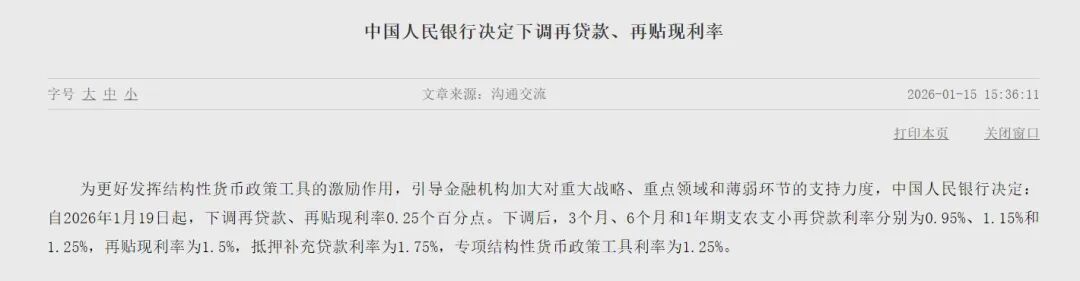
Core Viewpoint - The People's Bank of China (PBOC) is implementing monetary policy measures to support high-quality economic development, including a 0.25 percentage point reduction in various structural monetary policy tool rates to enhance bank lending in key areas [1][2]. Group 1: Policy Measures - The PBOC will lower the interest rates of various structural monetary policy tools by 0.25 percentage points, with the one-year re-lending rate decreasing from 1.5% to 1.25% [2]. - The new rates for re-lending and re-discounting will be 0.95%, 1.15%, and 1.25% for 3-month, 6-month, and 1-year terms respectively, with the re-discount rate set at 1.5% [2]. Group 2: Economic Impact - The reduction in rates aims to lower financing costs in specific sectors, encouraging banks to lend at lower rates to small and micro enterprises, technological innovation, and green transformation [4]. - The targeted approach of structural monetary policy tools is expected to improve the efficiency of fund utilization and enhance financial services for the real economy [4]. Group 3: Future Monetary Policy Outlook - There is still room for further reductions in the reserve requirement ratio, with the current average at 6.3%, indicating a potential decrease of about 1.3 percentage points [5][6]. - The PBOC is expected to maintain a moderately loose monetary policy, focusing on the integration of existing and new policies to create a conducive financial environment for stable economic growth [7][8].
如何理解央妈今天的讲话?
表舅是养基大户· 2026-01-15 13:33
Core Viewpoint - The article discusses the recent monetary policy adjustments, particularly structural interest rate cuts, and their implications for the financial market, emphasizing a cautious approach to overall interest rate reductions while focusing on targeted support for specific sectors like technology and small enterprises [4][5][6]. Group 1: Monetary Policy Insights - The recent structural interest rate cuts aim to direct funds towards technology and small enterprises rather than allowing capital to circulate in financial markets [4]. - The decision to lower the rates on structural monetary tools and increase quotas for technology re-loans indicates a continuous policy approach rather than a shift towards broad interest rate cuts [5]. - The central bank is cautious about further lowering the OMO rate, prioritizing structural monetary policy and fiscal measures, with a preference for maintaining bank interest margins [6]. Group 2: Market Reactions - Following the announcement of new financing regulations, the financing balance increased by over 150 billion, indicating strong market activity despite regulatory changes [10]. - A significant drop in daily trading volume was observed, with a decrease of over 1 trillion, marking one of the largest single-day volume reductions historically [12]. - The A-share market showed a mixed performance, with a median decline of only 0.4% across over 5,000 stocks, indicating a selective market reaction [21]. Group 3: Sector Performance - The commercial aerospace sector experienced a sharp decline, with leading stocks like China Satellite facing significant losses, highlighting the volatility in high-valuation sectors [24]. - Despite overall market cooling, sectors such as AI hardware and semiconductor equipment showed resilience, with notable gains following positive earnings reports from major companies like TSMC [27]. Group 4: Investment Strategies - The article suggests that the current low-interest-rate environment in China continues to create opportunities for structural investments in the stock market, despite limited room for significant interest rate reductions [7]. - The analysis of foreign capital flows indicates a strategic approach, with foreign investors adjusting their positions based on fundamental valuations, as seen in the case of Industrial and Commercial Bank of China [42].