
股市

Search documents
美国总统特朗普称,“股市处于历史高位,我们将保持下去”。7月4日,美国金融市场休市,比特币最近24小时持续走低,目前跌2%,暂报10.8万美元。
news flash· 2025-07-04 21:37
Core Viewpoint - The U.S. stock market is at historical highs, and there is an intention to maintain this status [1] Group 1: Stock Market - The U.S. stock market is currently experiencing historical high levels [1] - President Trump expressed confidence in sustaining the stock market's high performance [1] Group 2: Cryptocurrency - Bitcoin has seen a decline of 2% over the last 24 hours, currently priced at $108,000 [1]
PMI不弱,政策不急
HUAXI Securities· 2025-06-30 13:47
Group 1: PMI Overview - The manufacturing PMI for June is reported at 49.7%, matching expectations and slightly up from the previous value of 49.5%[1] - The non-manufacturing PMI stands at 50.5%, an increase from the prior value of 50.3%[1] - The average composite PMI for Q2 is 50.4%, lower than Q1's average of 50.9% and last year's Q2 average of 51.1%[1] Group 2: Demand and Price Trends - New orders in manufacturing, construction, and services have rebounded by 0.4, 1.6, and 0.3 percentage points respectively, indicating improved demand[2] - Manufacturing prices have rebounded by 1.5 percentage points, while construction and service prices increased by 0.8 and 1.6 percentage points respectively, although all remain below the expansion threshold[2] Group 3: External Demand and Employment - Manufacturing new export orders increased by 0.2 percentage points to 47.7%, still below the Q1 average of 48.0%[3] - Employment indices in manufacturing and services have decreased by 0.2 percentage points to 47.9% and 46.4%, respectively, indicating ongoing contraction in workforce[5] Group 4: Economic Outlook - The composite PMI of 50.7% in June is 0.2 percentage points lower than the Q1 average, suggesting a slower economic recovery[6] - The necessity for immediate policy stimulus is reduced, with potential policy actions expected to be postponed until August or September[6]
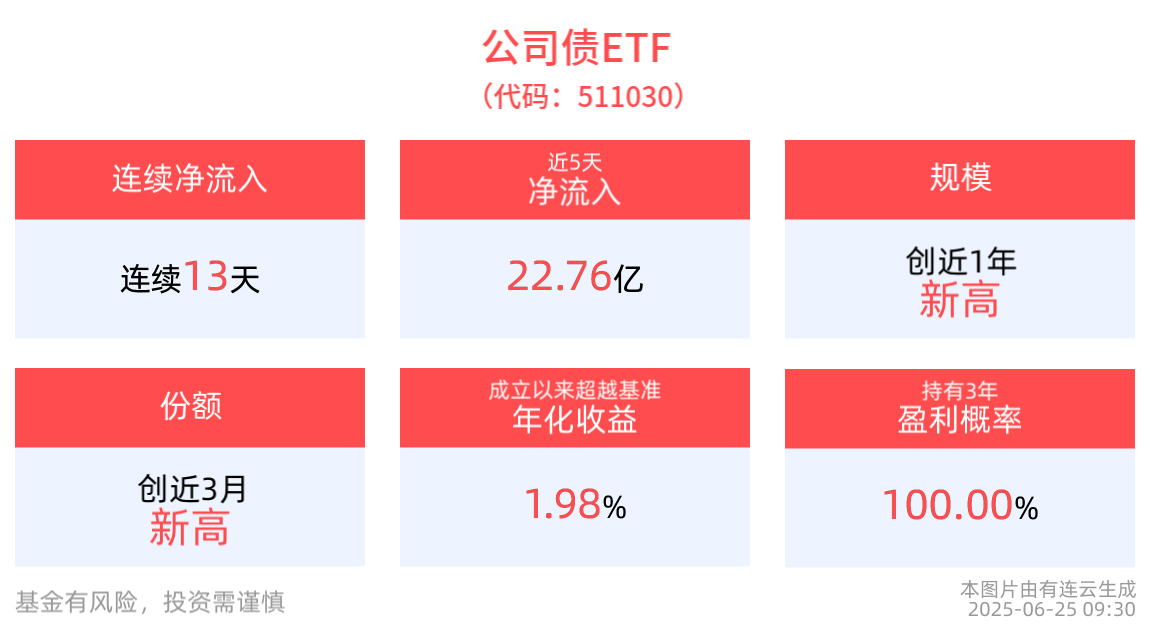
央行开展3000亿元MLF操作,公司债ETF(511030)连续13天获资金净流入,国债ETF5至10年(511020)开盘上扬
Sou Hu Cai Jing· 2025-06-25 02:07
Group 1 - The company bond ETF (511030) has increased by 0.02%, with the latest price at 106.08 yuan, and its scale has reached a new high of 20.869 billion yuan [1] - The company bond ETF has seen continuous net inflows for 13 days, with a maximum single-day net inflow of 1.538 billion yuan, totaling 5.3 billion yuan, averaging 408 million yuan per day [1] Group 2 - The national debt ETF for 5 to 10 years (511020) has risen by 0.01%, with the latest price at 117.56 yuan, and its scale is now 1.432 billion yuan [4] - The national development bond ETF (159651) is currently in a stalemate, priced at 106.18 yuan, with a scale of 1.003 billion yuan [4] - The central bank has conducted a 300 billion yuan MLF operation, with a net injection of 118 billion yuan this month [4] - In June, the government bond net issuance has reached 1.2 trillion yuan, with significant participation from major banks in the primary bidding [4] Group 3 - The recent stock market has performed well, with the A-share index reaching a year-to-date high, and banks listed in both A and H shares hitting new highs [5] - The company continues to favor long-term city investment bonds and bank capital bonds with yields above 2%, while also focusing on the central bank's liquidity behavior [5] - The bond ETF trio from Ping An Fund includes the company bond ETF (511030), national development bond ETF (159651), and national debt ETF for 5 to 10 years (511020), covering various durations to assist investors in navigating the bond market cycle [5]

【招银研究|固收产品月报】债市利率低位低波震荡,重视票息保护(2025年6月)
招商银行研究· 2025-06-20 10:01
Core Viewpoint - The bond market has shown a strong performance recently, with various fixed-income products experiencing growth in returns, particularly those with embedded options [2][3][11]. Summary by Sections Fixed Income Product Performance - In the past month, the bond market experienced fluctuations, with rates generally declining. Various stable products saw an increase in net value, especially option-embedded fixed income products, followed by medium- and long-term bond funds [3][9]. - As of June 18, the monthly returns for different products were as follows: option-embedded bond funds at 0.54% (previously 0.62%), medium-term bond funds at 0.31% (previously 0.13%), short-term bond funds at 0.18% (previously 0.19%), high-grade interbank certificates of deposit index funds at 0.15% (previously 0.18%), and cash management products at 0.11% (unchanged) [3][10]. Bond Market Review - The bond market showed a pattern of weakness followed by strength, influenced by market sentiment and liquidity conditions. The tightening of liquidity in late May, combined with the U.S.-China trade meeting in early June, initially suppressed bond market performance. However, after the month transitioned, the central bank's supportive stance on liquidity led to a recovery [11][12]. - The one-year AAA interbank certificate of deposit rate fell to approximately 1.65%, a slight decrease from the previous month, indicating a shift towards a more favorable liquidity environment [12][15]. Market Outlook - In the short term, the bond market is expected to maintain a low-interest, low-volatility trend, with the 10-year government bond yield projected to fluctuate between 1.5% and 1.8%, centered around 1.7% [31][34]. - Credit bonds are anticipated to outperform interest rate bonds, with credit spreads likely to remain relatively low, minimizing the risk of significant widening [34]. Asset Management Industry Trends - The scale of wealth management products increased to 31.3 trillion yuan by the end of May, reflecting a 1.6% month-on-month growth. This growth is attributed to the decline in bank deposit rates, which has made wealth management products more attractive [36]. - On May 23, the National Financial Regulatory Administration released a draft for asset management product information disclosure, allowing for more flexible performance benchmark disclosures, which may influence investor behavior in the long term [36]. Investment Strategy Recommendations - For investors needing liquidity management, maintaining cash-like products and considering stable low-volatility wealth management or short-term bond funds is advisable [39]. - For conservative investors, holding pure bond products with a potential extension of duration is recommended, especially as the 10-year government bond yield approaches 1.7%-1.8% [40]. - For more advanced conservative investors, continuing to hold fixed-income plus products is suggested, with a focus on incorporating convertible bonds and equity assets into the strategy [41].
以伊冲突迅速解决的希望渺茫,油价涨股市跌
news flash· 2025-06-17 18:18
跟踪中东局势动态 +订阅 订阅美国VS伊朗动态 +订阅 订阅特朗普动态 +订阅 以伊冲突迅速解决的希望渺茫,油价涨股市跌 美国扩大了在中东地区的军事部署,以色列和伊朗冲突迅速解决的希望渺茫,美国股市下跌,油价上 涨。特朗普警告说,他正在对伊朗失去耐心,呼吁伊朗无条件投降,并表示他"暂时"不会把伊朗最高领 袖哈梅内伊作为攻击目标。特朗普早些时候在签署了呼吁中东和平与稳定的七国集团声明后表示,他正 在努力"真正结束"这场冲突。 ...
5月基金月报 | 股市回暖债市平稳,权益基金迎来普涨,固收基金表现分化
Morningstar晨星· 2025-06-12 01:02
晨 星 月 报 01 市场洞察 宏观经济延续上月承压走势,股债表现分化 5月,国内宏观经济走势有所改善,但依旧承压。反映国内经济先行指标的制造业PMI录得 49.5%,在4月份49.0%的基础上回升0.5%,连续两个月位于收缩区间。制造业景气水平的上升 主要是受到生产指数、新订单指数、原料库存指数和从业人员指数环比上行所带来的影响。4 月份CPI同比下降0.1%,PPI同比下降2.7%。相比于3月份CPI和PPI同比分别下降0.1%和下降 2.5%而言,CPI同比涨幅持平主要是受到食品价格降幅收窄和服务价格上涨的影响;生产资料 价格和生活资料价格的降幅扩大,带动PPI同比降幅上升。 5月,中美关税冲突有所缓和,叠加央行降准降息政策的落地推动A股在上旬回暖。随着市场 对关税利好的消化,下旬,受到特朗普贸易政策不确定性的延续及4月经济数据边际偏弱的影 响,股市出现小幅回落。主要股指在5月迎来普涨,其中上证指数和深证成指分别上涨2.09% 和1.42%。代表大盘股、中盘股和小盘股的沪深300指数、中证500指数和中证1000指数分别上 涨1.85%、0.70%和1.28%。31个申万行业多数收涨,其中25个行业上涨 ...

策略周报:稳中求进,静待成长良机-20250608
HWABAO SECURITIES· 2025-06-08 05:11
Group 1 - The report emphasizes a cautious approach in the current market environment, suggesting a focus on defensive sectors such as banking due to ongoing tariff negotiations and economic pressures [3][10][12] - It highlights the potential for bond yields to reach new lows, recommending patience in positioning for left-side opportunities, particularly when the 10-year government bond yield approaches 1.7% after a 10 basis point rate cut [3][12] - The report notes a significant recovery in the domestic stock market, driven by short-term high-elasticity targets, with small-cap stocks becoming the core focus for capital [10][12] Group 2 - The report outlines key events impacting the market, including the U.S. tariff increase on steel and aluminum, and the People's Bank of China's liquidity support measures [9][10] - It tracks market performance indicators, noting a rise in average daily trading volume to 12,088.54 billion yuan, indicating increased trading activity and investor interest [22] - The report anticipates continued recovery in U.S. markets, driven by stable earnings from tech giants and a favorable environment during the tariff policy window [13]
特朗普:就业数据亮眼 股市大涨
news flash· 2025-06-06 14:19
特朗普:就业数据亮眼 股市大涨 金十数据6月6日讯,特朗普在社交媒体上表示:"就业数据亮眼,股市大涨!与此同时,数十亿美元因 关税而涌入!" ...
国投期货市场主流观点汇-20250605
Guo Tou Qi Huo· 2025-06-05 11:26
Report Overview - The report aims to objectively reflect the research views of futures and securities companies on various commodity varieties, track hot varieties, analyze market investment sentiment, and summarize investment driving logic. It is for internal company use only and does not constitute personal investment advice [1]. Market Data Commodities - **Palm oil**: Closed at 8060.00 with a weekly increase of 0.67% [2]. - **Live pigs**: Closed at 13605.00 with a weekly increase of 0.67% [2]. - **Soybean meal**: Closed at 2968.00 with a weekly increase of 0.54% [2]. - **Corn**: Closed at 2336.00 with a weekly increase of 0.39% [2]. - **Copper**: Closed at 77600.00 with a weekly decrease of 0.24% [2]. - **PTA**: Closed at 4700.00 with a weekly decrease of 0.34% [2]. - **Aluminum**: Closed at 20070.00 with a weekly decrease of 0.42% [2]. - **Silver**: Closed at 8218.00 with a weekly decrease of 0.54% [2]. - **Methanol**: Closed at 2208.00 with a weekly decrease of 0.63% [2]. - **Gold**: Closed at 771.80 with a weekly decrease of 1.06% [2]. - **Crude oil**: Closed at 447.90 with a weekly decrease of 1.08% [2]. - **Ethylene glycol**: Closed at 4349.00 with a weekly decrease of 1.23% [2]. - **Glass**: Closed at 982.00 with a weekly decrease of 1.80% [2]. - **PVC**: Closed at 4764.00 with a weekly decrease of 1.85% [2]. - **Iron ore**: Closed at 702.00 with a weekly decrease of 2.23% [2]. - **Rebar**: Closed at 2961.00 with a weekly decrease of 2.79% [2]. - **Coke**: Closed at 1308.00 with a weekly decrease of 5.42% [2]. A-shares - **CSI 500**: Closed at 5671.07 with a weekly increase of 0.32% [2]. - **CSI 300**: Closed at 3840.23 with a weekly decrease of 1.08% [2]. - **SSE 50**: Closed at 2678.70 with a weekly decrease of 1.22% [2]. Overseas Stocks - **Nikkei 225**: Closed at 37965.10 with a weekly increase of 2.17% [2]. - **Nasdaq Composite**: Closed at 19113.77 with a weekly increase of 2.01% [2]. - **S&P 500**: Closed at 5911.69 with a weekly increase of 1.88% [2]. - **FTSE 100**: Closed at 8772.38 with a weekly increase of 0.62% [2]. - **CAC 40**: Closed at 7751.89 with a weekly increase of 0.23% [2]. - **Hang Seng Index**: Closed at 23289.77 with a weekly decrease of 1.32% [2]. Bonds - **5-year Chinese Treasury bond**: Closed at 1.58 with a weekly increase of 2.36% [2]. - **2-year Chinese Treasury bond**: Closed at 1.50 with a weekly increase of 1.35% [2]. - **10-year Chinese Treasury bond**: Closed at 1.70 with a weekly decrease of 1.33% [2]. Foreign Exchange - **US Dollar Index**: Closed at 99.44 with a weekly increase of 0.32% [2]. - **US Dollar central parity rate**: Closed at 7.18 with a weekly decrease of 0.10% [2]. - **EUR/USD**: Closed at 1.13 with a weekly decrease of 0.14% [2]. Commodity Views Macro-financial Sector Stock Index Futures - **Strategy view**: Among 9 institutions, 1 is bullish, 0 is bearish, and 8 expect a sideways trend [3]. - **Bullish logic**: May PMI data shows significant improvement in corporate export orders; ETF shares tracking the CSI 300 index increased by 600 million this week; The Premier emphasized increasing policy support to expand consumption; Market sentiment for real estate and fiscal policies is expected to further recover [3]. - **Bearish logic**: May construction and service sector PMI is not high; A-share average daily trading volume decreased by 79.4 billion yuan week-on-week; Weak domestic demand affects profit expectations; Trump's false social media posts on China trade increase tariff uncertainty [3]. Treasury Bond Futures - **Strategy view**: Among 7 institutions, 3 are bullish, 0 is bearish, and 4 expect a sideways trend [3]. - **Bullish logic**: Setbacks in China-US economic and trade negotiations support the bond market; Manufacturing PMI remains below the boom-bust line; Weak stock market momentum benefits the bond market; Supply-demand disturbances in the bond market weaken after partial issuance [3]. - **Bearish logic**: Industrial enterprise profit growth rebounds; High-speed profit growth in new kinetic energy industries; Banks and insurance companies have limited capacity to absorb bond supply; Market concerns about rising certificate of deposit rates persist [3]. Energy Sector Crude Oil - **Strategy view**: Among 9 institutions, 1 is bullish, 2 are bearish, and 6 expect a sideways trend [4]. - **Bullish logic**: Saudi Arabia's production increase falls short of expectations; Low oil prices hinder US shale oil supply growth; The Northern Hemisphere enters the peak season for refined oil; Chinese refineries plan to end maintenance in June [4]. - **Bearish logic**: OPEC+ is expected to continue increasing production in July; A large amount of US Treasury bonds will mature in June; Trump reignites China-US trade disputes; Global economic weakness and trade frictions drag down oil demand [4]. Agricultural Products Sector Cotton - **Strategy view**: Among 8 institutions, 0 is bullish, 2 are bearish, and 6 expect a sideways trend [4]. - **Bullish logic**: Xinjiang cotton commercial inventory is depleting faster; Import window is mostly closed; India's cotton production decreases year-on-year; US cotton sowing progress lags behind [4]. - **Bearish logic**: The domestic textile industry enters the off-season; Textile enterprises' operating rates decline; Finished product inventories increase; Post-Dragon Boat Festival temperature rise benefits new cotton growth; US cotton-growing areas have good weather [4]. Non-ferrous Metals Sector Copper - **Strategy view**: Among 7 institutions, 2 are bullish, 2 are bearish, and 3 expect a sideways trend [5]. - **Bullish logic**: Global copper mine supply is disrupted; LME copper inventory is falling; Domestic social inventory is low; Strong demand from power grid and new energy industries [5]. - **Bearish logic**: US steel tariff hikes raise stagflation expectations; Weak domestic commodity market sentiment; Widening scrap-copper price difference; Poor cable orders [5]. Chemical Sector Soda Ash - **Strategy view**: Among 7 institutions, 0 is bullish, 4 are bearish, and 3 expect a sideways trend [5]. - **Bullish logic**: Maintenance peaks in July and August may ease supply pressure; Strong export performance; Stable light soda ash demand [5]. - **Bearish logic**: Weak glass demand affects the soda ash market; End of the PV installation rush; Low downstream purchasing enthusiasm; High production and inventory levels limit price increases [5]. Precious Metals Sector Gold - **Strategy view**: Among 7 institutions, 4 are bullish, 0 is bearish, and 3 expect a sideways trend [6]. - **Bullish logic**: US steel and aluminum tariff hikes increase uncertainty; Central bank gold purchases and safe-haven demand support prices; SPDR Gold ETF holdings increase; Long-term logic of gold as a hedge against credit currency risk [6]. - **Bearish logic**: US economic data shows resilience; The Fed's May meeting was hawkish; US stocks showed no significant reaction to tariff hikes; Market sensitivity to Trump's policies may decline [6]. Black Metals Sector Iron Ore - **Strategy view**: Among 9 institutions, 0 is bullish, 3 are bearish, and 6 expect a sideways trend [6]. - **Bullish logic**: Steel mills maintain profits; Port iron ore inventory decreases; Steel mills' imported ore inventory is low; Global iron ore shipments decline [6]. - **Bearish logic**: Trump plans to double steel and aluminum import tariffs; Mainstream ore shipments recover; Daily pig iron production decreases; Daily port throughput decreases; Weak domestic real estate market [6].