
关税

Search documents
Tapestry shares plunge 15% as Coach parent says tariffs will bite into profits
CNBC· 2025-08-14 16:35
Core Viewpoint - Tapestry, the parent company of Coach and Kate Spade, is facing significant profit headwinds due to increased tariffs, which are expected to cost the company $160 million in the upcoming fiscal year, despite anticipated sales growth [1][2]. Financial Performance - Tapestry expects full-year fiscal 2026 earnings to be between $5.30 and $5.45 per share, which is below analysts' expectations of $5.49 per share [1][3]. - The company projects revenue of approximately $7.2 billion for the fiscal year, indicating low single-digit growth compared to the previous year [3]. Tariff Impact - The CFO highlighted that the company is experiencing greater profit challenges from tariffs than previously anticipated, particularly due to the suspension of the de minimis rule, which previously allowed duty-free entry for items valued at $800 or less [2]. - Tapestry is exploring various strategies to mitigate the impact of tariffs, including diversifying manufacturing locations and improving operational efficiency [5]. Industry Context - Other retailers are also adapting to higher tariff costs by moving manufacturing, raising prices, and focusing on popular items [4]. - Major U.S. retailers, including Walmart, Home Depot, and Target, are expected to report their quarterly earnings soon, which may provide further insights into industry trends [6].



ATFX:50基点暴击在即?美联储9月降息预期飙至93.8%,黄金或迎新一轮爆发
Sou Hu Cai Jing· 2025-08-14 13:46
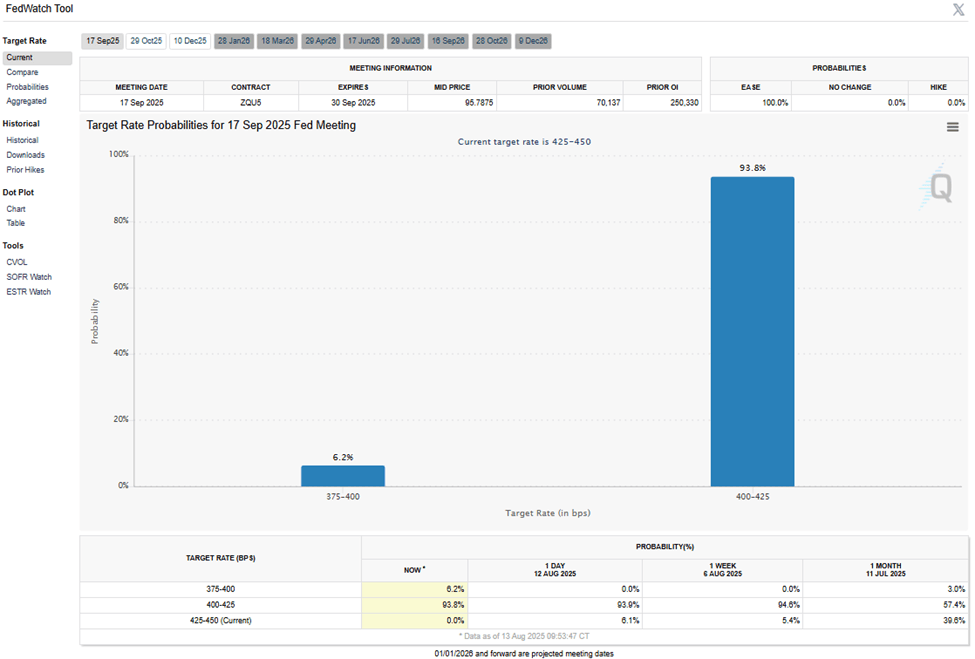
近期美国宏观环境的多重信号,使得9月美联储降息几乎板上钉钉。CME FedWatch工具显示,在7月CPI温和增长的背景下,市场对9月降 息的预期高达 93.8%,且美国财长贝森特直接抛出"一次性降息50个基点"的可能性,这一激进言论迅速引发全球市场关注。贝森特指出, 当前 4.25%-4.5%的联邦基金利率已过度限制经济,建议下调至接近 3% 中性利率水平,并在未来几个月累计降息 150-175个基点。这一立 场不仅与特朗普政府一贯的宽松倾向一致,也为市场打开了更大幅度宽松的想象空间。 ▲ATFX图 就业市场疲软是当前降息预期的重要推手。最新修正的5-7月非农就业数据均显示出显著放缓,失业率虽维持在相对稳定水平,但较2024年 上升约 0.75个百分点,表明劳动力市场正从"紧平衡"向"松动"转变。贝森特甚至直言,如果这些疲软信号更早出现,美联储可能已经采取 降息行动。部分官员担忧若不及时放松政策,失业率可能进一步攀升,损害经济信心。 下周即将召开的 杰克逊霍尔央行年会将成为鲍威尔释放政策信号的关键窗口。去年他在同一场合明确暗示降息,今年市场预期他可能重申 对经济数据依赖的政策框架,同时为更大幅度宽松铺路。与 ...
【comex白银库存】8月13日COMEX白银库存与上一日持平
Jin Tou Wang· 2025-08-14 09:34
Group 1 - COMEX silver inventory remained stable at 15,770.78 tons as of August 13, 2025, with no change from the previous day [1][2] - COMEX silver price closed at $38.55 per ounce on August 13, 2025, reflecting a 1.61% increase, with a daily high of $38.71 and a low of $37.88 [1] Group 2 - In July 2025, the U.S. budget deficit increased by 20% compared to the previous year, despite record tariff revenues from President Trump's administration [2][3] - Customs revenue in July 2025 rose by 273% year-over-year, amounting to an increase of $21 billion, but overall spending also increased significantly [2] - The total federal debt is approaching $37 trillion, indicating ongoing financial pressure despite tariff income [2][3]
制裁升级?关税加压?特普会前市场如坐针毡
Sou Hu Cai Jing· 2025-08-14 09:28
Geopolitical Impact on Oil Prices - The U.S. Treasury Secretary, Mnuchin, indicated that if the upcoming meeting between Trump and Putin fails, the U.S. may intensify sanctions against Russia, including the potential for secondary tariffs [1][3] - Following Mnuchin's comments, international oil prices reacted, with Brent crude reaching $66.30 and WTI crude above $63.10 before experiencing a decline after Trump's remarks [3][5] - Analysts noted that geopolitical factors are driving oil prices, particularly in light of the uncertainty surrounding the Russia-Ukraine situation [5][7] Economic Insights and Consumer Impact - Goldman Sachs reported that the burden of tariff costs is increasingly falling on U.S. consumers, with their share expected to rise from 22% to 67% by October [5][7] - The firm projected that the PCE price index would increase to 3.2% year-over-year by December, up from 2.6% in June [5][7] - Trump's criticism of Goldman Sachs highlighted a disconnect between his views on tariffs and the economic realities presented by the firm [5][7] Federal Reserve and Interest Rate Outlook - Goldman Sachs' chief economist, David Mericle, stated that if tariffs follow a similar trajectory as in February, consumers will bear a significant portion of the costs [7] - Mericle suggested that the Federal Reserve may consider minor interest rate cuts, but these would not significantly alter overall monetary policy [7] - Mnuchin also commented on the Federal Reserve, suggesting that current interest rates should be lower by 150 to 175 basis points, indicating a potential for rate cuts if data supports it [7]
关税风暴持续,美联储分歧加大,“懂王”正物色下一届主席!
Sou Hu Cai Jing· 2025-08-14 05:49
近日,有消息人士透露称,特朗普扬言对进口药品加征关税,但这些关税可能还需要几周时间才会实 施。 该人士称,美国国家安全部门对半导体的调查结果将在宣布药品关税前公布。此外,特朗普还忙于周五 即将与俄罗斯总统普京举行的会晤。 关税风暴持续 此前特朗普曾放风,希望通过关税举措,促进医药制药商将制造业务带回美国。他还威胁道:美国将首 先对进口药品征收"小额关税",并在一年左右的时间内提高税率,税率最高将升至250%。 很多制药公司一直对关税持反对意见,有分析指出,相关关税可能会推高成本,阻碍在美国的投资,扰 乱药品供应链,使患者面临风险。美国药品行业最大的游说团体美国药品研究与制造商协会 (PhRMA)也认为,药品历来被免除关税,因为它们会增加成本并导致短缺。然而这些反对的声音似 乎很难改变"懂王"的看法。 目前医药行业正准备应对关税"冲击波",上述消息人士的态度也给了市场一定的缓冲期。可以说,特朗 普对于关税的一举一动仍是市场关注的焦点。 值得注意的是,随着各国关税的逐步落地,其对经济、民生的影响也在显现,不少机构对此表示担忧。 博斯蒂克表示,美联储应避免可能给公众带来麻烦的政策波动,应该等待"形势发展更加明朗"。 ...
高盛惹怒特朗普,华尔街声援:关税引发的通胀冲击即将来袭
Feng Huang Wang· 2025-08-14 05:01
Core Viewpoint - Goldman Sachs predicts that U.S. consumers will bear an increasing burden of tariffs, with the cost expected to rise from 22% in June to 67% by October [2] Group 1: Economic Impact of Tariffs - Economists believe the maximum impact of tariffs on inflation has yet to be felt, with expectations of rising consumer inflation as inventory depletes and actual tariff rates increase from approximately 3% to 18% [1][4] - The tariffs could reduce GDP by 1% and increase inflation by 1% to 1.5%, with some effects already visible [4] - Monthly inflation increases are expected to be between 0.3% and 0.5%, pushing core inflation indicators to the 3% to 3.5% range [4] Group 2: Market Reactions and Predictions - Following Trump's criticism of Goldman Sachs, industry insiders noted that many economists with views contrary to the U.S. government's stance could face job losses [3] - The Blue Chip Economic Indicators report shows a slight increase in GDP growth forecasts for the second half of the year, now averaging 0.85% [5] Group 3: Inflation Trends and Concerns - Pantheon Macroeconomics forecasts core inflation to rise by 1 percentage point, reaching 3.5% by year-end, with only about 25% of the tariff impact currently passed to consumers [7] - BNP Paribas highlights upward pressure on service input prices, indicating that inflation concerns extend beyond goods [8] - The Cleveland Fed's sticky price CPI shows a three-month annualized rate of 3.8%, the highest since May 2024, suggesting persistent inflationary pressures [8]

关税冲击波将至!华尔街普遍预警:美国核心通胀恐破3% 消费者支出面临“1%GDP税”
智通财经网· 2025-08-14 02:28
Core Viewpoint - Goldman Sachs economists predict that by the end of this year, U.S. consumers will increasingly feel the impact of tariffs, leading to rising inflation and potential economic slowdown [1][2]. Economic Impact - Economists estimate that tariffs could reduce GDP by approximately 1% and increase inflation by 1% to 1.5%, with some effects already being felt [2]. - The effective tariff rate is expected to rise to around 18% from about 3% at the beginning of the year, contributing to a steady increase in prices [2]. - The impact of tariffs on consumer prices is uncertain, as the current tariff increases are unprecedented compared to historical data [2]. Inflation Trends - Inflation is projected to rise gradually, with core inflation potentially reaching 3.5% by the end of the year, driven by higher costs being passed on to consumers [4]. - The "sticky" nature of inflation is a concern, with the Cleveland Fed's "sticky price CPI" showing a three-month annualized rate of 3.8%, the highest since May 2024 [4]. Consumer Spending and Economic Growth - Short-term inflation increases may suppress consumer spending, with GDP growth for the second half of the year expected to be around 0.85% [3]. - Some economists believe that the restrictive effects of tariffs may be temporary, with expectations for significant growth improvement next year [3]. Future Concerns - The expiration of the "low-value tax exemption" on August 29 could particularly impact retail goods, leading to further price increases [4]. - There is a consensus among economists that higher inflation may lead to hesitation from policymakers regarding interest rate cuts, despite expectations for a more accommodative monetary policy in the future [5].
国际金融市场早知道:8月14日
Xin Hua Cai Jing· 2025-08-13 23:48
Core Insights - Trump proposes collaboration with Russia to develop rare earth minerals and lift export bans on aircraft parts [1] - US Treasury Secretary Basent suggests immediate interest rate cuts by the Federal Reserve [1] - Canadian central bank maintains current monetary policy amid trade uncertainties [2] - Chicago Fed President Goolsbee expresses caution regarding the economy, indicating reluctance to support rate cuts without clear signs of job market deterioration [2] Market Developments - US Energy Department allocates $1 billion for mineral security projects to ensure supply chain safety [1] - Mortgage rates for 30-year fixed contracts drop to 6.67%, marking the largest decline since February [1] - Korean ICT exports reach $22.19 billion in July, up 14.5% year-on-year, with semiconductor exports increasing by 31.2% [2] Global Market Dynamics - Dow Jones Industrial Average rises by 1.04% to 44,922.27 points, S&P 500 increases by 0.32% to 6,466.58 points, and Nasdaq Composite grows by 0.14% to 21,713.14 points [3] Commodity Prices - COMEX gold futures rise by 0.24% to $3,407.00 per ounce, while COMEX silver futures increase by 1.44% to $38.55 per ounce [4] Oil and Bond Markets - US oil main contract decreases by 0.68% to $62.74 per barrel, Brent crude falls by 0.54% to $65.76 per barrel [5] - US Treasury yields decline across various maturities, with the 2-year yield down by 5.84 basis points to 3.668% [5] Currency Movements - US dollar index drops by 0.28% to 97.80, while the euro appreciates by 0.27% against the dollar [5]
美国7月批发通胀或回升 消费者面临更大价格压力
Zhi Tong Cai Jing· 2025-08-13 22:25
Group 1 - The U.S. wholesale inflation rate is expected to show signs of recovery in July, indicating that businesses' ability to absorb high tariff costs is weakening, leading to increased pressure on consumer prices [1] - According to a FactSet survey, the Producer Price Index (PPI) is projected to rise by 2.4% year-on-year in July, slightly up from 2.3% in June, with a month-on-month increase of 0.2% [1] - Goldman Sachs economists indicate that as of June, U.S. companies have absorbed about 64% of tariff costs, but this figure may drop to below 10% in the coming months, resulting in more costs being passed on to consumers [1] Group 2 - Economists believe that the maximum impact of tariffs on inflation has yet to be felt, with the effective tariff rate rising from approximately 3% at the beginning of the year to 18% [2] - JPMorgan's chief U.S. economist estimates that tariffs could reduce U.S. GDP by about 1% and increase inflation by 1 to 1.5 percentage points [2] - Most institutions expect a limited upward pressure on inflation (0.3%-0.5% monthly), primarily as a temporary shock, which will not prevent the Federal Reserve from initiating rate cuts in late 2025 [2] Group 3 - The Blue Chip Economic Indicators August survey shows that the average GDP growth rate for the second half of the year is expected to be 0.85%, an increase from the previous forecast of 0.75% in July [3] - Analysts have adjusted their expectations regarding the impact of tariffs, anticipating a significant economic recovery in 2026 [3]