
物理AI

Search documents
1 万台,无人城配规模之战打响了
3 6 Ke· 2025-07-29 12:50
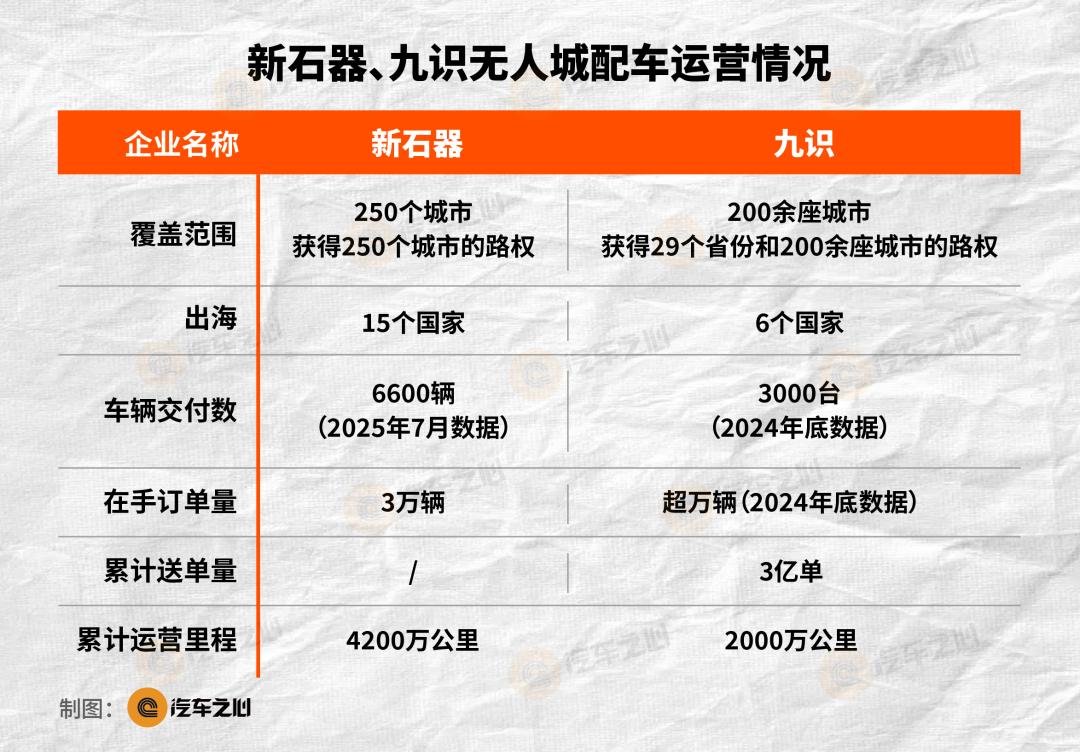
Core Insights - The article discusses the rapid growth and commercialization of autonomous delivery vehicles in China, particularly focusing on companies like New Stone and NineSight, which are leading the charge in this sector [1][2][3] Market Overview - As of 2024, over 6,000 autonomous delivery vehicles have been deployed in China, significantly outpacing the nearly 3,000 Robotaxi vehicles [2] - The market for autonomous delivery vehicles in China grew from 4 billion to 6.5 billion yuan between 2022 and 2023, with a compound annual growth rate exceeding 62%, and is projected to reach 17 billion yuan in 2024 [2] Company Performance - New Stone and NineSight are the first companies to reach the milestone of 10,000 units in production, with New Stone delivering over 6,600 vehicles and NineSight over 5,000 vehicles as of July 2024 [2][3] - New Stone's monthly delivery rate has increased tenfold compared to the previous year, with April 2024 alone surpassing the total deliveries for the entire year of 2024 [2] Competitive Landscape - The article highlights that major players like JD, Meituan, and Cainiao, which initially led the development of autonomous delivery vehicles, are lagging in scaling production compared to New Stone and NineSight [3][4] - New Stone and NineSight have developed strong capabilities in technology maturity, cost control, and operational maintenance, which are critical for achieving large-scale production [5][6] Technological Advancements - Both companies have achieved L4 level autonomous driving capabilities, allowing them to operate in various road conditions and scenarios [5] - New Stone's vehicles can reduce transportation costs from 0.15 yuan per delivery to 0.06 yuan, while NineSight's vehicles can lower costs from 0.17 yuan to 0.1 yuan [9][11] Product Strategy - New Stone and NineSight have diversified their product lines to cater to different transportation needs, offering various models that can handle different load capacities and road conditions [12][14] - New Stone focuses on large clients for bulk sales, while NineSight emphasizes small and medium-sized customers and niche markets [15][16] Financial Backing - Both companies have secured significant funding, with New Stone raising 1 billion yuan in February 2024 and NineSight raising 100 million USD in April 2024, which supports their technology development and production capabilities [16] Industry Challenges - The article notes that achieving the 10,000-unit milestone is a critical point for the industry, as it signifies a transition from small-scale validation to large-scale application [17][18] - The competition is expected to intensify as companies strive to optimize costs, enhance technology, and expand customer bases [27][28] Future Outlook - The next milestone for the industry is projected to be the sale of 100,000 units, with the potential for significant market transformation [42][43] - The article emphasizes the need for patience and observation as the industry navigates through its growth phase and faces challenges in technology validation and business model verification [44][45]

索辰科技(688507):举办物理AI论坛,多场景布局应用落地
Guotou Securities· 2025-07-29 04:32
Investment Rating - The investment rating for the company is "Buy-A" with a 6-month target price of 104.16 CNY, while the stock price as of July 28, 2025, is 88.29 CNY [5][14]. Core Insights - The company is a leading player in the field of physical AI, having launched several innovative products and platforms aimed at various applications, including virtual training and low-altitude economy [1][4][12]. - The company has established strategic partnerships, such as with Hangshi Group, to enhance the integration of low-altitude economy and virtual training technologies [1]. - The company is expected to achieve revenue growth from 5.15 billion CNY in 2025 to 9.21 billion CNY in 2027, with net profits projected to rise from 0.79 billion CNY to 1.42 billion CNY during the same period [14]. Summary by Sections Company Overview - The company hosted a forum on physical AI at the World Artificial Intelligence Conference, showcasing its leadership in the field and announcing four major innovations [1]. - The company has developed a comprehensive physical AI platform that includes various core technologies for simulation and training [2][3]. Product and Technology Development - Key technologies include integrated generative modeling and simulation, real-time physical AI computing engines, and intelligent environmental perception technologies [3]. - The company has launched a physical AI platform that supports various applications, including a low-altitude three-dimensional physical map to enhance the safety of low-altitude flying vehicles [12][13]. Financial Performance and Projections - The company’s revenue is projected to grow significantly, with a compound annual growth rate (CAGR) of 17.6% from 2025 to 2027 [16]. - The net profit margin is expected to stabilize around 15.5% by 2027, indicating improved profitability [16]. Market Position and Strategy - The company is positioned as a leading CAE software provider, expanding its business into renewable energy, low-altitude economy, and robotics through strategic acquisitions [14]. - The company aims to leverage its physical AI platform to create new growth opportunities and enhance its market presence [14].

AI跃入物理世界,需要“好数据”铺路
2 1 Shi Ji Jing Ji Bao Dao· 2025-07-28 10:32
Group 1 - The core argument emphasizes the necessity of "good data" for the successful implementation of physical AI, which must meet three key standards: physical authenticity, semantic comprehensibility, and scene generalization [2][4][8] - Physical authenticity is described as the "skeleton" of data, essential for accurately representing the physical world's rules, including geometric structures and material properties [3][4] - Semantic comprehensibility is highlighted as the "soul" of data, enabling intelligent agents to understand and execute commands in the physical world, requiring a deep connection between visual recognition and semantic understanding [3][4] Group 2 - Scene generalization is identified as crucial for breaking "data silos," allowing intelligent agents to adapt to various physical environments by extracting universal rules from limited training scenarios [4][8] - The rise of embodied intelligence is discussed as a transformative approach to AI, focusing on active interaction with the physical world to enhance learning and intelligence [5][6] - Challenges faced by embodied intelligence include the difficulty of simulating real-world interactions and the discrepancies between simulated and actual environments, which can hinder effective data acquisition and processing [6][7] Group 3 - The development of embodied intelligence is seen as reshaping the interaction logic between AI and the physical world, requiring data that captures both static and dynamic characteristics of physical entities [7][8] - The relationship between "good data" standards and the evolution of embodied intelligence is reciprocal, with "good data" providing a foundation for physical AI and embodied intelligence enriching the concept of "good data" [8]
索辰科技(688507):WAIC发布:具身智能虚拟训练、低空三维物理地图,物理AI落地加速
Shenwan Hongyuan Securities· 2025-07-28 10:13
Investment Rating - The investment rating for the company is "Buy" [6] Core Views - The company officially launched physical AI products such as embodied intelligent virtual training and low-altitude three-dimensional physical maps at the 2025 World Artificial Intelligence Conference, accelerating the commercialization process of physical AI [6] - The embodied intelligent virtual training solution achieves two levels: intelligent agent training and autonomous perception [6] - The low-altitude three-dimensional map enables simulation training and real-time navigation, creating a digital twin of urban low-altitude environments [6] - The company emphasizes its competitive advantage in physical solving capabilities, maintaining a "Buy" rating and projecting revenue of 600 million, 850 million, and 1.105 billion yuan for 2025, 2026, and 2027 respectively [6] Financial Data and Profit Forecast - Total revenue forecast for 2025 is 604 million yuan, with a year-on-year growth rate of 59.5% [2] - Net profit attributable to the parent company is projected to be 81 million yuan in 2025, with a year-on-year growth rate of 96.2% [2] - Earnings per share for 2025 is estimated at 0.91 yuan [2] - Gross margin is expected to be 72.4% in 2025 [2] - Return on equity (ROE) is projected to be 2.8% in 2025 [2] Market Data - The closing price of the stock is 90.01 yuan as of July 25, 2025 [3] - The stock has a price-to-book ratio of 2.8 and a dividend yield of 0.27% [3] - The circulating A-share market value is 4,432 million yuan [3]
赛意信息“All in AI”战略的关键落子:牵手逗号科技,布局物理AI!
Guang Zhou Ri Bao· 2025-07-23 12:35
Core Insights - The strategic partnership between Saiyi Information and Comma Technology aims to leverage Physical AI to enhance supply chain efficiency and reduce costs in the manufacturing sector [2][4][6] Group 1: Strategic Collaboration - The collaboration focuses on integrating Saiyi Information's ERP implementation capabilities with Comma Technology's AI algorithms to provide innovative solutions for supply chain intelligence [2][4] - This partnership is positioned as a key move in response to the global trend of integrating AI into business processes, marking the transition from theoretical concepts to practical applications [4][6] Group 2: Physical Internet and Logistics Innovation - The Physical Internet (PI) is highlighted as a revolutionary infrastructure in logistics, aiming to create a globally interconnected and efficient logistics network through standardized containers and smart nodes [4][5] - Comma Technology is recognized as a pioneer in the Asia-Pacific region for transforming PI theory into industrial practice, significantly reducing logistics costs for major companies [5] Group 3: AI and Supply Chain Optimization - The collaboration will enhance Saiyi Information's supply chain solutions by integrating Comma Technology's advanced logistics AI decision-making capabilities, optimizing the entire value chain [6] - The C-LINK smart logistics platform from Comma Technology utilizes real-time data to optimize logistics operations, aligning with the emerging trends in Physical AI [5][6]

国金证券:从线虫转向复盘至行动导航 旗帜鲜明看好物理AI
智通财经网· 2025-07-22 08:36
国金证券主要观点如下: 智通财经APP获悉,国金证券发布研报称,当前具身智能真正缺乏的是第三阶段的生物智能——模拟学 习的能力,而物理AI正是构建模拟学习的核心。通过梳理生物智能五阶段的演变,该行认为人形机器 人产业虽处早期,但模型侧发展迅速,物理AI将成为解决机器人与物理世界交互最后一环的关键技 术。重视3D数据资产+物理仿真引擎双主线,看好中国物理AI稀缺资产。 具身智能发展至今,从物理形态到大脑机理,机器人无一不在以"仿生"的脉络发展演绎。该行认为,虽 然目前人形机器人的产业发展阶段尚处早期,但市场往往会高估原子层面的变化,而低估比特层面的变 化——具身智能模型侧的发展日新月异,因而该行试图在本篇报告中详细梳理生物智能五阶段的变化, 并逐阶段地映射产业界的产品形态与模型算法。生物体亿万斯年的演化历程,蕴含着解读目前具身智能 发展阶段的钥匙,该行认为,当前具身智能真正缺乏的是第三阶段的生物智能——模拟学习的能力,而 物理AI正是构建模拟学习的核心。 2025年CES上,英伟达发布Cosmos世界模型平台,该行认为,世界模型≈空间智能+物理AI,也就是需 要让模型具备理解、生成3D几何关系、距离等空间信息的 ...

黄仁勋王坚对话,三个被忽略的关键信息
3 6 Ke· 2025-07-22 08:26
Core Insights - The dialogue between Alibaba Cloud's founder Wang Jian and Nvidia's CEO Jensen Huang signals a shift in AI discussions from parameters and data to a more physical interaction with the real world, indicating the emergence of a "physical AI" stage [1][2] Group 1: Transition to Physical AI - Huang predicts that the next wave of AI will enter the "physical AI" era, where AI will possess a complete capability chain from perception to action in the physical world, including applications like humanoid robots and autonomous driving [2][3] - Physical AI emphasizes interaction with real-world scenarios, requiring AI systems to autonomously understand and respond to uncertain physical environments, thus increasing demands for multimodal perception and real-time responsiveness [2][3] Group 2: Changes in Model Training - The transition to physical AI marks a shift in model training logic, moving from reliance on large datasets for pre-training to a focus on "post-training" and fine-tuning, with reinforcement learning becoming crucial for aligning AI behavior with human intentions [3][4] - The demand for computational power will escalate significantly, impacting the entire upstream value chain, as hardware manufacturers with multimodal input capabilities will become central to AI systems [3][4] Group 3: Cloud Computing Adjustments - The exponential growth in computational demands will lead to a standardization of IaaS as a fundamental infrastructure, while the SaaS layer will evolve into lighter interfaces, shifting differentiation back to business logic and product experience [4] - The evaluation of large models will transition from a focus on parameter size to a comprehensive assessment of performance across various capabilities, such as handling long texts and multi-step reasoning [4] Group 4: AI in Manufacturing - Future AI applications are expected to center around manufacturing, with AI not only controlling production lines but also being embedded directly into product forms, leading to a new category of devices that integrate physical AI [5] Group 5: Key Themes of Open Source and Bioengineering - The importance of open source in AI development is highlighted, evolving from a technical debate to a strategic and ecological choice as AI systems require customization and adaptability to diverse real-world scenarios [6][7] - Nvidia's push for open source is exemplified by its NVLink Fusion technology, which encourages interoperability with third-party hardware, indicating a shift towards building a comprehensive ecosystem around AI models [9][10] Group 6: Future Strategies of Nvidia and Alibaba Cloud - Nvidia is transitioning from a chip manufacturer to an AI infrastructure builder, exemplified by its investment in CoreWeave, which provides high-performance GPU cloud services [11][12] - In contrast, Alibaba Cloud is adapting to pressures from upstream hardware manufacturers by integrating IaaS and PaaS, aiming to evolve from a resource provider to a product provider, thus enhancing its ecosystem capabilities [13][14]

具身智能前瞻系列深度一:从线虫转向复盘至行动导航,旗帜鲜明看好物理AI
SINOLINK SECURITIES· 2025-07-22 08:17
Investment Rating - The report emphasizes the importance of 3D data assets and physical simulation engines, indicating a positive outlook on China's physical AI as a scarce asset [3]. Core Insights - The report outlines the five stages of biological intelligence and maps them to embodied intelligence, highlighting that the current missing elements are simulation and planning capabilities [4][10]. - It discusses the evolution of intelligent driving algorithms and their relevance to understanding the development of embodied intelligence models, noting that many core teams in humanoid robotics have extensive experience in the intelligent driving sector [39][41]. - The report identifies the need for physical AI to facilitate real-world interactions for robots, contrasting this with intelligent driving, which inherently avoids physical interactions [4][41]. Summary by Sections 1. Mapping Biological Intelligence to Embodied Intelligence - The report details the five stages of biological intelligence, emphasizing that the current stage of humanoid robots is still early, with a significant gap in simulation learning capabilities [10][35]. - It highlights the importance of understanding the evolutionary history of biological intelligence to inform the development of embodied intelligence [10]. 2. Intelligent Driving and Its Implications - The report reviews the history of intelligent driving algorithms, concluding that the architecture has evolved from 2D images to 3D spatial understanding, which is crucial for developing initial spatial intelligence [39]. - It notes that the transition from traditional algorithms to model-based reinforcement learning is essential for both intelligent driving and humanoid robotics, affecting their usability [39][41]. 3. The Role of Physical AI - The report emphasizes that physical AI is critical for enabling robots to interact with the physical world, addressing the challenges of data scarcity in the robotics industry [4][10]. - It contrasts the requirements for physical interaction in humanoid robots with the goals of intelligent driving, which focuses on avoiding physical collisions [41].


一场聚焦AI“前世今生与未来”的对话
Zhong Guo Qing Nian Bao· 2025-07-21 23:14
Core Insights - The third China International Supply Chain Promotion Expo featured a significant dialogue on AI, highlighting the importance of AI in modern technology and its rapid evolution [4][5][9] Group 1: AI Development and Trends - Huang Renxun emphasized that AI has transitioned from relying on manual programming to utilizing machine learning on vast datasets, marking a significant technological breakthrough since 2012 [4][5] - The focus of AI technology is shifting towards reasoning intelligence, enabling AI to understand, decompose, and solve problems similarly to humans [4][5] - Huang introduced the concept of Physical AI, which integrates AI capabilities into the physical world, particularly in robotics and autonomous vehicles [5] Group 2: The Role of Computing Power - Wang Jian highlighted that computing power is the foundation of AI, asserting that advancements in computing capabilities have transformed the landscape of AI technology [7] - Huang revealed that NVIDIA's computing power has increased by 100,000 times over the past decade, allowing for more effective machine learning [7] Group 3: Open Source and Collaboration - Huang noted that China leads in the number of AI research papers published globally, with researchers collaborating on open-source projects to advance AI technology [8] - He stressed the importance of open-source engineering, which allows contributions from individuals and organizations, thereby accelerating innovation in the AI ecosystem [8] Group 4: AI's Impact on Science and Society - AI is poised to reshape scientific paradigms, with applications in drug design and climate modeling, showcasing its potential to revolutionize various fields [9] - Huang provided advice to young people, encouraging them to embrace AI and understand its foundational principles, as it presents significant opportunities for future generations [9]

记者观察 | 从黄仁勋来华谈起,中国市场意味着什么?
Shang Hai Zheng Quan Bao· 2025-07-21 12:08
Group 1 - Nvidia's founder and CEO Jensen Huang emphasizes the importance of the Chinese market, highlighting its significant growth potential and strategic value for the company [1][4] - The Chinese market is the fourth largest for Nvidia, with projected revenue of approximately $17 billion in the fiscal year 2025, accounting for about 13% of total revenue [1] - Huang predicts that the AI market in China will grow to $50 billion in the next two to three years, indicating a strong incentive for Nvidia to increase investments in the region [1] Group 2 - The Chinese AI industry is vibrant and contributes significantly to global AI development, with Huang noting that China leads in AI models and engineering talent [2] - Approximately 50% of global AI researchers are based in China, and the country produces the highest number of papers on arXiv, a leading preprint platform [2] - Huang identifies the next wave of innovation as "physical AI," where AI integrates with robotics, and sees China as a leader in relevant industries such as autonomous driving [2] Group 3 - China's supply chain is complex, complete, and efficient, making it a critical foundation for global AI hardware and smart factory construction, which is vital for Nvidia's production and supply [3] - The visit of global tech leaders to China signals a strong reliance on and optimism for the Chinese market, reflecting its scale, industrial chain position, and digital transformation potential [3][4] - China's ongoing open policy environment boosts long-term confidence for foreign enterprises, with government officials affirming a commitment to attracting foreign investment [3] Group 4 - The strategic value of the Chinese market for foreign tech giants has increased due to its size, unique application scenarios, stable policies, and innovative growth potential [4] - This positive outlook is based on both immediate interests and long-term strategic considerations, recognizing the resilience and vast potential of the Chinese economy [4]