
十五五规划

Search documents
创新为锚 智造为帆 新兴产业“未来已来” 中国科技创新如何“惊艳”世界
2 1 Shi Ji Jing Ji Bao Dao· 2025-12-30 23:14
Core Viewpoint - The article emphasizes the importance of innovation in driving China's economic transformation, highlighting the strategic focus on building a modern industrial system and fostering emerging and future industries as outlined in the "14th Five-Year Plan" [1] Group 1: Economic Transformation - China's economic transformation is marked by a shift from traditional growth drivers to the rapid rise of emerging and future industries, aligning with the strategic direction of the "14th Five-Year Plan" [1] - The emergence of strategic emerging industries and future industries is creating new growth poles, supported by increased R&D investment and technological breakthroughs [1] Group 2: Global Competitiveness - Continuous technological advancements and industrial upgrades are reshaping China's core competitiveness in the global market [1] - The focus on innovation as a core driver is positioning China to capture a higher status within global industrial and value chains, contributing to sustained economic growth [1]
奋力实现“十五五”良好开局 ——中国经济圆桌会共话贯彻落实中央经济工作会议精神
Ren Min Ri Bao· 2025-12-30 22:04
Core Insights - The Central Economic Work Conference held on December 10-11 in Beijing is a significant meeting marking the transition from the "14th Five-Year Plan" to the "15th Five-Year Plan" [1] Group 1: Economic Achievements and Goals - The conference highlighted major achievements in China's economic and social development over the past five years, with the economy expected to reach approximately 140 trillion yuan this year, averaging over 5% growth annually, surpassing the global average [2][3] - The meeting emphasized the importance of policy stability in fostering market vitality and business confidence, particularly for private enterprises [3] Group 2: Policy Directions and Strategies - The conference outlined eight key tasks for the upcoming year, including prioritizing domestic demand, driving innovation, and promoting coordinated development [12] - Emphasis was placed on the need for a combination of policy support and reform innovation to address complex challenges and uncertainties in the current economic environment [8][14] Group 3: Investment and Consumption - The meeting stressed the importance of combining investment in physical assets with investment in human capital, focusing on enhancing people's well-being and capabilities [4] - There is a strong push to stimulate domestic consumption and investment, with plans to optimize policies to boost consumer spending in sectors like culture, tourism, and childcare [12] Group 4: Regional Development and Employment - The conference called for promoting urban-rural integration and regional coordination, with a focus on new urbanization and enhancing public service levels [13] - Employment stability was highlighted as a key aspect of improving people's livelihoods, with initiatives aimed at supporting job creation for specific groups such as college graduates and migrant workers [13] Group 5: Innovation and Digital Transformation - The conference recognized the role of enterprises as the main drivers of innovation, encouraging them to leverage digitalization and smart technologies for transformation [9] - Policies were introduced to guide enterprises in achieving upgrades through technological and industrial innovation [8]
积极识变应变求变 牢牢把握战略主动(人民观点)
Ren Min Ri Bao· 2025-12-30 22:04
善于识变应变求变,于变局中稳大局、开新局,是我们党领导人民战胜一切风险挑战、牢牢把握战略主 动的重要方法。 2026年我们将迎来"十五五"开局之年。党的二十届四中全会深刻把握世界大势和时代潮流,就"十五 五"时期我国发展面临的环境作出重大判断,对事关全局的战略任务进行顶层设计和战略擘画。全会审 议通过的"十五五"规划建议,事关我国未来5年发展的新蓝图,是以习近平同志为核心的党中央发扬历 史主动精神的重要体现,是我们党准确识变、科学应变、主动求变的实践成果,为我们掌握主动、赢得 未来提供了重要遵循。 确保"十五五"开好局、起好步,一个重要方面就是增强识变应变求变的自觉和本领,以历史主动精神克 难关、战风险、迎挑战,奋力开创中国式现代化建设新局面。 (一) 正确判断形势是科学决策的重要前提。 习近平总书记指出,"正确认识党和人民事业所处的历史方位和发展阶段,是我们党明确阶段性中心任 务、制定路线方针政策的根本依据"。 从直面"三期叠加"的复杂局面,作出我国经济发展进入新常态的判断,到把握结构失衡、环境污染等粗 放发展问题,明确我国经济已由高速增长阶段转向高质量发展阶段……新时代以来,党中央准确把握大 局大势,在关 ...
“启航·2025金融年会”,江小涓、尹艳林、朱光耀、田轩、贺强等专家重磅发声
Sou Hu Cai Jing· 2025-12-30 16:36
Group 1 - The "2025 Financial Conference" focused on the theme of "New Starting Point, New Momentum, New Journey," gathering over 100 experts and 500 financial institutions to discuss macroeconomics, capital markets, and technological trends [1][3] - Zhang Bin, Chairman of Financial界 Group, emphasized that 2026 will be a pivotal year for China's economy, marking a transition from low inflation to a new equilibrium [1] - The conference highlighted the importance of the "14th Five-Year Plan" in achieving a 5% economic growth target, with China's economy expected to exceed 140 trillion RMB by 2025 [6] Group 2 - Liang Tao, former Vice Chairman of the China Banking and Insurance Regulatory Commission, stated that the insurance industry should play a role as "patient capital" by supporting technology enterprises through specialized investment funds [8] - Chen Wenling identified seven international risks that need to be monitored, including economic bubbles, geopolitical tensions, and public health events [11] - The conference discussed the need for a modern industrial system to strengthen the real economy, with insights from various industry representatives on promoting high-quality development [12] Group 3 - Experts like Zhang Jingjing believe that the "15th Five-Year Plan" will usher in a golden era for China's economy and capital markets, with foreign investment expected to increase [27] - The banking sector is seen as crucial for financing efficiency and market resilience, with discussions on how financial institutions can adapt to support economic growth [20][28] - Jiang Xiaojun emphasized the need for the financial industry to accelerate its market-oriented, digital, and international transformation to seize opportunities in technological innovation [30]

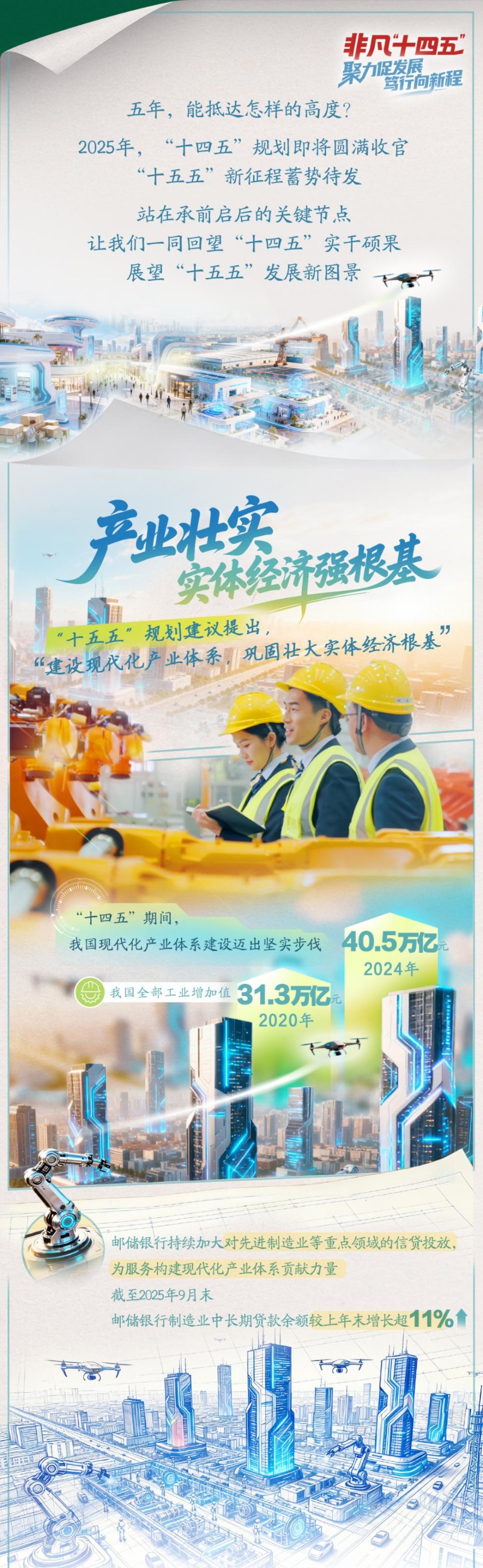
笃行向新程!在回望与展望中 奔赴“十五五”
2 1 Shi Ji Jing Ji Bao Dao· 2025-12-30 16:05
Group 1 - The "14th Five-Year Plan" has made significant progress in building a modern industrial system, with a focus on strengthening the real economy [2] - By the end of September 2025, the balance of medium- and long-term loans for the manufacturing sector from Postal Savings Bank has increased by over 11% compared to the previous year [2] - The comprehensive innovation capability of the country has steadily improved, ranking first in the national comprehensive innovation capability ranking by 2024 [3] Group 2 - The consumer market has seen both quantity and quality improvements during the "14th Five-Year Plan," with total retail sales of social consumer goods reaching 4,419.45 billion yuan by 2024 [4] - Postal Savings Bank continues to optimize financial supply to promote the upgrading of consumption [4] - The number of registered business entities in the country has been increasing, reflecting the vitality of business entities during the "14th Five-Year Plan" [5] Group 3 - The development of high-quality private and small and micro enterprises has been supported, with the balance of inclusive small and micro enterprise loans reaching 801.247 billion yuan by September 2025 [6] - Agricultural modernization has progressed steadily, with the comprehensive mechanization rate of crop farming reaching 41.3% by 2025 [7] - Postal Savings Bank has deepened its involvement in the agricultural sector, with the balance of agricultural loans reaching 1.41 trillion yuan by 2020 [7] Group 4 - The quality of life for citizens has improved significantly, with per capita disposable income reaching 6.74 billion yuan by 2024 [8] - Postal Savings Bank has extended its services to enhance the quality of financial services for the betterment of people's lives [8]

上海市十六届人大常委会第二十六次会议举行
Xin Lang Cai Jing· 2025-12-30 15:02
Group 1 - The core message emphasizes the commitment to high-quality development and the completion of economic and social development goals for the year [1][3] - The government plans to focus on expanding domestic demand as a strategic foundation for economic growth, aiming for qualitative improvements and reasonable quantitative growth [1] - There will be increased efforts to boost consumption through special actions and to expand the supply of quality goods and services [1] Group 2 - The government aims to stabilize foreign trade by optimizing market and product structures and enhancing trade hub functions [1] - There is a commitment to improving the business environment to stimulate the vitality of various business entities, with plans for a new version of the business environment optimization action plan [1] - The construction of a modern infrastructure system is prioritized, focusing on safety, resilience, and urban renewal initiatives [2] Group 3 - The government is dedicated to fostering new productive forces and deepening high-level reform and opening up [3] - The completion of the 14th Five-Year Plan is highlighted, with a focus on achieving stable and healthy economic development and modernizing urban governance [3] - Preparations for the upcoming municipal people's congress are emphasized to ensure high-quality discussions on government reports and the 15th Five-Year Plan [3]
2025年全国台协会长座谈会在北京举行 台商:大陆是最好市场最佳选择
Zhong Guo Xin Wen Wang· 2025-12-30 13:37
中共中央台办、国务院台办主任宋涛出席座谈会,听取台商意见建议,向广大台商台胞致以新年祝福。 他表示,"十五五"规划开启中国式现代化新征程,必将为推动两岸经济合作、融合发展注入新动力,为 广大台商台企深耕大陆发展开创新前景。希望台商台胞坚持一个中国原则和"九二共识",反对"台独"分 裂和外来干涉,把握两岸融合发展新机遇,开创两岸交流合作新局面,展现守护共同家园新担当。 与会台商表示,今年以来大陆各地出台一系列措施,帮助台企有效应对外部环境不利影响,保持了大陆 台资经济健康发展。"十五五"规划为台商台企深度融入国家发展大局、共享发展红利指明了清晰路径、 开辟了广阔天地。台商代表表示,祖国大陆始终是台商台胞的坚定依靠,仍然是台商投资兴业的最佳选 择。 2025年全国台协会长座谈会在北京举行 台商:大陆是最好市场最佳选择 12月30日,2025年全国台协会长座谈会在北京举行。全国台湾同胞投资企业联谊会主要会务干部、各地 台资企业协会会长、台商台胞代表约200人参加。 编辑:张嘉怡 广告等商务合作,请点击这里 本文为转载内容,授权事宜请联系原著作权人 中新经纬版权所有,未经书面授权,任何单位及个人不得转载、摘编或以其它 ...
2026:26个关键词里的未来(三)
Di Yi Cai Jing· 2025-12-30 13:14
Group 1: State-Owned Enterprise Reform - The central economic work conference emphasized the need to deepen state-owned enterprise (SOE) reform, focusing on optimizing the layout of state-owned economy, improving modern enterprise systems, and enhancing state asset supervision efficiency [1][2] - Key areas of reform include functional, structural, and institutional reforms, with a focus on better utilizing market forces to fulfill national strategic missions and improving the evaluation system for SOEs [2][3] Group 2: Urban and Rural Resident Income Increase Plan - The central economic work conference proposed a new income increase plan for urban and rural residents, transitioning from a focus on low-income groups to a broader approach covering all residents [3][4] - The plan aims to enhance consumer spending and stabilize the middle-income group while addressing income disparities and illegal income [3][4] Group 3: Investment Stabilization - The conference highlighted the need to stabilize investment, suggesting an increase in central budget investment and optimizing the use of local government special bonds [6][7] - Investment growth has been declining due to various factors, including real estate market adjustments and competition, with fixed asset investment down by 2.6% year-on-year [6][7] Group 4: Education Resource Allocation - The "14th Five-Year Plan" suggests improving education resource allocation in response to demographic changes, particularly by expanding ordinary high school enrollment to address the shortage of high school places [8][9] - The number of ordinary high school enrollments is set to exceed 10 million in 2024, with a recorded admission rate of over 60% [8][9] Group 5: Long-Term Care Insurance Implementation - Long-term care insurance (LTCI) is set to be implemented nationwide in 2026 after a decade of trials, aiming to cover nearly 3 billion people and provide equal protection for all disabled individuals [16][17] - The LTCI is expected to inject significant funds into the market, potentially exceeding 100 billion annually, thus stimulating the long-term care service industry [17] Group 6: Birth Policy Optimization - The central economic work conference stressed the need for a comprehensive optimization of birth policies to stabilize the declining birth rate, with a focus on financial support and service system improvements [18][19] - New measures include expanding maternity insurance coverage to flexible workers and enhancing public services for early childhood care [19][20]
2026:26个关键词里的未来(二)
Di Yi Cai Jing· 2025-12-30 13:14
Group 1: Domestic Chip Replacement - The rise of domestic AI chip manufacturers is marked by significant stock price increases, with companies like Cambrian Technology surpassing major brands like Kweichow Moutai [1] - The market anticipates more AI chip companies to go public, with notable performances from companies like Moer Thread and Muxi, indicating strong investor interest in domestic chip alternatives [1] - The domestic market share for smart computing chips is projected to grow from approximately 20% in 2024 to about 60% by 2029, reflecting a shift towards local production [2] Group 2: AI Edge Computing - The emergence of AI in hardware is expected to redefine traditional devices, with predictions that mobile phones and apps may become obsolete in favor of AI-driven edge devices [3] - The global edge AI market is forecasted to grow from 321.9 billion yuan to 1.22 trillion yuan between 2025 and 2029, with a compound annual growth rate of 40% [4] - The focus of competition is shifting from hardware specifications to AI experience and ecosystem collaboration, indicating a transformation in the value chain [5] Group 3: Quantum Computing Advances - Quantum technology is recognized as a strategic frontier for technological revolution, with significant breakthroughs expected in the coming years [6] - China's advancements in quantum communication and computing are positioning it alongside global leaders, with the "Zu Chongzhi No. 3" quantum computer expected to maintain a competitive edge [7] - The practical application of quantum computing in fields like finance and protein simulation is anticipated to grow, marking a critical step towards commercialization [6] Group 4: Commercial Space Acceleration - The commercial space sector is entering a new phase of rapid evolution, supported by government policies and increased capital investment [8] - The global commercial space market is projected to grow at a compound annual growth rate of 10.5% over the next five years [8] - The demand for satellite launches is expected to surge, with significant increases in the number of satellites being deployed [9] Group 5: Solid-State Battery Development - Solid-state batteries are gaining attention as a transformative technology for electric vehicles, with major manufacturers announcing plans for testing and production [10] - The timeline for mass production is set for 2027, with initial production expected to be in small batches [11] - The industry faces challenges in cost and manufacturing processes, with a consensus that semi-solid batteries will precede full solid-state solutions [10] Group 6: L3 Autonomous Driving - The introduction of L3 autonomous driving is accelerating due to supportive policies and decreasing costs in the supply chain [12] - The commercial application of L3 technology is expected to expand significantly in 2026, with several manufacturers already in the approval process [13] - The transition from assisted to fully automated driving represents a critical milestone for the industry, with ongoing improvements in technology and data accumulation [13] Group 7: Real Estate Debt Restructuring - Major real estate companies like Country Garden and Sunac have successfully completed debt restructuring, indicating a shift in the industry’s approach to financial challenges [14] - The total scale of debt restructuring in 2025 reached approximately 1.2 trillion yuan, significantly alleviating short-term repayment pressures for affected companies [14] - The focus for 2026 will be on balancing risk management and transformation within the real estate sector, with expectations for continued progress in debt resolution [15] Group 8: "15th Five-Year Plan" Initiatives - The "15th Five-Year Plan" emphasizes high-quality development and technological self-reliance as key objectives for the next five years [16] - The plan outlines initiatives to enhance the modern industrial system and promote strategic emerging industries, including quantum technology and renewable energy [17] - Increasing the resident consumption rate is highlighted as a crucial goal, with measures aimed at boosting consumer spending and improving living standards [18]
联合国专家点赞“十五五”规划:AI工厂凸显中国制造业优势丨世界观
Zhong Guo Xin Wen Wang· 2025-12-30 12:38
2026年是"十五五"规划开局之年,联合国国际电信联盟医疗元宇宙任务组主席罗宾·罗韦(Robin Rowe)在 接受中国新闻网采访时表示,中国"十五五"规划强调从农场、工厂到城市终端各环节高效协同,人工智 能被嵌入实体经济体系。 在未来发展上,罗宾·罗韦表示,中美两国劳动力与能源因素进一步放大差异。中国加快部署高度智能 化、自动化的现代工厂,即使无人操作,工厂也能24小时不间断生产;而美国仍试图以传统制造岗位吸 纳劳动力。(巩微微) 罗宾·罗韦认为,美国的人工智能行动计划聚焦于建设价值5000亿美元的云数据中心,依赖更新周期极 短的高端芯片,成本高昂且能耗巨大。 ...