
避险资产

Search documents
泰会投 | 黄金价格创新高解读
Sou Hu Cai Jing· 2025-10-21 08:51
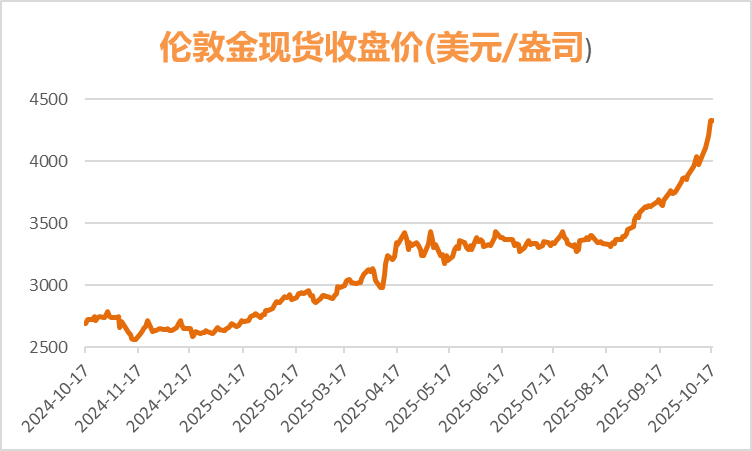
点击泰康幸福说关注 从避险资产到投资新宠 解读黄金价格再创历史新高 近期正在给未来儿媳准备婚礼"三金"的泰女士发现,看中的首饰频频因为金价跳涨而被迫追加预算,不禁生出"晚一天下单要多付好 多钱"的感慨。 其后是黄金价格的一路势如破竹——伦敦金现货价格自10月中旬以来 快速突破每盎司4000、4100、4200美元的关口,屡创历史新 高。 黄金市场参与者结构复杂 需求行为共同影响金价走势 黄金市场的参与者既有珠宝首饰、工业生产或科技用金等不同领域,也有央行购金、金融投资、个人黄金实物消费及投资等多种用 途,参与者结构复杂,其需求和行为共同决定了黄金价格的走势。 从规模体量来看,各国中央银行或官方投资机构是"定海神针",近年来扮演着最大的净买家和持有者角色。尤其在当前全球货币信用 失衡和地缘政治风险加剧的背景下,黄金重新确立了其作为全球资金"底盘资产"的地位。 从投资价值来看,包括对冲基金、养老金、保险公司、银行、ETF基金在内的专业机构投资者,是黄金市场中最活跃、交易量最大的 群体。 通过预测金价波动进行交易赚取价差,或在预期通货膨胀上升时买入黄金保全购买力,或在经济衰退或金融动荡时投资黄金寻求避 险,都是机构 ...

帮主郑重解读:贸易降温、政府将开门,黄金为啥还能创纪录新高?
Sou Hu Cai Jing· 2025-10-21 08:41
Core Viewpoint - Despite easing trade tensions and positive developments regarding the U.S. government shutdown, gold prices have surged to a historical high of $4,381.52, indicating strong demand for the precious metal driven by a persistent need for safety among investors [1][3]. Group 1: Market Dynamics - The recent rise in gold prices is attributed to a strong "buying power" in the market, where traders quickly stepped in to purchase gold after a slight dip, reflecting a mindset of seizing opportunities [3]. - The current market is predominantly composed of buyers, suggesting that any minor price corrections are met with renewed demand, indicating that investors are maintaining their "core holding" mentality [3]. Group 2: Investor Sentiment - The underlying logic of the market behavior shows that, despite favorable news, there remains a deep-seated desire for safety among investors, as evidenced by the stability of gold prices above $4,360 and the concurrent rise in silver and platinum [3]. - Future monitoring of gold demand will be essential, particularly in response to developments in trade negotiations and government actions, as these factors could influence long-term investment strategies [3].

黄金年内46次新高,有银行对无持仓客户解约
21世纪经济报道· 2025-10-21 07:36
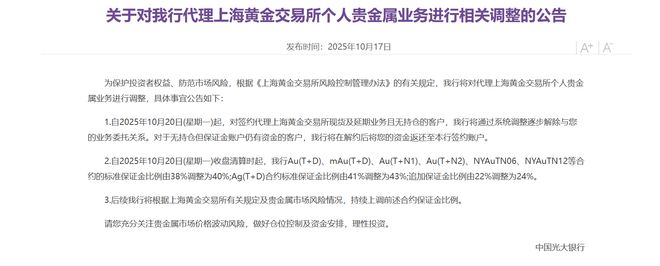
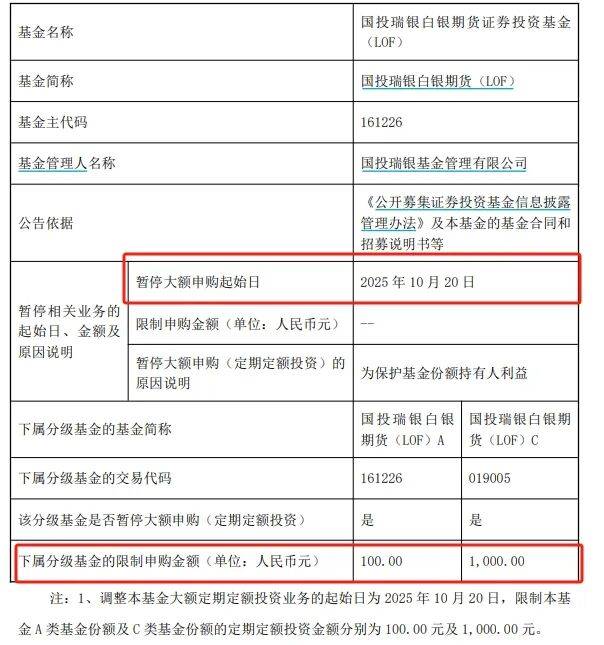
Core Viewpoint - The article discusses the significant rise in gold prices, which have reached historical highs, and the subsequent actions taken by financial institutions to manage risks associated with gold trading [1][6]. Group 1: Gold Price Surge - Gold prices have reached a peak of $4,394 per ounce as of October 21, with a year-to-date increase of over 65% [1]. - The surge in gold prices has led to a shift in market sentiment, with bearish voices diminishing significantly [6]. Group 2: Institutional Responses - Everbright Bank announced adjustments to its business relationships with clients trading gold, aiming to protect investors from high-leverage gold derivatives [2][4]. - Other banks, including Industrial Bank, China Merchants Bank, and China Construction Bank, have also issued warnings about market risks in precious metals trading [6]. Group 3: Margin Adjustments - The Shanghai Gold Exchange has raised margin requirements for various gold contracts, with standard margin ratios for certain contracts increasing from 38% to 40% and for silver contracts from 41% to 43% [6]. Group 4: Market Dynamics - UBS strategist Sagar Khandelwal noted that political and trade uncertainties are driving gold prices higher, with predictions that prices could reach $4,700 per ounce by Q1 next year [7]. - Deutsche Bank analysts reported a significant increase in gold's share of global foreign exchange and gold reserves, rising from 24% in June to 30% [7]. Group 5: Fund Management Adjustments - Fund companies are limiting subscription amounts due to overwhelming demand, with specific funds capping daily investments to 10,000 yuan [9]. - The adjustments reflect a trend of increasing restrictions on large subscriptions, indicating a response to the rapid influx of capital into gold-related investments [9]. Group 6: Investor Sentiment - A recent survey indicated that 43% of fund managers view "going long on gold" as the most crowded trade, surpassing the interest in major U.S. tech stocks [10]. - Despite the perception of gold being overvalued, the average allocation to gold among global investors remains low at 2.4% [10].


黄金年内46次创新高 机构持续收紧贵金融交易业务
2 1 Shi Ji Jing Ji Bao Dao· 2025-10-21 06:56
Core Viewpoint - The gold market has experienced significant volatility, with gold prices reaching historical highs and prompting banks to adjust their trading policies to protect investors [1][3][4]. Group 1: Gold Price Movement - Gold has reached a record high of $4,381.11 per ounce as of October 21, with a year-to-date increase of over 65% [1]. - The surge in gold prices is attributed to rising political and trade uncertainties, declining real interest rates, a weakening dollar, and increasing government debt [4]. Group 2: Institutional Responses - Everbright Bank has announced adjustments to its trading relationships and margin requirements for clients without positions in gold trading, effective October 20 [1]. - Other banks, including Industrial Bank and China Merchants Bank, have also issued warnings regarding the increased market risks associated with precious metals [3]. Group 3: Margin Adjustments - The Shanghai Gold Exchange has raised margin requirements for various gold contracts, with standard margin ratios increasing from 38% to 40% for certain contracts [3][4]. - Additional margin requirements have also been adjusted for silver contracts, reflecting the heightened market volatility [3]. Group 4: Fund Management Adjustments - Fund companies are limiting subscription amounts due to increased inflows, with specific funds capping single-day subscriptions to 10,000 yuan [6]. - This marks the third adjustment in subscription limits for certain funds since September, indicating a trend of tightening access to gold-related investments [6]. Group 5: Investor Sentiment - As of October 20, the scale of gold-themed ETFs has surpassed 200 billion yuan, with five ETFs exceeding 10 billion yuan in size [7]. - A recent survey indicated that 43% of fund managers view "going long on gold" as the most crowded trade, surpassing the interest in major U.S. tech stocks [7].
多个市场,突然跳水!发生了什么?
券商中国· 2025-10-21 06:41
Market Overview - The cryptocurrency market experienced a significant downturn, with Bitcoin dropping by $3,000 to $107,500, and Ethereum falling over 5% to below $3,900. Other cryptocurrencies like BNB, Solana, and Cardano also saw declines [1][3] - In the past 24 hours, the total liquidation in the cryptocurrency market exceeded $401 million, affecting over 122,000 traders, with 60% of liquidations being long positions [3][4] Analyst Predictions - Jon Glover, an analyst known for his Elliott Wave Theory predictions, warned that Bitcoin may enter a bear market, potentially dropping to $70,000 or lower, indicating a possible decline of over 35% from current levels [1][7] - Glover stated that the recent peak of Bitcoin at $126,000 has likely marked the end of the bull market, predicting that the bear market could last until at least the end of 2026 [7][8] Market Sentiment - Investors are shifting towards safer assets like gold amid global trade tensions, leading to a significant increase in gold prices. This trend is causing a decline in the appeal of volatile assets like Bitcoin [5] - Analysts suggest that Bitcoin is not a reliable safe-haven asset, as its price movements resemble those of tech stocks, which tend to decline during negative market sentiment [5] Regulatory Developments - Japan's Financial Services Agency is considering allowing banks to hold and trade cryptocurrencies, which marks a significant shift from its previous conservative stance. This could lead to increased adoption of cryptocurrencies in Japan, where the number of crypto accounts has grown 3.5 times in the past five years [9][10]

DLS外汇:黄金飙升后,市场等待美联储的降息抉择
Sou Hu Cai Jing· 2025-10-21 03:55
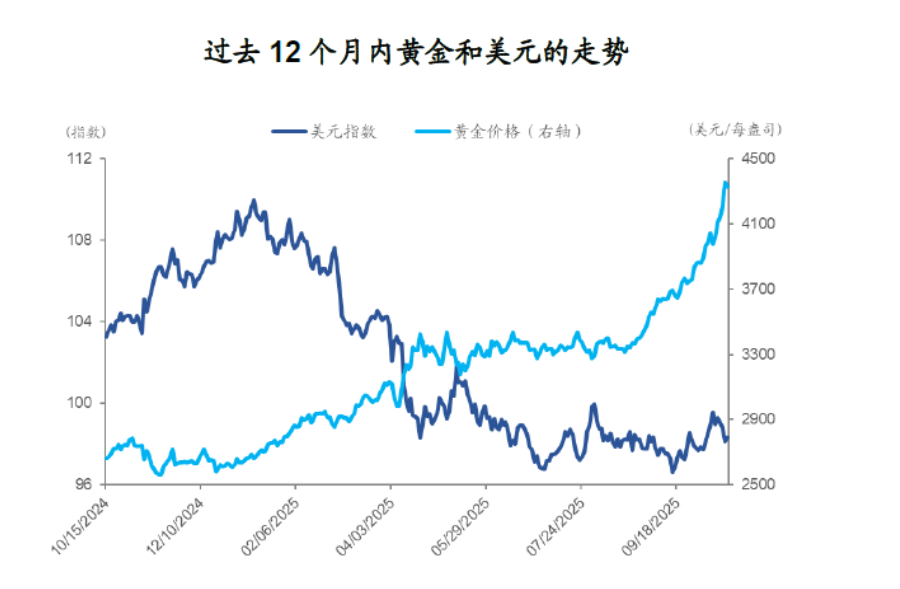
Group 1 - Gold prices have notably risen over the past year, surpassing $4,300 per ounce, while the US dollar has shown persistent weakness [1] - The stability in the US Treasury market contrasts with the rising gold prices, indicating a market concern regarding the long-term value of the dollar [1] - The differing performances of gold and US Treasuries point to a central question regarding the Federal Reserve's future policy direction, whether to prioritize rate cuts to prevent economic recession or to tighten policies to address potential inflation [1] Group 2 - The factors driving the strength of gold include concerns over the US potentially monetizing its high debt, global trade tensions, and geopolitical uncertainties, which have heightened risk aversion [1] - The US dollar index has declined approximately 10% from its peak at the beginning of the year, with the market now focused on whether the dollar will rebound or maintain its weakness [4] - The contrasting movements of gold and US Treasuries reflect the market's differing judgments on long-term risks versus short-term realities, with investor divergence centered on which economic signals will ultimately influence Federal Reserve decisions [4]
谁在爆买黄金?CME数据揭秘:散户正以史上最快速度冲进场
Jin Shi Shu Ju· 2025-10-21 03:40
央行需求自2022年末以来一直是黄金上涨的关键推动力,但最新交易数据显示,投资需求如今已成为这 种贵金属的新动能引擎。 "随着市场参与者努力应对持续的经济不确定性,对避险资产的需求正在激增,"芝商所集团董事总经理 兼全球金属业务主管金·亨尼希(Jin Hennig)表示。 "全球客户继续通过我们的黄金期货和期权来对冲风险,并在这复杂环境中寻找机会,大型机构和零售 交易商共同推动了我们金属产品系列的纪录级交易活动。" 世界黄金协会数据显示,全球黄金支持交易所交易基金上周流入59.2吨黄金——这是自2020年3月以来 最大的单周增幅。 道富投资管理公司黄金策略主管阿卡什·多希(Aakash Doshi)近期接受Kitco新闻采访时指出,即便面 对创纪录需求,黄金仍是配置不足的资产。道富旗下运营着全球最大的黄金支持ETF——SPDR Gold Shares(GLD)。 "1月份GLD仍呈现资金外流。因此从这个角度看,尽管出现增长,黄金仍非超配资产。" 周一,芝加哥商品交易所集团(CME Group)宣布其金属合约总成交量于上周五达到创纪录的282.9666 万份合约,这一数字突破了两周前刚创下的214.899万份合 ...

黄金连涨9周后高台跳水,黄金一夜暴跌192美元!九周连涨神话终结?多空决战4150生命线,有人变现20万,有人两天血亏!
Sou Hu Cai Jing· 2025-10-20 23:45
10月17日,国际金价以一场猝不及防的暴跌打破了市场的宁静。前一秒,现货黄金刚刚触及4379.52美 元/盎司的历史峰值,下一秒便如断线风筝般急坠192美元,最低探至4186美元,单日跌幅达1.78%。这 场"高台跳水"迅速蔓延至国内市场:10月20日开盘,沪金主力合约从千元关口直线回落,盘中最低触及 960元/克,最终收报970元,日内跌幅1.63%。一根长阴线,不仅终结了黄金自8月以来的九周连涨神 话,更让无数追高者瞬间从狂欢跌入恐慌。 一、 暴跌24小时:谁掀翻了黄金的盛宴? 周五夜盘,交易员的屏幕被一片血色浸染。"当时金价像被抽走了地板,止损单层层爆仓,连反应时间 都没有。"一位外资期货交易员描述道。这场暴跌的导火索看似偶然:芝加哥商品交易所与上海期货交 易所接连上调白银、黄金的保证金要求,部分多头被迫平仓;白银遭抛售的跌势迅速传导至黄金,形成 连环踩踏。但更深层的原因,是市场情绪的微妙转向。 特朗普在周五专访中突然释放关税缓和信号,承认"高关税威胁中国的策略不可持续"。与此同时,美国 地区银行财报显示贷款拨备低于预期,缓解了市场对金融风险的忧虑。风险偏好回升,资金迅速从避险 资产撤离。然而,这仅是表 ...
太火爆!涨幅已超黄金,突发公告:限购升级
Sou Hu Cai Jing· 2025-10-20 18:48
Core Insights - Precious metal prices, particularly silver, have seen significant increases, with silver prices recently surpassing historical highs [1][3] - The domestic investment market is experiencing a surge, leading fund managers to implement purchase limits to maintain stable operations [1] - The liquidity crisis in the London silver market is a key driver behind the rising silver prices [3][7] Group 1: Market Dynamics - The international spot silver price has outperformed gold this year, with a notable increase of over 50 USD per ounce [2][3] - The London silver market is facing severe liquidity constraints, exacerbated by reduced inventories and increased industrial demand [3][5] - Since mid-2021, London silver inventories have decreased by approximately one-third, with available stocks dropping from around 850 million ounces in 2019 to about 200 million ounces [7] Group 2: Demand Factors - Industrial demand for silver is projected to be the largest source of demand this year, estimated at 430 million ounces, with solar energy applications accounting for approximately 299 million ounces [9] - The current geopolitical climate and economic uncertainties have heightened investor interest in precious metals as safe-haven assets [9] - Analysts suggest that silver is in a "catch-up rally" with significant potential for further price increases [9] Group 3: Future Outlook - Goldman Sachs indicates that the current liquidity tightening in the silver market is a temporary phenomenon, with expectations of silver returning from the U.S. and other regions back to London [9] - The volatility and potential downside risks for silver prices are anticipated to be greater than those for gold, due to the lack of central bank support for silver [9]
金价波动,“上车即站岗”?投资者心态分化
Di Yi Cai Jing· 2025-10-20 14:30
Core Viewpoint - After a nine-week rally, gold prices experienced a significant drop, with international market prices falling by $152 per ounce, leading to a decline in domestic gold prices as well [1][2] Market Dynamics - The recent decline in gold prices is attributed to easing trade tensions and a recovery in global risk appetite, prompting investors to withdraw from safe-haven assets like gold and silver [2] - The adjustment in margin requirements for silver and gold futures by exchanges has forced some long positions to reduce their holdings, contributing to the price drop [2][3] Investor Sentiment - There is a divide in investor sentiment, with some taking profits after the recent surge while others view the price drop as an opportunity to buy [5][6] - Long-term investors continue to accumulate gold, as evidenced by increased holdings in ETFs, despite short-term volatility [8] Supply and Demand Factors - Recent data shows a tightening of gold and silver inventories, with significant outflows from COMEX silver and increases in SPDR gold ETF holdings [8] - The World Gold Council noted that central banks have shown a tendency to buy on dips, indicating ongoing support for gold prices despite short-term fluctuations [8] Risk Management - Exchanges and banks have issued warnings regarding market volatility, advising investors to manage their positions carefully amid the current uncertainty [9][10]