
中资出海

Search documents
分论坛:国别研究|国泰海通“远望又新峰”2026春季策略会
国泰海通证券研究· 2026-03-12 00:00
Core Viewpoint - The article discusses the challenges and opportunities in the context of major power competition and the restructuring of global supply chains, emphasizing the need for cooperation and institutional consensus to address failures in global governance [3]. Group 1: Conference Highlights - The conference titled "2026 Spring Strategy Meeting" focuses on the geopolitical and economic dynamics in key regions such as Europe, Latin America, the Middle East, and Asia-Africa, exploring new changes and strategies for Chinese investments abroad [3][4]. - The event features prominent scholars and industry experts who will discuss topics including the transformation of U.S. foreign policy, the geopolitical landscape in Europe, and the development of Latin America under new Monroe Doctrine influences [3][4]. Group 2: Agenda Overview - The agenda includes opening remarks by the Vice President of the Research and Institutional Business Committee, followed by sessions on U.S.-China relations, European geopolitical issues, and security dilemmas in the Middle East [3][4]. - A roundtable forum will address the themes of Chinese investments abroad and country-specific investment strategies, featuring executives from various sectors [4].



中金 • 全球研究 | 中资出海东南亚二十载:从走出去,到融进去
中金点睛· 2026-03-06 00:00
Core Viewpoint - The report outlines the evolution of Chinese investment in Southeast Asia over the past two decades, transitioning from a focus on commodity trade to a comprehensive integration of investment, localized operations, and deep capital market connections, driven by the China-ASEAN Free Trade Agreement (CAFTA) and the dual engines of industrial and financial capital [2][8]. Trade Dimension - The evolution of the China-ASEAN Free Trade Agreement (CAFTA) is central to the deepening economic relationship, with three phases: 1. From 2002 to 2015, achieving 90% zero tariffs on goods trade, leading to significant trade volume growth from $54.8 billion in 2002 to $467.1 billion in 2015 [12][13]. 2. From 2015 to 2022, focusing on service trade liberalization and regulatory alignment, facilitating industrial chain investments [13]. 3. From 2022 to 2025, negotiating rules for digital and green economies, marking a shift from "goods flow" to "institutional and innovative collaboration" [2][14]. Industrial Investment Dimension - In 2024, China's total outward direct investment (ODI) reached $192.2 billion, with a net outflow of approximately $76 billion, indicating a historic shift from being a capital-importing to a capital-exporting country [3][19]. - ASEAN emerged as the largest single region for Chinese ODI, totaling $34.4 billion, accounting for about 37% of China's global ODI [3][22]. Corporate Layout Dimension - By 2024, overseas revenue of A-share listed companies exceeded 11 trillion yuan, representing over 15% of total revenue, with a compound annual growth rate (CAGR) of 14% from 2014 to 2024, significantly outpacing domestic revenue growth of 8% [5][34]. - Key industries contributing to overseas revenue include information technology, consumer discretionary, and industrial sectors, which together account for over 90% of total overseas revenue [5][35]. Capital Linkage Dimension - By the end of 2025, the total scale of QDII funds is expected to approach 1 trillion yuan (over $170 billion), with a significant concentration of market share among the top fund managers [6][49]. - QDII funds have increasingly focused on Hong Kong and U.S. markets, with emerging markets and Southeast Asia seeing continuous product innovation [6][55].

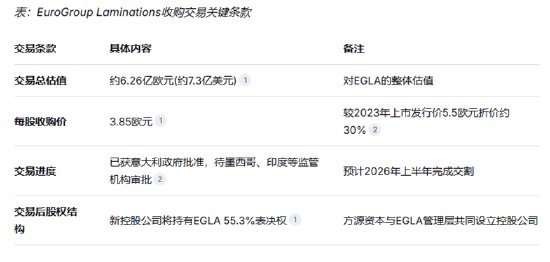
方源资本6亿欧元收购“定转子之王” 中资出海瞄准欧洲电动化核心
Xin Lang Cai Jing· 2026-02-06 09:55
Core Viewpoint - The Italian government approved the acquisition of EuroGroup Laminations (EGLA) by Chinese private equity firm FountainVest Partners under the "golden power" rules, valuing EGLA at approximately €626 million (about $730 million), with the transaction expected to close in the first half of 2026, leading to EGLA's delisting from the Milan Stock Exchange [1][13]. Transaction Structure - FountainVest reached a final agreement to acquire a controlling stake in EGLA in mid-2025, with a complex structure involving the purchase of 45.7% of shares from major shareholder EMS Euro Management Services at €3.85 per share, which is about 30% lower than the 2023 IPO price of €5.5 [2][4][16]. - EMS will reinvest 50% of the proceeds into a new holding company established with FountainVest, while FountainVest will also acquire a 7.9% stake from Tikehau Capital, resulting in the new holding company controlling 55.3% of EGLA's voting equity [2][4][16]. Strategic Intent - The acquisition reflects a significant shift in the path of Chinese capital overseas and a strategic adjustment in the global electric vehicle supply chain, with FountainVest focusing on deep industry integration rather than purely financial investments [5][17]. - FountainVest, established in 2008, has a global presence with offices in major cities and aims to enhance its industrial layout in Europe through this acquisition [5][17]. Company Overview - EGLA, founded in 1967, has evolved into a leading supplier of stators and rotors for electric vehicles and machinery, with a significant presence in the electric vehicle market [6][17]. - The company had a revenue of €429.2 million in the first half of 2025, with a 1.6% year-on-year growth, and a net debt of €264 million, indicating a leverage ratio of 2.4 times [7][18]. Industry Synergy - The strategic partnership between FountainVest and EGLA is expected to leverage FountainVest's industry experience and connections in Asia, particularly in the Chinese electric vehicle market, to accelerate EGLA's growth in Asia [8][20]. - EGLA's collaboration with Chinese companies, such as the partnership with Huakin Rubber, highlights its commitment to expanding in the electric vehicle sector [8][20]. Market Outlook - The global electric vehicle market is undergoing structural adjustments, with short-term growth slowing but long-term electrification trends remaining intact, making companies with core component technologies more competitive [10][21]. - The acquisition is part of FountainVest's ongoing investment strategy, which includes other significant deals in the technology and consumer sectors [10][21]. Market Reaction - Following the announcement of the acquisition, EGLA's stock price surged by 8.7% on the day of the news, closing up 3.5%, indicating positive market sentiment towards the transaction [22].
对话泰中罗勇工业园总裁赵斌:中资出海泰国现在是天高海阔
2 1 Shi Ji Jing Ji Bao Dao· 2026-01-09 07:45
Core Insights - The article highlights the increasing interest of Chinese enterprises in Thailand, particularly in the Rayong Industrial Park, which has become a hub for nearly 300 Chinese companies across various sectors [1][2]. Group 1: Investment Opportunities - The Rayong Industrial Park offers permanent land ownership for industrial use, which is a significant investment opportunity for companies looking to establish a presence in Thailand [1]. - The park's strategic location, being only 100 kilometers from Bangkok and close to major transportation hubs, enhances its attractiveness for Chinese businesses [2]. - In 2022, the park attracted 180 Chinese manufacturing companies and over 30 supporting enterprises, indicating a growing trend of Chinese investment in the region [2]. Group 2: Competitive Advantages - Thailand's favorable trade agreements result in relatively low export tariffs, making it an appealing destination for Chinese manufacturers [3]. - The strong bilateral relationship between China and Thailand, marked by the "China-Thailand family" concept, provides a stable environment for Chinese enterprises [4]. - Thailand's leading business environment in the ASEAN region, including financial services and infrastructure, further enhances its competitiveness compared to neighboring countries [4]. Group 3: Trends in Chinese Enterprises - Recent years have seen a shift in the types of Chinese companies entering the park, with a growing focus on emerging industries such as renewable energy, smart home technology, and semiconductors [6]. - There is a trend towards collective investment, with companies forming clusters to enhance their competitive edge in international markets [8]. - The evolution of Chinese enterprises in Thailand reflects a transition from merely establishing manufacturing bases to developing comprehensive operational systems, including R&D and supply chain management [7][9]. Group 4: Future Prospects - The Rayong Industrial Park plans to expand from 20 square kilometers to 30 square kilometers, aiming to attract 500 to 1,000 companies in the future, indicating confidence in the ongoing wave of Chinese investment [12][13]. - The upcoming 50th anniversary of diplomatic relations between China and Thailand is expected to further enhance cooperation and open new opportunities for Chinese enterprises [12].
11月6日论坛议程|启航新征程·国泰海通2026年度策略会
国泰海通证券研究· 2025-11-05 23:06
Core Insights - The article discusses the rise of "emotional consumption" and its implications for various sectors, highlighting the ongoing trends in consumer behavior and market dynamics [1][3]. Group 1: Consumer Trends - The retail and service sectors are expected to experience high growth due to sustained consumer demand and the emergence of new consumption patterns [3]. - The aviation industry is anticipated to benefit from a demographic dividend, leading to a potential super cycle in demand [3]. - The express delivery sector is witnessing rapid growth in volume, indicating a recovery in profitability as competition stabilizes [3]. - The pet industry is capitalizing on the emotional value associated with pets, particularly among the younger generation [3]. Group 2: REITs and Investment Strategies - The article outlines the annual strategy for REITs, emphasizing the outlook for the Chinese REITs market and the rise of private REITs [4]. - A roundtable discussion is planned to explore the future of the secondary market for REITs, involving various industry experts [4]. - The article also covers asset allocation strategies for 2026, including insights on gold and equity investments [4]. Group 3: Macroeconomic Perspectives - The article features discussions on macroeconomic changes and their impact on long-term asset allocation strategies [10]. - Insights into the geopolitical landscape and its implications for investment strategies are provided, particularly regarding China’s outbound investments [14]. - The article highlights the challenges and opportunities for Chinese enterprises in international markets, especially in the context of changing global dynamics [14].

分论坛:大国博弈与中资出海|国泰海通证券2026年度策略会
国泰海通证券研究· 2025-10-29 06:09
Core Insights - The article discusses the establishment of a new order in global geopolitics and the challenges and opportunities faced by Chinese enterprises going abroad amidst a multi-polar world [1] Agenda Summary - The conference is hosted by Chen Ximiao, head of the National Research Institute of Policy and Industry at Guotai Junan Securities, featuring several experts discussing various topics related to international relations and economic conditions [2] - Key topics include the changing geopolitical landscape and the trajectory of China-U.S. relations, the current economic situation in Europe and its impact on China-Europe trade relations, challenges and new opportunities for Chinese enterprises in the Middle East, and cooperation between China and Africa under the strategic context of critical minerals [3]

东南亚见闻之越南:消费出海正当时
Haitong Securities International· 2025-06-25 01:32
Economic Growth - Vietnam's GDP growth rate averaged 7.2% from 1988 to 1999, significantly higher than the emerging markets average of 3.7%[8] - From 2000 to 2024, Vietnam's GDP growth rate is projected to average 6.4%, surpassing the emerging markets average of 5.2% and the global average of 3.5%[8] - By 2024, Vietnam's GDP is expected to account for over 0.4% of the global total, up from less than 0.05% in 1990[8] Foreign Investment and Trade - Foreign direct investment (FDI) in Vietnam surged from $4 million in 1989 to $18.5 billion in 2023, with FDI accounting for over 10% of fixed capital formation[12] - Vietnam's trade volume increased from under $3 billion before "Doi Moi" to nearly $800 billion by 2024, with a global trade share rising to 1.6%[12] Manufacturing Opportunities - The manufacturing sector constituted 23.9% of Vietnam's GDP in 2023, significantly above the global average of 15%[16] - Manufacturing investment accounted for 24.4% of total investment in 2023, leading all sectors[16] Consumer Market Potential - Vietnam's population is projected to exceed 100 million by 2024, with a median age of 34 years, indicating a youthful demographic[28] - Urbanization rate reached 39.5% in 2023, with plans to increase to 45% and 50% by 2025 and 2030, respectively[28] Consumer Preferences - OPPO leads the smartphone market with a 25% share, followed by Samsung at 22% and Apple at 20%[33] - In the home appliance sector, Samsung dominates the TV market with a 46% share, while LG holds 22%[33] Electric Two-Wheeler Market - Over 74 million two-wheelers were registered in Vietnam by 2023, making it the second-largest market in ASEAN after Indonesia[40] - The market share of electric motorcycles increased from 1.2% in 2017 to 10.4% in 2021, with projections suggesting it could reach 75% by 2035[40] Risks and Challenges - Rising labor costs in Vietnam, with average monthly wages increasing from $89 in 2007 to approximately $330 in 2023[19] - Increased competition due to a surge in manufacturing enterprises entering the Vietnamese market, leading to higher operational pressures[25]
银河证券每日晨报-20250616
Yin He Zheng Quan· 2025-06-16 02:54
Key Insights - The report emphasizes the transformative impact of artificial intelligence (AI) on China's economy, predicting an average increase of approximately 1.3% in total factor productivity (TFP) from 2025 to 2035 due to AI advancements, which could contribute an additional 14.8% to GDP by 2035 [1] - The report highlights the ongoing challenges in the real estate market, indicating that the adjustment period has entered its fourth year, with significant inventory issues persisting despite government efforts to stabilize the market [11][12] - The report discusses the need for a new supply-side reform that adapts to the current economic landscape, moving beyond traditional methods to address structural issues and promote high-quality development [7][8] Macro Insights - The report notes that the Producer Price Index (PPI) has experienced negative growth for 32 months, indicating a prolonged period of deflationary pressure that has not been seen since previous economic crises [2] - It suggests that the current economic environment necessitates a comprehensive approach to stimulate domestic demand, with a focus on balancing supply and demand to achieve sustainable growth [4][5] - The report outlines the importance of addressing the structural overcapacity and "involution" competition in various industries, advocating for a more market-oriented approach to capacity reduction [15][19] Real Estate Sector - The report identifies the critical need for inventory reduction in the real estate sector, emphasizing that the current high levels of unsold properties pose a significant challenge to market stabilization [12][13] - It discusses the government's "three red lines" policy aimed at curbing debt expansion in the real estate sector, which has led to a prolonged adjustment phase [11] - The report suggests that a more proactive government role is necessary to facilitate the clearing of excess inventory and stabilize the housing market [14] Industry Dynamics - The report highlights the competitive pressures in the automotive and renewable energy sectors, noting that many companies are engaged in "involution" competition, which undermines market stability and profitability [21][22] - It emphasizes the need for industries to innovate and adapt to avoid the pitfalls of excessive competition and to promote sustainable growth [24][25] - The report advocates for the establishment of a unified national market to enhance resource allocation and reduce local protectionism, which has historically led to inefficiencies [26][27]