供应链自主

Search documents
一块电池卡住印度的绿色雄心
Sou Hu Cai Jing· 2026-01-14 02:45
Core Insights - The recent halt in Reliance Industries' plans to produce lithium batteries in India highlights the challenges faced by even the most powerful companies in the clean energy supply chain due to technological limitations [1][5] - The situation underscores the broader difficulties in India's ambitious green energy goals, particularly in securing critical technology from countries like China [5][7] Company Overview - Reliance Industries is a significant player in India's business landscape, involved in various sectors including petrochemicals, telecommunications, retail, and renewable energy [3] - The company had planned to start battery production this year, relying on technology licensing from a Chinese firm, but negotiations fell through due to restrictions on technology transfer [3][5] Industry Challenges - The halt in battery production reflects the high concentration of core battery technology and industrial experience in a few countries, with China being at the center [5][8] - The transition to green energy requires not just financial investment but also a mature and stable industrial capability, which India currently lacks in the battery sector [5][7] Geopolitical Factors - The limitations on technology transfer are rooted in long-term institutional policies, complicating negotiations for Indian companies [7][8] - The disconnect between commercial logic and national policy can restrict corporate options, leading to delays in achieving green energy goals [7][8] Future Outlook - Despite the setback, Reliance's green ambitions remain intact, but the company will need to navigate complex diplomatic and industrial challenges to realize its plans [8] - The timeline for the battery factory's completion is critical, as delays could push back India's carbon neutrality targets [7][8]


十年来首次超越我国,美国重新投资非洲,意欲何为?
Sou Hu Cai Jing· 2025-11-21 06:48
Investment Overview - In 2023, the United States invested $7.8 billion in Africa, surpassing China's $4 billion investment, marking the first time since 2012 that the U.S. has outpaced China in African investments [1] - The shift in U.S. investment strategy towards Africa is largely driven by the need for rare earth elements, which are crucial for modern technology products [1][10] Strategic Implications - The U.S. International Development Finance Corporation, established in 2019, is leading the investment efforts in Africa, with a clear objective to counter China's influence in strategic regions [3] - Investments are focused on key minerals and metals, with companies like Trinity Metals in Rwanda receiving funding to develop rare earth mines, indicating a strategic pivot towards securing supply chains [4][5] Economic Considerations - African nations are advised to negotiate firmly with U.S. entities to protect their national interests, emphasizing the need for clear outcomes from these negotiations [7] - The establishment of joint ventures and local equity participation is suggested as a means for African countries to benefit from U.S. investments, potentially leading to the creation of sovereign wealth funds for development [7] Competitive Landscape - Despite the U.S. increasing its investments, China's long-standing presence in Africa, with cumulative investments of $40 billion, poses a significant challenge for the U.S. to catch up [8] - The lower extraction and compliance costs in Africa make it an attractive option for U.S. investments, but the U.S. still faces challenges in refining and processing these resources effectively [10] Future Outlook - The competition between the U.S. and China for mineral resources in Africa is expected to be prolonged, with the U.S. needing several years to establish a robust supply chain independent of China [10] - The European Union aims to reduce its reliance on China for rare earths by 50% by 2035, indicating a long-term strategic shift that will also impact U.S. supply chains [10]

看来,中国的稀土牌打得好!普京也下死命令:一个月内必须入局
Sou Hu Cai Jing· 2025-11-07 07:32
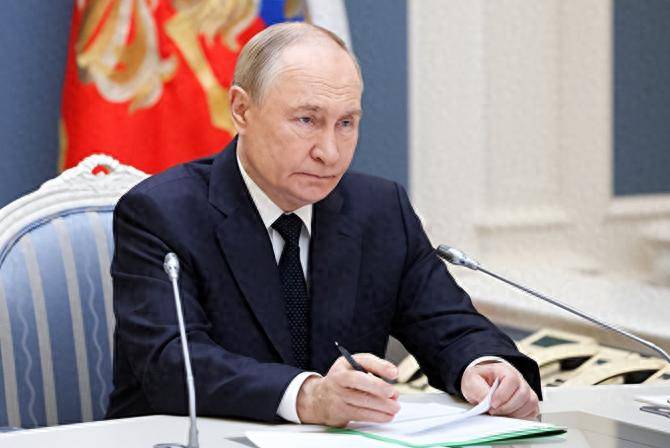
Core Viewpoint - The Russian government, under President Putin's directive, is prioritizing the development of a long-term roadmap for rare earth mining and production to achieve self-sufficiency and reduce dependence on the US and China [1][3]. Group 1: Strategic Objectives - The core goal of the plan is to establish a fully autonomous rare earth industry chain, reflecting Russia's increasing anxiety over strategic resource independence [1][3]. - Putin has emphasized that rare earths are a priority for enhancing economic competitiveness, indicating a heightened awareness of resource sovereignty [3][4]. - The plan aims to create a complete industry chain from mining to high-tech product manufacturing, showcasing Russia's ambition to reduce reliance on resource exports [6][11]. Group 2: Challenges and Risks - Russia faces significant challenges in developing an independent rare earth industry, including a technological gap, as China leads in rare earth extraction technology [8][10]. - Financial constraints are severe, with Western sanctions limiting funding options and high development costs for mining in Siberia and the Far East [10]. - The time window for establishing production capacity is narrowing, with global competition intensifying, potentially leading to a situation where Russia has resources but lacks market access [10][11]. Group 3: Potential Opportunities - If successful, the initiative could provide Russia with economic resilience against Western sanctions, leverage in negotiations with the US and Europe, and stimulate economic development in the Far East [11]. - There is a possibility for limited cooperation with China, despite the emphasis on self-sufficiency, indicating a nuanced approach to international collaboration [10].
凯德石英:公司12英寸半导体石英制品订单将会逐步放量
Xin Jing Bao· 2025-09-07 14:32
Core Viewpoint - The company Kaide Quartz is experiencing growth in its semiconductor quartz product orders, driven by increased demand from downstream customers, particularly for 12-inch semiconductor quartz products [1] Group 1: Company Overview - Kaide Quartz, established over 20 years ago, became the first company listed on the Beijing Stock Exchange in the semiconductor quartz product sector on March 4, 2022 [1] - The company's highest revenue segment is its semiconductor business, which generated approximately 150 million yuan in the first half of this year, reflecting a year-on-year growth of 24.33% [1] Group 2: Business Strategy - The company plans to enhance its production capacity while maintaining its 6-inch and below product lines, aiming to increase the proportion of high-end quartz products in its semiconductor offerings [1] - Kaide Quartz is transitioning its product structure from primarily mid-to-low-end products to a focus on high-end products [1] Group 3: Supply Chain Management - The company acknowledges the limited number of suppliers for high-end quartz raw materials and the potential negative impact of upstream raw material price fluctuations on its product gross margins [2] - To mitigate these risks, Kaide Quartz is extending its operations upstream to reduce reliance on foreign high-purity quartz sand and enhance supply chain autonomy and stability [2] - In collaboration with Tongmei Crystal Technology Co., Ltd., Kaide Quartz established Chaoyang Kaimei Quartz Co., Ltd. to focus on producing high-quality quartz glass tubes and high-purity quartz sand for semiconductor and integrated circuit applications [2][3]
苏联运输机成绝响!俄罗斯无法复产
Sou Hu Cai Jing· 2025-08-19 08:38
Core Insights - The global transport aircraft market is experiencing significant growth, particularly for Chinese medium-sized aircraft, with export orders increasing by 21% from 2024 to 2025, contributing to a military trade scale of 226.6 billion yuan, capturing nearly 30% of the market share [1] - Kazakhstan's purchase of Chinese Y-8F-200WA aircraft highlights the preference for Chinese products due to their reliability, lower cost of $35 million per unit, and comprehensive after-sales support [1] - Russia faces severe challenges with its aging An-12 aircraft, which has a fleet of only about 60 units remaining, leading to high maintenance costs and low operational readiness [3] - The An-124 "Ruslan," once a symbol of pride, is now hindered by geopolitical tensions and a lack of necessary components for production, resulting in a production rate of only one or two aircraft per year [3] - China's aviation industry has evolved significantly since the 1960s, with the Y-8 series becoming popular in international markets, showcasing a strong domestic supply chain and continuous innovation [4] - The Y-20 heavy transport aircraft is gaining traction, with potential orders from countries like Egypt, and is expected to fill the void left by Russia in the global market [6] - Reports predict that the military transport aircraft market will reach 538.5 billion yuan by 2029, with China positioned to benefit from Russia's decline [6] - The competitive landscape in aviation is shifting, with China's robust industrial policies and local supply chains undermining Western monopolies, while Russia struggles with its fragmented ecosystem [8][10]

工业金属行业受政策提振明显,稀有金属ETF基金(561800)涨超2%冲击3连涨,成分股雅化集团、盛和资源10cm涨停
Xin Lang Cai Jing· 2025-07-21 03:28
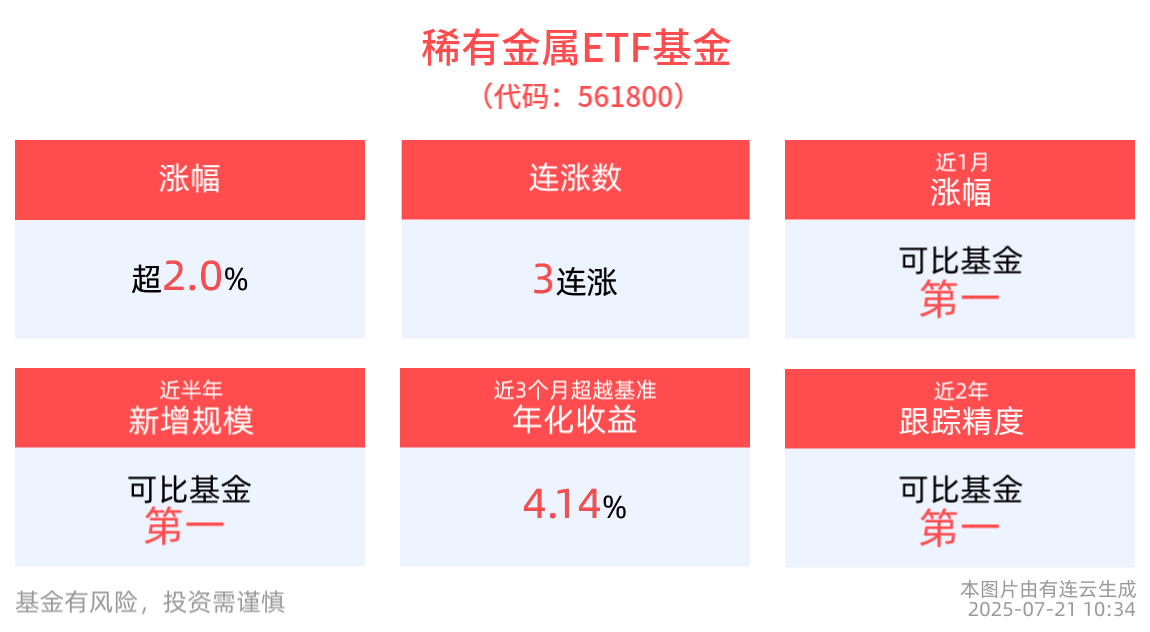
Group 1 - The Rare Metals ETF has seen a net value increase of 36.41% over the past year, with the highest monthly return reaching 24.02% since its inception [3] - The ETF closely tracks the Zhongzheng Rare Metals Theme Index, which includes up to 50 listed companies involved in rare metal mining, smelting, and processing [3] - As of June 30, 2025, the top ten weighted stocks in the Zhongzheng Rare Metals Theme Index account for 54.07% of the index, with companies like Salt Lake Co. and Northern Rare Earth among the leaders [3] Group 2 - The industrial metals sector is expected to benefit from policy support, with plans to expand demand and optimize supply, boosting industry confidence [4] - The Ministry of Industry and Information Technology aims to promote structural adjustments and high-quality development in key industries, including copper and aluminum [4] - Strategic metals are anticipated to experience valuation reconstruction opportunities, with prices for praseodymium and neodymium oxide rebounding and black tungsten ore prices reaching historical highs [4] Group 3 - The top ten stocks in the Rare Metals ETF include Salt Lake Co. (8.52% weight), Northern Rare Earth (8.49% weight), and others, providing a solid investment tool for investors in the rare metals sector [6]

黄金股票ETF(517400)上涨1.39%,地缘避险与降息预期支撑贵金属走强
Mei Ri Jing Ji Xin Wen· 2025-06-26 04:32
Group 1: Precious Metals Market Insights - The report from Wenkang Securities highlights that strategic minor metals are experiencing price increases due to resource scarcity and growing demand from the downstream new energy sector, benefiting companies with resource and technological advantages [1] - Platinum prices have surged over 35% this year, leading to an increase in platinum jewelry stores and a decrease in gold outlets in the Shenzhen market [1] - Geopolitical uncertainties are driving up safe-haven demand, with expectations for continued increases in precious metal prices, particularly gold and silver [1] Group 2: Industrial Metals and Energy Metals - The Federal Reserve's decision to maintain the benchmark interest rate has resulted in stable industrial metal prices, with copper prices facing upward pressure due to tightening supply of copper concentrate [1] - Aluminum prices are impacted by supply chain vulnerabilities following an incident in Guinea's bauxite mines [1] - The Democratic Republic of Congo's extension of the temporary cobalt export ban is expected to support rising cobalt prices [1] Group 3: Strategic Metals Developments - Prices for praseodymium and neodymium oxides have rebounded from lows, while black tungsten concentrate prices have reached historical highs, indicating potential valuation reconstruction opportunities for strategic metals amid global supply chain autonomy pursuits [1]
黄金股票ETF(517400)涨超1.1%,避险情绪升温支撑贵金属走强
Mei Ri Jing Ji Xin Wen· 2025-06-23 04:30
Group 1 - The core viewpoint of the articles highlights that geopolitical uncertainties are driving an increase in risk aversion, which supports the rise in precious metal prices, particularly gold and silver [1] - The gold stock ETF (517400) has risen over 1.1%, reflecting the strengthening of precious metals due to heightened risk aversion [1] - The SSH Gold Stock Index (931238), tracked by the gold stock ETF, includes companies involved in gold mining, smelting, and sales, providing a representative performance of the gold industry chain [1] Group 2 - The Federal Reserve's decision to maintain the benchmark interest rate has led to continued fluctuations in industrial metal prices, with strong long-term support for copper prices [1] - In the energy metals sector, cobalt prices are expected to continue rising, while strategic metals like neodymium oxide have seen a price recovery from a low point [1] - The black tungsten concentrate price has reached a historical high, indicating a potential revaluation opportunity for strategic minor metals like antimony and tungsten amid supply chain autonomy trends [1]
中国芯片迎来“玄戒时刻”?小米自研3nm芯片引热议,雷军发声了!
Sou Hu Cai Jing· 2025-06-04 02:27
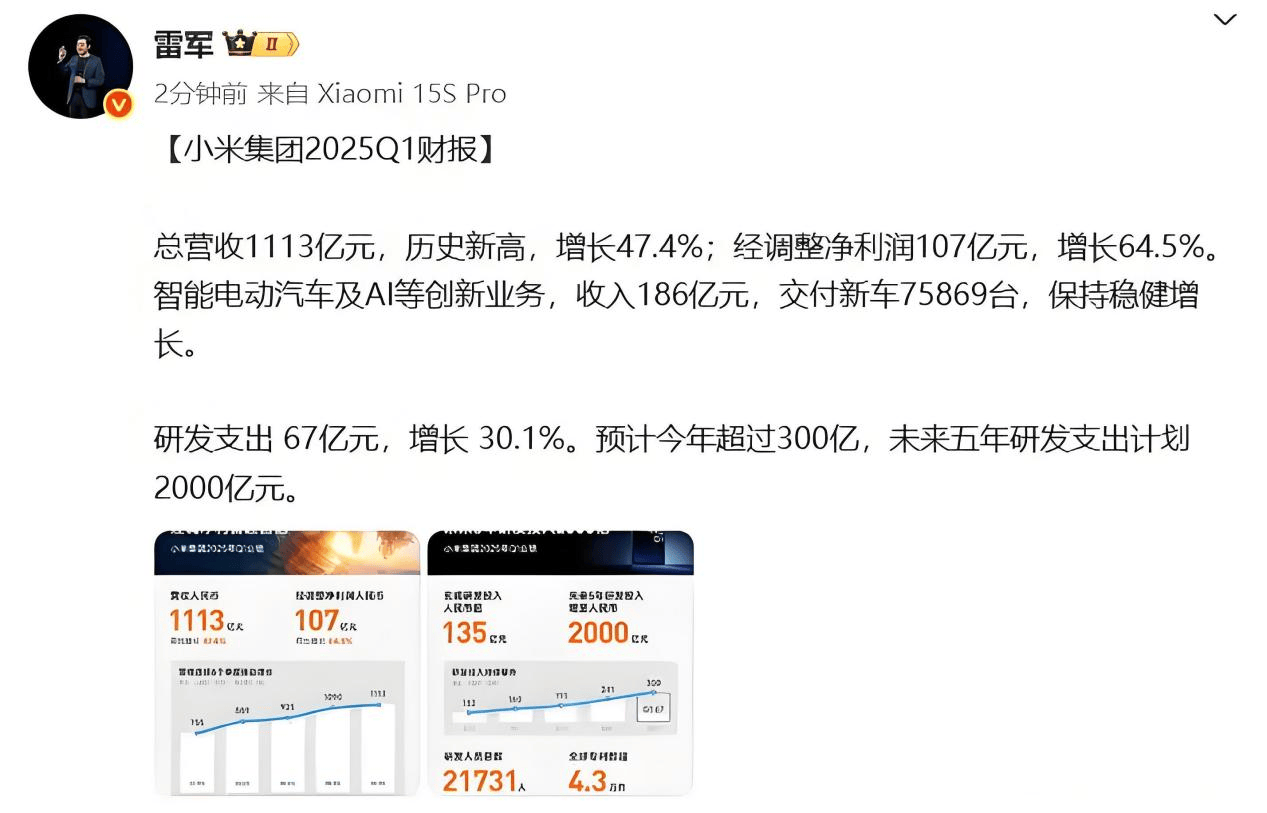
Core Viewpoint - Xiaomi has recently gained significant attention due to various controversies, but its latest financial report reveals strong performance, with record revenue and profit growth in Q1 2025 [1]. Group 1: Financial Performance - In Q1 2025, Xiaomi's total revenue reached 111.3 billion yuan, marking a historical peak for a single quarter, equivalent to daily earnings of 1.23 billion yuan [1]. - Adjusted net profit for the same period was 10.7 billion yuan, representing a remarkable increase of 64.5% [1]. Group 2: Business Segments - Revenue from the smart electric vehicle segment surged from 1.84 million yuan in the same period last year to 18.1 billion yuan, with gross margin rising from 12.6% to 23.2% [2]. - The first model, the SU7 series, has delivered over 258,000 units in its first year, with 75,900 new cars delivered in Q1 2025, indicating strong market momentum [2]. - Xiaomi's smartphone business remains foundational, with Q1 2025 shipments reaching 41.8 million units, a 3% year-on-year increase, reclaiming the top position in China with an 18.8% market share [4]. - The share of high-end smartphone models has increased to 25%, with the Xiaomi 15 Ultra flagship model seeing a 90% year-on-year sales surge in its first month [4]. Group 3: Chip Development - The self-developed chip, Xuanjie O1, was unveiled at the Xiaomi 15 Pro launch, utilizing TSMC's 3nm process and featuring 19 billion transistors, positioning it against Qualcomm's Snapdragon 8 Gen3 [8]. - Despite facing skepticism regarding its development, Xiaomi's leadership has publicly defended its chip design as independent [8]. - Xiaomi plans to integrate self-developed 5G baseband technology and increase R&D funding to 200 billion yuan, emphasizing its commitment to chip development as a core strategy [18].
新强联(300850) - 300850新强联投资者关系管理信息20250527
2025-05-27 09:20
Group 1: Supply Chain and Production - The company has established a self-sufficient supply chain for rolling elements and forgings through vertical integration with subsidiaries, ensuring quality stability and delivery cycles [2][3] - Current production capacity utilization remains high, with efforts to expand capacity through equipment adjustments and process optimizations [3] Group 2: Market Focus and Orders - The company is primarily focused on the domestic market, with overseas operations still in the development phase, while maintaining a strong order backlog [3] - The high demand from downstream wind power installations supports the company's order fulfillment capabilities [3] Group 3: Product Development and Technology - The company is actively developing high-end precision bearings, particularly in the wind power sector and gearbox bearings, with the latter currently in small batch shipments [2] - Various heat treatment processes and advanced equipment are utilized to meet customer demands while balancing performance, quality, and cost [4] Group 4: Financial Performance and Strategy - The company anticipates strong performance in Q2 2025, driven by robust order volumes and increased production efficiency [5] - Strategies to enhance gross margins include optimizing processes, increasing R&D investment, and leveraging cost advantages across the supply chain [5]