信用货币体系重构

Search documents
金价“过山车”银行理财配置逻辑迎“压力测试”
Jing Ji Wang· 2026-02-05 02:37
Core Viewpoint - Recent fluctuations in international gold prices have significantly increased volatility, impacting both gold itself and related bank wealth management products, which has prompted a reassessment of asset allocation capabilities in the context of risk awareness [1][2]. Group 1: Market Dynamics - The recent volatility in the gold market is attributed more to emotional and capital dynamics rather than fundamental shifts [2]. - The gold market experienced rapid price increases and decreases, driven by factors such as expectations of Federal Reserve interest rate cuts and geopolitical risks, followed by a reversal in market sentiment due to potential changes in Fed leadership [2]. - Institutions maintain a long-term positive outlook on gold, viewing it as a core asset in the new macroeconomic cycle, transitioning from a traditional safe-haven asset to a sovereign reserve asset [2]. Group 2: Strategic and Tactical Importance of Gold - Gold's strategic role in wealth management remains unchanged, serving as a hedge against currency credit risks, while its tactical importance is increasing as it adjusts within certain price ranges to address geopolitical and monetary uncertainties [3]. - The design of bank wealth management products positions gold as a "satellite" asset, enhancing portfolio resilience rather than determining absolute returns, with typical allocations ranging from 5% to 15% [5][6]. Group 3: Product Design and Risk Management - Most mainstream "fixed income + gold" products still primarily consist of fixed income assets, with only a small portion allocated to gold derivatives, ensuring risk control while seeking flexible returns [6]. - The impact of market fluctuations on wealth management products is considered manageable, as gold primarily serves a hedging and diversification role without cash flow returns [6]. Group 4: Investor Behavior and Education - The recent market dynamics have challenged the perception that safe-haven assets are free from volatility, necessitating a shift in investor expectations and understanding of risk [7][8]. - Investors are advised to align their product choices with their risk tolerance, with conservative investors recommended to stick to low-exposure "fixed income +" products, while aggressive investors may consider accumulating gold or ETFs for higher returns [7][8].
金价“过山车” 银行理财配置逻辑迎“压力测试”
Shang Hai Zheng Quan Bao· 2026-02-04 18:12
Core Viewpoint - Recent fluctuations in international gold prices have significantly increased volatility, impacting both gold itself and related bank wealth management products, which has prompted a reassessment of asset allocation capabilities in the context of risk awareness [2][3]. Group 1: Market Dynamics - The recent volatility in the gold market is attributed more to emotional and capital dynamics rather than fundamental shifts [2]. - The surge in gold prices at the beginning of the year was driven by expectations of Federal Reserve rate cuts and geopolitical risks, but market sentiment reversed with the potential appointment of a hawkish Fed chair [2]. - The concentration of profit-taking led to a significant market downturn, exacerbated by leveraged futures liquidations and quantitative trading strategies [2]. Group 2: Long-term Outlook - Despite short-term volatility, institutions maintain a strong long-term outlook for gold, viewing it as a core asset in the new macroeconomic cycle [3]. - Gold is evolving from a traditional safe-haven asset to a sovereign reserve asset, with its pricing logic shifting from financial cycles to monetary cycles [3]. Group 3: Strategic and Tactical Importance - The strategic role of gold in asset allocation remains unchanged, but its tactical importance is increasing, with a focus on flexible adjustments to respond to geopolitical and monetary uncertainties [4]. - Gold is viewed as a "satellite" asset in wealth management, enhancing portfolio resilience rather than determining absolute returns [6]. - The allocation of gold in investment portfolios is typically controlled between 5% to 15%, aimed at improving overall portfolio stability [6]. Group 4: Product Design and Risk Management - Wealth management products linked to gold have shown minor fluctuations, reflecting the transmission of underlying asset risks to higher-level products [5]. - The design of wealth management products emphasizes risk diversification and hedging against stock and bond volatility, with gold serving as a stabilizer due to its low correlation with mainstream assets [6][7]. - The impact of market shocks on most wealth management products is considered manageable, as gold does not provide cash flow returns and primarily serves a hedging function [7]. Group 5: Investor Psychology and Education - The recent market dynamics challenge the perception that safe-haven assets are devoid of volatility, necessitating a shift in investor expectations [8]. - Investors must recognize that gold allocation involves accepting price volatility in exchange for long-term stability in extreme conditions [9]. - There is a need for improved investor education to address misconceptions about the nature of gold as a financial instrument and the realities of net asset value fluctuations in a fully net-valued environment [9].

大涨控制不住,现货黄金首次涨破4500美元关口
Sou Hu Cai Jing· 2025-12-24 02:45
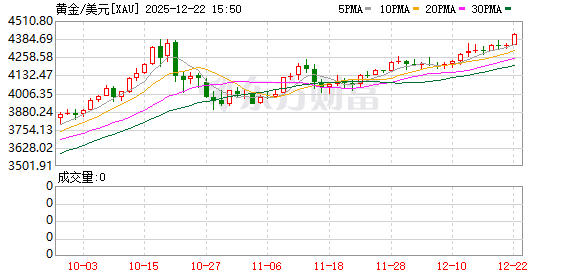
Group 1 - Global gold prices have reached a new high, surpassing $4500 per ounce for the first time, currently reported at $4520 per ounce, with a year-to-date increase of 71% [2] - COMEX silver has also seen significant gains, reaching a peak of $70.155 per ounce, with a year-to-date increase of 138%, leading the precious metals market [2] - Domestic gold jewelry prices have been adjusted upwards by several brands, with prices for pure gold jewelry reported as follows: Lao Feng Xiang at 1406 CNY per gram, Lao Miao Gold at 1402 CNY per gram, Chow Sang Sang at 1411 CNY per gram, Chow Tai Fook at 1410 CNY per gram, and Liufuk Jewelry at 1401 CNY per gram [2] Group 2 - Gold is on track for its best annual performance since 1979, with major international institutions predicting gold prices will exceed $4000 by 2026 [3] - Gold ETFs have become a primary focus for ETF fund inflows, with net inflows exceeding 100 billion CNY this year, accounting for approximately 10% of total ETF inflows during the same period [3]
帮主郑重:金价冲上4500美元,有人却高调离场!该跟谁?
Sou Hu Cai Jing· 2025-12-24 01:43
Core Insights - The international gold price has surged to a historic high of $4500 per ounce, driven by strong support factors [1][3] - Notably, some prominent investors have chosen to exit the market at this peak, indicating a divergence in market sentiment [1][3] Group 1: Market Drivers - Three key pillars supporting the gold price include global central bank purchases, geopolitical uncertainties, and the restructuring of the fiat currency system [3] - Mainstream institutions are predicting that gold prices will generally exceed $4000 [3] Group 2: Investment Strategies - For investors using gold as a long-term asset to hedge against risks, short-term fluctuations can be ignored, and holding positions is advisable [4] - For trend traders, the current price level has significantly priced in short-term benefits, suggesting a high risk in chasing higher prices, and patience is recommended for better entry points [4]

金价癫了!有知名投资者“撤退”
Sou Hu Cai Jing· 2025-12-23 12:24
Core Viewpoint - International gold prices have surged, reaching a new high of $4530.8 per ounce, driven by factors such as the restructuring of the credit currency system, geopolitical uncertainties, and continued central bank purchases of gold [1][3]. Group 1: Gold Price Trends - COMEX gold futures have seen a year-to-date increase of over 60%, with significant milestones at $3000, $3500, $4000, and $4500 per ounce [3]. - Retail gold prices have also risen, with prices for gold jewelry reaching around 1403 yuan per gram as of December 23 [3]. - Predictions from major institutions suggest that gold prices could exceed $4000 per ounce by 2026, with some forecasts even suggesting a potential rise to $5000 per ounce [1][7]. Group 2: Central Bank Activities - Global central banks have been net buyers of gold, with purchases exceeding 1000 tons annually from 2022 to 2024. In the first three quarters of this year, net purchases totaled 634 tons [3][5]. - The International Monetary Fund (IMF) reported a decline in the dollar's share of global foreign exchange reserves, indicating a potential shift in reserve currency dynamics [4]. Group 3: ETF Inflows - Gold ETFs have become a significant focus for investment, with net inflows exceeding 100 billion yuan this year, accounting for about 10% of total ETF inflows [5]. - The demand for gold ETFs is driven by geopolitical risks and expectations of interest rate cuts by the Federal Reserve [5]. Group 4: Market Sentiment and Predictions - Some investors have begun to exit the gold market, citing historical trends of long-term bear markets in gold prices [6]. - Despite some selling activity, institutions like Morgan Stanley and JPMorgan remain optimistic about gold prices, predicting continued support from macroeconomic factors [6][7]. - The recent sale of gold reserves by the Russian central bank has raised concerns about future demand and price stability [7][8].
金价癫了!
Xin Jing Bao· 2025-12-23 12:08
Group 1 - The international gold price has reached a new peak, with COMEX gold futures hitting $4530.8 per ounce on December 23, marking a historical high after two months of volatility [1][8] - The driving factors for gold prices include the restructuring of the credit monetary system, heightened demand for hedging against geopolitical and policy uncertainties, and continuous gold purchases by global central banks [1][2] - Major institutions predict that gold prices will exceed $4000 per ounce by 2026, but there is disagreement on whether prices will surpass $5000 per ounce [1][8] Group 2 - Gold has emerged as one of the best-performing assets in the capital market this year, with COMEX gold futures increasing by over 60% year-to-date [2][9] - The retail price of gold jewelry has also surged, with prices for gold per gram reaching around 1403 RMB for major brands as of December 23 [2][9] - Central banks globally have been purchasing gold, with net purchases totaling 634 tons in the first three quarters of this year, although this is lower than the previous three years' highs [2][9] Group 3 - The share of the US dollar in global foreign exchange reserves has declined, dropping from 57.79% to 56.32% between the first and second quarters of 2025, marking 11 consecutive quarters below 60% [3][10] - Gold ETFs have become a primary focus for ETF fund inflows, with over 100 billion RMB net inflows this year, accounting for about 10% of total ETF inflows [3][10] - Geopolitical tensions, including the US's "reciprocal tariffs" and conflicts in Ukraine and the Middle East, have highlighted gold's safe-haven attributes [3][10] Group 4 - Some prominent investors have exited the gold market, with notable figures selling their holdings at the $4500 per ounce mark [4][11] - Historical trends indicate that central bank actions, such as large-scale gold sales, can significantly impact long-term gold prices [4][11] - The recent sale of gold reserves by the Russian central bank serves as a critical signal for the market, indicating potential shifts in gold demand [5][11][12] Group 5 - Major financial institutions remain optimistic about gold prices, with Morgan Stanley predicting prices could reach $4800 per ounce by the end of 2026, while JPMorgan forecasts $5055 per ounce based on strong future demand [5][12] - Goldman Sachs anticipates a 14% increase in gold prices by December 2026, projecting prices to reach $4900 per ounce, with ongoing demand from central banks [5][12] - The future trajectory of gold prices hinges on whether central banks will continue to purchase gold and the sustained demand from the market [5][12]
金价癫了!一天站上4500美元/盎司,有知名投资人高调离场
Xin Jing Bao· 2025-12-23 10:21
Group 1 - International gold prices have surged, reaching a peak of $4530.8 per ounce on December 23, marking a new historical high [1] - The driving factors for gold prices include the restructuring of the credit currency system, heightened demand for hedging against geopolitical and policy uncertainties, and continuous gold purchases by global central banks [1][2] - Major institutions predict that gold prices will exceed $4000 per ounce by 2026, with some forecasts suggesting potential to break the $5000 mark, although there is disagreement among institutions [1][5] Group 2 - Gold has emerged as one of the best-performing assets in the capital market this year, with COMEX gold futures increasing by over 60% year-to-date [2] - The retail price of gold jewelry has also risen significantly, with prices reaching around 1403 yuan per gram for major brands [2] - Central banks globally have been net buyers of gold, with a total of 634 tons purchased in the first three quarters of this year, despite being lower than the previous three years' highs [2][3] Group 3 - The share of the US dollar in global foreign exchange reserves has declined, dropping from 57.79% to 56.32% over two quarters, indicating a trend of reduced reliance on the dollar [3] - Gold ETFs have seen significant inflows, with over 100 billion yuan net inflow this year, accounting for about 10% of total ETF inflows [3] - Geopolitical tensions, including the US's tariff policies and conflicts in Ukraine and the Middle East, have highlighted gold's safe-haven attributes [3] Group 4 - Some prominent investors have begun to exit the gold market, with notable figures selling their holdings at around $4500 per ounce [4] - The Russian central bank has started selling its gold reserves to meet budgetary needs, having sold at least 3.11 tons in the first nine months of the year [5][6] - The potential for a shift towards the Chinese yuan in international trade settlements could impact gold demand, as the yuan's share in reserves remains low compared to China's trade volume [4] Group 5 - Major financial institutions remain optimistic about gold prices, with Morgan Stanley predicting prices could reach $4800 per ounce by Q4 2026, while JPMorgan has set a target of $5055 per ounce based on strong future demand [5] - Goldman Sachs forecasts a 14% increase in gold prices by December 2026, reaching $4900 per ounce, with ongoing demand from central banks expected [5] - The future trajectory of gold prices hinges on whether central banks will continue to purchase gold and the sustained demand from the market [5]
资讯早班车-2025-12-23-20251223
Bao Cheng Qi Huo· 2025-12-23 02:11
1. Industry Investment Rating - No industry investment rating information is provided in the report. 2. Core Viewpoints - The report presents a comprehensive overview of the macro - economic data, commodity investment trends, financial news, and stock market conditions. It shows that the global economy is facing various factors such as geopolitical tensions, policy changes, and market fluctuations, which have different impacts on different industries and markets. For example, geopolitical factors in Venezuela and the EU's sanctions on Russia affect the energy market, while the "aluminum - for - copper" trend in the home appliance industry is influenced by the soaring copper price [5][9][10]. 3. Summary by Directory Macro Data - GDP in Q3 2025 grew at a 4.8% year - on - year rate, down from 5.2% in the previous quarter but up from 4.6% in the same period last year. - In November 2025, the manufacturing PMI was 49.2%, slightly up from 49% in the previous month but down from 50.3% in the same period last year; the non - manufacturing PMI for business activities was 49.5%, down from 50.1% in the previous month and 50% in the same period last year. - The year - on - year growth rates of M0, M1, and M2 in November 2025 were 10.6%, 4.9%, and 8% respectively. The growth rate of M1 decreased from 6.2% in the previous month, while M2 decreased from 8.2% in the previous month [1]. Commodity Investment Comprehensive - The 1 - year and 5 - year - plus LPRs remained unchanged at 3.0% and 3.5% respectively in December 2025, for the seventh consecutive month, due to stable policy rates and pressure on the banking industry's net interest margin. - Starting from December 23, 2025, China will impose temporary counter - subsidy measures on imported dairy products from the EU, with ad - valorem subsidy rates ranging from 21.9% to 42.7%. - Multiple exchanges, including the Guangzhou Futures Exchange, Zhengzhou Commodity Exchange, Dalian Commodity Exchange, Shanghai Gold Exchange, and China Financial Futures Exchange, have announced fee - reduction or exemption policies for 2026. The Shanghai Futures Exchange has adjusted the trading fees for silver futures to cool the market [2][3][4]. Metals - On December 22, platinum and palladium futures on the Guangzhou Futures Exchange hit the daily limit, with the platinum futures main contract 2606 closing at 568.45 yuan/gram, up 6.99%, and the palladium futures main contract 2606 at 508.45 yuan/gram, up 7%. The spot platinum in the overseas market broke through the $2000/ounce mark for the first time since 2008. - Spot gold reached $4400/ounce for the first time, up about 1.4%. The long - term upward trend of precious metals remains strong due to factors like the reconstruction of the credit currency system and central banks' continuous gold purchases. - The "aluminum - for - copper" trend in the home appliance industry has become a hot topic due to the soaring copper price. The China Household Electrical Appliances Association has put forward five initiatives. - Precious metals and rare metals such as silver and tungsten have seen significant price increases. The annual increase of silver has reached 137%, and that of tungsten concentrate 202%. In the past week, silver rose 8.27%, and tungsten powder rose about 18%. - Hong Kong plans to focus on developing the gold market next year, aiming to increase its gold storage to at least 2000 tons in the next three years and launch a central settlement system for gold contract trading [5][6][7]. Coal, Coking, Steel and Minerals - Six special working groups have carried out inspections in 12 key regions across the country to crack down on illegal mining and seal up abandoned mine holes. - In November 2025, India's major industries showed mixed growth. Crude oil production decreased by 3.2% year - on - year, while coal, steel, cement, and fertilizer production increased by 2.1%, 6.1%, 14.5%, and 5.6% respectively. Electricity production decreased by 2.2% [8]. Energy and Chemicals - On December 22, 2025, domestic refined oil prices were lowered. Gasoline and diesel prices were reduced by 170 yuan/ton and 165 yuan/ton respectively. - On December 22, the main contract of US crude oil rose due to the escalating situation in Venezuela, which raised concerns about supply. - The EU decided to extend economic sanctions against Russia for six more months until July 31, 2026, and introduced special counter - measures against sanctions - evading behaviors [9][10]. Agricultural Products - CBOT wheat and soybean prices rose due to the escalating Russia - Ukraine tension, which raised concerns about agricultural product exports in the Black Sea region. Chicago wheat futures rose up to 1.7%, and soybean futures up to 0.7%. - The US Department of Agriculture reported the export inspection volumes of soybeans, wheat, and corn, as well as the weekly export sales of various agricultural products in the next sales year [11]. Financial News Open Market - On December 22, the central bank conducted 67.3 billion yuan of 7 - day reverse repurchase operations at an interest rate of 1.40%. With 130.9 billion yuan of reverse repurchases maturing on the same day, the net withdrawal was 63.6 billion yuan. - The central bank issued 40 billion yuan of 6 - month RMB central bank bills in Hong Kong at a winning bid rate of 1.67% [12]. Key News - The central bank introduced a one - time credit repair policy for personal overdue information from January 1, 2020, to December 31, 2025, with a single amount not exceeding 10,000 yuan. If the overdue debt is fully repaid by March 31, 2026, the information will not be shown in the credit report. - Vanke's 2 - billion - yuan bond extension plan was rejected again, but it won a 30 - trading - day grace period. Vanke's subsidiary also extended the investment term of a 2.62 - billion - yuan insurance - related debt plan by one year. - The State Council is working on the "15th Five - Year Plan" and plans to launch major projects to drive economic growth. - The 1 - year and 5 - year - plus LPRs in December 2025 remained unchanged for the seventh consecutive month. - The Ministry of Commerce imposed temporary counter - subsidy measures on imported dairy products from the EU. - The Central Economic Work Conference deployed key reform tasks for next year, aiming to enhance economic vitality. - The draft revision of the Banking Supervision and Management Law was submitted for the first review, aiming to strengthen supervision of major shareholders and actual controllers of banking financial institutions. - The China Financial Futures Exchange will halve the delivery fees for stock index futures and treasury bond futures and the exercise (performance) fees for stock index options in 2026. - In November and December 2025, institutions increased their bond allocation. Insurance companies accelerated their bond issuance, and many banks adjusted their deposit business to stabilize the net interest margin. - There were multiple bond - related events, including Vanke's bond extension issues, and some companies' credit rating changes [14][15][16][17][18]. Bond Market - The Chinese bond market weakened overall. The yield of the 30 - year active bond "25 Super Long Special Treasury Bond 06" rose by more than 1bp, and the 30 - year main contract of treasury bond futures fell 0.28%. - In the exchange - traded bond market, Vanke's bonds showed mixed performance. The Wande Real Estate Bond 30 Index and the Wande High - Yield Urban Investment Bond Index rose slightly. - The CSI Convertible Bond Index rose 0.55%, and the Wande Convertible Bond Equal - Weighted Index rose 0.61%. - Most money market interest rates declined, while the performance of European and US bond yields was mixed [19][20][21][22]. Foreign Exchange Market - The on - shore RMB exchange rate against the US dollar closed at 7.0382 on December 22, up 28 points from the previous trading day. The central parity rate was 7.0572, down 22 points. - The US dollar index fell 0.46% in New York trading, and non - US currencies showed mixed performance [23]. Research Reports - CITIC Securities believes that the long - term and ultra - long - term bond yields are volatile at the end of the year, mainly due to the pressure on banks' liability side. In the long run, ultra - long - term bonds still have allocation value. - Huatai Fixed Income suggests continuing to layout convertible bonds on dips, paying attention to style switching, and taking weight - based varieties as the bottom position. - Huatai Fixed Income also believes that the bond market is currently desensitized to fundamentals, and institutions should focus on short - term and medium - term bonds. - CITIC Securities' chief economist Ming Ming believes that the US employment market is weak, and the Fed may cut interest rates by about 50bps next year [24][25]. Today's Reminders - On December 23, 205 bonds will be listed, 112 bonds will be issued, 72 bonds will require payment, and 135 bonds will pay principal and interest [26][27]. Stock Market - The A - share market rose significantly, with the Shanghai Composite Index up 0.69%, the Shenzhen Component Index up 1.47%, and the ChiNext Index up 2.23%. The trading volume reached 1.88 trillion yuan. Hainan Free Trade Port concept stocks and the semiconductor industry chain were strong, while pharmaceutical business stocks declined. - The Hong Kong Hang Seng Index rose 0.43%, the Hang Seng Technology Index rose 0.87%, and the Hang Seng China Enterprises Index rose 0.43%. Semiconductor and gold stocks rose, and four new stocks broke their issue prices [28].

美股全线上涨,黄金、白银价格创历史新高
Zhong Guo Zheng Quan Bao· 2025-12-22 23:34
Market Performance - On December 22, US stock markets saw all three major indices rise, with the Dow Jones, Nasdaq, and S&P 500 increasing by 0.47%, 0.52%, and 0.64% respectively [2] - In contrast, European stock indices experienced declines, with the UK FTSE 100 down by 0.32%, France's CAC40 down by 0.37%, and Germany's DAX down by 0.05% [2] Technology Sector - Major technology stocks showed mixed performance; Tesla rose by 1.56%, Nvidia by 1.49%, Google-C by 0.89%, Amazon by 0.48%, and META by 0.41%, while Microsoft fell by 0.25% and Apple by 1.04% [4] - The US tech giants index increased by 0.41% [4] Banking Sector - Bank stocks generally rose, with JPMorgan up by 1.87%, Goldman Sachs by 0.60%, Citigroup by 2.79%, Morgan Stanley by 1.52%, Bank of America by 1.05%, and Wells Fargo by 1.35% [5] Chinese Stocks - The Nasdaq Golden Dragon China Index increased by 0.58%, with notable gains in stocks such as Canadian Solar up over 10%, and iQIYI, Sohu, JinkoSolar, and TAL Education up over 2% [5] - Other Chinese stocks like Alibaba, Xpeng Motors, and New Oriental saw slight increases [5] Commodity Market - Precious metals prices surged, with London spot gold rising by 2.37% to $4,443.97 per ounce, and COMEX gold futures up by 2.13% to $4,480.60 per ounce, both reaching historical highs [6] - London spot silver increased by 2.98%, and COMEX silver futures rose by 2.37%, also hitting historical highs [6] - International oil prices rose, with ICE Brent and NYMEX WTI crude both increasing by over 2% [6] Future Outlook - Goldman Sachs projects that gold prices will rise to $4,900 per ounce by December 2026, driven by structural high demand from central banks and cyclical support from Federal Reserve rate cuts [7] - Long-term support for precious metals is expected to remain strong due to factors such as the reconstruction of the credit monetary system, geopolitical uncertainties, and ongoing global central bank purchases [8]

黄金大涨再创历史新高!现货黄金首次站上4400美元/盎司
Mei Ri Jing Ji Xin Wen· 2025-12-22 07:49
Core Viewpoint - Gold prices have reached a new high, with spot gold surpassing $4,400 per ounce for the first time, marking an increase of nearly 68% year-to-date [2]. Market Performance - The A-share precious metals sector opened higher on the 22nd, rising over 4%, with notable gains from companies such as Xiaocheng Technology, Hunan Silver, and Western Gold, all increasing by over 5% [4]. - Hong Kong gold stocks also showed strength, with Lingbao Gold and China Gold International rising over 5%, while Shandong Gold and Chifeng Jilong Gold increased by over 4% [4]. Gold Prices - As of December 22, retail gold prices were reported as follows: - Foot gold (jewelry, crafts) at 1,368 RMB per gram - Craft gold bars at 1,199 RMB per gram - Gold value-added service at 1,160 RMB per gram - Gold recycling service at 951 RMB per gram [6]. - Other retailers reported similar prices, with Shou Sheng's foot gold jewelry at 1,367 RMB per gram and Cai Bai's foot gold jewelry at 1,320 RMB per gram [8][10]. Geopolitical Factors - Geopolitical tensions have increased the appeal of precious metals as a safe haven, particularly due to the U.S. intensifying oil sanctions against Venezuela and Ukraine's military actions against Russian assets [10]. Central Bank Actions - Experts believe that the ongoing gold purchases by global central banks are a key variable disrupting traditional supply-demand balances, with expectations of a shift to looser monetary policy by the Federal Reserve further benefiting gold prices [10]. - The market's confidence in potential interest rate cuts by the Federal Reserve in January has decreased, with the probability of a 25 basis point cut in January 2026 now at 21%, down from previous estimates [10]. Long-term Outlook - Analysts from Citic Securities noted that the U.S. November CPI exceeded expectations, leading to an upward revision of market expectations for Fed rate cuts, which has strengthened precious metal prices [11]. - Guotai Junan Securities indicated that while short-term fluctuations may occur, the long-term upward logic for gold remains intact, supported by factors such as the restructuring of the global monetary credit system and ongoing central bank gold purchases [12]. - The National Futures Research Institute emphasized that the core logic supporting the rise in precious metal prices has not fundamentally changed, with a solid basis for long-term upward trends [12].