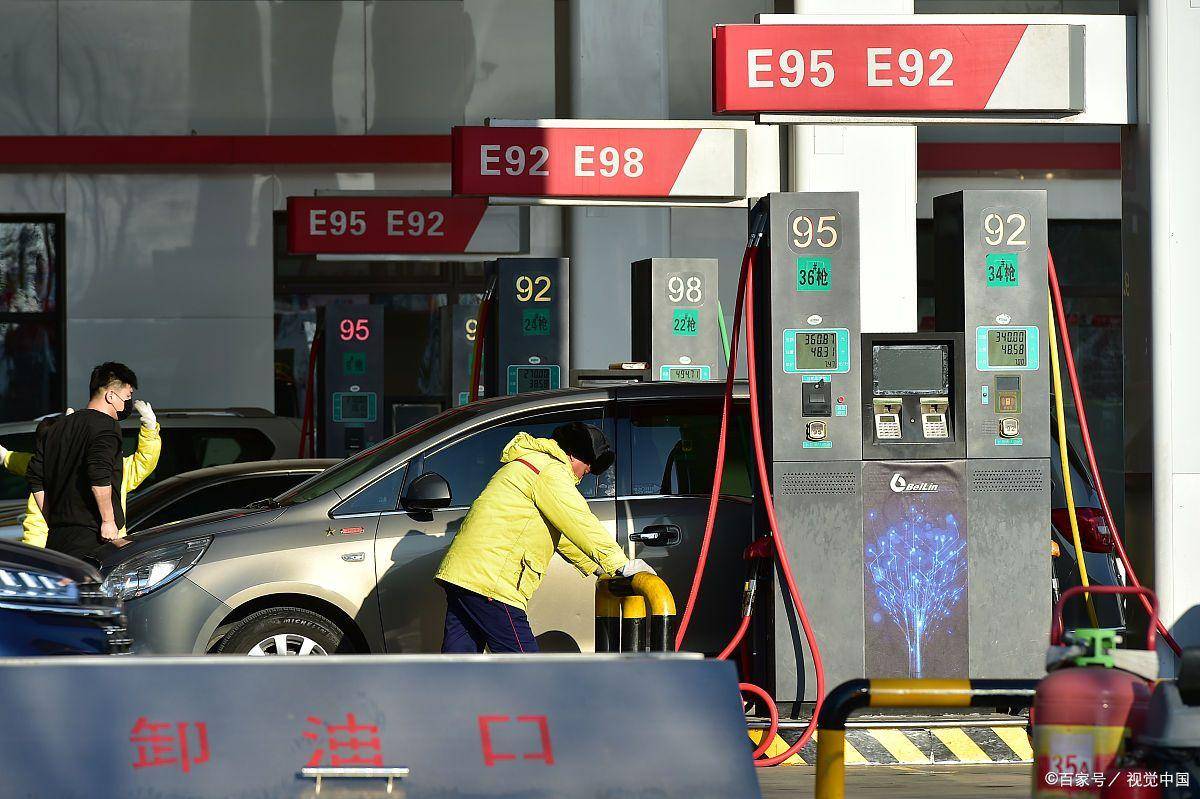
地缘政治影响油价

Search documents
原油成品油早报-20260326
Yong An Qi Huo· 2026-03-26 02:07
Report Information - Report Title: Crude Oil and Refined Oil Morning Report - Research Team: Energy and Chemicals Team at the Research Center - Date: March 26, 2026 [2] 1. Price Data Daily Prices and Changes - **WTI**: Ranged from $96.14 on March 19 to $90.32 on March 25, with a change of -$2.03 [3] - **BRENT**: Ranged from $108.65 on March 19 to $102.22 on March 25, with a change of -$2.27 [3] - **DUBAI**: Ranged from $137.82 on March 19 to $131.97 on March 23, with no data on March 24 - 25 [3] - **SC**: Ranged from 814.90 on March 19 to 723.90 on March 25, with a change of -15.20 [3] - **OMAN**: Ranged from 157.66 on March 19 to 107.80 on March 25, with a change of -24.03 [3] - **Japanese Naphtha**: Ranged from $1160.50 on March 19 to $997.75 on March 25, with a change of -$90.75 [3] - **Singapore Fuel Oil 380 CST**: Ranged from $50.15 on March 19 to $26.0 on March 25, with a change of -$12.3 [3] Spreads and Other Data - **BRENT 1 - 2 Month Spread**: Changed from $4.87 on March 19 to $4.96 on March 25, with a change of $0.70 [3] - **WTI - BRENT**: Changed from -$12.51 on March 19 to -$11.90 on March 25, with a change of $0.24 [3] - **SC - BRENT**: Changed from 9.49 on March 19 to 2.83 on March 25, with a change of 0.12 [3] - **Domestic Gasoline - BRENT**: Changed from 3407 on March 19 to 4332 on March 25, with a change of 133 [3] 2. News Diplomatic News - According to Arab mediators cited by the Wall Street Journal, Iran's private stance in cease - fire discussions is less rigid than its public statements. However, the success of diplomatic efforts remains low due to high demands from both Iran and the US. Iran is still listening during the mediators' attempt to draft a compromise for future meetings, and an Iranian diplomat said Iran has not closed the door to indirect negotiations but is highly skeptical of the US's interest [3] Production News - Due to the ongoing Iran war, Iraq's oil production has significantly declined. The oil production in southern Iraq's major oil fields has dropped by about 80% to around 800,000 barrels per day. Earlier this month, it had already dropped by about 70% to around 1.3 million barrels per day. Before the war, the daily production was about 4.3 million barrels per day. Iraq has also asked BP and Eni to cut production at their respective fields [3][4] - Iran has put forward five conditions for a cease - fire, including a complete stop to aggression and assassination, ensuring the war will not be imposed on Iran again, war reparations, ending the war on all fronts and by all resistance organizations, and recognition of Iran's sovereignty over the Strait of Hormuz [4] 3. EIA Reports - On the week of March 20, US crude oil exports decreased by 1.576 million barrels per day to 3.322 million barrels per day [11] - US domestic crude oil production decreased by 11,000 barrels to 13.657 million barrels per day [11] - Commercial crude oil inventories (excluding strategic reserves) increased by 6.926 million barrels to 456 million barrels, a 1.54% increase [11] - The four - week average supply of US crude oil products was 20.678 million barrels per day, a 2.37% increase compared to the same period last year [11] - The US Strategic Petroleum Reserve (SPR) inventory remained unchanged at 415.4 million barrels [11] - US commercial crude oil imports (excluding strategic reserves) were 6.464 million barrels per day, a decrease of 730,000 barrels per day compared to the previous week [11] 4. Weekly View - This week, oil prices continued to rise. The traffic volume in the Strait of Hormuz remained low, with only 3 oil tankers passing through on March 18 and no crude oil tankers. The average daily tanker traffic volume in the past week was less than 2. Trump threatened to attack Iranian power plants if the Strait of Hormuz was not reopened within 48 hours, and Iran responded that it would attack energy and oil facilities in the Middle East if its power plants were targeted, which could lead to long - term oil price increases [4] - The premium of Oman crude oil rose to $60 per barrel. Affected by the escalation of the Middle East situation, the spread between Brent and WTI reached the highest level in nearly a decade [4] - On March 20, the US approved a 30 - day authorization to conditionally relax sanctions on Iranian oil products [4] - Recently, the global floating storage has significantly reduced inventory, with an average reduction of 1.8 million barrels per day. Goldman Sachs estimates that there are about 131 million barrels of Russian oil and 105 million barrels of Iranian oil at sea, which can offset the supply interruption in the Strait of Hormuz for two weeks. In the case of a factual interruption in the strait, the price in the compliant market still faces upward pressure. Attention should be paid to whether Trump will have constructive dialogue with Iran on the strait's navigation and geopolitical situation next week [4]
大越期货原油早报-20260309
Da Yue Qi Huo· 2026-03-09 05:55
1. Report Industry Investment Rating - Not provided in the content 2. Core View of the Report - Oil prices have breached the $100 per - barrel mark for the first time since 2022. The Iran conflict is severely constraining global oil supplies, with limited strait navigation and some oil - producing countries starting passive production cuts. The attack on Iranian oil facilities has further panicked the market. Short - term crude oil will continue to rise, and it is expected that the domestic oil price will hit the daily limit today. SC2604 is expected to trade in the 765 - 771.9 range, and there will be opportunities to try short positions on rallies in the long - term [3] 3. Summary According to the Directory 3.1 Daily Prompt - **Fundamentals**: Israeli Prime Minister Netanyahu said the government would continue military operations and strike "mercilessly" against Iranian rulers. Due to the Iran war, Iraq's southern main oilfield production has dropped 70% to 1.3 million barrels per day, and Kuwait National Petroleum Company has also started to cut production and declared force majeure [3] - **Basis**: On March 6, the Oman crude oil spot price was $100.8 per barrel, the Qatar Marine crude oil spot price was $86.24 per barrel, and the basis was 31.53 yuan/barrel, with the spot at a premium to the futures [3] - **Inventory**: U.S. API crude oil inventories for the week ended February 27 increased by 5.647 million barrels (expected +2.2 million barrels), EIA inventories increased by 3.475 million barrels (expected +2.305 million barrels), Cushing area inventories increased by 1.564 million barrels, and Shanghai crude oil futures inventories as of March 6 were 2.557 million barrels, unchanged [3] - **Disk**: The 20 - day moving average is upward, and the price is above the average [3] - **Main Position**: As of March 3, the main long positions in WTI and Brent crude oil both decreased [3] - **Expectation**: Short - term upward, SC2604 to trade in the 765 - 771.9 range, long - term wait for shorting opportunities on rallies [3] 3.2 Recent News - Due to the Iran conflict, more major oil - producing countries have cut production. WTI and Brent crude oil both exceeded $100 per barrel on Monday. WTI once soared more than 21% to over $111 per barrel, and Brent rose more than 15%. The U.S. President threatened to further escalate the conflict. The UAE, Kuwait, and Iraq have cut production [5] - IEA Executive Director Fatih Birol said on the 6th that the logistics disruptions caused by the Middle East war are challenging many countries, but the global oil supply is still sufficient. All options are under discussion, but there is no plan to use the emergency oil reserve at present [5] - Iraq's southern oilfield production has dropped 70% to 1.3 million barrels per day. The U.S. military is formulating a plan to pass ships through the Strait of Hormuz. The U.S. may lift more sanctions on Russian oil. Qatar said that if the Iran conflict continues and oil prices rise to $150 per barrel, all Gulf energy producers are expected to stop exports within weeks. Kuwait has also cut production and declared force majeure [5] 3.3 Long - Short Concerns - **Likely to Rise**: Sanctions on Russia, deterioration of the Middle East situation [6] - **Likely to Fall**: IEA's concern about crude oil surplus, alleviation of supply problems in some oil - producing countries [6] - **Market Driver**: Short - term focus on geopolitics, long - term risk of supply exceeding demand [6] 3.4 Fundamental Data - **Futures Market**: The settlement prices of Brent, WTI, SC, and Oman crude oil have all increased, with increases of 4.93%, 8.51%, 6.68%, and 4.68% respectively [7] - **Spot Market**: The prices of most spot crude oils have increased, except for a 1.02% decrease in Shengli crude oil. The increases in British Brent Dtd, WTI, Oman, and Dubai crude oil are 8.46%, 8.51%, 10.16%, and 10.15% respectively [9] - **Inventory Data**: API and EIA inventories in the United States have generally shown an upward trend in recent weeks. As of February 27, API inventories increased by 5.647 million barrels, and EIA inventories increased by 3.475 million barrels [10][12] 3.5 Position Data - **WTI Crude Oil**: The net long position of WTI crude oil funds as of March 3 was 172,150, a decrease of 562 from the previous period [17] - **Brent Crude Oil**: The net long position of Brent crude oil funds as of March 3 was 285,594, a decrease of 35,358 from the previous period [19]
建信期货原油日报-20260304
Jian Xin Qi Huo· 2026-03-04 01:32
1. Report Industry Investment Rating - No relevant information provided 2. Core View of the Report - Short - term geopolitical situation will make oil prices rise strongly. SC is more supported than the external market, and its volatility will increase. There is still great uncertainty in the US - Iran situation, and attention should be paid to the later navigation time of the strait [6] 3. Summary by Directory 3.1. Market Review and Operation Suggestions - **Market Review**: WTI's opening price was $75, closing price was $71.03, with a high of $75.33, a low of $69.2, a decline of 5.98%, and a trading volume of 842,400 lots. Brent's opening price was $81.57, closing price was $78.07, with a high of $82.37, a low of $75.75, an increase of 7.14%, and a trading volume of 1,144,500 lots. SC's opening price was 545 yuan/barrel, closing price was 572.3 yuan/barrel, with a high of 572.3 yuan/barrel, a low of 544.1 yuan/barrel, an increase of 12%, and a trading volume of 208,800 lots [5] - **Analysis of Supply and Demand**: Iran officially announced the blockade of the Strait of Hormuz, causing oil prices to rise. The maximum capacity of Saudi Arabia's east - west pipeline is 5 million barrels per day, and the UAE can transport 1.5 million barrels per day of crude oil by land through the pipeline. However, there is still a gap of more than 13 million barrels per day that is difficult to fill. According to the balance sheet, EIA and IEA expect a supply surplus of 3 million barrels per day in the global market in the first quarter of this year. If the blockade lasts for more than two weeks, the market in the first quarter will turn to a basic balance between supply and demand [5] 3.2. Industry News - Some Asian refineries are considering reducing production by 20% to 30% [9] - Due to the conflict in the Middle East, tanker freight rates have soared to record levels, and the daily income of benchmark tankers has reached $424,000 [9] - Saudi Aramco's Ras Tanura refinery was attacked by Iranian drones and caught fire. As a preventive measure, it has been shut down, and the situation is under control [9] - JPMorgan Chase said that even if the passage of the Strait of Hormuz is blocked for only 3 - 4 weeks, it may force the GCC member states to shut down oil production and push the Brent crude oil price above $100 per barrel [9]
“三桶油”罕见携手两连板,晚间齐发异动公告
第一财经· 2026-03-03 13:24
Core Viewpoint - The A-share oil and gas sector has experienced significant gains recently, influenced by the geopolitical situation in the Middle East, with the "Big Three" oil companies achieving their first-ever consecutive trading limit increases [1] Group 1: Company Performance - China Petroleum, China Petrochemical, and China National Offshore Oil Corporation have all reported abnormal stock trading fluctuations, with their A-share prices deviating by over 20% cumulatively over three consecutive trading days [5][6] - China Petrochemical's stock closed at 114 billion with a market capitalization of 873.9 billion and a price-to-earnings ratio of 26.2 [3] - The recent price movements are attributed to the volatility in the international oil market, driven by geopolitical factors and supply-demand dynamics, leading to significant uncertainty in short-term oil prices [5][6] Group 2: Market Conditions - The international oil market is currently experiencing wide fluctuations due to multiple factors, including geopolitical tensions and changes in supply-demand patterns [5][6] - Companies have confirmed that their production and operational conditions remain normal, with no significant changes in industry policies [5][6]





中国石油、中国石化、中国海油齐发股价异动公告
财联社· 2026-03-03 12:37
Core Viewpoint - The A-share oil and gas sector has experienced a rare surge due to the geopolitical situation in the Middle East, with the "Big Three" oil companies in China achieving consecutive trading limits for the first time in history over two trading days [1]. Group 1: Company Announcements - China National Petroleum Corporation (CNPC) announced that its A-share stock price had deviated by over 20% cumulatively over three consecutive trading days, indicating abnormal trading activity. The company confirmed that its production and operational status remains normal, with no significant changes in industry policy [1][5]. - China Petroleum & Chemical Corporation (Sinopec) also reported a similar deviation in its stock price, confirming that its production and operational status is normal and that there are no undisclosed significant matters [5][6]. - China National Offshore Oil Corporation (CNOOC) stated that its stock price had deviated by over 20% cumulatively over three consecutive trading days, citing the impact of geopolitical factors on the international oil market, which is experiencing significant price volatility [9]. Group 2: Stock Performance - As of the latest trading day, CNPC's stock closed at 13.15 CNY per share, with a total market capitalization of 240.67 billion CNY, reflecting a year-to-date increase of 26.32% [2]. - Sinopec's stock closed at 7.82 CNY per share, with a total market capitalization of 94.56 billion CNY, showing a year-to-date increase of 26.54% [6]. - CNOOC's stock closed at 43.41 CNY per share, with a total market capitalization of 206.33 billion CNY, marking a year-to-date increase of 43.84% [10].

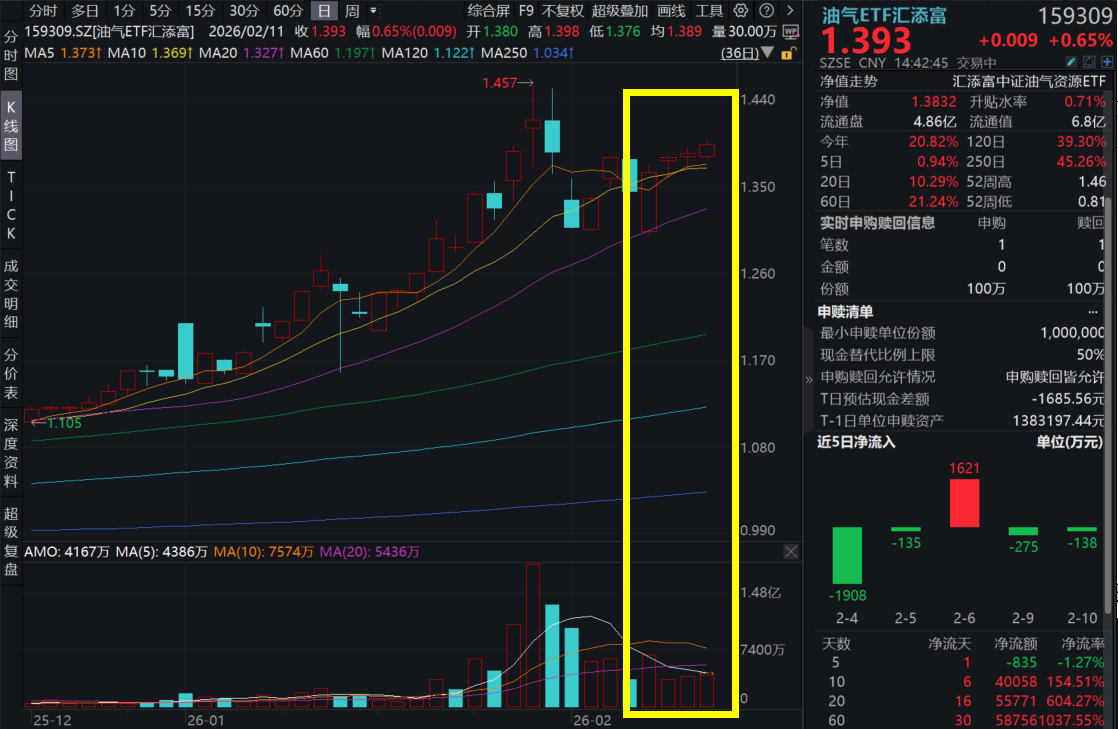
油气股走强,海油工程涨停,油气ETF汇添富(159309)翻红涨近1%,冲击4连阳!油气板块中长期配置逻辑怎么看?
Xin Lang Cai Jing· 2026-02-11 07:48
Core Viewpoint - The oil and gas sector in the A-share market is experiencing upward momentum, with the oil and gas ETF Huatai Fu (159309) showing a nearly 1% increase and achieving a four-day winning streak [1][3]. Group 1: Market Performance - The oil and gas ETF Huatai Fu (159309) has seen significant trading activity, with a transaction volume of 44 million yuan [1]. - Major component stocks of the oil and gas ETF have mostly risen, with notable performances including Haiyou Engineering hitting the daily limit, and Intercontinental Oil and Gas rising over 2% [3]. Group 2: Geopolitical Factors - The geopolitical situation in Iran remains unstable, with the U.S. expressing a desire to reach an agreement with Iran while also issuing warnings to its citizens [4]. - Ongoing tensions in Ukraine, including recent attacks on energy facilities, contribute to the uncertainty in the oil market [4][5]. Group 3: Long-term Outlook - The long-term outlook for oil prices is anchored in fundamental factors, with expectations of a continued oversupply due to OPEC+ production increases and developments in American oil fields [5]. - Domestic oil companies are diversifying their operations and reducing reliance on foreign energy sources, which may enhance their resilience against international oil price fluctuations [5]. Group 4: Investment Opportunities - The oil and gas ETF Huatai Fu (159309) focuses on the oil and gas industry chain, providing exposure to key sectors such as exploration, equipment, refining, and transportation [6]. - The ETF includes a concentrated selection of leading oil and gas companies, ensuring high purity and quality in its holdings [6]. Group 5: Index Performance - The China Securities Oil and Gas Resource Index has shown strong returns over various periods, with a six-month return of 27.92%, a one-year return of 29.85%, and a three-year return of 50.20% [7].


石油及油服股早盘走低 伊朗局势持续扰动油价 机构提示警惕地缘事件反转
Zhi Tong Cai Jing· 2026-02-02 02:05
Group 1 - Oil and oil service stocks experienced a decline in early trading, with Shandong Molong down 8.6% to HKD 3.93, Sinopec Oilfield down 7.22% to HKD 0.9, CNOOC Oilfield down 1.98% to HKD 8.4, CNOOC down 2.87% to HKD 23.68, and PetroChina down 2.16% to HKD 9.08 [1] - WTI crude oil fell by 4% and Brent crude oil dropped by over 5% [1] - Iranian Foreign Minister Zarif indicated the possibility of reaching a fair agreement with the U.S., and an Iranian official stated that there are no plans for military exercises in the Strait of Hormuz, contradicting previous reports [1] Group 2 - Huatai Futures reported that the recent rise in oil prices is attributed to a combination of geopolitical, macroeconomic, and liquidity factors [2] - The macro sentiment and potential stabilization of the dollar may reduce the upward pressure on oil prices, while liquidity factors could also retreat [2] - The situation in Iran remains tense, particularly in the Strait of Hormuz, which is a critical oil export chokepoint, necessitating close monitoring of developments [2]



原油期货:地缘驱动变弱、油价回落
Ning Zheng Qi Huo· 2026-01-19 09:06
Report Summary 1. Report Industry Investment Rating - Not provided in the report. 2. Core Viewpoints of the Report - This week, crude oil prices first rose and then fell. At the beginning of the week, prices increased due to the escalation of domestic demonstrations in Iran and the US's warning. In the middle of the week, as the expectation of the US attacking Iran weakened, oil prices dropped significantly. Overall, the crude oil market still faces supply - surplus pressure, and without geopolitical drivers, it's difficult for oil prices to maintain a strong pattern [2]. - OPEC+ will pause production increases in Q1 2026, but there was significant cumulative production increase in 2025. Non - OPEC+ countries like the US, Brazil, and Guyana are operating at high production levels. It is expected that the non - OPEC+ supply will increase by about 1.2 million barrels per day in 2026. The situation in Venezuela may cause short - term disruptions to exports, but in the long - term, it is seen as a potential supply expansion. Overall, supply growth pressure remains, with short - term supply variables depending on Iran (geopolitical developments) and long - term on OPEC+ policies [2]. 3. Summary by Relevant Catalogs Market Review and Outlook - This week, crude oil prices fluctuated. Geopolitical factors initially drove prices up, but later the weakening of relevant expectations led to a decline. The supply - surplus pressure in the crude oil market persists [2]. Key Concerns - Geopolitical factors and weekly crude oil data should be focused on [3]. Weekly Changes in Fundamental Data - **Periodic and Spot Market**: SC crude oil futures rose from 432.70 yuan/barrel to 438.80 yuan/barrel, a 1.41% increase; Oman crude oil spot increased from 61.20 dollars/barrel to 62.79 dollars/barrel, a 2.60% increase; Brent crude oil futures went up from 63.02 dollars/barrel to 64.20 dollars/barrel, a 1.87% increase; WTI crude oil futures rose from 58.40 dollars/barrel to 59.44 dollars/barrel, a 1.78% increase [4]. - **Supply**: US crude oil production decreased from 13,792 thousand barrels per day to 13,753 thousand barrels per day, a 0.28% decline. OPEC's production situation is presented in relevant charts [4][13]. - **Inventory**: US crude oil inventory increased from 419,056 thousand barrels to 422,477 thousand barrels, a 0.82% increase [4]. - **Demand**: Data such as refinery operating rates in the US, China, Europe, and India are presented in relevant charts [26][28][30]. - **Cost - profit**: The comprehensive refinery profit increased from 677 yuan/ton to 726 yuan/ton, a 7.24% increase [4].
原油成品油早报-20260119
Yong An Qi Huo· 2026-01-19 05:20
Report Summary 1. Report Industry Investment Rating - No information provided. 2. Core View - This week, oil prices fluctuated at high levels due to geopolitical events. Iran has restored internet and text messaging services. Trump's stance has become more rational, but the risk of military intervention cannot be completely ruled out. Fundamentally, global onshore oil inventories are accumulating in the off - season, and the total waterborne inventory is decreasing month - on - month but higher year - on - year. The North Sea market has tightened recently, and the Dubai market is loose. The WTI and Brent markets are decoupled. European refinery profits are facing downward pressure due to rising crude oil prices. The absolute price center in the first quarter is expected to remain high. [6] 3. Summary by Relevant Catalogs Daily News - Syrian government forces have occupied the Conoco gas field, the largest Omar oil field in the east, and two oil fields in the north. - In Iran, the armed forces' chief of staff said that hostile forces were distorting facts through the media. The supreme leader, Khamenei, said the US incited the domestic unrest in Iran, and Trump was guilty. Iran has restored text messaging and will gradually restore internet connectivity. - The US military is increasing its defensive and offensive capabilities in the Middle East in case Trump orders an attack on Iran. - The head of Israel's Mossad intelligence agency visited the US to discuss the Iran situation. Trump and Netanyahu had two phone calls in two days to discuss the Iran situation, and Putin offered to mediate between Israel and Iran. [3][4][5] Inventory - In the week ending January 9, US crude oil exports increased by 43,000 barrels per day to 4.306 million barrels per day. - US domestic crude oil production decreased by 58,000 barrels to 13.753 million barrels per day. - Commercial crude oil inventories excluding strategic reserves increased by 3.391 million barrels to 422 million barrels, an increase of 0.81%. - The four - week average supply of US refined oil products was 19.98 million barrels per day, a year - on - year decrease of 1.14%. - The US Strategic Petroleum Reserve (SPR) inventory increased by 214,000 barrels to 413.7 million barrels, an increase of 0.05%. - US imports of commercial crude oil excluding strategic reserves were 7.092 million barrels per day, an increase of 753,000 barrels per day from the previous week. - US EIA gasoline inventory for the week ending January 9 was 8.977 million barrels, with an expected value of 3.565 million barrels and a previous value of 7.702 million barrels. - US EIA refined oil inventory for the week ending January 9 was - 29,000 barrels, with an expected value of 512,000 barrels and a previous value of 5.594 million barrels. [12]
油价一夜下跌!今天1月18日调整后,全国加油站92、95汽油最新售价
Sou Hu Cai Jing· 2026-01-18 21:37
Core Viewpoint - The oil prices are expected to rise due to geopolitical tensions and increased demand ahead of the Chinese New Year, despite a generally oversupplied market and a shift towards electric vehicles [2][3][8]. Price Trends - The next price adjustment window is on January 20, with expectations of an increase of approximately 75 yuan per ton, translating to a rise of about 0.06 yuan per liter [2][8]. - Since August of the previous year, there have been ten price adjustments, with six decreases and one increase, resulting in a cumulative drop of nearly 700 yuan per ton for gasoline [2][3]. Regional Price Variations - Gasoline prices vary significantly across regions, with 92-octane gasoline priced at 6.66 yuan per liter in Hunan and up to 7.82 yuan in Hainan [4][5][6]. - The price for 98-octane gasoline also shows considerable regional differences, with prices reaching 9.30 yuan in Hainan and as low as 7.72 yuan in Gansu [6][7]. Supply and Demand Dynamics - Global oil supply remains ample, with U.S. shale oil production exceeding 13.8 million barrels per day and OPEC not reducing output [3]. - The International Monetary Fund (IMF) forecasts global economic growth at 3.1% for the year, which is lower than the previous year, indicating a weaker demand outlook for oil [3]. Long-term Outlook - Analysts predict that the average international oil price may settle between $60 and $65 per barrel this year, which is lower than last year [3][8]. - The overall market is expected to remain oversupplied, with increasing competition from electric vehicles and policies aimed at reducing carbon emissions [8][12].