市场化交易

Search documents
突破4500亿!同比增长3.87倍
Zhong Guo Dian Li Bao· 2026-02-05 11:38
Core Insights - The annual green electricity and green certificate trading volume in the southern region is expected to exceed 450 billion kilowatt-hours by 2025, representing a year-on-year increase of 387% and surpassing the total of the previous four years combined [1] - The green certificate trading market is projected to reach 407 million certificates, accounting for approximately 60% of the national trading volume [1] - The number of registered entities in the green certificate market is anticipated to grow by 1034% to 84,000, covering 34 provincial-level administrative regions across the country [1] Group 1: Market Dynamics - High-energy-consuming, export-oriented, and high-tech enterprises are the main consumers of green certificates, with manufacturing accounting for 50% and the electricity, heat, gas, and water production and supply industry for 23% [2] - The awareness of residential green electricity consumption is increasing, with nearly 1.57 million green certificates purchased by residents in 2025, marking a 33% year-on-year growth [2] - The total installed capacity of renewable energy in the southern power grid is expected to exceed 260 million kilowatts, maintaining its position as the largest power source, with non-fossil energy accounting for 66% of installed capacity and 55% of electricity generation [2] Group 2: Market Reforms and Innovations - As market reforms deepen, renewable energy entities are fully integrated into the trading system, with 1,149 renewable energy trading units participating in the southern electricity spot market [3] - The first five virtual power plants officially participated in the southern electricity spot trading on December 29, 2025, enhancing the market pathways for distributed renewable energy [3] - Future plans include further deepening the green electricity and green certificate market reforms, improving mechanisms for renewable energy participation, and expanding cross-regional trading collaboration [3]


183GWh!国家能源局公布2025储能数据
Xin Lang Cai Jing· 2026-01-30 04:25
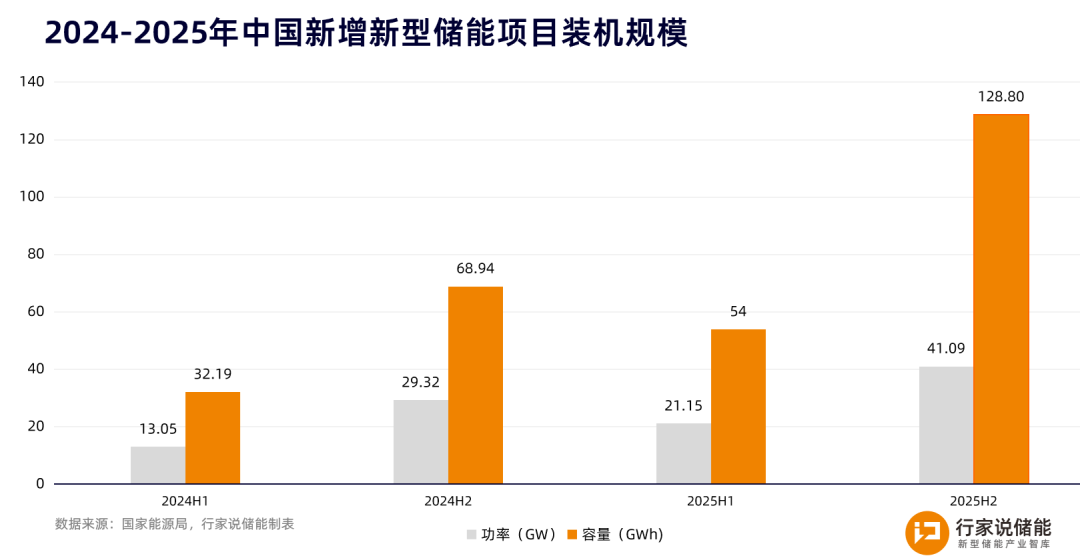
Core Insights - The new energy storage capacity in China is projected to reach 136 million kilowatts (351 GWh) by the end of 2025, marking an 84% increase from the end of 2024 and over a 40-fold growth compared to the end of the 13th Five-Year Plan [1][11][20] Capacity Growth - By the end of 2024, the cumulative installed capacity of new energy storage projects in China was 73.76 GW (168 GWh), with an estimated addition of 62.24 GW (183 GWh) in 2025 [3][14] - The average storage duration has increased to 2.58 hours, up by 0.30 hours from the end of 2024 [1][11] Regional Distribution - North China has the largest share of installed capacity, accounting for 32.5%, followed by Northwest China at 28.2%, East China at 14.4%, Southern China at 13.1%, Central China at 11.1%, and Northeast China at 0.7% [5][13] - The main growth regions for new energy storage in the past year were North and Northwest China, contributing 35.2% and 31.6% of the new installations, respectively [5][13] Provincial Development - Rapid development of new energy storage is observed in provinces such as Xinjiang, Inner Mongolia, Yunnan, Hebei, and Shandong, with new installations of 10.23 million, 10.03 million, 6.13 million, 5.69 million, and 4.04 million kilowatts, respectively [7][16] - The top three provinces by cumulative installed capacity are Inner Mongolia (20.26 million kW), Xinjiang (18.80 million kW), and Shandong (11.21 million kW) [7][16] Project Scale and Technology - Projects with capacities over 100,000 kW represent 72% of total installations, an increase of approximately 10 percentage points from 2024 [7][16] - Lithium-ion battery storage remains dominant, accounting for 96.1% of the installed capacity, while other technologies like compressed air and flow batteries make up 3.9% [7][16] Utilization and Future Plans - The equivalent utilization hours for new energy storage are expected to reach 1,195 hours in 2025, an increase of nearly 300 hours from 2024 [9][18] - The National Energy Administration plans to implement a comprehensive development plan for new energy storage, focusing on policy management, technological innovation, and high-quality development [9][18] Electricity Market Trends - The total electricity market transaction volume in China reached 664 billion kWh in 2025, a year-on-year increase of 7.4% [11][20] - Market-based transactions accounted for 64% of total electricity consumption, reflecting a 1.3 percentage point increase [11][20] - Cross-provincial electricity transactions reached a record 1.59 trillion kWh, growing by 11.6% year-on-year [11][20] - Green electricity transactions surged to 328.5 billion kWh, a 38.3% increase, representing 18 times the volume of 2022 [11][20]
电力行业2026年度投资策略
2025-12-31 16:02
Summary of Key Points from the Conference Call Industry Overview - The conference call focuses on the **electric power industry** and its investment strategies for 2026, particularly in the context of coal-fired power, nuclear power, and renewable energy sectors [1][2][3]. Core Insights and Arguments Coal-Fired Power - The **price mechanism reform** initiated in 2021 has broken the previous constraints on electricity prices, allowing for potential increases, which is expected to enhance the competitiveness of coal-fired power [2][3]. - The performance of coal-fired power is typically stronger in the first half of the year, influenced by annual trading negotiations and coal price trends [3]. - Future competitiveness will be bolstered by the implementation of capacity compensation and auxiliary service markets over the next couple of years [1][3]. - Key investment considerations include **cost, region, and dividend yield** [3][4]. Nuclear Power - Nuclear power assets are characterized by high quality and significant growth potential, with a projected compound annual growth rate (CAGR) of nearly 10% over the next 5-6 years [2][10]. - Short-term challenges include high market transaction ratios and price reductions in coastal regions, which have already impacted revenue per kilowatt-hour [10][11]. - Long-term growth potential remains strong, making nuclear power a focus for investment despite short-term market risks [11]. Renewable Energy - The **dual carbon goals** have led to large-scale renewable energy projects, but issues with adjustment and transmission capabilities have resulted in increased curtailment of wind and solar energy [4][5]. - Market pressures have caused a decline in electricity prices for mainstream renewable companies, affecting both new and existing projects [5]. - Despite fundamental pressures, Hong Kong-listed renewable companies benefit from policy support, which attracts investment [5][6]. - Investment strategies in renewable energy include targeting regions with less market pressure and selecting undervalued state-owned enterprises, particularly in wind energy [7][8]. Additional Important Content - The **15th Five-Year Plan** emphasizes green development, with measures such as price mechanism reforms and the inclusion of high-energy-consuming industries in mandatory consumption systems [6]. - Recent subsidies have alleviated cash flow issues related to renewable energy, but the pace of policy implementation remains uncertain, keeping green energy investments speculative [6]. - Water power investments can be approached through two strategies: short-term opportunities in small hydropower companies and capturing the dividend value of leading companies like Changjiang Power and Guotou [9]. Investment Recommendations - For coal-fired power, focus on companies with integrated cost advantages and strong dividend yields, particularly in northern regions [12]. - In nuclear power, while short-term observation is advised, long-term positioning is recommended due to substantial growth potential [11]. - Water power investments are currently more favorable due to lower valuations and less impact from market pressures [12]. - In renewable energy, consider stable coastal entities or leading companies in Hong Kong for undervalued opportunities [12].
透视A股并购新局 市场化交易占比提升,并购“卖方”变“买方”
2 1 Shi Ji Jing Ji Bao Dao· 2025-11-25 23:59
Core Insights - The A-share merger and acquisition (M&A) market has seen significant activity driven by policy changes, particularly following the introduction of the "Six M&A Guidelines" on September 24, 2024, leading to a total of 5,868 disclosed M&A events by November 24, 2025, with 2,745 transactions involving equity purchases by listed companies and their subsidiaries [1][2] - The total transaction value of these M&A activities reached 7.49 trillion yuan, indicating a substantial increase in both scale and number compared to previous years [1] - A notable trend is the shift from being frequent targets of acquisitions to becoming buyers in the M&A market, particularly among star enterprises from the primary market [1][6] Market Trends - The proportion of market-driven transactions has significantly increased, with non-related party transactions accounting for over 70% of the 2,745 equity transactions since the "Six M&A Guidelines" were released [2] - In major restructuring transactions, while related party transactions still dominate in terms of value, the share of non-related party transactions has risen markedly compared to the previous year [2] Transaction Challenges - Market-driven transactions generally face higher difficulties, with a termination rate of nearly 60% for non-related party major restructuring transactions last year, compared to a termination rate of about 30% for related transactions [3] - This year, 24% of disclosed non-related party major restructuring transactions have been terminated, indicating ongoing challenges in successfully completing these deals [3] Notable Cases - Specific cases illustrate the challenges faced in market-driven M&A, such as the failed acquisition of Huimang Micro by Yingjixin, which was terminated less than two weeks after the announcement due to disagreements on core terms [4][5] - The trend of primary market star enterprises transitioning to buyers is exemplified by Zhiyuan Robotics' acquisition of Shangwei New Materials, marking a significant shift in strategy [6][7] Valuation Discrepancies - There exists a significant valuation gap between assets in the M&A market and those in the IPO market, complicating negotiations and increasing the difficulty of transactions [8] - Acquiring small-cap listed companies allows primary market enterprises to leverage capital market platforms for smoother financing and capital operations, enhancing the quality of existing listed companies [9]
透视A股并购新局:市场化交易占比提升,并购“卖方”变“买方”
2 1 Shi Ji Jing Ji Bao Dao· 2025-11-25 11:41
Core Insights - The M&A market has been significantly boosted by policy initiatives, particularly the introduction of the "Six M&A Guidelines," leading to a notable increase in activity and a strong demand for industry consolidation [1][2] - As of November 24, 2024, there have been 5,868 disclosed M&A events in the A-share market, with 2,745 transactions involving equity purchases by listed companies or their subsidiaries, totaling a transaction value of 7.49 trillion yuan [1][2] - A shift is observed where non-related transactions have increased, accounting for over 70% of the total equity transactions since the "Six M&A Guidelines" were released [2] Group 1: M&A Market Trends - The number of non-related transactions has risen significantly, with 1,992 out of 2,745 equity transactions being non-related, marking a substantial increase compared to previous years [2] - In terms of major restructuring transactions, there were 208 disclosed since September 24, 2023, with 137 being related and 71 non-related, indicating a growing trend towards non-related deals [2] - The termination rate for non-related transactions is higher than that for related transactions, with 24% of non-related major restructurings failing this year compared to 19% for related ones [3] Group 2: Challenges in Market Transactions - Market-driven transactions are generally more complex, with a high termination rate observed in non-related major restructurings, highlighting the difficulties in negotiations and agreement on core terms [3][5] - Notable examples include the failed acquisition attempts by companies like Yingjixin and Mengtian Home, which faced challenges in reaching consensus on key transaction terms [3][5] - The trend of IPO candidates or star companies transitioning from seeking independent listings to pursuing acquisitions of smaller listed companies is becoming more prevalent [6][8] Group 3: Valuation Discrepancies - There exists a significant valuation gap between assets in the M&A market and those in the IPO market, complicating negotiations and increasing the difficulty of reaching agreements [8] - Many small-cap companies are facing operational challenges and may become "zombie" companies, which could lead to their acquisition by higher-quality firms from the primary market, thus revitalizing their growth potential [8]
中国核电20250902
2025-09-02 14:41
Summary of China Nuclear Power Conference Call Company Overview - **Company**: China Nuclear Power - **Industry**: Nuclear and Renewable Energy Key Points Financial Performance - In the first half of 2025, China Nuclear Power achieved revenue of **33.373 billion yuan**, a year-on-year increase of **6.54%** [2] - The net profit attributable to shareholders was **5.322 billion yuan**, up **9.48%** year-on-year [2] - The total electricity generated was **121.776 billion kWh**, with revenue from nuclear power reaching **40.973 billion yuan** [4] Nuclear Power Operations - The company currently operates **26 nuclear units** with a total installed capacity of **25 million kW** [4] - There are **18 units** under construction or approved for construction, with a combined capacity of **21.859 million kW** [2] - By 2031, the company expects to have a total operational capacity of **46.859 million kW**, representing an **87%** increase from current levels [2][5] Renewable Energy Business - As of June 30, 2025, the company had **33.2249 million kW** of renewable energy capacity in operation, including **10.3418 million kW** of wind and **22.8831 million kW** of solar [6] - The electricity generated from renewable sources was **21.915 billion kWh**, a **35.76%** increase year-on-year [6] - However, net profit from renewable energy dropped **66.28%** to **344 million yuan** due to regional power restrictions and increased depreciation costs [6] Market Dynamics - The average market price for renewable energy sales was approximately **0.28 yuan/kWh**, slightly down by **0.01 yuan/kWh** year-on-year [9] - The company anticipates stable electricity prices in Jiangsu province next year, with a gradual increase in market share [10] Cost Management - Uranium fuel costs are expected to remain stable between **60-80 USD** due to long-term contracts with suppliers [3][11] - The company has implemented cost control measures, which contributed to better-than-expected performance in net profit despite challenges [20] Strategic Planning - The company plans to focus on increasing wind power projects while reducing the scale of solar installations in its **15th Five-Year Plan** [4][14] - Following the implementation of Document 136, the company is optimizing project layouts and shifting focus from the northwest to the southeast coastal areas for better market conditions [16] Dividend Policy - The company maintains a mid-term dividend policy with a payout ratio of no less than **35%**, which is expected to gradually increase [23] - The dividend payout ratio for 2025 reached **41%**, with projections of **70-80%** if only existing units are operated [24] Challenges and Risks - Some renewable projects in the northwest are facing losses due to power restrictions and declining market prices, but overall losses are manageable [25] - The company is exploring solutions to address the issue of electricity transmission lagging behind power generation in the northwest region [19] Future Outlook - The capital expenditure for renewable energy is expected to remain stable but gradually decrease as projects are completed [17] - The company is preparing for the merger of its subsidiary, China Nuclear Huaneng, with Xinhua Hydropower, which is currently in the planning stage [13] This summary encapsulates the key insights from the conference call, highlighting the company's performance, strategic direction, and market conditions.

甘肃能源(000791):水火板块表现优异 风光电价承压
Xin Lang Cai Jing· 2025-08-15 12:30
Core Viewpoint - Gansu Energy reported a slight increase in revenue and a significant rise in net profit for the first half of 2025, driven by strong performance in the hydropower and thermal power sectors, despite challenges in renewable energy pricing [1][2][3][4]. Group 1: Financial Performance - In H1 2025, Gansu Energy achieved revenue of 3.931 billion yuan, a year-on-year increase of 0.19%, and a net profit attributable to shareholders of 825 million yuan, up 16.87% year-on-year [1]. - Q2 2025 revenue was 1.692 billion yuan, down 0.73% year-on-year and 24.40% quarter-on-quarter, with net profit of 345 million yuan, reflecting a year-on-year increase of 1.16% but a quarter-on-quarter decrease of 28.04% [1]. - The hydropower segment saw a significant increase in on-grid electricity prices, up 39.99% year-on-year to 0.376 yuan/kWh, with a gross margin increase of 6.07 percentage points to 31.17% [1]. Group 2: Segment Performance - The thermal power segment showed strong results with on-grid electricity volume increasing by 5.46% year-on-year to 8.879 billion kWh and on-grid electricity price rising by 2.30% to 0.369 yuan/kWh [2]. - The net profit from the thermal power segment increased by 57.59% year-on-year to 1 billion yuan, with a calculated net profit per kWh of 0.113 yuan, up 3.7 cents year-on-year [2]. - The company anticipates further profit growth from the thermal power segment with the commissioning of new coal-fired units in the second half of 2025 [2]. Group 3: Renewable Energy Challenges - The company faced significant pressure in the wind and solar segments, with on-grid electricity prices decreasing by 33.80% and 17.17% year-on-year to 0.365 yuan/kWh and 0.3 yuan/kWh, respectively [3]. - The gross margins for wind and solar energy dropped by 30.41 and 12.75 percentage points to 27.45% and 23.77% [3]. - No new renewable energy installations were added in H1 2025, with approved capacities for wind and solar at 1.25025 million kW and 3.85 million kW, respectively [3]. Group 4: Profit Forecast and Valuation - The company revised down its net profit forecasts for 2025-2027 by 0.22%, 6.13%, and 7.48% to 1.895 billion yuan, 2.247 billion yuan, and 2.317 billion yuan, respectively [4]. - The downward revision is attributed to significant pressure on wind and solar electricity prices, with reductions of 27.58%, 28.13%, and 28.71% for wind and 14.21%, 14.63%, and 15.54% for solar over the same period [4]. - The target price was adjusted to 8.18 yuan based on a 14.0x 2025E PE, maintaining a "buy" rating [4].

福能股份20250620
2025-06-23 02:09
Summary of Fuzhou Energy Co., Ltd. Conference Call Company Overview - **Company**: Fuzhou Energy Co., Ltd. (福能股份) - **Date**: Q2 2025 Conference Call Key Points Industry Insights - **Wind Power**: - Slightly poorer wind conditions in Fujian Province compared to the same period last year, but Q1 showed good wind conditions, leading to an expected annual wind power generation increase of approximately 20% [2][4] - **Thermal Power**: - Power generation from thermal sources decreased by approximately 200-300 million kWh from January to May 2025 due to weak electricity demand, but improvement is expected during the peak summer demand period [2][4][5] Financial Performance - **Coal Procurement**: - The price of coal has been declining, with the current price for standard coal (including tax) at 880-890 RMB/ton. The company plans to procure 1.3-1.4 million tons of long-term coal, with a high fulfillment rate in the first half of the year [2][6] - **Natural Gas Power Generation**: - Improved performance in natural gas power generation business, with the National Development and Reform Commission raising the natural gas grid price to 0.645 RMB/kWh retroactively effective from January 1, 2025 [2][7] - **Investment Returns**: - Good performance from equity investments, particularly from Huaneng Wenzhou thermal power project benefiting from lower coal prices, with expected investment returns higher than last year [2][8] Market Dynamics - **Desulfurization Trading**: - In Fujian Province, approximately 20%-30% of desulfurization projects participate in market trading annually under the old system. The average bidding price for land-based wind power desulfurization is 0.4136 RMB/kWh [2][9] - **Market Pricing for Wind Power**: - The minimum wind power price in Fujian is approximately 0.35 RMB/kWh, with expectations for stable pricing due to historical lack of consumption issues [2][10] Future Plans - **Dividend Policy**: - The company commits to a minimum of 10% mid-term dividend by the end of 2025, with an overall dividend ratio of at least 35%, higher than last year [2][20] - **Project Development**: - The company has significant offshore wind power reserves in Ningde, with plans for multiple projects including pumped storage projects and thermal power plants, expected to provide good cash flow [2][12][18] Additional Considerations - **Electricity Market Dynamics**: - In 2025, 80% of Fujian's electricity market transactions are long-term contracts, with 10% each for monthly and spot trading. The average price for long-term contracts is approximately 0.4441 RMB/kWh [2][16] - **Profitability Trends**: - The company reported a profit of 520 million RMB in Q1 2025, an increase of 280 million RMB year-on-year, despite some segments experiencing losses [2][19] This summary encapsulates the key insights and financial performance of Fuzhou Energy Co., Ltd. as discussed in the conference call, highlighting the company's strategic direction and market conditions.

太阳能(000591) - 2025年5月28日 投资者关系活动记录表
2025-05-29 01:12
Group 1: Company Overview and Future Plans - The company aims to exceed a total scale of 13.6 GW for operational, under construction, and planned power stations by the end of 2025, with projected revenue of CNY 5.26 billion and net profit not less than CNY 1.318 billion [2] - The company expects to add approximately 1.5 GW of new installed capacity in 2025, with total investment in photovoltaic power stations estimated at around CNY 6 billion, assuming a cost of CNY 4 per watt [3] Group 2: Market Performance - In 2024, the total electricity traded in the market was 3.283 billion kWh, an increase of 858 million kWh year-on-year, accounting for approximately 47.07% of the company's total sales volume [4] - The average market transaction price was approximately CNY 0.2172 per kWh, excluding subsidies [4] Group 3: Dividend Policy - Over the past three years, the company has distributed a total cash dividend of approximately CNY 1.512 billion, with a dividend payout ratio of about 36% of the average annual net profit attributable to shareholders [5] Group 4: Project Distribution and Acquisition Criteria - Current construction projects are primarily located in East China, Central China, North China, Xinjiang, and South China [6] - The company evaluates acquisition projects based on compliance, yield, and local consumption conditions, focusing on projects that meet compliance requirements, have suitable yields, and present lower risks [8]

长江电力:2024年报&2025一季报点评:发电量稳增,财务费用持续改善-20250501
Soochow Securities· 2025-05-01 12:25
Investment Rating - The investment rating for the company is "Buy" [1] Core Views - The company has shown steady growth in power generation, with a significant improvement in financial expenses [8][10] - The company aims to achieve a power generation target of 300 billion kWh in 2025, supported by favorable water resource conditions [10][15] - The company has increased its market-oriented trading volume, which is expected to enhance revenue and pricing [13][14] Summary by Relevant Sections Financial Performance - In 2024, the company achieved total revenue of 84,492 million yuan, a year-on-year increase of 8.12%, and a net profit attributable to shareholders of 32,496 million yuan, up 19.28% [9][10] - For Q1 2025, the company reported revenue of 17,015 million yuan, a growth of 8.68%, and a net profit of 5,181 million yuan, reflecting a 30.56% increase [9][10] - The company's financial expenses decreased significantly, contributing to higher profit growth rates compared to revenue growth [10][12] Operational Highlights - The total installed capacity of hydropower is 71,795 MW, with domestic hydropower accounting for 16.45% of the national total [10] - The company’s six hydropower stations generated 295.904 billion kWh in 2024, a 7.11% increase year-on-year [10][12] - The company has successfully implemented market-oriented pricing strategies, with the proportion of market transactions rising to 38.6% in 2024 [13][14] Future Outlook - The company has revised its profit forecasts for 2025-2027, projecting net profits of 35,028 million yuan, 36,715 million yuan, and 37,087 million yuan respectively, with growth rates of 7.8%, 4.8%, and 1.0% [15] - The expected dividend payout ratio for 2025 is 70%, translating to a dividend yield of 3.4% [15]