替代能源

Search documents
中金 | 机械:中东地缘冲突下,关注油气能源运输、替代能源与防御性板块
中金点睛· 2026-03-22 23:54
Core Viewpoint - The article highlights the impact of rising energy prices due to recent geopolitical conflicts in the Middle East, leading to a clear differentiation in the mechanical industry, with positive trends in oil and gas energy, transportation, and alternative energy sectors [1] Oil and Gas Energy and Transportation Sector - Oilfield services are expected to benefit from high oil and gas prices, improving profitability and potentially increasing capital expenditures due to OPEC+ production adjustments and energy supply demands [2] - The shipping industry, particularly VLCCs, is poised to gain from a shortage of compliant capacity, increased oil production distances, and improved economics for shipowners, alongside demand for Capesize bulk carriers driven by West African bauxite projects [2] - Container shipping may face regional supply-demand mismatches and price increases if navigation through the Strait of Hormuz is disrupted, despite only 2.8% of global container routes passing through it [2] Alternative Energy Sector - The rise in oil prices is expected to boost demand for coal and wind-solar storage alternatives, with coal machinery and coal chemical equipment likely to see stable demand as coal production capacity utilization improves [2] - Recent policy changes in Europe, such as the removal of tariffs on offshore wind components and the introduction of the EU's Clean Energy Investment Strategy, are anticipated to accelerate the demand for clean energy, benefiting wind-solar storage equipment [2] Defensive Sector - High oil prices may lead to inflation, making the railway sector attractive due to its counter-cyclical nature, stable cash flows, and high dividend rates [3] - The engineering machinery sector is noted for its strong global competitiveness, with limited exposure to North America and the Middle East, and steady growth in Asia, Africa, and Latin America, making it less susceptible to geopolitical conflicts [3]

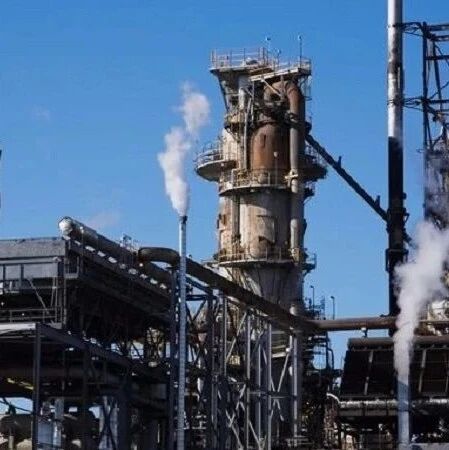
港股周观点:地缘阴云下,油气之外还应关注什么?-20260316
Soochow Securities· 2026-03-16 05:11
Group 1 - The report highlights that global markets experienced a decline, with the Hang Seng Index dropping by 1.1% while the Hang Seng Technology Index increased by 0.6% during the week of March 9-13, 2026 [1][2] - The energy sector led the gains with a 6.2% increase, while the financial sector faced the largest decline at 4.4% [1][2] - The geopolitical tensions in the Middle East have led to a rise in oil prices, impacting the profitability of the technology sector and increasing market volatility [1][3] Group 2 - The report suggests that investors should remain cautious with their positions in the Hong Kong stock market, focusing on sectors related to energy, military, and renewable energy [3] - The report indicates that the "calculation power for all" policy supports the AI sector, while high oil prices enhance the defensive attributes of the lithium battery and energy storage industries [1][3] - The report notes that there is a significant net inflow of capital from mainland China into Hong Kong, particularly in the technology, healthcare, and non-essential consumer sectors [2][12] Group 3 - Upcoming key data and events include the NVIDIA GTC conference, China's retail sales data, and the U.S. Federal Reserve's interest rate decision [4][30] - The report emphasizes the importance of monitoring the earnings reports of major internet companies, which are expected to influence market sentiment [3][4] - The report also mentions that the IPO market in Hong Kong is showing signs of recovery, with a total of 47.8 billion HKD raised in the week [2][4]
焦煤、焦炭日报-20260310
Yin He Qi Huo· 2026-03-10 11:10
Report Industry Investment Rating - Not provided in the report Core Viewpoints - The sharp rise in oil and gas prices drives up the price of thermal coal as an alternative energy source, which in turn supports coking coal. The price center of coking coal is passively lifted, and funds and sentiment flow into coking coal futures, pushing up its price. Currently, the fundamental factors of coking coal are secondary, and funds and sentiment amplify price elasticity. Before the conflict eases or ends, coking coal prices may follow the upward trend of oil and gas. It is advisable to wait for a pullback and then go long on dips [4]. Summary by Directory Market Information - **Futures Prices**: The prices of coking coal and coke futures contracts all increased. For example, the JM01 coking coal futures price rose from 1426 to 1468, and the J01 coke futures price rose from 1855.5 to 1906 [2]. - **Spot Prices**: Some coking coal and coke spot prices increased. For instance, the price of Mongolian 5 raw coal at the port increased by 40 to 1060, and the price of port quasi - first - grade (wet quenching) coke increased by 10 to 1480 [2]. - **Warehouse Receipts**: The warehouse receipts of coking coal and coke also changed. For example, the Mongolian 5 coking coal warehouse receipt increased by 47 to 1221, and the port spot (wet quenching) coke warehouse receipt increased by 11 to 1591 [2]. - **Basis**: The basis of coking coal and coke showed different values for different contracts and varieties [2]. - **Transportation Prices**: The transportation prices of coking coal and coke remained stable [2]. Market Judgement - **Trading Strategy** - **Single - side**: It is recommended to wait and see due to large fluctuations. From the perspective of valuation and risk - return ratio, one can also go long on dips. In the medium term, it is expected to continue wide - range fluctuations, and it is advisable to conduct band trading [5]. - **Arbitrage**: It is recommended to wait and see [6]. - **Options**: Take profit on selling out - of - the - money put options [7]. - **Related Prices**: The report provides the warehouse receipt prices of coke and coking coal, such as the 1591 yuan/ton for Rizhao Port quasi - first - grade (wet quenching) coke warehouse receipt and 1170 yuan/ton for Shanxi coking coal warehouse receipt [8]. - **Important Information** - Some coal prices in the Shanxi Lvliang area rebounded. For example, the price of medium - sulfur lean coal increased by 50 to 1170 yuan/ton, and the price of medium - sulfur main coking coal increased by 30 to 1190 yuan/ton [10]. - The import of thermal coal continued to rise. The bid price of 3800 - calorie coal was 69.72 US dollars CIF, and the terminal had not responded. The arrival cost increased significantly, and attention should be paid to RKAB and the international situation [10]. Related Attachments - The report provides multiple charts, including the coke comprehensive absolute price index, Mongolian 5 clean coal price, coking coal basis, coke price index, etc., showing the price trends from 2021 to 2026 [12][14][18]
周期专场-冲突催化-春意几何-聚焦中东局势下的利好标的
2026-03-04 14:17
Summary of Key Points from Conference Call Records Industry Focus - **Coal Chemical Industry**: The rising oil prices enhance the economic viability of coal-to-chemical routes, with significant orders in Xinjiang coal chemical estimated at approximately 800 billion CNY. Leading companies include China Chemical, Donghua Technology, and 3D Chemical, which are expected to benefit from capital expenditure expansion [1][2][3]. Core Insights and Arguments - **China Chemical**: The price of adiponitrile has recently increased by over 1,000 CNY/ton. The company is expected to see performance elasticity as it ramps up production in 2026. The overall valuation is around 7-8 times PE [1][4]. - **3D Chemical**: The company has opportunities to raise prices for propanol, with a market share exceeding 90% in sulfur recovery EPC. The order elasticity is significant, with potential orders reaching close to 100 billion CNY [1][5]. - **Northern International**: The company has a European power generation exposure of about 500 million kWh. A 0.2 CNY/kWh increase in electricity prices corresponds to a profit increase of approximately 100 million CNY. The expected coal trade volume in 2026 is 4.5-5 million tons, with a central profit estimate of about 700 million CNY [1][6]. Additional Important Content - **Real Estate Market**: New home transactions in March showed a slight year-on-year decline, with a focus on potential interest rate cuts. Long-term investments are being made in companies like China Resources and China Overseas [1][8]. - **Oil Shipping**: VLCC rates have reached a new high of 400,000 USD/day, with an annual average expected to reach 130,000 USD/day. A 10,000 USD/day increase in TCE is projected to enhance annual net profits for China Merchants Energy and COSCO Shipping by approximately 1.1 billion CNY and 950 million CNY, respectively [1][12]. - **Port Sector**: The opening of the Pinglu Canal is expected to significantly increase throughput at the Beibu Gulf Port, driving volume growth and profit margin recovery [2][13]. Investment Strategy - **Short-term and Mid-term Focus**: In the short term, the focus is on policy-driven market movements, with specific attention to companies like New Town Holdings and Binjiang Group. In the mid-term, there is optimism for stabilization in certain cities, with long-term funds beginning to accumulate positions in value-oriented companies [1][11]. This summary encapsulates the key insights and data points from the conference call, highlighting the potential investment opportunities and risks within the coal chemical, real estate, oil shipping, and port sectors.


上海石化预亏近15亿元,2025年化工品价格大跌
Hua Xia Shi Bao· 2026-01-24 02:17
Core Viewpoint - Shanghai Petrochemical is expected to report a net loss of approximately 1.289 billion to 1.576 billion yuan in 2025, primarily due to declining international crude oil prices and reduced demand for its products [2] Group 1: Financial Performance - In 2025, Shanghai Petrochemical anticipates a net profit loss of about 12.89 billion to 15.76 billion yuan, with a similar range for its non-recurring net profit loss [2] - The company reported significant losses in 2022 and 2023, with a net loss of 2.872 billion yuan in 2022 and a net loss of 1.406 billion yuan in 2023 [6][7] - The revenue for 2022 was 82.518 billion yuan, a decrease of 7.57% year-on-year, while 2023 saw an increase in revenue to 93.014 billion yuan, a growth of 12.72% [6] Group 2: Market Conditions - The average annual price of WTI crude oil in 2025 is projected to be $64.73 per barrel, a decrease of 14.55% year-on-year, while Brent crude is expected to average $68.19 per barrel, down 14.62% [3] - Domestic gasoline and diesel prices are also expected to decline in 2025, with gasoline averaging 8,282 yuan per ton (down 5.76%) and diesel at 7,146 yuan per ton (down 5.51%) [3] Group 3: Product Pricing and Demand - The prices of key chemical products produced by Shanghai Petrochemical, such as polyethylene and polypropylene, are expected to decline significantly in 2025, with polyethylene prices dropping by 20.28% [4] - The average price of paraxylene is projected to decrease from $940.74 per ton in 2024 to $814.75 per ton in 2025, reflecting a 13.39% decline [5] - The demand for traditional petroleum products is under pressure due to the rise of electric vehicles and alternative energy sources, leading to a decrease in gasoline and diesel consumption [7] Group 4: Operational Challenges - The company faced operational challenges due to maintenance shutdowns, which impacted production and increased material and energy consumption [5] - The overall refining profit margin for independent refineries in Shandong is projected to be low, averaging 260.1 yuan per ton in 2025 [4]

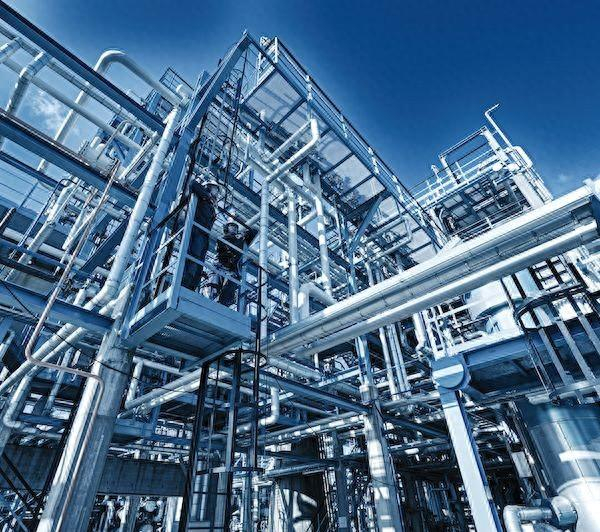
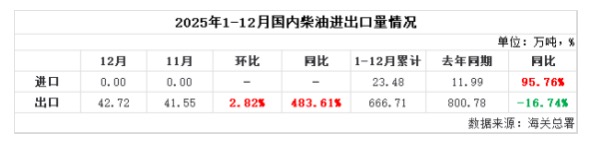
替代能源持续发力挤占需求 2025年12月柴油出口小幅增量
Zhong Guo Neng Yuan Wang· 2026-01-21 10:06
Core Viewpoint - In December 2025, China's diesel exports showed a significant increase both month-on-month and year-on-year, while the cumulative annual export volume experienced a decline. The market dynamics indicate a shift towards alternative energy sources impacting diesel demand, despite a temporary rebound in exports due to stable logistics and construction activities [1][2][3]. Group 1: Export Data - In December 2025, diesel export volume reached 427,200 tons, marking a month-on-month increase of 2.82% and a year-on-year increase of 483.61% [1][2]. - The cumulative diesel export volume for the year 2025 was 6,667,100 tons, reflecting a year-on-year decline of 16.74% [1][2]. - The export destinations expanded from 18 to 26 countries, with Bangladesh, the Philippines, and Singapore being the top three destinations [3]. Group 2: Import Data - There were no diesel imports recorded in December 2025, while the cumulative import volume for the year was 234,800 tons, representing a year-on-year increase of 95.76% [1][2]. Group 3: Market Dynamics - The logistics and construction industry showed stable performance, contributing to the slight rebound in diesel exports [2]. - The penetration of alternative energy vehicles, particularly in the logistics sector, is increasingly suppressing diesel demand, with new energy heavy truck sales rising by 198% year-on-year in December [2]. - The current export quota remains similar to the previous year, with no significant easing of export policies, which may limit future diesel export volumes [3].
Why Is Ormat Technologies (ORA) Up 1.8% Since Last Earnings Report?
ZACKS· 2025-12-03 17:36
Core Viewpoint - Ormat Technologies reported strong Q3 2025 earnings, surpassing estimates and raising revenue guidance for 2025, indicating positive momentum despite a slight year-over-year decline in adjusted earnings per share [2][8]. Financial Performance - Adjusted earnings per share for Q3 2025 were 41 cents, exceeding the Zacks Consensus Estimate of 37 cents by 10.8%, but down 2.4% from 42 cents in the same quarter last year [2]. - Total revenues reached $249.7 million, surpassing the Zacks Consensus Estimate of $233 million by 7% and increasing 17.9% year-over-year [3]. - Operating income rose 13.3% year-over-year to $40.4 million, while total operating expenses decreased by 9.2% to $26.4 million [6]. Segment Performance - Electricity segment revenues were $167.1 million, up 1.5% year-over-year, driven by the Blue Mountain acquisition and improved performance at Dixie Valley [4]. - Product segment revenues surged 66.6% to $62.2 million, attributed to the timing of revenue recognition from manufacturing and construction progress [4]. - Energy segment revenues increased significantly by 108.1% to $20.4 million, supported by contributions from the Bottleneck facility, Montague, and Lower Rio [5]. Financial Condition - As of September 30, 2025, Ormat had cash and cash equivalents of $79.6 million, down from $94.4 million as of December 31, 2024 [7]. 2025 Guidance - The company updated its revenue guidance for 2025 to a range of $960-$980 million, compared to the previous range of $935-$975 million, with the Zacks Consensus Estimate at $956.4 million [8]. - Expected revenues for the Electricity segment are now projected between $700-$705 million, Product segment revenues between $190-$200 million, and Energy Storage segment revenues between $70 million and $75 million [9]. Market Reaction - Since the earnings release, there has been a flat trend in estimates revision, with the consensus estimate shifting down by 5.48% [10]. - Ormat Technologies holds a Zacks Rank 3 (Hold), indicating an expectation of an in-line return from the stock in the coming months [12].


两个订单,三个涨停板!
证券时报· 2025-12-03 08:48
Core Viewpoint - Jerry Holdings (002353) has recently signed multiple contracts for gas turbine generator sales in North America, each exceeding $100 million, indicating a significant breakthrough in the high-end power market for data centers [5][8]. Group 1: Company Developments - Jerry Holdings achieved its third trading limit up in four days following the announcement of a new sales contract [3]. - The company held a conference call for institutional investors to discuss the new contract, which was not disclosed under standard public company regulations [5]. - This marks the second similar order received by Jerry Holdings within a week, showcasing a growing demand for their products [7]. Group 2: Market Context - The gas turbine generators ordered are designed for various applications, including primary or backup power systems for data centers, off-grid computing parks, and emergency power for urban edge data centers [6]. - The global gas turbine market is projected to grow from $30.24 billion in 2025 to approximately $57.44 billion by 2034, with a compound annual growth rate (CAGR) of 7.4% from 2025 to 2034 [9]. - The increasing energy demands of large data centers, particularly in the U.S., are creating investment opportunities in alternative energy sources, as highlighted by investor Steve Hoffman [8]. Group 3: Competitive Landscape - Major players in the gas turbine market, such as GE, Siemens Energy, and Mitsubishi Power, currently supply about two-thirds of the gas turbines for new natural gas power plants globally, with increasing order backlogs [10]. - The tight capacity among leading U.S. companies may lead to a spillover of orders to Chinese manufacturers, potentially benefiting companies like Jerry Holdings [10].


多家全球资管巨头发布2026年展望科技创新为核心投资主线
Shang Hai Zheng Quan Bao· 2025-11-30 14:09
Core Viewpoint - Major global asset management firms are optimistic about the performance of global risk assets in 2026, driven by a supportive monetary environment and ongoing technological innovation, particularly in artificial intelligence [2][3] Group 1: Global Market Outlook - Fidelity International's Matthew Quigley indicates a generally positive macroeconomic environment for 2026, with resilient economic growth and continued loose monetary and fiscal policies [2] - Schroders' 2026 market outlook predicts strong performance in U.S. equities, particularly the S&P 500 and Russell 2000 indices, and highlights opportunities in Asian technology and European banking and industrial sectors [2] - Wellington Management maintains an overweight stance on global equities, citing robust earnings fundamentals and a favorable policy environment [3] Group 2: Investment Themes - Fidelity International expects the AI investment boom to dominate the market in 2026, with AI-driven profit growth trends continuing, although investors should be aware of the risks associated with unverified commercialization paths [3] - Four main investment themes identified for the A-share market include: 1. Artificial Intelligence, with opportunities across the entire value chain from chips to industry applications [4] 2. Commercial Aerospace, reflecting China's advancement in manufacturing capabilities and the potential for satellite internet [4] 3. Low-altitude Economy, leveraging China's leadership in battery technology and drones for urban air mobility and logistics [4] 4. Innovative Consumption, driven by a shift in consumer demand towards quality, fostering new consumption patterns like smart homes and emerging brands [4]

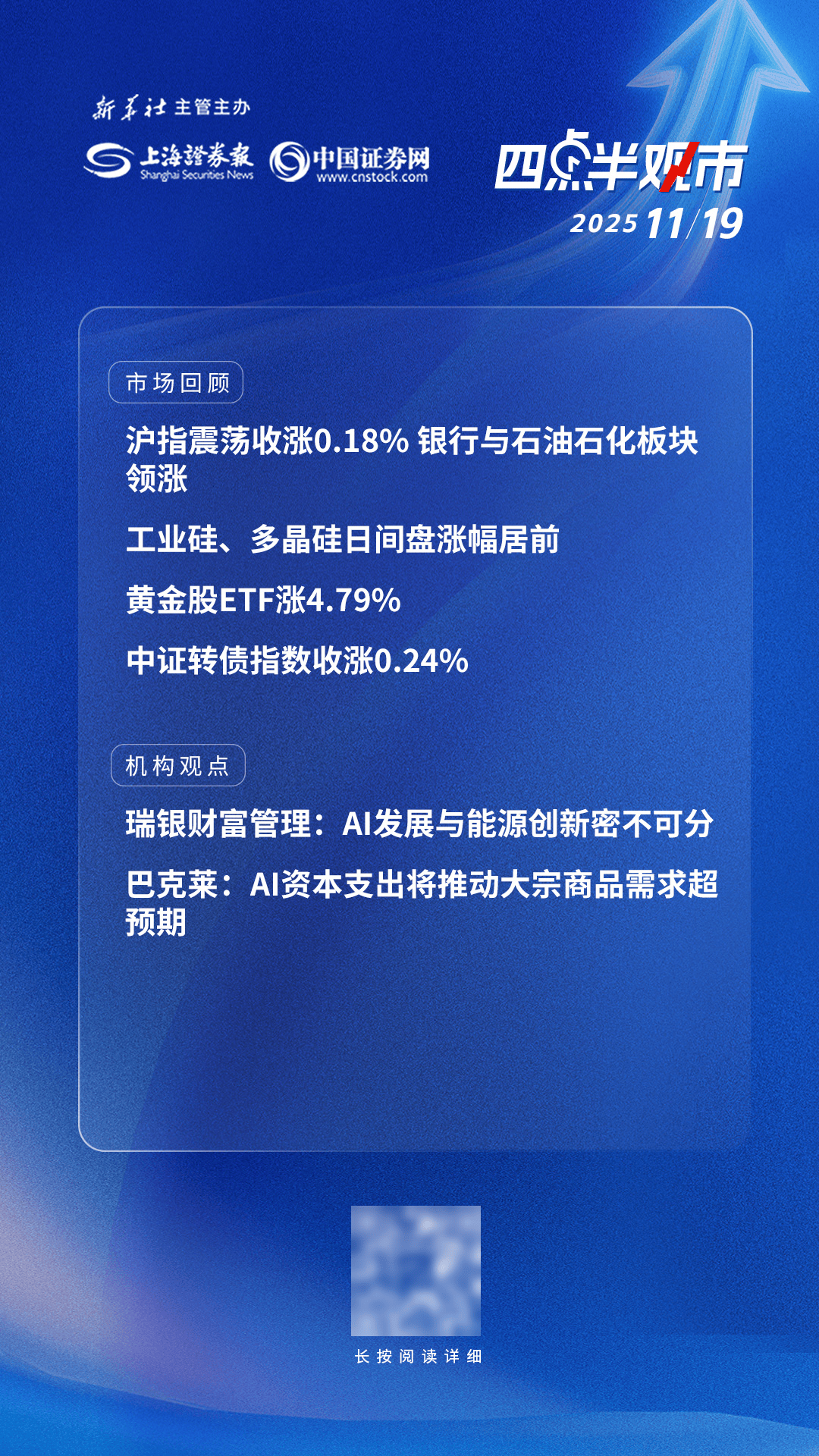
四点半观市 | 机构:AI资本支出将推动大宗商品需求超预期
Sou Hu Cai Jing· 2025-11-19 08:26
Market Overview - On November 19, the A-share market showed stability with significant gains in the banking and oil & petrochemical sectors, leading to a rise in the Shanghai Composite Index by 0.18% [3] - The Nikkei 225 index in Japan fell by 0.34% to 48,537.70 points, while the Korean Composite Index dropped by 0.61% to 3,929.51 points [3] - Domestic government bond futures saw declines across major contracts, with the 30-year bond futures (TL2512) closing at 116.090 yuan, down 0.41% [3] Commodity Market - On the same day, domestic commodity futures exhibited mixed performance, with industrial silicon and polysilicon showing notable gains [4] - The gold stock ETFs experienced significant increases, with the gold stock ETF (517520) rising by 4.79%, and other related ETFs also showing strong performance [5] Convertible Bonds - The China Securities Convertible Bond Index rose by 0.24% to 489.21 points, with notable increases in several convertible bonds, including a 5.74% rise in the large and medium convertible bonds [6] Institutional Insights - Barclays reported that numerous U.S. companies are planning substantial AI-related capital expenditures over the next three to five years, which may lead to unexpectedly high demand for commodities, particularly in the context of rising electricity needs [7] - UBS Wealth Management emphasized the critical role of energy in the development of AI technologies, suggesting a strong correlation between energy innovation and AI advancements [8] - UBS also projected a potential strengthening of the RMB against the USD, possibly reaching 7.05, influenced by seasonal factors and stability in the RMB/USD midpoint [8]