有色金属价格

Search documents
中信证券:大幅波动后仍对贵金属和有色金属价格持乐观预期
Xin Hua Cai Jing· 2026-02-10 00:53
Core Viewpoint - Recent fluctuations in gold prices are driven by changing market perceptions regarding the independence of the Federal Reserve and the evolving situation in Iran, leading to rapid price increases followed by significant declines [1] Market Analysis - The speculative capital in the market has amplified the trend changes in gold prices [1] - Short-term market expectations may have overestimated Kevin Warsh's "hawkish" stance, while uncertainty surrounding the situation in Iran remains high [1] Future Outlook - The company maintains an optimistic outlook for precious and non-ferrous metal prices for the year 2026 [1] Risk Factors - Key risk factors include geopolitical risks, lower-than-expected gold purchases by global central banks, less-than-expected easing by the Federal Reserve, lower-than-expected U.S. fiscal deficits, and U.S. economic growth exceeding expectations [1]

中信证券:维持对贵金属和有色金属价格的乐观预期
Sou Hu Cai Jing· 2026-02-10 00:29
Group 1 - The core viewpoint of the article is that recent fluctuations in gold prices are driven by concerns over the independence of the Federal Reserve and changes in expectations regarding the situation in Iran, leading to a rapid rise followed by significant volatility in gold prices [1] - The market may have overestimated the hawkish stance of the new Federal Reserve Chairman Kevin Walsh, while uncertainty regarding the situation in Iran remains high, suggesting that gold market volatility may only settle once the situation stabilizes [1] - For the year 2026, the company maintains an optimistic outlook on the prices of precious metals and non-ferrous metals [1]
股指期货周报-20260203
Guo Jin Qi Huo· 2026-02-03 08:43
Report Summary 1. Report Industry Investment Rating - Not provided in the content. 2. Core View of the Report - The stock index futures market may maintain an oscillating and differentiated pattern in the short term. The market is mainly focused on the performance of the technology industry, international gold and non - ferrous metal prices, capital flow changes, and policy changes. Overall, the stock index will mainly oscillate and consolidate in the short term, with clear expectations of supporting technological innovation and boosting consumption, providing strong support, but also subject to risks of market sentiment fluctuations [3][4][5]. 3. Summary by Relevant Catalogs 3.1 This Week's Market Trend Review - The stock index futures market showed an obvious differentiation pattern this week. The Shanghai 50 stock index futures were relatively strong, rising oscillatingly throughout the week and falling on Friday. The main contract opened at 3049.8 points, reached a high of 3136.6 points, a low of 3044 points, and closed at 3074 points, up 36.2 points from the previous trading week [2]. - The CSI 300 stock index futures oscillated horizontally throughout the week, surging on Thursday and falling on Friday. The main contract opened at 4726.8 points, reached a high of 4793 points, a low of 4640 points, and closed at 4711 points, up 1.8 points slightly [2]. - The CSI 500 stock index futures oscillated downward this week. The main contract opened at 8695 points, reached a high of 8728.2 points, a low of 8135 points, and closed at 8362.4 points, down 295.8 points from the previous trading week [2]. - The CSI 1000 stock index futures were also weak. The main contract opened at 8541.8 points, reached a high of 8568 points, a low of 8050 points, and closed at 8260.6 points, down 256 points from the previous trading week [2]. 3.2 Performance of Underlying Indexes - The performance of each underlying index was significantly differentiated this week. The weekly increase - decrease rates of the 000016.SH, 000300.SH, and 000852.SH indexes were +1.1313%, +0.0817%, and - 2.5486% respectively [2][3]. 3.3 Market Influencing Factors - **Macroeconomic Factors**: Domestically, the Ministry of Commerce will soon introduce policies to cultivate new growth points in service consumption, involving transportation, housekeeping, online audio - visual, and other fields, and optimize the implementation of consumer goods trade - in, which will support the market in the medium and long term. Internationally, the US economic data was strong, with personal consumption expenditure in November 2025 increasing 0.3% month - on - month and industrial output in December exceeding expectations, affecting global market sentiment [3]. - **Funding Factors**: The market trading volume remained at a high level, with the trading volume of the Shanghai, Shenzhen, and Beijing stock markets ranging from 29,000 to 31,000 billion yuan this week, indicating active trading. Policy - based positive expectations and the continuous net inflow of incremental funds into the stock market are the main supporting forces for the upward movement of the stock index [3]. - **Market Sentiment Factors**: After continuous rises, there were differences in the capital market between chasing up and taking profits, increasing the demand for the stock index to oscillate and consolidate. The market's style preference for small and medium - cap stocks has changed, leading to increased volatility in the IC and IM contracts [3]. 3.4 Short - term Outlook - The stock index futures market may maintain an oscillating and differentiated pattern. Market attention is focused on the performance of the technology industry, international gold and non - ferrous metal prices, capital flow changes, and policy changes. In the short term, the stock index will mainly oscillate and consolidate, with clear expectations of supporting technological innovation and boosting consumption, providing strong support, but also subject to risks of market sentiment fluctuations [3][4][5].
沪铜周报:冠通期货研究报告-20260126
Guan Tong Qi Huo· 2026-01-26 11:42
1. Report Industry Investment Rating There is no information provided regarding the report's industry investment rating. 2. Core Views of the Report - After the market sentiment eased from the Greenland event in the macro - market last week, copper prices rebounded slightly today. Due to fundamental disturbances and the recurrence of macro - level sentiment, copper prices rose steadily and slightly last week. Affected by the sharp decline of the US dollar today, copper prices gapped up, but the upward trend of Shanghai copper before the Spring Festival is expected to be suppressed due to the weakening of the demand side [3]. 3. Summary by Relevant Catalogs 3.1行情分析 (Market Analysis) - **Macro aspect**: US President Trump announced a 10% tariff increase on imported goods from 8 European countries starting February 1, 2026, and to 25% starting June 1, to pressure negotiations on Greenland's sovereignty. After he declared not to use force on Greenland, market tensions eased. With the strengthening of the yen, the US dollar declined continuously during the week, supporting non - ferrous metal prices [3]. - **Supply aspect**: On Thursday, Capstone Copper's Mantoverde copper mine in Chile stopped production due to a strike caused by the failure of collective bargaining between the largest union and the company. The mine's expected cathode copper production in 2025 was 29,000 - 32,000 tons. TC/RC fees remained weakly stable with a further downward trend. SMM estimated that China's electrolytic copper production in January would decrease by 14,500 tons month - on - month (a 1.23% decline) and increase by 156,300 tons year - on - year (a 14.78% increase). The start - up rate of scrap copper enterprises decreased, and the scrap copper market's supply and demand were affected [3]. - **Demand aspect**: As of December 2025, the apparent consumption of copper was 1.3188 million tons, a 4.00% increase from the previous month. Approaching the Spring Festival and with high copper prices, most small and medium - sized enterprises started their holidays, with low procurement willingness for raw materials. The performance of new - energy vehicles at the terminal was poor, while there was a slight increase in traditional industries such as refrigerators and air conditioners [3]. 3.2沪铜价格走势 (Shanghai Copper Price Trend) - This week, Shanghai copper fluctuated strongly. The weekly high was 102,000 yuan/ton, the low was 99,210 yuan/ton, the weekly amplitude was 2.77%, and the range increase/decrease was + 0.57% [5]. 3.3沪铜现货行情 (Shanghai Copper Spot Market) - As of January 26, the average spot premium/discount in East China was - 190 yuan/ton, and in South China it was - 135 yuan/ton. Under the bearish sentiment of downstream enterprises, the spot was traded at a discount, and the sentiment is expected to remain unchanged in the short term [10]. 3.4伦铜价差结构 (LME Copper Spread Structure) - As of January 23, LME copper rose 0.43% during the week, closing at $12,980/ton, with a spot premium of - $59.5/ton [15]. 3.5铜精矿供给 (Copper Concentrate Supply) - In December 2025, China imported 2.704 million physical tons of copper ore and concentrates, a 7% month - on - month and 7.2% year - on - year increase. From January to December 2025, the cumulative import was 30.365 million physical tons, a 7.8% cumulative year - on - year increase. In January 2026, there were strikes and road blockades in some Chilean mines, which were later resolved [19]. 3.6废铜供给 (Scrap Copper Supply) - In December 2025, China imported 239,000 physical tons of copper scrap and waste, a 14.81% month - on - month and 9.88% year - on - year increase. Affected by policy changes and tax inspections, the supply and demand of the scrap copper market were affected [24]. 3.7冶炼厂费用 (Smelter Fees) - As of January 23, China's spot rough smelting fee (TC) was - $50/dry ton, and the RC fee was - 5.18 cents/pound. TC/RC fees remained weakly stable with a downward trend. The China Copper Smelters Purchasing Consortium (CSPT) announced a joint production cut of over 10% in 2026, and the 2026 copper concentrate long - term processing fee was set at $0/ton and 0 cents/pound [29]. 3.8精炼铜供给 (Refined Copper Supply) - In December 2025, SMM's China electrolytic copper production increased by 75,000 tons month - on - month (a 6.8% increase) and 7.54% year - on - year. From January to December 2025, the cumulative production increased by 1.372 million tons (an 11.38% increase). SMM estimated that the domestic electrolytic copper production in January 2026 would decrease by 14,500 tons month - on - month and increase by 156,300 tons year - on - year. In December 2025, the import of unwrought copper and copper products was 437,000 tons, a 21.8% decrease compared to December 2024 [33]. 3.9表观需求 (Apparent Demand) - As of December 2025, the apparent consumption of copper was 1.3188 million tons, a 4.00% increase from the previous month [37]. 3.10下游消费 (Downstream Consumption) - Some copper rod enterprises have entered the holiday state, with a significant decline in the start - up rate. The copper foil market has no obvious fluctuations in transactions, with reduced new orders. Copper tube enterprises have increased low - price replenishment recently, and most small and medium - sized enterprises will start their holidays next week. The downstream demand for copper rods has begun to decline, and copper rod enterprises mainly maintain just - in - time inventory [41]. 3.11电网工程数据 (Power Grid Project Data) - As of the end of November 2025, the national cumulative power generation installed capacity was 3.79 billion kilowatts, a 17.1% year - on - year increase. Among them, solar power installed capacity was 1.16 billion kilowatts (a 41.9% increase), wind power installed capacity was 600 million kilowatts (a 22.4% increase), hydropower installed capacity was 440 million kilowatts (a 3% increase), and nuclear power installed capacity was 60 million kilowatts (a 7.6% increase) [45]. 3.12房地产基建数据 (Real Estate and Infrastructure Data) - In December 2025, the sales area of newly - built commercial housing was 93.99 million square meters, a 39.87% month - on - month increase and a 16.58% year - on - year decrease; the sales volume was 880.7 billion yuan, a 44.07% month - on - month increase and a 24.24% year - on - year decrease [51]. 3.13汽车/新能源汽车产业数据 (Automobile/New - Energy Automobile Industry Data) - The Passenger Car Association predicted that the retail sales of narrow - sense passenger cars in January 2026 would be about 1.8 million, a 20.4% month - on - month decrease and a flat - to - slightly - increasing year - on - year. The retail sales of new - energy vehicles were expected to reach 800,000, but the retail penetration rate dropped to 44.4%. In 2026, the vehicle purchase tax changed from exemption to half - collection, and there were subsidy policies for vehicle replacement [57]. 3.14全球各主要交易所铜库存 (Copper Inventories in Major Global Exchanges) - As of January 23, LME copper inventory increased by 28,125 tons to 171,700 tons week - on - week (a 3.31% increase), and was 33.72% lower year - on - year. COMEX copper inventory was 562,600 tons, a 3.63% week - on - week increase and 473.67% higher year - on - year. On January 22, the combined copper spot inventory in Shanghai and Guangdong bonded areas was 120,600 tons, still increasing. As of January 23, Shanghai Futures copper inventory was 146,800 tons, a 2.53% week - on - week increase, and cathode copper inventory was 225,900 tons, a 5.82% week - on - week increase [62][67].
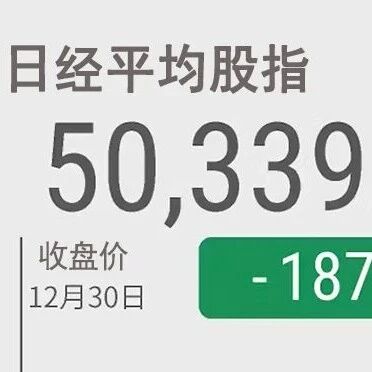
日经股指年终收盘价创新高,收于5万339点
日经中文网· 2025-12-30 07:30
Group 1 - The Nikkei average index fell by 0.37% on December 30, closing at 5,339.48 points, marking a decline of 187.44 points from the previous trading day [2] - Despite the decline, the Nikkei average index has achieved a new year-end closing high for two consecutive years [4] - Market expectations suggest that capital efficiency for Japanese companies will further improve in 2026, providing support for stock prices [4]

广发期货日评-20251107
Guang Fa Qi Huo· 2025-11-07 06:23
1. Report Industry Investment Ratings - No specific industry investment ratings are provided in the report. 2. Core Views - The A - share market is in a repricing adjustment after the quarterly reports, with common short - term rebounds and limited downside risks [2]. - The bond market pricing may tilt towards fundamentals as credit data is expected to weaken in October, and the strong equity market suppresses the bond market [2]. - International gold prices will mainly show a volatile consolidation trend, with silver following gold's fluctuations [2]. - The shipping index (European line) will be volatile in the short term [2]. - The supply of iron elements in the steel market is loose, and there are various trading strategies for different steel - related products [2]. - The prices of some chemical products are affected by supply - demand and cost factors, with limited rebound space or downward pressure [2]. - Agricultural product prices are influenced by factors such as trade negotiations, supply, and production, showing different trends [2]. - Special and new energy products have their own price trends and trading logics [2]. 3. Summary by Related Catalogs Financial Futures - **Stock Index Futures**: After the market冲高兑现预期, there is a slight callback, and the technology sector recovers. A - shares are in repricing adjustment, with short - term rebounds and limited downside risks. It is recommended to wait and see [2]. - **Treasury Bond Futures**: The bond market pricing may tilt towards fundamentals, and the strong equity market suppresses the bond market. It is recommended to go long on a single - side strategy and pay attention to the positive arbitrage strategy due to the rising IRR [2]. - **Precious Metals Futures**: International gold prices will oscillate between 3900 - 4030 dollars, and silver will fluctuate between 47 - 49 dollars [2]. - **Shipping Index Futures (European Line)**: It will be volatile in the short term, and it is recommended to buy on dips for the December contract [2]. Black Metals - **Steel**: The supply of iron elements in the January contract is loose. It is recommended to hold a strategy of going long on coking coal and short on hot - rolled coils, and to go short on the iron ore contract at high prices [2]. - **Iron Ore**: After the shipping volume declines and the arrival volume increases, the port inventory rises, and the iron ore price drops after rising. It is recommended to go short at high prices and consider an arbitrage strategy of going long on coking coal and short on iron ore [2]. - **Coking Coal**: The coal price in the producing area is strong, and the Mongolian coal price is firm. It is recommended to go long on coking coal at low prices and consider an arbitrage strategy of going long on coking coal and short on coke [2]. - **Coke**: The third - round price increase of mainstream coking enterprises has been implemented, and coking coal provides cost support. It is recommended to go long on coke at low prices and consider an arbitrage strategy of going long on coking coal and short on coke [2]. Non - ferrous Metals - **Copper**: The copper price center has回调, and the downstream demand has briefly recovered. Pay attention to the support at 84000 and the pressure at 86500 [2]. - **Aluminum**: The aluminum price has increased in both volume and price, but the short - term fundamentals restrict the upward height. The main operation range is 20800 - 21600 [2]. - **Other Non - ferrous Metals**: Each metal has its own price range and trading suggestions, such as zinc oscillating at a high level between 22300 - 23000, tin maintaining a high - level oscillation, etc. [2]. Chemical Products - **PX, PTA, Short - fiber, Bottle - chip**: The supply - demand expectations are weak, and the cost - end support is limited, with limited rebound space [2]. - **Ethanol**: The supply is abundant, and there is an expectation of inventory accumulation. It is recommended to hold out - of - the - money call options and consider a reverse arbitrage strategy [2]. - **Other Chemicals**: Each chemical product has its own supply - demand situation and trading suggestions, such as PVC being recommended to go short on rebounds [2]. Agricultural Products - **Grains and Oils**: The prices of some grains and oils are affected by factors such as trade negotiations and production. For example, the price of palm oil is weak, and it is recommended to close the long positions of some contracts [2]. - **Livestock and Poultry**: The pig price is oscillating, and it is recommended to hold a 3 - 7 reverse arbitrage strategy [2]. - **Other Agricultural Products**: Each product has its own price trend and trading suggestions, such as sugar being recommended to trade short on rebounds [2]. Special and New Energy Products - **Glass**: There is support at the bottom due to the peak construction season and production line disturbances. It is recommended to pay attention to the spot market for short - term long - trading opportunities [2]. - **Rubber**: The negative factors have been gradually digested, and the rubber price has rebounded. It is recommended to wait and see [2]. - **Industrial Silicon and Polysilicon**: They are mainly oscillating, with specific price ranges [2]. - **Lithium Carbonate**: The trading logic has changed recently, and it is in a weak adjustment [2].
中金9月数说资产
中金点睛· 2025-09-15 23:31
Core Viewpoint - The demand continues to decline and is still searching for a bottom, with various economic indicators showing signs of weakness in August [4][10]. Demand Analysis - In August, the total retail sales (社零) grew by 3.4% year-on-year, a slowdown of 0.3 percentage points compared to July, marking the third consecutive month of decline [4][10]. - The structure of retail sales reflects a continued slowdown, particularly in the "old-for-new" category, which saw a decrease from 5.0% to 4.4% in growth [4][10]. - High-frequency data indicates that retail sales of home appliances and passenger vehicles have shown negative year-on-year growth since September, suggesting significant pressure on retail growth for the remainder of the year [4][10]. Fixed Asset Investment - Cumulative fixed asset investment growth fell to 0.5% year-on-year in the first eight months, down from 1.6% in July, with a month-on-month seasonally adjusted decline of 0.2% [5][6]. - The construction and installation sector remains a major drag, contributing a 1.6 percentage point decline to fixed asset investment, which has widened by 1.0 percentage points compared to the first seven months [5][6]. - Investment in real estate, infrastructure, and manufacturing showed year-on-year declines of -12.9%, +5.4%, and +5.1%, respectively, with all sectors experiencing a decrease compared to the previous month [5][6]. Real Estate Market - The sales area of newly built commercial housing in August saw a year-on-year decline of -10.6%, worsening from -7.8% in July, while the sales amount remained stable at -14.0% [28][29]. - The funding situation for real estate companies improved slightly, with the year-on-year decline in funds received narrowing to -11.9% from -15.8% in July, but new construction and project areas continue to show significant declines [29][30]. - The overall real estate sales volume and price improvement is contingent upon effective policies that enhance supply and demand dynamics [29][30]. Production Sector - The industrial value-added and service production indices in August were 5.2% and 5.6% year-on-year, respectively, indicating a continued decline in production growth [8][10]. - The export delivery value turned negative in August, with a year-on-year decline of -0.4%, reflecting weak domestic demand and certain industry pressures [8][10]. Market Performance - Despite the weak economic data, the A-share and Hong Kong stock markets have shown strong performance, reaching new highs for the year, driven by emotional and liquidity factors [10][11]. - The market's short-term volatility is expected to increase, but the underlying bullish trend remains intact, supported by structural improvements in key industries [11][12].