
经济预测

Search documents
一周美股市场展望,从澳洲网球公开赛开始
Xin Lang Cai Jing· 2026-02-02 17:37
Group 1 - As of Friday, 167 companies in the S&P 500 index, approximately 33%, have reported their earnings [1] - The expected earnings per share (EPS) growth for the fourth quarter is 11.7%, an increase from last week's estimate of 8.1% [1] - Sales growth for the same quarter is projected at 8.3%, up from 7.8% the previous week [1] Group 2 - In early December, the market's expectation for EPS growth for the fourth quarter was 6.9% [1] - Ameriprise's economic forecasts include actual GDP, unemployment rate, CPI, and core PCE for both annual and quarterly perspectives [1] - The global asset allocation committee's targets include the S&P 500 index and the 10-year Treasury yield under basic, adverse, and favorable scenarios [1]
小摩吹起美联储利率决议前哨:内部鹰声隐现 政策声明措辞或将微调
智通财经网· 2026-01-26 09:09
Core Viewpoint - The upcoming Federal Open Market Committee (FOMC) meeting is expected to be a straightforward decision with no changes to the policy interest rate, maintaining the federal funds rate target range at 3.5%-3.75% [1][2] Group 1: Meeting Expectations - The majority of market participants anticipate that the policy interest rate will remain unchanged during the FOMC meeting [1] - The meeting is not expected to release a new dot plot or economic forecasts, and any modifications to the post-meeting statement are unlikely to convey substantial policy signals [1][2] Group 2: Voting Dynamics - Committee member Miran may vote against the decision, advocating for a rate cut of 25 or 50 basis points, while Bowman and Waller's voting positions are also of interest [2] - Bowman has indicated a likelihood of supporting a rate cut but remains open to pausing if economic conditions change, while Waller has expressed concerns about the labor market despite a recent drop in unemployment to 4.4% [2] Group 3: Statement Adjustments - The statement is expected to adjust the description of economic growth from "moderate" to "robust," while employment growth may still be described as slow but with a more stable outlook on unemployment [2] - Inflation is likely to continue being described as "slightly elevated," and the committee may remove references to rising employment downside risks [3] Group 4: Forward Guidance - The statement may eliminate the term "additional" from the phrase regarding adjustments to the target interest rate range, indicating a potential shift in forward guidance [3] - References to reserve management purchases are also expected to be removed, with asset balance sheet strategies not being a primary topic of discussion in the upcoming meeting [3]

Opinion | U.S. Economy Still Beating Expectations
WSJ· 2025-12-31 19:43
Core Insights - The article emphasizes the critical role of forecasting experts in various industries, highlighting their impact on decision-making and strategic planning [1] Group 1 - Forecasting experts provide essential insights that help companies navigate market uncertainties and optimize their operations [1] - The demand for accurate forecasting has increased, driven by rapid technological advancements and changing consumer behaviors [1] - Companies that leverage forecasting effectively can gain a competitive edge, leading to improved financial performance and market positioning [1]


彼得·林奇:不要把增长和赚钱混为一谈
Sou Hu Cai Jing· 2025-12-05 02:50
Group 1: Peter Lynch's Four Rules of Stock Investment - Rule 1: Understand the stocks held. Investors should be able to explain their reasons for buying a stock in simple terms. If the only reason for purchasing a stock is the expectation of price increase, it is advisable not to buy it [3]. - Rule 2: Economic predictions are futile. Investors should not attempt to predict interest rates or market movements, as even experts like Alan Greenspan cannot accurately forecast these [4]. - Rule 3: Do not worry about indices. Focus on individual companies like McDonald's and Walmart, as their performance can differ significantly from overall market trends [5][6]. - Rule 4: Patience is key. Investors have ample time to research companies before making purchases, and successful investments often come after years of observation [7][8]. Group 2: Common Dangerous Statements in the Stock Market - Dangerous Statement 1: "How much lower can the stock price go?" This mindset can lead to poor investment decisions, as seen with the example of Kaiser Industries [10][11]. - Dangerous Statement 2: "How much higher can the stock price go?" This can result in missed opportunities, as demonstrated by the case of Philip Morris [12]. - Dangerous Statement 3: "I can only lose a little since the stock price is low." This is misleading, as the potential loss is the same regardless of the stock price [15]. - Dangerous Statement 4: "Eventually, the price will rebound." Historical examples show that some stocks never recover to previous highs [16]. - Dangerous Statement 5: "It can't get any worse, so I should buy." This reasoning can lead to further losses, as seen in the railroad and oil drilling examples [17][18]. Group 3: Peter Lynch's Ten Pieces of Advice - Advice 1: Avoid long-shot companies that lack near-term earnings. These companies often do not succeed [26][27]. - Advice 2: Do not confuse growth with profitability. High-growth industries can lead to losses due to increased competition [28][29]. - Advice 3: Basic math is sufficient for investing. Investors do not need advanced mathematics to succeed in the stock market [30][31]. - Advice 4: Spend time reviewing balance sheets. A quick assessment can reveal a company's financial health [32]. - Advice 5: Research stocks as thoroughly as one would research a microwave. This diligence can lead to better investment outcomes [35]. - Advice 6: Great stocks are often unexpected. Investors cannot predict which stocks will become successful [36]. - Advice 7: Retail investors have significant advantages. They often have access to information that can inform better investment decisions [40][42]. - Advice 8: Professional investors may have biases that limit their investment choices. This can lead to missed opportunities in less conventional stocks [43][44]. - Advice 9: There will always be concerns. Investors must be prepared to tolerate uncertainty in the market [45][46].



两年半最差!美国小非农意外利空,美联储鹰派是否会让步
Sou Hu Cai Jing· 2025-12-03 23:53
Core Insights - In November, the U.S. private sector experienced a significant job loss of 120,000 positions, marking the largest decline in nearly two and a half years, primarily driven by small businesses [1] - This marks the third instance of job losses in the private sector within four months, indicating a general slowdown in hiring activities [1] - The report from Automatic Data Processing (ADP) highlighted a reduction of 32,000 jobs in the overall market, the largest drop since March 2023 [1] Employment Trends - Small businesses accounted for the loss of 120,000 jobs, attributed to increased costs from import tariffs [1] - In contrast, medium-sized businesses added 51,000 jobs, while large enterprises saw an increase of 39,000 jobs [1] Economic Implications - The ongoing trend of job losses could lead to a rise in the unemployment rate and negatively impact the economy [1] - The upcoming Federal Reserve meeting is expected to address these employment trends, potentially concluding the speculation around interest rate cuts [1]
海外宏观周报:美国经济不确定性上升-20251110
Ping An Securities· 2025-11-10 09:27
Group 1: US Economic Overview - The US federal government shutdown has lasted 36 days as of November 5, marking the longest shutdown in US history, potentially reducing Q4 GDP growth by up to 2 percentage points[2][3] - The October ISM Manufacturing PMI is at 48.7, indicating contraction for the eighth consecutive month, while the ISM Services PMI rose to 52.4, the highest in eight months[3][4] - The ADP employment report for October shows an increase of 42,000 jobs, significantly exceeding the expected 30,000[3][4] - The probability of a 25 basis point rate cut in December has increased from 63% to 66.9%[4] Group 2: Global Economic Trends - Eurozone's October Manufacturing PMI is at 50, while Services PMI is at 53, indicating stable economic conditions[5][8] - Japan's nominal wages increased by 1.9% year-on-year in September, supporting the Bank of Japan's tightening policy[6][8] - Global stock markets have collectively declined, with US indices like the S&P 500 and Nasdaq dropping by 1.6% and 3.0% respectively[10][12] - Commodity prices, including oil and gold, have decreased, reflecting suppressed global risk appetite[10][17] Group 3: Risks and Predictions - Risks include potential unexpected impacts from Trump's policies, higher-than-expected stagflation in the US, and increased volatility in global financial markets[22] - The GDPNow model predicts a 4.0% annualized growth rate for Q3 2023 in the US[3][4]
美联储发布最新经济预测:GDP增长预期1.6% 利率中位数维持3.6%
Xin Hua Cai Jing· 2025-09-17 18:31
Economic Growth Expectations - The FOMC members project a median GDP growth of 1.6% for 2025, 1.4% for 2026, and 1.8% for both 2027 and 2028, with a long-term median growth rate of 1.8% [2] - The central tendency for 2025 GDP growth is between 1.4% and 1.7%, with a range of 1.3% to 2.0% [2] Unemployment Rate Projections - The median unemployment rate is forecasted to be 4.5% for both 2025 and 2026, 4.3% for 2027, and 4.2% for 2028, with a long-term median of 4.0% [3] - The central tendency for 2025 unemployment rate is between 4.4% and 4.5%, with a range of 4.2% to 4.6% [3] Inflation Trends - The median forecast for the PCE price index year-on-year growth is 3.0% for 2025, 2.6% for 2026, 2.1% for 2027, and 2.0% for 2028, with a long-term median of 2.0% [4] - The core PCE inflation forecast (excluding food and energy) is 3.1% for 2025, 2.6% for 2026, 2.1% for 2027, and 2.0% for 2028 [4] Interest Rate Path - The median forecast for the federal funds rate is 3.6% at the end of 2025, 3.4% for 2026, and 3.1% for both 2027 and 2028, with a long-term median of 3.0% [5] - The central tendency for the 2025 interest rate is between 3.6% and 4.1%, with a range of 2.9% to 4.4% [5] Comparison with Previous Forecasts - Compared to the June 2025 forecast, the median predictions for GDP growth, unemployment rate, PCE inflation, core PCE inflation, and federal funds rate remain unchanged, indicating stable assessments by FOMC members [6] Uncertainty and Risk Assessment - FOMC members assess that the uncertainty regarding GDP growth and inflation for 2025 is "similar to or higher than" the past 20 years [7] - Some members view the risks for GDP growth and unemployment as "roughly balanced," while inflation risks are seen as "roughly balanced" or "tilted upward" [7]
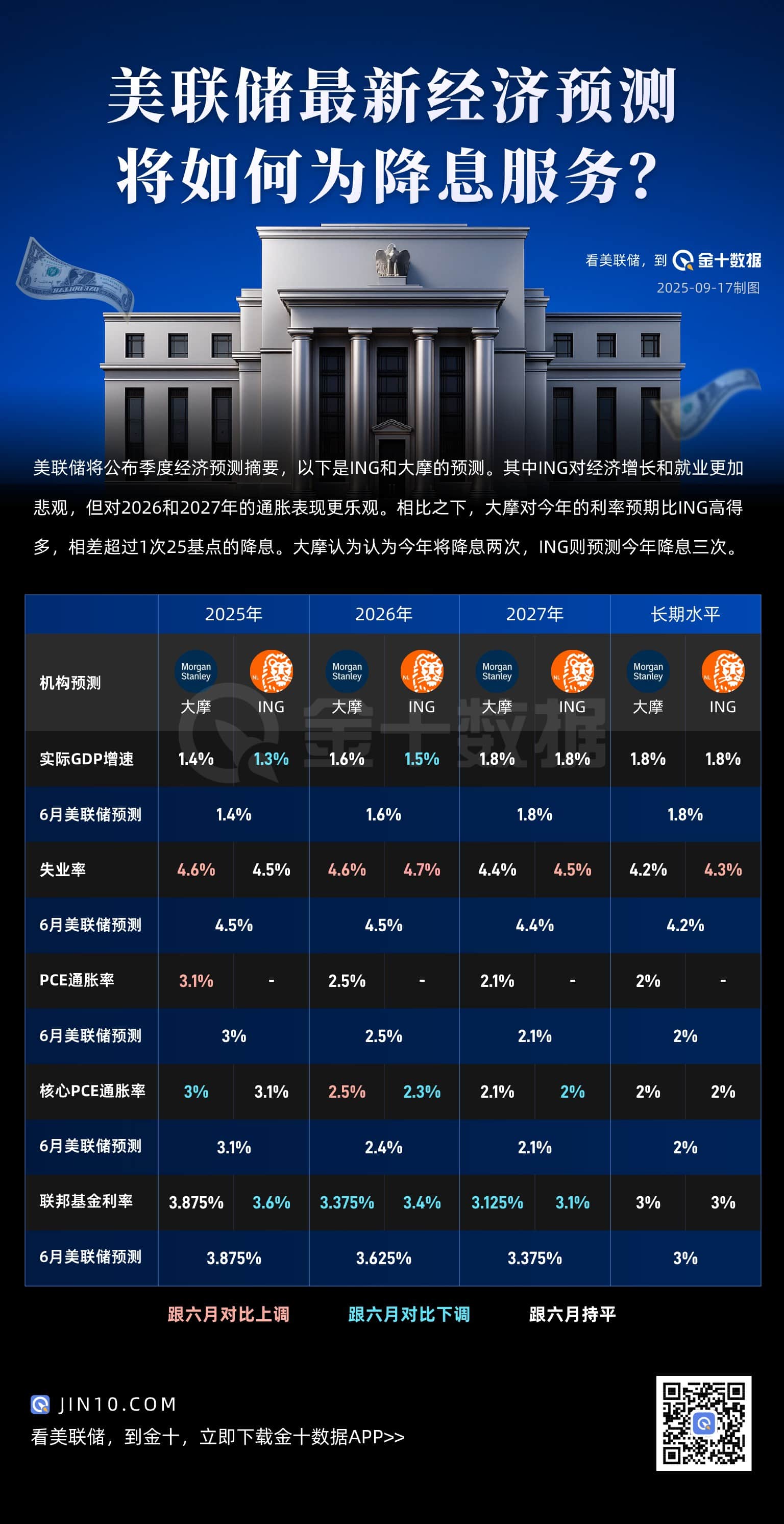
美联储最新经济预测,将如何为降息服务?
Jin Shi Shu Ju· 2025-09-17 12:56
Core Viewpoint - The Federal Reserve's latest economic forecasts indicate differing predictions for interest rate cuts, with Morgan Stanley projecting two cuts this year, while ING remains more pessimistic about the near-term outlook but optimistic for inflation in 2026 and 2027 [3][4]. Economic Growth Projections - Morgan Stanley forecasts a real GDP growth rate of 1.4% for 2025 and 1.6% for 2026, while ING predicts slightly lower growth rates of 1.3% and 1.5% respectively [3]. - For 2027, Morgan Stanley anticipates a growth rate of 1.8% [3]. Unemployment Rate Predictions - The unemployment rate is projected to be 4.6% in 2025 according to Morgan Stanley, while ING estimates it at 4.5% [4]. - For 2026, both institutions predict a slight decrease in the unemployment rate, with Morgan Stanley at 4.4% and ING at 4.5% [4]. Inflation Rate Forecasts - The PCE inflation rate is expected to be 3.1% in 2025 according to Morgan Stanley, while ING predicts it will be 3% [4]. - For 2026, both firms project a decline in inflation, with Morgan Stanley forecasting 2.5% and ING at 2.1% [4]. - The core PCE inflation rate is also expected to decrease, with Morgan Stanley predicting 3% for 2025 and 2.5% for 2026, while ING estimates 3.1% and 2.3% respectively [4]. Federal Funds Rate Expectations - The Federal Funds Rate is projected to be 3.875% in 2025 according to Morgan Stanley, while ING estimates it at 3.6% [4]. - For 2026, Morgan Stanley anticipates a rate of 3.375%, compared to ING's prediction of 3.4% [4].

西班牙央行上调经济与通胀预测,财政赤字及债务率有望持续改善
Sou Hu Cai Jing· 2025-09-16 13:22
Core Insights - The Bank of Spain forecasts a quarter-on-quarter GDP growth of 0.6% to 0.7% for the third quarter, indicating a sustained robust expansion trend [1] - The GDP growth forecast for 2025 has been revised upward from 2.4% to 2.6%, while the forecasts for 2026 and 2027 remain unchanged at 1.8% and 1.7% respectively [1] - The inflation rate forecast for 2025 has been slightly increased to 2.5%, up from the previous estimate of 2.4%, although it remains lower than the actual inflation rate of 2.9% in 2024, suggesting a gradual easing of overall inflationary pressures [1] - The fiscal situation shows positive improvement, with the forecast for the government budget deficit as a percentage of GDP for 2025 revised down from 2.8% to 2.5%, indicating strengthened fiscal discipline and a trend towards a more stable fiscal situation [1]
海外宏观周报:美联储理事任命风波延续-20250901
Ping An Securities· 2025-09-01 03:43
Group 1: U.S. Economic Policy - The Trump administration announced a plan to impose a 50% tariff on Indian products and indicated high tariffs on imported furniture[1] - U.S. new home sales in July fell 0.6% to an annualized rate of 652,000, exceeding market expectations of 630,000[1] - The U.S. Q2 GDP annualized growth rate was revised to 3.3%, higher than the expected 3.1%[1] - The core PCE price index for July rose 2.9% year-on-year, the highest since February 2025, matching expectations[1] - The probability of a 25 basis point rate cut in September increased from 75% to 86.4%[1] Group 2: European Economic Policy - The Eurozone economic sentiment index fell to 95.2 in August, down from 95.7 in July, breaking previous market expectations for a slight recovery[1] - The European Commission proposed legislative measures to implement tariff reductions on U.S. industrial goods and ensure U.S. tariff reductions on EU automobiles[1] Group 3: Global Market Performance - Global stock markets showed mixed performance, with most Asian markets rising while European and U.S. markets faced pressure[1] - The 10-year U.S. Treasury yield fell by 3 basis points to 4.23%, while 20-30 year yields rose, indicating inflation concerns[1] - Gold prices increased due to rising concerns over the credibility of the U.S. dollar amid the Federal Reserve appointment controversy[1]