计算机科学

Search documents
邵逸夫奖增设计算机科学奖
Xin Lang Cai Jing· 2026-01-28 11:36
Core Points - The Shaw Prize Foundation announced the establishment of a new award in Computer Science, increasing the total number of award categories to four [1] - The nomination period for the new award will begin in September this year, with the first laureates to be announced in the spring of 2027 [1] - The existing categories of the Shaw Prize include Astronomy, Life Sciences and Medicine, and Mathematical Sciences, with the new award designed to operate in balance with these categories [1] - Each award category, including the new Computer Science award, will have a prize amount of 1.2 million USD [1] Summary by Category Award Establishment - The Shaw Prize in Computer Science is a natural extension of the existing award system, reflecting the significant impact of computer science on various aspects of human activity [1] Nomination and Selection - The new award will follow the same nomination and selection criteria as the existing awards, ensuring consistency across all categories [1] Prize Amount - Each award, including the newly established Computer Science award, will offer a prize of 1.2 million USD, maintaining parity with the other categories [1]
冯·诺依曼的传奇人生
3 6 Ke· 2026-01-19 12:35
Core Insights - The article chronicles the life and achievements of John von Neumann, highlighting his contributions to mathematics, computer science, and game theory, which have had a lasting impact on various fields [2][33]. Early Life and Education - John von Neumann was born into a Jewish family in Budapest, Hungary, in 1903, with a father who was a successful banker [1]. - He exhibited extraordinary intelligence from a young age, mastering ancient Greek by age six and completing complex mathematical calculations mentally [3][4]. - Von Neumann attended elite schools and was mentored by prominent scholars, publishing his first paper at the age of 17 [5][9]. Academic Career and Contributions - After obtaining his PhD in mathematics and a degree in chemical engineering, von Neumann worked at Göttingen University under David Hilbert, focusing on quantum mechanics [10]. - He made significant contributions to game theory, notably the minimax theorem, which laid the foundation for this mathematical branch [10][20]. - In 1933, he joined the Institute for Advanced Study in Princeton, becoming its youngest member and collaborating with notable scientists like Albert Einstein [11][13]. Impact During World War II - As World War II progressed, von Neumann shifted his research focus from pure mathematics to applied mathematics, contributing to military efforts [18][20]. - He played a crucial role in the Manhattan Project, developing mathematical models for the atomic bomb and recognizing the need for computational power in scientific research [20][21]. Development of Computer Science - Von Neumann joined the ENIAC project, contributing to the design of the first electronic computers and co-authoring the EDVAC report, which introduced key concepts like binary code and stored programs [21][23]. - His architecture, known as the "von Neumann architecture," remains the foundation for most modern computer designs [23][25]. Personal Life and Legacy - Despite his scientific achievements, von Neumann faced personal challenges, including a divorce and health issues later in life [16][29]. - He passed away in 1957, leaving behind a legacy that profoundly influenced computer science, economics, and various scientific disciplines [32][33].


2025 ACM杰出会员出炉,北大邹磊、复旦姜育刚等13位华人获选
3 6 Ke· 2025-12-23 02:46
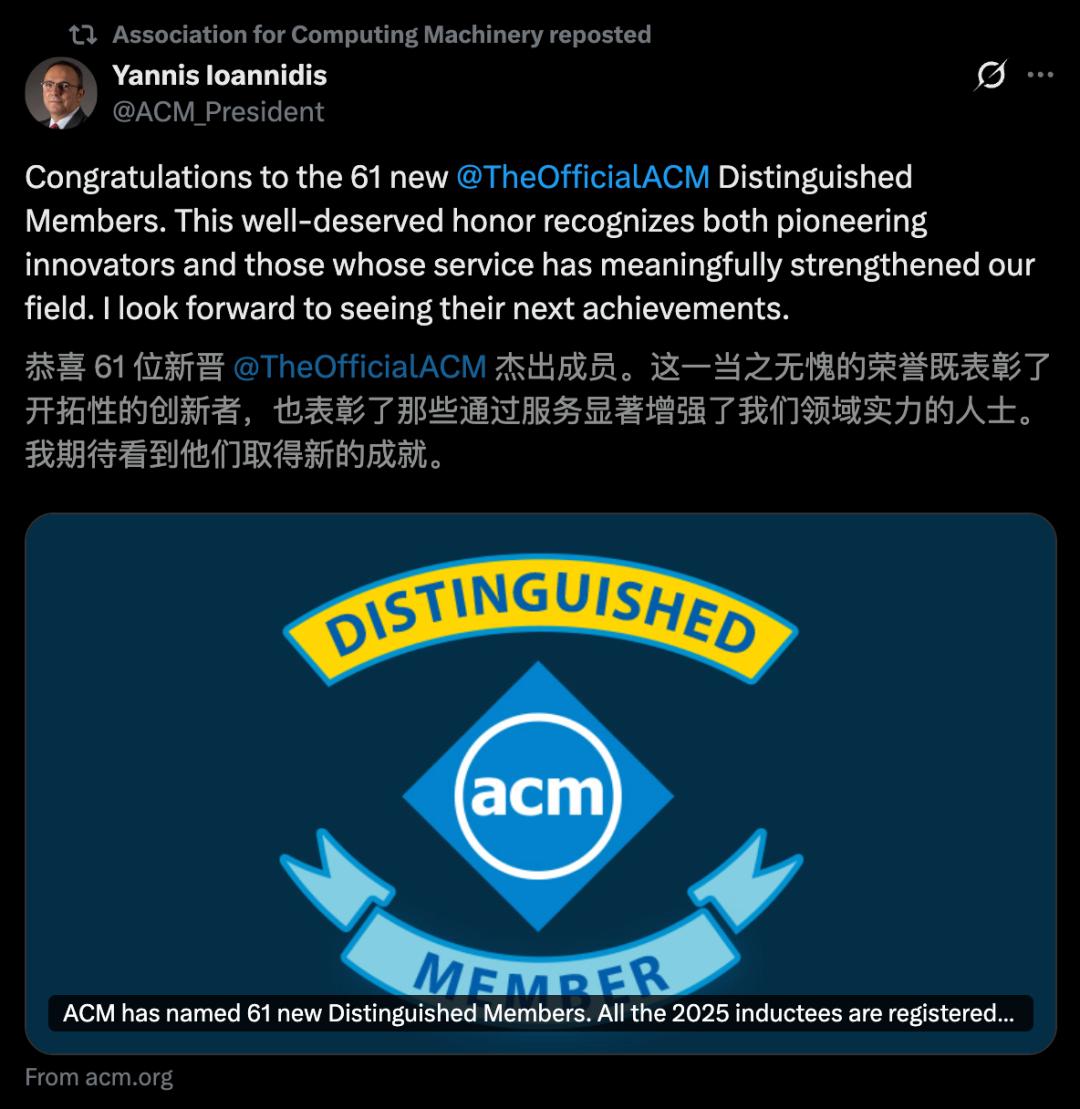
Core Insights - A total of 61 new leaders in the field of computer science have been inducted as ACM Distinguished Members, recognizing their significant contributions across various domains including medical AI, data management, and human-computer interaction [1][3][4]. Group 1: ACM Distinguished Members Program - The ACM Distinguished Members program, initiated in 2006, honors members who have demonstrated outstanding technical achievements and professional service, with only the top 10% of global members eligible for induction [4]. - Inductees must have at least 15 years of professional experience and have made a substantial impact in the computing field [4]. Group 2: Notable Inductees - Jianfei Cai from Monash University was recognized for his contributions to visual language understanding and visual computing [6]. - Sheng Di from Argonne National Laboratory was honored for his work in lossy compression and high-performance computing resilience [8]. - Daxin Jiang, founder of StepFun, received recognition for his contributions to context-aware search and language model expansion [10]. - Yu-Gang Jiang from Fudan University was acknowledged for his work in large-scale video analysis [14]. - Weiyi Shang from the University of Waterloo was recognized for his contributions to software performance and log engineering [18]. - Nan Tang from Hong Kong University of Science and Technology was honored for his work in AI-based data preparation [20]. - Huamin Wang from Style3D was recognized for his contributions to physics-based modeling and simulation in computer graphics and vision [24]. - Yubin Xia from Shanghai Jiao Tong University was acknowledged for his work in hardware-software co-design in computer systems [26]. - Junsong Yuan from the University at Buffalo was recognized for his contributions to human behavior and interaction modeling based on video [28]. - Mi Zhang from Ohio State University was honored for his work in mobile AI and AIoT applications [30]. - Rui Zhang from Huazhong University of Science and Technology was recognized for his contributions to data-centric systems and AI-driven big data applications [31]. - Ying Zhang from Meta was acknowledged for her contributions to the design and operation of large-scale production networks [33]. - Lei Zou from Peking University was recognized for his work in graph database query processing and optimization [35].
AI专业爆火,CS被美国00后抛弃了
3 6 Ke· 2025-12-11 23:23
Core Insights - The trend of abandoning Computer Science (CS) in favor of Artificial Intelligence (AI) is becoming increasingly popular among young Americans choosing their college majors, driven by better job prospects in AI-related fields [1][4][19] Group 1: Shift in Academic Focus - AI has emerged as a "hot" major in U.S. universities, with programs like MIT's "Artificial Intelligence and Decision Making" quickly becoming the second largest major at the institution [2][4] - The number of AI-related undergraduate and master's programs in the U.S. has seen exponential growth, with master's programs increasing from 116 to 310 between 2022 and 2025 [9] - Universities are leveraging AI programs as a key strategy to attract student applications, with institutions like the University of South Florida and the University of California, San Diego launching new AI-focused departments [2][4] Group 2: Employment Landscape - The job market for CS graduates has become increasingly challenging, with 62% of CS programs reporting a decline in undergraduate enrollment due to employment concerns [10][11] - In contrast, AI-related job postings have surged, with a 323% increase in online job listings related to generative AI capabilities over the past year [8] - Major tech companies like Amazon, Google, and Microsoft are investing billions into AI and are actively training millions of students and adult workers in AI skills, further driving demand for AI education [7][8] Group 3: Student Perspectives - Students are increasingly drawn to AI due to its potential for real-world applications and job opportunities, as exemplified by individuals like Leena Banga, who shifted from CS to AI after engaging with AI technologies [4][5] - The appeal of AI extends beyond traditional tech fields, influencing students from various disciplines, including biology and healthcare, to pursue AI studies [5][16] - The trend indicates a broader shift towards specialization in computing degrees, with AI becoming a focal point for new academic offerings [14][19]

比尔·盖茨:我不是俗套的奇迹男孩,我是幸运儿
3 6 Ke· 2025-10-14 08:59
Core Insights - Bill Gates is described as a "lucky person" due to various privileges that contributed to his success, including a wealthy background, quality education, and the timing of the semiconductor boom [2][5] - Gates' journey from a rebellious teenager to the founder of Microsoft is marked by significant moments, including his early programming experiences and the eventual creation of the first software for personal computers [3][6] Background and Early Life - Gates was born in 1955 in Seattle to a well-off family, with a father who was a prominent lawyer and a mother involved in charitable work [7] - He attended Lakeside School, a private institution with a tuition of $1,400 per year, which was a significant investment at the time [7][8] - Gates' parents emphasized education and social skills, encouraging him to participate in family gatherings and discussions, which exposed him to adult conversations about finance and business [8] Education and Programming Beginnings - The introduction of computers at Lakeside School in 1968 was a pivotal moment for Gates, allowing him to gain early access to programming [9][10] - Gates created his first computer program, a tic-tac-toe game, during his time at Lakeside, which sparked his passion for programming [9][10] - He later worked on a payroll management program for a local company, marking his first practical application of programming skills [11] Transition to Microsoft - Gates dropped out of Harvard University to pursue his passion for software development, a decision that aligns with the paths of other tech leaders like Steve Jobs and Elon Musk [13] - The release of the Altair 8800 microcomputer in 1975 presented a significant opportunity for Gates and his partner Paul Allen to develop software, leading to the founding of Microsoft [14][16] - Microsoft quickly gained traction by providing customized BASIC software for various personal computers, establishing itself as a key player in the tech industry [17] Legacy and Reflection - Gates acknowledges the role of luck and external factors in his success, emphasizing that his story is shaped by unique circumstances beyond his control [5][6] - Despite his achievements, Gates maintains a connection to his early experiences and the mindset of curiosity and exploration that defined his youth [17]


美国CS就业梦碎,狂投5000家0 Offer,名校毕业00后被麦当劳惨拒
3 6 Ke· 2025-08-15 02:31
Core Insights - The once-promising job market for computer science graduates is rapidly deteriorating, with many now facing unemployment or underemployment due to the rise of AI and significant layoffs in major tech companies [5][11][12]. Group 1: Job Market Trends - Computer science has become the seventh highest major for unemployment in the U.S., with a rate of 6.1% [5][12]. - The demand for entry-level software engineering positions is declining as AI programming tools automate many coding tasks [18][20]. - Graduates are experiencing a stark contrast to previous years, where high salaries and numerous job offers were the norm [11][12]. Group 2: Graduate Experiences - Many graduates report applying to hundreds or even thousands of jobs, often receiving no responses or being ghosted by employers [15][18]. - A specific case highlighted is that of a graduate who applied for 5,762 tech positions but received no full-time offers [15]. - The emotional toll of the job search process is significant, with many feeling disillusioned and frustrated by the lack of opportunities [15][17]. Group 3: Shift in Educational Focus - There is a notable shift from promoting coding skills to embracing AI technologies, with influential figures now advocating for AI education [20][21]. - Companies like Microsoft are investing heavily in AI skills training for students and professionals, indicating a strategic pivot in workforce development [21][22]. Group 4: Alternative Career Paths - Some graduates are finding success in non-traditional roles, such as sales and marketing within tech companies, rather than pursuing pure coding jobs [24]. - The adaptability of graduates to explore diverse skill sets is becoming increasingly important in navigating the current job landscape [24].


编程“学废”了?普渡毕业却只获烤肉店面试!美国IT失业创新高:AI面试成最大屈辱,网友怒称宁愿失业!
AI前线· 2025-08-11 05:30
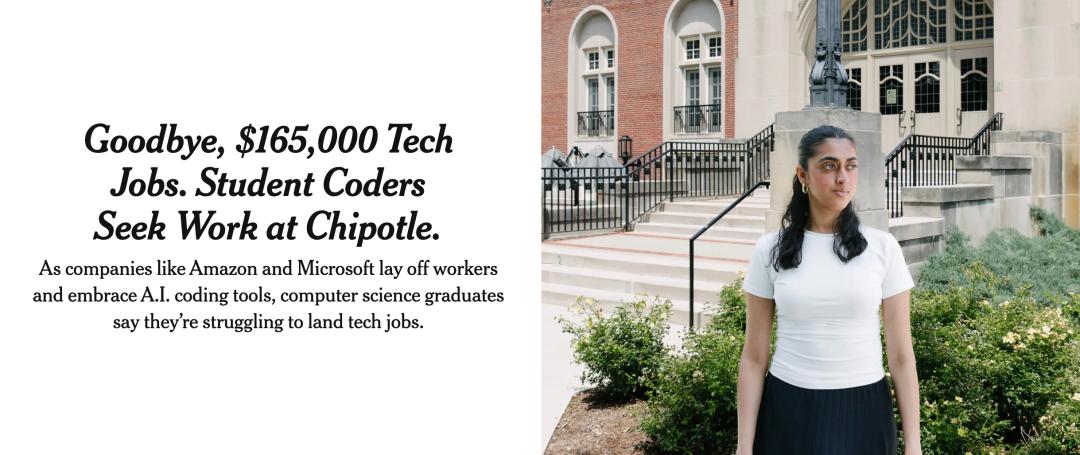
Core Viewpoint - The article discusses the challenges faced by recent computer science graduates in the U.S. job market, highlighting a significant increase in unemployment rates and the impact of AI on job opportunities in the tech industry [6][10][19]. Group 1: Job Market Trends - Since 2025, the U.S. IT job market has been experiencing a downturn, with the Bureau of Labor Statistics (BLS) revising down job growth figures for May and June, indicating a continued decline in job openings [7][10]. - The total number of IT jobs has decreased by 26,500 this year, significantly higher than the 6,200 job losses in the same period last year [7][8]. - The unemployment rate for the IT sector reached 5.5% in June, surpassing the national average of 4.2% [10]. Group 2: Impact of AI on Employment - The proliferation of AI programming tools has led to a reduced demand for entry-level software engineering positions, which are typically sought after by recent graduates [5][12]. - Many tech companies are adopting AI systems to screen resumes and conduct initial interviews, making it more challenging for candidates to stand out [13][19]. - Graduates report feeling trapped in a cycle where they must use AI tools to apply for jobs, while companies use AI to filter out applicants, creating a paradoxical situation [13][18]. Group 3: Graduate Experiences - Recent graduates have shared their frustrations, with some applying to thousands of positions without success, leading to feelings of despair and disillusionment [11][12]. - The job application process has become increasingly difficult, with many candidates facing automated assessments and AI interviews that lack human interaction [11][20]. - Some graduates express a preference for not participating in AI interviews, feeling that it undermines their dignity and the value of human interaction in the hiring process [15][17].


王垠:不懂编程的人想用 AI 成功做项目,几乎是妄想!
程序员的那些事· 2025-07-17 09:35
Core Viewpoint - The article emphasizes that while AI tools can assist in programming, they cannot replace the need for deep understanding and expertise in computer science to produce high-quality code [3][5][6]. Group 1: AI Programming Experience - The author shares experiences with various AI programming tools, highlighting that non-programmers are unlikely to successfully complete projects using AI alone [3]. - Despite generating over 60,000 lines of code with Cursor, the author only accepted around 5,000 lines due to frequent errors and misunderstandings by the AI [3]. - The complexity of AI-generated code often leads to confusion and the need for extensive corrections, indicating that AI struggles with even simple functions [3][5]. Group 2: Limitations of AI - The article argues that AI cannot produce "high-level" code due to the mediocre quality of the training data it relies on, which primarily consists of average programmers' work [5]. - The distinction between computer scientists and programmers is emphasized, with the assertion that AI may replace ordinary programmers but cannot substitute for computer scientists [5]. Group 3: AI as a Tool - AI is viewed as a valuable tool that can enhance productivity, but it is limited to amplifying existing skills rather than compensating for a lack of knowledge [6]. - The author acknowledges the benefits of using AI for problem-solving but stresses that without foundational skills, AI's effectiveness is nullified [6].

英伟达CEO黄仁勋:中国的计算机科学是“世界级的”,尤其是软件能力。
news flash· 2025-07-16 07:32
Core Viewpoint - Nvidia's CEO Jensen Huang stated that China's computer science capabilities are "world-class," particularly in software development [1] Group 1 - The emphasis on China's software capabilities highlights the country's growing influence in the global tech landscape [1] - Huang's remarks suggest potential collaboration opportunities between Nvidia and Chinese tech firms [1] - The acknowledgment of China's strengths may impact Nvidia's strategic decisions in the region [1]

Z世代就业市场极度内卷,摩根大通CEO指点迷津
财富FORTUNE· 2025-06-27 11:53
Core Viewpoint - The job market for Generation Z is filled with contradictory signals, with entry-level positions disappearing while CEOs complain about talent shortages. The key to job security lies in acquiring the right skills [1][2]. Skills Gap and Workforce Needs - Companies are facing a skills gap in specific areas and urgently need young talent to fill these roles [2]. - Essential skills include networking, coding, programming, financial management, and project management [3][4]. Education and Training - Many schools are failing to provide adequate training in these critical areas, which hampers the development of the next generation of programmers and project managers [5]. - Education should focus on whether students can secure jobs after graduation, rather than solely on college graduation rates [6]. Importance of Computer Science Education - There is a strong belief in the necessity of students learning programming, especially in light of advancements in generative AI technologies [8]. - Over 250 CEOs, including leaders from Microsoft and Airbnb, signed a letter advocating for all students to receive education in computer science and artificial intelligence [8][9]. - A study from the University of Maryland found that students who take computer science courses in high school earn an average of 8% more in their first job [10]. Soft Skills and Character - Generation Z often struggles with workplace readiness, particularly in areas like professionalism, organizational skills, and communication [11]. - Companies prioritize character over technical expertise when hiring, emphasizing the importance of being smart, ethical, and having good character [13][14].