
通胀逻辑

Search documents
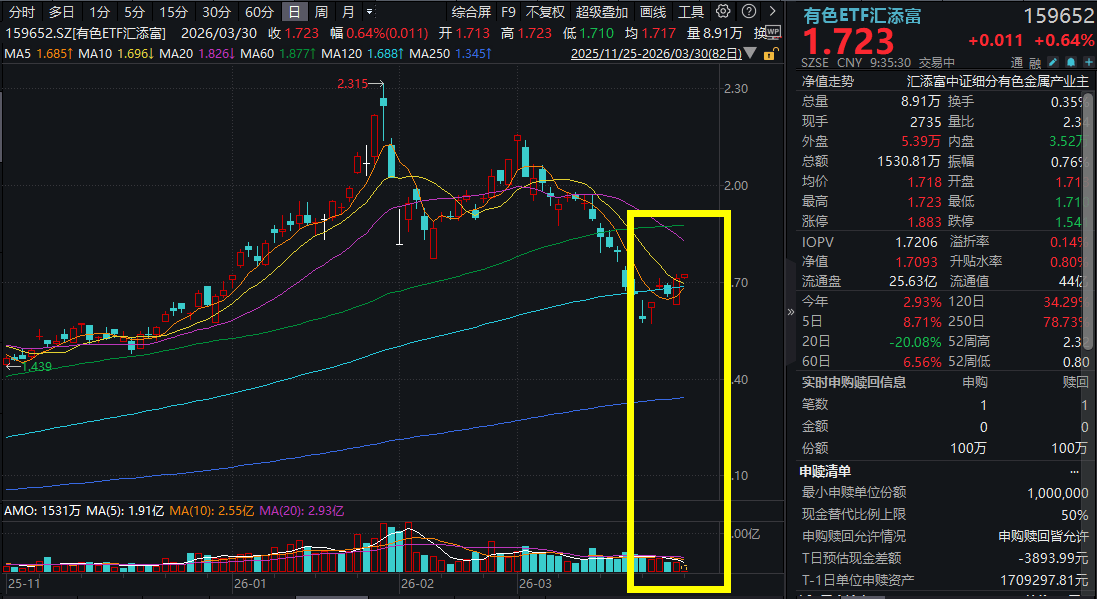
中东两大铝厂遇袭,铝价狂涨超4%!天山铝业涨停,一季度业绩预增107%!有色ETF汇添富(159652)冲击两连阳!中信证券:铝价或超预期上涨
Sou Hu Cai Jing· 2026-03-30 02:25
Core Viewpoint - The A-share market experienced fluctuations on March 30, with the non-ferrous metals sector rising against the trend, particularly the aluminum stocks, driven by supply chain disruptions and strong earnings reports from leading companies [1][3][6]. Group 1: Market Performance - The non-ferrous ETF Huatai (159652) rose by 0.64% as of 9:36 AM, aiming for a second consecutive day of gains [1]. - Major component stocks of the non-ferrous ETF saw significant increases, with Tianshan Aluminum hitting the daily limit, Yun Aluminum rising over 6%, and China Aluminum increasing by over 4% [3]. Group 2: Supply Chain Disruptions - Recent attacks on two major aluminum plants in Bahrain and the UAE by Iranian forces have raised concerns about supply disruptions, as these regions account for approximately 10% of global aluminum supply [6]. - Tianshan Aluminum reported a revenue of 29.502 billion yuan for 2025, a year-on-year increase of 5.03%, and a net profit of 4.818 billion yuan, up 8.13% [6][7]. Group 3: Dividend and Earnings Outlook - Tianshan Aluminum announced a cash dividend plan of 2.5 yuan per 10 shares, totaling 1.147 billion yuan, with a commitment to maintain a dividend payout ratio of no less than 50% of net profit for 2026 [7]. - The aluminum sector is expected to face significant supply risks due to the recent attacks, which could lead to prolonged production disruptions and potential price increases [8]. Group 4: Investment Opportunities - The non-ferrous ETF Huatai (159652) is positioned to benefit from a comprehensive layout across various metal sectors, including gold, copper, aluminum, lithium, and rare earths, capitalizing on the ongoing super cycle in non-ferrous metals [10][12]. - The ETF has a leading "gold-copper content" of 45% among its peers, with a high concentration of leading companies in strategic and supply-deficient core varieties [12][14].



中国银河证券:美伊冲突持续升级 建议关注煤化工、金融及科技创新三大方向
智通财经网· 2026-03-22 11:48
Core Viewpoint - The ongoing geopolitical conflicts create significant uncertainty regarding their duration and evolution, leading to persistent disturbances in global risk assets, with expectations of high volatility in global equity markets. However, the A-share market is likely to experience limited downside, with a probable oscillation and structural rotation to absorb external pressures [1]. Group 1: A-share Market Performance - During the week of March 16-20, 2026, the A-share market experienced a volatile adjustment, with the overall A-index declining by 4.13%. Only the ChiNext index saw an increase of 1.26%, while the North Star 50 and CSI 1000 indices fell by over 5%, and other indices dropped by more than 2% [2]. - In terms of market style, large-cap stocks outperformed, while all five major style indices retreated, with the cyclical style dropping over 7% and stability, growth, and consumer styles declining by more than 2% [2]. - Most primary industry sectors saw declines, with only the communication and banking sectors rising, while non-ferrous metals, basic chemicals, and steel experienced the largest drops [2]. Group 2: Fund Flows - The A-share market's trading activity slightly cooled, with an average daily turnover of 22,111 billion yuan, down by 2,875.9 billion yuan from the previous week [3]. - The margin financing balance stood at 26,501.11 billion yuan, a decrease of 15.89 billion yuan compared to the previous week [3]. - A total of 30 new equity funds were established, with an issuance volume of 21.388 billion units, an increase of 1.564 billion units from the previous week [3]. - From March 12 to 18, global funds saw a net outflow of 12.78 million USD, improving from a previous outflow of 36.15 million USD, while overseas funds had a net outflow of 5.32 million USD, down from 10.35 million USD [3]. Group 3: Valuation Changes - The PE (TTM) valuation of the overall A-index decreased by 3.16% to 22.59 times, placing it at the 91.20 percentile since 2010. The PB (LF) valuation fell by 3.39% to 1.86 times, at the 51.45 percentile since 2010 [4]. - The bond-equity spread for the overall A-share market is 2.5959%, situated near the three-year rolling average (3.316%) minus 1.39 standard deviations, at the 45.88 percentile since 2010 [4]. Group 4: Investment Outlook - The ongoing escalation of the US-Iran conflict is expected to drive strong demand for energy and alternatives, with a focus on sectors such as coal chemical, coal, shipping ports, and oil and gas. The recent significant pullback in non-ferrous metals warrants attention for valuation recovery and cost-effectiveness [6]. - The market is shifting towards defensive assets, with a focus on financials, public utilities, and transportation [6]. - The technology innovation sector is highlighted, particularly in areas such as power equipment, new energy, energy storage, storage, semiconductors, computing power, and communication devices. Additionally, the consumer sector is noted for its historically low valuations, with certain sub-sectors like agriculture, food and beverage, and home appliances showing potential for recovery [6].

国防军工行业专题研究:铼:先进航空发动机、燃气轮机、商业航天具备通胀逻辑核心材料
GOLDEN SUN SECURITIES· 2026-03-15 03:24
Investment Rating - The industry investment rating is "Accumulate" [7] Core Viewpoints - Rhenium is a core material for advanced aerospace engines, gas turbines, and commercial space, with significant inflationary attributes due to its scarcity and high processing difficulty [1][12] - The demand for rhenium is expected to grow rapidly driven by advanced aerospace engines, gas turbines, and commercial space, while supply constraints are anticipated to exacerbate the supply-demand imbalance [3][4] Summary by Sections Rhenium as a Core Material - Rhenium is one of the highest melting point elements and is considered a strategic element due to its rarity and high cost, with a price of 47.15 million yuan per ton as of March 10, 2026 [1][12] - Over 70% of rhenium consumption is in high-temperature alloys, which are critical for aerospace applications [2][13] Demand Growth and Supply Constraints - The domestic demand for rhenium is projected to increase significantly, with advanced aerospace engines alone expected to require 45.9 tons by 2030, compared to 7.8 tons in 2023 [3][22] - The supply of rhenium in China is limited, with only 200 tons of reserves, leading to a forecasted supply shortage starting in 2026 [4][35] Investment Recommendations - It is recommended to focus on companies involved in rhenium production, such as Sains [5][38]
十五五-军工哪些方向值得关注
2026-03-13 04:46
Summary of Key Points from the Conference Call Industry Overview - The focus of military investment logic is shifting towards "new quality combat power" with growth driven by military trade, commercial aerospace, military AI, and laser weapons by 2025 [1][2] - The military trade and unmanned equipment sectors are expected to experience significant growth, with China's military trade share currently at only 2.9%, indicating substantial room for improvement [1][11] - The domestic large aircraft C919 is entering a production ramp-up phase, with over 1,300 orders valued at nearly 1 trillion RMB, contingent on stable overseas engine supply [1][12] Core Insights and Arguments - The A-share military sector's performance from 2020 to 2025 can be divided into three phases: 1. A significant uptrend from 2020 to 2021 driven by defense policies and equipment construction, particularly in military aircraft and missiles [2] 2. A downward trend from 2022 to 2024 due to profit growth slowing and industry personnel changes [2] 3. A recovery phase in 2025, with improved orders for upstream companies and validation of Chinese equipment performance in conflicts [2][4] - The market favors sectors with high growth potential, particularly those transitioning from "1 to 100" growth phases, such as military trade and commercial aerospace [4] - Companies with "inflation logic" or those positioned as "chain leaders" in the industry are more attractive for investment, as they can provide greater profit elasticity and valuation upside [3][4] Investment Opportunities - Key investment opportunities include: - **Unmanned Equipment**: Recognized as a primary force in modern warfare, with significant growth potential in both domestic and international markets [10] - **Military Trade**: Seen as a crucial growth driver for domestic military companies, with potential for valuation uplift as international orders materialize [11] - **C919 Aircraft**: Investment opportunities in the supply chain, particularly in components with domestic production capabilities [12][13] - **Gas Turbines**: The market is projected to grow to $64.8 billion by 2035, with high demand for aftermarket services, particularly for hot-end components [14][15] Additional Important Insights - The commercial aerospace sector is experiencing intensified competition, with a focus on cost reduction and high performance, particularly in rocket recovery technologies and satellite capabilities [1][16] - The military industry is characterized by a dual structure of stable growth in traditional equipment and high growth in new quality combat power equipment [5] - The investment framework for the military industry should consider macroeconomic factors, geopolitical environments, and domestic military spending trends [5][6] - The importance of governance structures in military enterprises is highlighted, as improvements can lead to significant performance elasticity [7] Conclusion - The military industry is poised for growth driven by technological advancements and increased military spending, with specific sectors and companies offering promising investment opportunities. The focus should be on those with strong market positions, innovative technologies, and the ability to adapt to changing market dynamics.
煤炭板块如何受益“反内卷”?
2025-07-23 14:35
Summary of Key Points from Conference Call on Coal Industry Industry Overview - The coal sector is expected to benefit from the "anti-involution" policy, which is seen as a supplement to the unfulfilled inflation logic, boosting demand expectations through stable growth plans and large infrastructure projects [1][3][4]. Core Insights and Arguments - The anti-involution policy aims to alleviate the downward pressure on prices by opening up upstream capacity, intensifying competition in the midstream, and facilitating profit transfer from mid to downstream sectors [1][6]. - The coal industry is positioned to benefit from supply constraints, allowing it to share in the profit growth of the midstream industry [1][7]. - The 108 document further tightens coal supply, reinforcing constraints and enabling the coal sector to enjoy profit transfers from midstream anti-involution effects, with coking coal prices showing a significant rebound [8][9]. - A trend of price recovery in the coal sector is anticipated post-2026, driven by the completion of domestic supply, resource depletion risks, and inventory cycle digestion [10][12]. Price and Demand Forecasts - Current coal prices are at a support range of 570-610 RMB/ton, with expectations that prices have bottomed out [11][12]. - The likelihood of a significant price increase in the coal sector by the end of 2025 is low, but a rebound in thermal power demand post-2026 could drive coal demand and prices upward [13][14]. Investment Recommendations - Recommended stocks include: - Coking coal: Lu'an Huanneng, Pingmei Shenma, and Shenhua Energy - Thermal coal: Jinkong Coal and Shaanxi Coal - Long-term dividend stocks: China Shenhua and China Coal Energy, which are expected to benefit from stable earnings and long-term pricing agreements [17]. Additional Considerations - The anti-involution policy has led to a valuation recovery and increased market sentiment in the coal sector, despite coal not being one of the four main industries targeted by the policy [2]. - The impact of large infrastructure projects on the coal market remains difficult to quantify, but if policies are implemented or disproven by the end of September, it could present an investment opportunity [16]. - International market dynamics, particularly the relationship between natural gas prices and coal demand, could influence domestic coal prices, with expectations of a potential increase in international coal demand by late 2026 [15].