造车新势力

Search documents
头部造车新势力集体盈利:告别烧钱时代,行业进入真较量
经济观察报· 2026-03-29 04:11
Core Viewpoint - The profitability achieved by new energy vehicle companies marks a new starting point, indicating their transition from a "newbie protection period" to competing on equal footing with traditional automakers, relying on their own capabilities for growth [1][12]. Financial Performance - NIO, Xpeng, Li Auto, and Leap Motor have recently disclosed their 2025 annual financial reports, showing a collective trend towards profitability after a decade of heavy spending [2]. - Li Auto achieved a full-year profit for the third consecutive year, with sales of 406,300 units and revenue of 112.31 billion yuan, marking it as the only new energy vehicle company to surpass 100 billion yuan in revenue [4]. - Leap Motor reported a delivery volume of 596,600 units, a year-on-year increase of over 103.1%, with revenue exceeding 32 billion yuan and a net profit of 538 million yuan, marking its first annual profit [5]. - Xpeng and NIO, while still in the loss zone, significantly reduced their losses and achieved their first quarterly profit since inception [5][6]. Market Dynamics - The new energy vehicle sector is at a historical turning point, with penetration rates exceeding 50% and the gradual withdrawal of policy incentives, prompting all types of automakers to focus on real capabilities in a more stable market [2][12]. - The top 10 new energy vehicle manufacturers accounted for 75.6% of wholesale and 75.9% of retail market shares in 2025, indicating a clear industry consolidation [12]. Profitability and Margins - The four companies exhibit significant differences in revenue and sales rankings, with Li Auto leading in revenue but ranking third in sales, while Leap Motor leads in sales but ranks last in revenue [8]. - The automotive industry is characterized by economies of scale, and the new energy vehicle companies are beginning to realize these effects, improving their overall gross margins [9]. - Xpeng's gross margin reached 18.9%, the highest among the four, driven by increased average selling prices and improved cost control [9]. - Leap Motor's gross margin improved to 14.5%, benefiting from a strategy focused on cost-effective pricing and increased production scale [10]. Competitive Landscape - The new energy vehicle companies are entering a phase of intense competition, with the market shifting from policy-driven growth to market-driven dynamics [12][13]. - Each company has its strengths and weaknesses, with Li Auto excelling in product foundation, NIO in innovative technology, Xpeng in intelligent driving, and Leap Motor in pricing strategy [13]. - The future competition will be more intense, and the sustainability of profitability will require time to validate, emphasizing the need for establishing long-term competitive barriers [13].


Rivian 2025年实现正毛利润,营业收入同比增长8%
Sou Hu Cai Jing· 2026-02-13 04:36
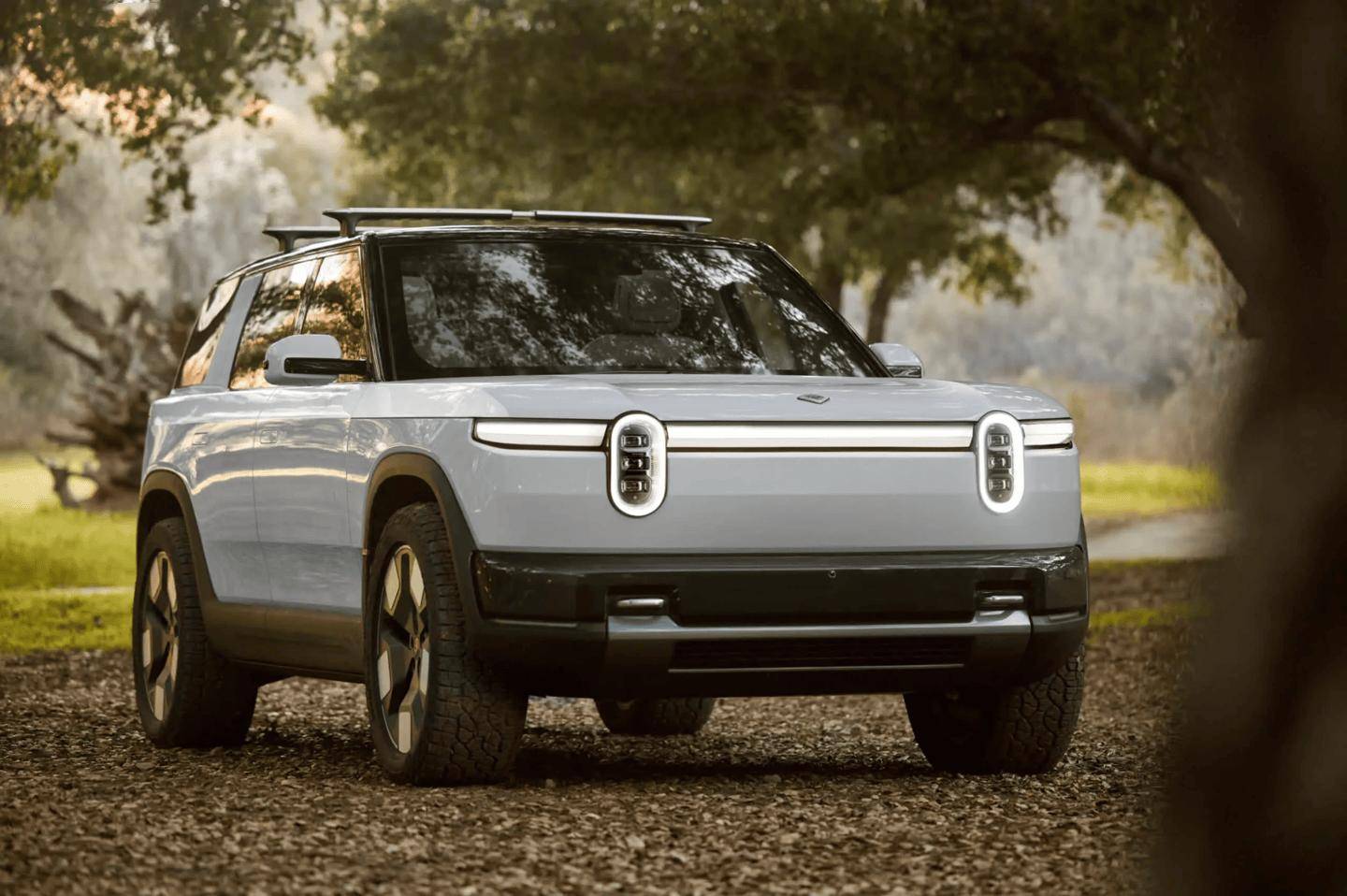
Core Viewpoint - Rivian reported its financial performance for Q4 2025, showing a revenue of $5.387 billion, a year-on-year increase of 8%, despite challenges in production and delivery [1] Financial Performance - Total revenue for Rivian in 2025 was $5.387 billion, equivalent to approximately 372.22 billion RMB [1] - Automotive revenue accounted for $3.830 billion, while software and service revenue was $1.557 billion [1] - The company achieved a positive gross profit in 2025, improving by over $1.3 billion compared to 2024, driven by increased average vehicle prices and reduced costs [1] Production and Delivery - Rivian's partnership with a joint venture has positively impacted its vehicle electrical architecture and software development, providing a boost to its performance [1] - The production of the new Rivian R2 model is progressing well, with validation models completed in January 2026, and first customer deliveries expected in Q2 2026 [1] - Rivian anticipates a total delivery volume of approximately 64,500 vehicles across all models for the year 2026 [1]

造车新势力10年沉浮:“蔚小理”分化
Jing Ji Guan Cha Wang· 2026-01-23 02:48
Group 1 - The three new forces in the electric vehicle market, namely NIO, Xpeng, and Li Auto, have experienced fluctuating sales and rankings since 2021, with distinct development paths emerging [1] - NIO, once a leader in delivery volume, saw its ranking decline after being surpassed by Xpeng in 2021, and is projected to be at the bottom among new forces by 2025, despite a 47% year-on-year increase in sales to 326,000 units [1] - NIO's strategy includes launching new brands, such as Ladao and Firefly, and introducing a new ES8 model at a significantly reduced price to enhance market competitiveness [1] Group 2 - Xpeng Motors led the market in 2025 with sales of 429,000 units, a 126% year-on-year increase, exceeding its annual target of 380,000 units [2] - Despite previous challenges, including a decline in monthly sales in 2023, Xpeng has begun to recover by appointing a new president and launching low-cost models in collaboration with Didi [2] - Li Auto experienced a 19.6% year-on-year decline in sales to 405,900 units in 2025, failing to meet its annual target of 640,000 units, marking a significant drop from its previous three-year championship status [2] Group 3 - Li Auto initially focused on range-extended electric vehicles, achieving market success with its model ONE, but faced challenges in 2025 with new electric models underperforming and increased competition in the range-extended hybrid market [3] - The competition in the electric vehicle market is intensifying, with new entrants like Huawei and Xiaomi, as well as traditional manufacturers launching new brands, posing challenges for the established players [3] - Brands like Changan's Deep Blue and Geely's Zeekr are gaining traction, with Deep Blue selling 333,000 units in 2025, surpassing NIO [3]
造车新势力10年沉浮:既分高下,也决生死
经济观察报· 2026-01-08 10:29
Core Viewpoint - The article discusses the evolution of China's new car-making forces over the past decade, highlighting the contrasting fates of companies like Leap Motor and Neta Auto, and the emergence of new players like Xiaomi and Huawei's Hongmeng Zhixing [2][4]. Group 1: Market Dynamics - By 2025, Leap Motor is projected to achieve nearly 600,000 annual sales, becoming the sales champion among new car-making forces, while Neta Auto faces auctioning due to its decline [2]. - The number of new car-making enterprises has drastically reduced from over 60 in 2015 to only a few that still report sales [2]. - The new rankings for 2025 among new car-making enterprises include Leap Motor, Hongmeng Zhixing, Xiaopeng, Li Auto, Xiaomi, and NIO [2]. Group 2: Rise of New Players - Leap Motor's sales reached 597,000 units in 2025, a 103% increase year-on-year, marking its first time at the top of the sales chart [4]. - Hongmeng Zhixing, although not a traditional new car-making force, has seen rapid growth with its AITO brand, achieving 445,000 units in 2024 and 589,000 units in 2025, a 32% increase [5]. - Xiaomi, entering the market later, achieved 120,000 units in its first year of delivery and 412,000 units in 2025, surpassing NIO, which has been in the market for ten years [5]. Group 3: Challenges for Established Players - NIO, once a leader, saw its sales drop to 326,000 units in 2025, despite launching new brands and models to regain market share [8]. - Xiaopeng Motors sold 429,000 units in 2025, a 126% increase, but faced challenges with product positioning and market competition [9]. - Li Auto's sales fell to 405,900 units in 2025, a 19.6% decline, as it struggled to meet its annual target of 640,000 units [10]. Group 4: Industry Consolidation - Many once-prominent new car-making enterprises have disappeared, categorized into three groups: those that failed before mass production, those that made strategic errors, and those that faced funding issues [12][13][14]. - The industry has undergone a brutal elimination process, with only a few companies remaining competitive as they face increasing pressure from new entrants and established brands [14]. - The next decade is expected to be even more complex, testing the operational efficiency and competitive capabilities of the remaining players [15].
2025年新势力成绩单出炉,零跑小米小鹏完成年度目标
3 6 Ke· 2026-01-04 00:37
Core Insights - In 2025, only three new energy vehicle brands, Leap Motor, Xiaomi, and Xpeng, achieved their annual sales targets, with Leap Motor emerging as the top performer with nearly 600,000 units sold, exceeding its target by over 19% [1][4] - The performance of traditional leading brands, often referred to as "Wei Xia Li" (Weilai, Xiaopeng, and Li Auto), showed significant divergence, with Xpeng achieving a 125.94% year-on-year growth, while Li Auto experienced an 18.81% decline in sales [2] - State-owned enterprises like Changan and Dongfeng are also facing challenges in scaling their new energy vehicle brands, with Deep Blue and Avita struggling to meet their revised sales targets [3] Group 1: Performance of New Energy Vehicle Brands - Leap Motor sold 596,555 units, achieving a target completion rate of 119.31% and a year-on-year growth of 103.10% [4] - Hongmeng Zhixing delivered 589,107 units, marking a 32% increase year-on-year [1][4] - Zeekr, after merging with Lynk & Co, reported a total delivery of 574,628 units, but fell short of its target with an 80.93% completion rate [4] Group 2: Performance of Traditional Leading Brands - Xpeng sold 429,445 units, achieving a target completion rate of 113.01% and a year-on-year growth of 125.94% [2][4] - Li Auto's sales reached 406,343 units, but this represented a significant decline of 18.81% compared to the previous year, with a completion rate of only 58.05% against its initial target of 700,000 units [2][4] - NIO delivered 326,028 units, reflecting a year-on-year growth of 46.88%, but its main brand saw a decline in performance compared to the previous year [2][4] Group 3: Performance of State-Owned Enterprises - Deep Blue, a brand under Changan, sold 333,117 units, achieving a completion rate of 92.53% after revising its target down to 360,000 units [3][4] - Avita's sales remained low at 128,772 units, with a completion rate of only 58.53% against its target of 220,000 units [3][4] - Dongfeng's brand, Lantu, sold 150,169 units, achieving a completion rate of 75.08% [3][4]
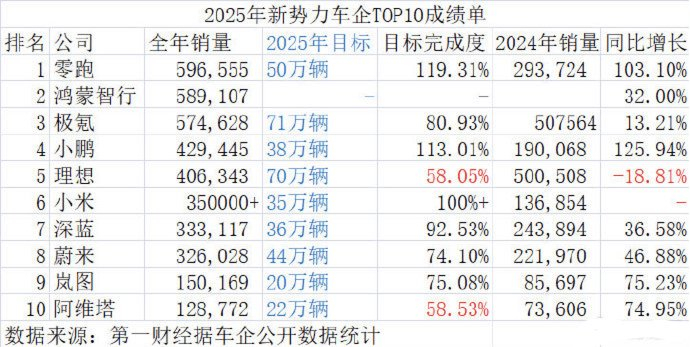
2025年造车新势力成绩单揭晓:零跑夺冠,多家品牌面临目标压力
Jin Rong Jie· 2026-01-02 00:17
Core Insights - The new energy vehicle market in 2025 saw significant growth, with Leap Motor leading in sales, delivering nearly 600,000 units, while other brands faced challenges in meeting their annual targets [1][2][11] Sales Performance - Leap Motor achieved the highest sales with 596,555 units, followed by Lantu with 150,169 units, and Zhiji with 81,017 units [2] - The top-performing brands forming a leading group with annual sales exceeding 400,000 units include Leap Motor, Hongmeng Zhixing, Xiaopeng, Seres, Xiaomi, and Li Auto [2] Monthly Performance - In December 2025, over 60% of new energy vehicle brands set monthly delivery records, indicating a strong end-of-year performance [3] - Hongmeng Zhixing topped the December delivery chart with 89,611 units, marking three consecutive months of record deliveries [4] - Leap Motor delivered 60,423 units in December, maintaining a strong performance above 60,000 units [5] - Xiaomi's monthly deliveries surpassed 50,000 units, showing a significant increase compared to its average monthly performance [6] Target Achievement - Brands that exceeded their sales targets include: - Leap Motor: Target of 500,000 units, actual sales of 596,555 units, achieving 119.32% of the target [7] - Xiaopeng: Target of 350,000 units, actual sales of 429,445 units, achieving 122.69% of the target [7] - Xiaomi: Target of 350,000 units, actual sales over 410,000 units, achieving approximately 117.14% of the target [7] - Brands facing pressure in meeting their targets include: - NIO: Target of 440,000 units, actual sales of 326,028 units, achieving 74.09% of the target [8] - Li Auto: Adjusted target of 640,000 units, actual sales of approximately 406,315 units, achieving about 63.48% of the target [8] Policy Outlook - The automotive industry is expected to benefit from supportive policies in 2026, including continued subsidies for trade-ins and reduced vehicle purchase taxes for new energy vehicles [9][10] - These policies aim to stabilize market expectations and encourage consumer purchases, laying a foundation for steady growth in the automotive market in 2026 [10] Market Trends - The competitive landscape among new energy vehicle brands is becoming clearer, with significant growth in sales and a potential for further differentiation among brands in 2026 [11]

新势力如何体面地告别?
3 6 Ke· 2025-12-30 02:56
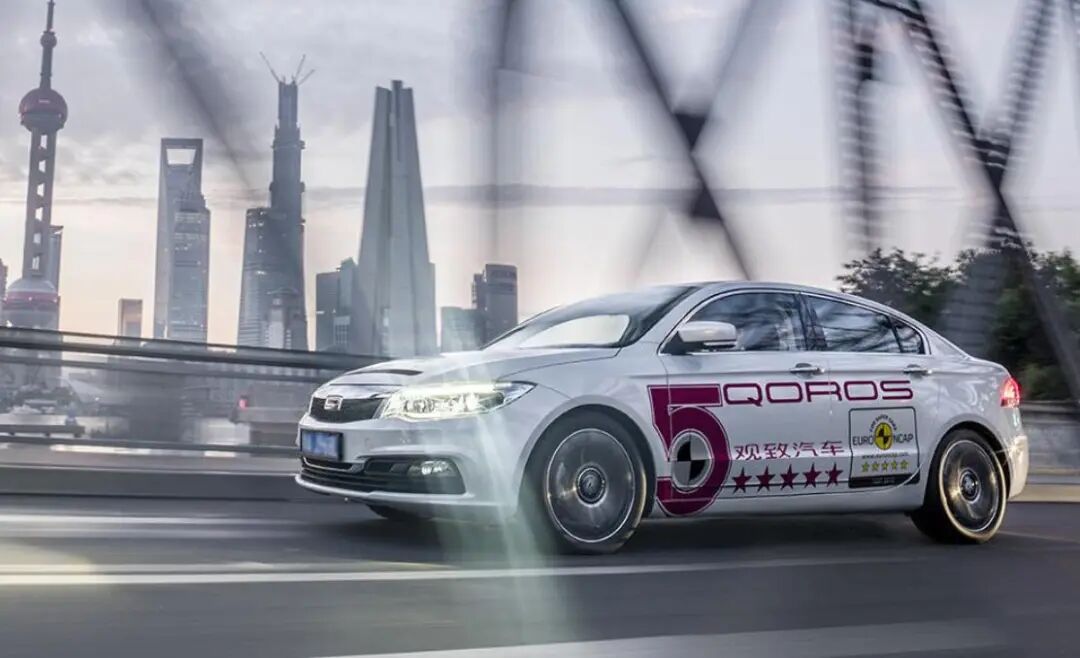
Core Insights - Qoros Auto, once a promising Chinese automotive brand, has filed for bankruptcy after 18 years of operation, primarily due to long-term debts to suppliers and a lack of repayment capability [1][4] - The company, which had a peak valuation with over 35 billion yuan in frozen assets, saw its sales plummet to fewer than 100 vehicles in 2023 [1] - Founded in 2007 as a joint venture between Chery Automobile and Israel's Quantum Group, Qoros aimed to become China's first international premium brand but failed to convert early acclaim into domestic sales [3][4] Company Overview - Qoros Auto was established with high aspirations, launching its first model, the Qoros 3, at the 2013 Geneva Motor Show, which received positive reviews for its build quality and safety [1] - Despite initial praise, the Qoros 3 struggled in the Chinese market, with sales stagnating around 10,000 units annually from 2014 to 2016 [3] Industry Context - The rise of new automotive players in 2014 marked a significant shift in the industry, with companies like NIO, Xpeng, and Li Auto emerging alongside traditional brands [5][9] - The competitive landscape evolved as traditional automakers began to establish their own electric brands in response to the new entrants, leading to a dual competition between established companies and new forces [9][11] - The automotive industry in China has seen a wave of brand creation and elimination, with many new entrants failing due to a lack of sustainable business models and market understanding [12][14] Success and Failure Analysis - Qoros Auto exemplifies the pitfalls of entering the market with high-priced products without aligning with consumer expectations and market demand [14][16] - Successful brands have demonstrated resilience and adaptability, often pivoting their strategies to meet consumer needs and leveraging unique technological advantages [17][19] - The automotive sector's evolution highlights the importance of systemic capabilities, where successful brands build sustainable operations rather than merely producing individual models [19]
均瑶集团王均豪谈造车新势力:很多人造车就为募集资本,然后准备跑路
Xin Lang Cai Jing· 2025-12-09 05:17
Core Viewpoint - The "2025 China Enterprise Competitiveness Conference" was held in Beijing on December 9-10, where Wang Junhao, the President of Junyao Group and Chairman of Junyao Health, discussed innovations in the automotive sector and emphasized a sustainable business model in car manufacturing [1][2]. Group 1: Automotive Industry Insights - Wang Junhao highlighted that many new car manufacturers are primarily focused on raising capital and may abandon their projects when challenges arise [3][5]. - He stated that the approach to car manufacturing should not be about quantity but rather about establishing a long-lasting business, akin to a "century-old store" [3][5]. - The company aims to consolidate market research and development resources to produce better cars at lower costs, indicating a shift towards efficiency and innovation in the automotive sector [3][5].


新势力洗牌鸿蒙智行月销8万夺冠 零跑“单打独斗”再售7万辆连增9月
Chang Jiang Shang Bao· 2025-12-02 23:32
Core Viewpoint - The delivery volumes of leading new energy vehicle manufacturers in China are showing positive trends, with significant competition for monthly sales leadership among companies like Hongmeng Zhixing, Leap Motor, and Xiaomi Auto [2][4]. Group 1: Hongmeng Zhixing - In November, Hongmeng Zhixing achieved a record delivery of 81,900 vehicles, marking a year-on-year increase of 89.61% [3][4]. - This delivery volume not only set a historical high for Hongmeng Zhixing but also surpassed Leap Motor, allowing it to claim the title of monthly sales champion [3][4]. - The company has a diverse product lineup, including models from Seres, Chery, BAIC, and JAC, collectively branded under the "Hongmeng Zhixing" series [5]. Group 2: Leap Motor - Leap Motor reported a delivery of 70,300 vehicles in November, reflecting a year-on-year growth of over 75% and a month-on-month increase [8]. - The company has achieved a cumulative sales target of over 500,000 vehicles since 2025, ahead of its annual goal [9]. - Leap Motor's third-quarter financial report indicated a revenue of 19.45 billion yuan, a 97.3% increase year-on-year, with a gross margin of 14.5% [10]. Group 3: Xiaomi Auto - Xiaomi Auto has emerged as the third-largest player in the new energy vehicle sector, with a cumulative delivery of over 500,000 vehicles since its launch in April 2024 [11][12]. - In November, Xiaomi Auto maintained a monthly delivery volume of over 40,000 vehicles for the third consecutive month [12]. - The company has already met its annual target of 350,000 vehicles for 2025 [13]. Group 4: Other Competitors - Xpeng Motors delivered 36,700 vehicles in November, a year-on-year increase of 19%, with a total of 391,900 vehicles delivered in the first eleven months of 2025 [15]. - NIO delivered 36,300 vehicles in November, showing a year-on-year growth of 76.3% [18]. - Lantu Motors achieved a monthly delivery of 20,000 vehicles in November, marking an 84% year-on-year increase and setting a new record for the company [18].

大洗牌!造车新势力巨变来袭
Xin Lang Cai Jing· 2025-12-02 11:44
Core Insights - The competition among new energy vehicle manufacturers is intensifying, with significant shifts in market leadership as companies strive to establish themselves ahead of the 2025 deadline [1][3][38] - The "big reshuffle" in the automotive market is a recurring theme as new players enter the field, leading to increased industry concentration and the potential elimination or upgrading of smaller firms [4][39] Sales Performance - Hongmeng Zhixing achieved a record monthly delivery of 81,900 vehicles in November, marking a 89.61% year-on-year increase [5][40] - Leap Motor delivered 70,327 vehicles in November, maintaining a growth streak for nine consecutive months [5][40] - Xiaomi's sales exceeded 40,000 units, solidifying its position in the second tier of new energy vehicle manufacturers [5][40] - Xpeng Motors delivered 36,728 vehicles, showing a 19% year-on-year increase but a 12.6% decline from the previous month [5][40] - NIO delivered 36,275 vehicles, with a 76.3% year-on-year increase but a 10% month-on-month decline [5][40] - Li Auto's deliveries were 33,181 units, reflecting a 31.9% year-on-year decrease but a 4.45% month-on-month increase [5][40] - Deep Blue and Lantu also reported sales of 33,060 and 20,005 vehicles respectively, with varying year-on-year performance [5][40] Market Dynamics - The new energy vehicle sector is experiencing a significant transformation, with companies like Leap Motor and Xiaomi achieving their annual sales targets ahead of schedule [8][43] - The competitive landscape is shifting, with traditional leaders like NIO, Xpeng, and Li Auto facing challenges as they collectively fall below 40,000 units in November [6][41][42] - The market is increasingly defined by technological advancements, with safety becoming a critical concern for manufacturers as they navigate the evolving landscape [70] Financial Performance - Leap Motor has exceeded its annual delivery target of 500,000 vehicles, while NIO, Xpeng, and Leap are all currently operating at a loss [26][61] - Li Auto has emerged as the first new energy vehicle manufacturer to achieve annual profitability, with a reported net profit of 11.81 billion yuan [25][26] - The cumulative losses for NIO have surpassed 100 billion yuan, highlighting the financial struggles faced by many in the sector [58][61] Industry Trends - The new energy vehicle market is characterized by a rapid influx of players, with significant investments exceeding 100 billion yuan over the past decade [11][46] - The competitive dynamics have led to a re-evaluation of market positions, with companies like Xiaomi quickly gaining traction despite being relatively new entrants [10][67] - The industry is moving towards a phase where technological capabilities will determine survival, with safety and reliability becoming paramount [70]