
铜精矿供应紧张

Search documents
中辉有色观点-20251208
Zhong Hui Qi Huo· 2025-12-08 03:25
Report Industry Investment Ratings - Gold: Long - term hold [1] - Silver: Long - term hold [1] - Copper: Long - term hold [1] - Zinc: Rebound (short - term), rebound and sell on rallies (long - term) [1] - Lead: Under pressure [1] - Tin: Bullish [1] - Aluminum: Rebound [1] - Nickel: Rebound [1] - Industrial silicon: Rebound [1] - Polysilicon: Sell on rallies [1] - Lithium carbonate: Correction, then go long after stabilizing [1] Core Views - The market is influenced by factors such as US inflation, consumer confidence, central bank gold purchases, geopolitical situations, and major meetings like the Fed's interest - rate meeting and China's Politburo meeting. Different metals have different supply - demand situations and price trends [1]. Summary by Related Catalogs Gold - Core view: Long - term hold. The US inflation and consumer confidence data support interest - rate cuts. The People's Bank of China has been increasing its gold holdings for 13 consecutive months. Geopolitical trading has decreased, and gold prices remain high. In the long - term, the geopolitical order is being reshaped, uncertainties persist, and central banks continue to buy gold, so its long - term strategic allocation value remains unchanged [1]. Silver - Core view: Long - term hold. In the short - term, there are issues like delivery squeezes and low inventories. Global large - scale fiscal policies are beneficial for silver in the long - run. However, the high spot premium and soaring volatility of silver futures mean it's not advisable to chase the high in the short - term. In the long - term, there is a supply gap, and with global economic stimulus and loose liquidity, the logic for going long remains [1]. - Basic logic: The core of the recent silver rally is the severe supply - demand imbalance. Its strong industrial attributes (such as in photovoltaic, new - energy vehicles, and computing power) and restricted supply have led to a five - year consecutive supply shortage with a cumulative gap of 23,000 tons, and inventories have dropped to a historically tight level, pushing up prices and leasing costs. The recent short - squeeze is a more direct driver. Trump's tariff policy has caused a large - scale transfer of silver from London inventories to the US, resulting in an extreme shortage of London spot silver, a soaring spot premium, and arbitrage trading, further driving up global silver prices. The US including silver in the critical minerals list has intensified tariff concerns, and similar inventory transfers in Asia have exacerbated regional price differences and the upward trend [2]. - Macro - fundamental: US inflation has been continuously cooling (core PCE in September was 2.8% year - on - year and 0.2% month - on - month), and consumer confidence has recovered (Michigan confidence index in December was 53.3, ending a four - month decline), strengthening the market's expectation of a Fed rate cut in December. The White House has called for "prudent rate cuts," and the focus of the December meeting has shifted to potential policy combinations. Besides rate cuts, the Fed may announce a monthly bond - buying program of $45 billion (expected to start in 2026) to ease liquidity pressure, which may mark the restart of balance - sheet expansion [3]. Copper - Core view: Long - term hold. A super - macro week is approaching, with the Fed's interest - rate meeting and China's Politburo meeting imminent. Fundamentally, the cancelled LME copper warehouse receipts have increased sharply, heightening concerns about overseas squeezes. In China, inventories are decreasing during the off - season, and non - US copper inventories may gradually run out. Both LME copper and SHFE copper have continuously reached new highs, with increased volatility at high levels. It's recommended to set a trailing stop for long positions. In the long - term, copper is still bullish [1]. - Industry logic: The global supply of copper concentrates remains tight. The CSPT group has reached a consensus on reducing the production capacity of copper smelting, resisting unreasonable pricing, and preventing vicious competition. The latest copper concentrate TC is - $42.83 per ton. In November, China's electrolytic copper production increased by 11,500 tons month - on - month to 1.1031 million tons, a year - on - year increase of 9.75%. The increase in copper prices has widened the spread between refined and scrap copper to 5,510 yuan per ton, reaching a new high since May 2024. The arbitrage space of the COMEX - LME price difference has attracted trading giants such as Trafigura and Glencore to actively participate in the large - scale transfer of copper inventories. The US has become a "siphon" for global copper, and non - US copper inventories may gradually dry up, triggering a global copper - buying war [5]. Zinc - Core view: Rebound (short - term), rebound and sell on rallies (long - term). A super - macro week is approaching, the dollar index is weakening, and the macro and sector sentiment is positive. Fundamentally, the processing fees for zinc concentrates continue to decline, and the downstream has entered the consumption off - season, resulting in a weak supply - demand situation overall. In China, inventories are decreasing during the off - season. In the short - term, zinc prices have risen and then fallen. It's recommended to gradually take profits on long positions. In the long - term, supply is expected to increase while demand decreases, so the view of selling on rallies remains [1]. - Industry logic: The processing fees for domestic zinc concentrates have continued to decline due to smelters' winter stockpiling, currently at 1,850 yuan per ton, a month - on - month decrease of 250 yuan per ton. Northern mines have reduced production, and there is still room for further decline in zinc concentrate processing fees. In November, China's zinc ingot production decreased by 22,000 tons month - on - month to 595,200 tons. Consumption has entered the off - season, and downstream buyers are making purchases based on rigid demand. The LME zinc inventory has increased to 55,375 tons, further alleviating the risk of a soft squeeze. China's social inventory of zinc ingots has slightly decreased to 1.403 million tons on a month - on - month basis. Zinc's short - term supply - demand is weak, and inventories continue to decline during the off - season. Attention should be paid to the impact of northern winter environmental inspections on the smelting end [8]. Aluminum - Core view: Rebound. It's recommended to take short - term profits on SHFE aluminum and then wait and see, paying attention to the change direction of aluminum ingot social inventories. The main operating range is [21,500 - 22,500] yuan per ton [1]. - Industry logic: For electrolytic aluminum, the market's expectation of a Fed rate cut at the end of the year has been further strengthened. Industrially, as the dry season approaches in southwestern China, the costs of aluminum enterprises with a high proportion of hydropower are expected to increase. In December, the latest domestic electrolytic aluminum ingot inventory is 596,000 tons, a decrease of 17,000 tons compared to last week; the inventory of aluminum rods in major domestic consumption areas is 128,000 tons, a decrease of 3,000 tons compared to last week. On the demand side, the operating rate of domestic downstream aluminum processing leading enterprises has increased by 0.4 percentage points to 62.3%, and the consumption in the automotive terminal field is fair. For alumina, the shipment of bauxite from Guinea overseas has returned to normal and is expected to continue to increase. Bauxite mines in northern China have gradually resumed production, and the absolute inventory of bauxite remains at a high level. Currently, there are frequent news of maintenance of alumina enterprises in the north, but no large - scale alumina production cuts have been heard. In the short - term, the oversupply pattern in the alumina market continues, and attention should be paid to changes in the overseas bauxite end [12]. Nickel - Core view: Rebound. It's recommended to take profits on nickel and stainless steel at low prices and then wait and see, paying attention to the changes in downstream stainless - steel inventories. The main operating range of nickel is [117,000 - 119,000] yuan per ton [1]. - Industry logic: For nickel, the market's expectation of a Fed rate cut at the end of the year has been further strengthened. Industrially, the Indonesian Ministry of Energy and Mineral Resources plans to lower the nickel production target for 2026, and it is reported that some Indonesian smelters have plans to cut production. In December, the latest LME nickel inventory has climbed to 252,000 tons, and the domestic pure - nickel social inventory is about 52,000 tons. With the expectation of reduced refined - nickel production, the inventory - building speed may slow down. For stainless steel, the terminal consumption field has gradually entered the off - season. According to statistics, the total inventory of the two major stainless - steel markets in Wuxi and Foshan has slightly decreased to 940,000 tons in December, a week - on - week decrease of 1.28%. As stainless - steel prices have weakened significantly, the social inventory has changed from increasing to decreasing again, but there is still a large risk of inventory accumulation in the long - term. Currently, the stainless - steel market has entered the year - end consumption off - season, and downstream demand remains sluggish. Close attention should be paid to the impact of downstream terminal consumption on inventory changes [16]. Lithium Carbonate - Core view: Correction, then go long after stabilizing. The total inventory has been decreasing for 16 consecutive weeks. Recently, affected by the increase in the arrival of overseas spodumene and the expectation of domestic production resumption, the price will correct. Wait for the opportunity to go long after stabilization [1]. - Industry logic: The total inventory has been declining for 16 consecutive weeks. Upstream inventories have further decreased, downstream has actively reduced inventories to a reasonable range, and there has been obvious inventory accumulation in the trader segment. As prices have risen rapidly, the production enthusiasm of lithium salt plants has increased, and there is still room for an increase in the operating rate. Terminal demand remains strong, and the optimistic expectation for energy storage still exists. The weekly production of lithium iron phosphate has reached a new high. Overall, lithium carbonate inventories continue to decline, and there is no significant room for price drops. Recently, affected by the increase in the arrival of overseas spodumene and the expectation of domestic production resumption, the price will correct, and wait for the opportunity to go long after stabilization [20].
沪铜 将再度挑战前高
Qi Huo Ri Bao· 2025-11-28 00:34
Core Viewpoint - The copper market has experienced a significant price increase, driven by tight supply of copper concentrate, rising expectations for interest rate cuts by the Federal Reserve, and positive signals from US-China trade negotiations [1][4]. Group 1: Copper Price Movement - From September 24 to October 30, the main copper contract rose nearly 12%, surpassing 89,000 yuan/ton, reaching a historical high [1]. - Following a hawkish stance from Powell and increasing internal disagreements within the Federal Reserve regarding rate cuts, copper prices have fluctuated between 85,000 and 88,000 yuan/ton since November [1][2]. Group 2: Federal Reserve and Economic Data - The US government faced a historic shutdown due to the failure to pass the 2026 fiscal budget, delaying the release of key labor market data [2]. - The Federal Reserve implemented a "blind cut" in October without supporting data, and subsequent hawkish comments from Powell diminished expectations for a December rate cut [2][3]. - The end of the government shutdown in mid-November allowed the Labor Statistics Bureau to report a significant increase in September's non-farm employment, but the October report was not released, leading to uncertainty about the Fed's December decisions [2][3]. Group 3: Supply and Demand Dynamics - The tight supply of copper concentrate has worsened this year, with the treatment charge (TC) dropping from around $6 per dry ton at the beginning of the year to approximately -$42 per dry ton [4]. - Several mines have faced production disruptions, including a 25% year-on-year decline in output from Chile's Codelco and significant impacts from natural disasters and social unrest in Indonesia and Peru [4]. - The price difference between refined copper and scrap copper has strengthened, currently running between 7,500 and 8,500 yuan/ton, which has suppressed demand for refined copper products [4]. Group 4: Future Outlook - The probability of continued interest rate cuts by the Federal Reserve remains high, contributing to a more relaxed global liquidity environment [5]. - The ongoing tight supply of copper concentrate is expected to persist, potentially leading to coordinated production cuts by smelters to pressure mines to increase TC [5]. - While demand has weakened this year, the energy storage sector in 2026 is anticipated to boost demand for refined copper, suggesting a future supply-demand imbalance may widen [5].
沪铜将再度挑战前高
Qi Huo Ri Bao· 2025-11-28 00:22
Group 1 - The core driver of the recent copper price surge includes tight copper concentrate supply, rising expectations for interest rate cuts by the Federal Reserve, and positive signals from US-China trade negotiations [1] - From September 24 to October 30, the main copper futures contract increased by nearly 12%, breaking through the 89,000 yuan/ton mark, reaching a historical high [1] - Following the Federal Reserve's hawkish stance and internal disagreements regarding rate cuts in December, copper prices have been fluctuating between 85,000 and 88,000 yuan/ton [1][2] Group 2 - The US government faced a historic shutdown due to the failure to pass the 2026 fiscal budget, delaying the release of key labor market data [2] - The Federal Reserve implemented a rate cut without data support, leading to uncertainty about future rate cuts, which contributed to copper price volatility [2] - After the government shutdown ended, significant labor market data was released, but the Federal Reserve's stance on December rate cuts remained cautious [2] Group 3 - The copper concentrate supply tightness has worsened this year, with the treatment charge (TC) dropping from around $6 per dry ton at the beginning of the year to approximately -$42 per dry ton [4] - Several mining disruptions have occurred, including a 25% year-on-year production drop at Chile's Codelco and a complete shutdown at Indonesia's Grasberg mine due to landslides [4] - The Chinese Copper Smelters' Joint Negotiation Group (CSPT) has called for domestic smelters to reduce production in response to low processing fees [4] Group 4 - Since August, the price spread between refined copper and scrap copper has strengthened, currently operating in the range of 7,500 to 8,500 yuan/ton, which has suppressed the demand for refined copper [5] - The utilization rates of downstream products such as copper pipes, rods, and foils are running weak, with real estate adjustments contributing to a marginal decline in refined copper demand [5] - Despite the weak demand outlook for the year, the energy storage sector in 2026 is expected to boost refined copper demand [5]
宏观压制叠加淡旺季累库,铜承压回落:沪铜周报-20251124
Zhong Hui Qi Huo· 2025-11-24 03:22
Report Industry Investment Rating No relevant information provided. Core Viewpoints of the Report - Overall, macro sentiment has cooled, and the market has prematurely priced in the Fed not cutting interest rates in December, with the stronger US dollar suppressing copper prices. Coupled with inventory accumulation at home and abroad, copper is under short - term pressure and is expected to test the important psychological support level of 85,000 yuan. In the short term, it is recommended to wait for the price to stop falling and stabilize before making right - side low - buying arrangements. In the long term, copper is still highly regarded as an important strategic resource in the China - US game and a substitute for precious metals, given the tight copper concentrate supply and the booming demand for green copper [3][83]. - New speculative investors should wait for the price to stop falling and stabilize, then make right - side layouts. They can try to go long at low levels around 84,500 - 85,000 yuan, with a stop - loss at 83,000 yuan. Long - term strategic long positions can buy copper put options to hedge risks. Industrial sellers can set up sell - hedges on price rebounds using an inverted pyramid approach. Industrial buyers can wait for the right time, make appropriate spot purchases based on rigid demand, and build long - term positions at low levels when prices correct to lock in raw material costs. The short - term price range for Shanghai copper is [84,000, 88,000] yuan/ton, and for LME copper is [10,400, 11,000] US dollars/ton [4][83]. Summary of Each Section Overseas Macro - US economic data shows mixed results. The number of initial jobless claims in the week ending November 15 was 220,000, lower than the expected 227,000. The number of continued jobless claims was 1.974 million, slightly higher than the expected 1.95 million. Existing home sales in October reached an eight - month high, with the median home price rising 2.1% year - on - year. The unemployment rate in September was 4.4%, higher than the expected 4.3%, and non - farm payrolls increased by 119,000, far exceeding the expected 51,000. The release of October non - farm data is postponed to December 16 [5]. - Fed hawkish officials have been vocal, and the probability of a rate cut on December 10 has dropped to 32.8%, a significant decline from over 90% a month ago. The US dollar index has returned above 100, suppressing copper prices [5]. - Trump publicly criticized Fed Chairman Powell and threatened to dismiss him, which has raised market concerns. Although the market has experienced a sharp decline, it is mainly due to liquidity concerns rather than economic recession fears. The Fed will stop selling Treasury bonds and end quantitative tightening starting from December 1 [5]. Domestic Macro - China's LPR remained unchanged in October, and the market is looking forward to the Politburo meeting in early December. In October, CPI rose 0.2% year - on - year and 0.2% month - on - month, while PPI fell 2.1% year - on - year, with the decline narrowing by 0.2 percentage points [10]. - The growth rate of social financing slowed down slightly in October, and the "scissors gap" between M2 and M1 widened. Industrial added value and service production index growth rates declined year - on - year, and retail sales growth slowed down. Fixed - asset investment decline widened, and real estate sales showed a decline in both volume and price, with the decline in development investment widening [10]. - The current economic downward pressure is significant, consumer and investment willingness is weak, the real estate market is facing a hard landing, and the market's risk - aversion sentiment is strong due to tense Asia - Pacific relations [10]. Copper Research Multi - and Short - Term Logic - Bullish factors include continuous tight global copper concentrate supply, anti - involution in the copper smelting industry at home and abroad, a decline in electrolytic copper production in October with expected further contraction, and strong demand for copper from the power and new - energy vehicle sectors in the long term [20]. - Bearish factors are the obvious suppression of demand by high copper prices, the entry into the consumption off - season with a decline in downstream enterprise operating rates, the difficult bottom - seeking of the real estate market, and the high level of global visible copper inventories [20]. Futures and Spot Market - As of November 20, COMEX copper was priced at 495.35 cents/pound (equivalent to 10,917.5 US dollars/ton), and LME copper was at 10,686 US dollars/ton, with a price difference of 231.5 US dollars/ton. The spot (0 - 3) of LME copper was at a discount of 18.89 US dollars/ton, and (3 - 15) was at a premium of 117.68 US dollars/ton [21]. - As of November 21, the spot of domestic electrolytic copper in the South China region had a premium of 95 yuan/ton, and in Shanghai, it was 60 yuan/ton. After the copper price decline, downstream buyers actively purchased at low prices, and market trading picked up. The Yangtze River Non - ferrous electrolytic copper spot was at 85,980 yuan/ton, and the main contract of Shanghai copper was at 85,660 yuan/ton, with a basis of 320 yuan/ton [21]. - As of November 14, the net long position of speculative funds in LME copper was 60,294 lots, a 5.23% increase from the previous period. As of November 21, the main contract position of Shanghai copper was 190,218 lots, a 1.08% decrease, and the trading volume was 98,905 lots, a 4.58% decrease [21]. Copper Prices at Home and Abroad - As of November 21, LME copper was at 10,686 US dollars/ton, with a weekly decline of 1.48% and an annual increase of 21.42%. COMEX copper main contract was at 495 cents/pound, with a weekly decline of 1.91% and an annual increase of 22.73%. The main contract of Shanghai copper was at 85,660 yuan/ton, with a weekly decline of 1.43% and an annual increase of 16.89% [23]. Fundamental Summary - Supply Global Copper Concentrate Supply - In 2025, many large copper mines around the world have unexpectedly reduced or halted production. The total output of major global copper mining enterprises in 2025 is expected to be 12.2 million tons, a 3.18% decrease from 2024. The copper concentrate TC is at a continuously low level, currently at - 41.72 US dollars/ton, a 0.2 - dollar decrease from the previous period [43][46]. - Freeport - McMoRan plans to restart the production of about 30% of the Indonesian Grasberg copper - gold mine by July next year. The negotiation of long - term contracts for copper concentrate and electrolytic copper is approaching during the upcoming CESCO meeting, and the spot market is expected to be quiet [43]. Domestic Copper Concentrate Supply - In October 2025, China imported 2.451 million tons of copper concentrate, a 5.9% increase year - on - year. The cumulative import from January to October was 25.086 million tons, a 7.5% increase year - on - year. The inventory of copper concentrate at major domestic ports is currently 7.049 million tons, a 570,000 - ton increase from the previous period [43]. Electrolytic Copper Supply - In October, the output of SMM China electrolytic copper decreased by 29,400 tons month - on - month to 1.0916 million tons, a 2.62% decrease, and is expected to further decrease by 4,000 tons in November. The import volume of refined copper in October was 323,100 tons, a 13.62% decrease month - on - month and a 16.32% decrease year - on - year [43]. Fundamental Summary - Demand - The copper consumption in renewable energy systems is 8 - 12 times that of traditional power generation systems. The copper consumption per unit in the photovoltaic field is 4 tons per megawatt, and the copper consumption for photovoltaic installation is about 0.5 tons per GW. The copper consumption of a pure - electric vehicle is 83 kilograms, 3.6 times that of a fuel - powered vehicle, and that of a pure - electric bus is 224 - 369 kilograms, more than 10 times that of a fuel - powered vehicle [61]. - In October, the operating rates of copper product industries generally declined, except for the copper foil industry, which increased. The sales volume of new - energy passenger vehicles in October was 1.657 million, a 19.3% increase year - on - year. The power investment maintained its resilience, especially the new photovoltaic installation [61]. Inventory at Home and Abroad - As of November 20, the copper inventory in mainstream domestic regions increased by 700 tons to 194,500 tons, and the bonded - area inventory increased by 500 tons to 86,200 tons. The total global exchange copper inventory was 664,100 tons, at a high level compared to the same period in history [74]. - The increase in inventory is due to the off - season of consumption at home and abroad, the opening of the domestic export window, and the influence of the COMEX - LME price difference. There is a potential risk of a local copper inventory backlog in the United States [74]. Summary and Outlook - The US non - farm employment data in September was mixed, and the probability of the Fed cutting interest rates in December has declined, with the US dollar strengthening. China's macro data is weak, and the policy is in a vacuum period. The market sentiment is cooling, and attention should be paid to US inflation data, the Fed's December meeting, and China's Politburo meeting [83]. - The copper concentrate TC is at a low level, and the production of electrolytic copper has declined. After the copper price decline, downstream purchasing has increased, but the global visible copper inventory is at a high level. The power and automobile industries maintain their resilience, while the real estate and infrastructure sectors are weak [83].
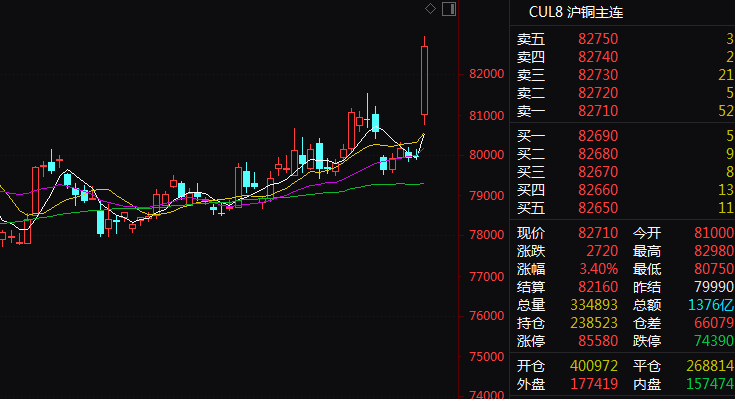
突发大消息,铜价暴涨
Zheng Quan Shi Bao· 2025-09-25 12:19
Group 1: Copper Price Movement - On September 25, the main copper contract in Shanghai surged approximately 3.5%, nearing 83,000 yuan/ton, marking the highest point since June 2024 [1] - The current price of domestic 1 electrolytic copper is reported at 82,390 yuan/ton, an increase of 2.98% from the previous period [2] Group 2: Supply Chain and Production Impact - The mudslide incident at Freeport Indonesia's Grasberg mine has led to a suspension of operations, with an estimated 800,000 tons of wet material affecting multiple operational layers [3] - The company anticipates a 4% year-on-year decline in copper sales and a 6% decline in gold sales for Q3, with a potential 35% reduction in projected production for FY2026 [3] - The incident is expected to tighten raw material supply, potentially impacting domestic refined copper output [4] Group 3: Market Dynamics and Future Outlook - Analysts indicate that the copper market has been constrained by rapid expansion in smelting capacity and ongoing disruptions in the copper concentrate market [3] - The domestic refined copper output is projected to reach 13.62 million tons by 2025, with nearly 3 million tons of new capacity expected from 2024 to 2026 [3] - The anticipated tightness in raw material supply may further support copper prices, with expectations for spot copper prices to remain in the range of 82,500 to 84,000 yuan/ton [5] Group 4: Consumer Behavior and Market Sentiment - The recent price surge has led to increased pressure on traders and copper processing companies, with some facing margin call challenges [6] - The upcoming National Day holiday may affect downstream operations and stocking demands, potentially leading to an increase in copper inventory levels [6]

中国大冶有色金属发盈警 预计中期净亏损约600万元
Zhi Tong Cai Jing· 2025-08-20 14:45
Core Viewpoint - China Daye Non-Ferrous Metals (00661) anticipates a revenue of approximately RMB 29.306 billion for the six months ending June 30, 2025, representing a year-on-year decrease of about 10.72% [1] - The company expects a gross profit of approximately RMB 514 million, a year-on-year decrease of about 37.47% [1] - A net loss of approximately RMB 6 million is projected for the period, contrasting with a profit of approximately RMB 148 million in 2024 [1] Revenue and Profit Analysis - The expected revenue decline is attributed to a combination of accelerated release of domestic and international smelting capacity and tight supply of copper concentrate [1] - The sustained low level of smelting processing fees and reduced product output have contributed to the decrease in revenue and narrowed profit margins [1] Financial Performance Outlook - The board of directors indicates that the anticipated net loss for the first half of 2025 is primarily due to the reduction in gross profit [1] - The significant drop in gross profit reflects the challenges faced by the company in the current market environment [1]
情绪裹挟下沪铜冲高回落 淡季背景下价格将继续受困?
Wen Hua Cai Jing· 2025-07-30 18:13
Group 1 - Recent fluctuations in copper prices have been influenced by a weakening US dollar and inventory depletion in non-US regions, alongside domestic sentiment regarding "anti-involution" [2] - The US has announced trade agreements with Japan and the Philippines, and negotiations with the EU have eased, reducing uncertainty around tariffs [2] - The "anti-involution" sentiment has led to optimism in the industrial sector, but the actual impact on copper prices has been limited due to low domestic copper inventory and concerns over US import tariffs [3][4] Group 2 - Domestic smelting enterprises are facing challenges due to low processing fees, but strong performance in by-products like sulfuric acid and gold has provided some profit support [6] - The tightening supply of copper concentrate is expected to persist, with major mining companies reporting mixed production outcomes [4][6] - The upcoming increase in US import tariffs on copper, potentially rising from 25% to 50%, is expected to alter global copper trade dynamics, leading to increased inventories in non-US regions [8][10] Group 3 - The copper market is currently experiencing a demand lull, which is limiting upward price momentum despite low social inventory levels [10] - The International Monetary Fund (IMF) has slightly upgraded its global economic growth forecasts, which may support copper demand in the near term [10] - The market is closely monitoring the August 1 deadline for US tariffs, which could lead to increased volatility in copper prices if implemented as scheduled [10]
