
2%通胀目标

Search documents
美国2%的通胀目标失效了?38万亿美债压顶,能否挽救4.6%失业率
Sou Hu Cai Jing· 2026-01-10 05:15
Group 1 - The core argument suggests that the U.S. may abandon its 2% inflation target, with employment issues remaining unresolved even if this occurs [1][2] - The Federal Reserve's dual mandate of price stability and full employment is facing structural conflict, as employment has become a dominant variable in the U.S. political system [2][5] - The Congressional Budget Office (CBO) predicts that the unemployment rate will drop to 4.6% this year and further to 4.4% by 2028, indicating a classic dilemma for the Federal Reserve [5] Group 2 - The current rise in unemployment is characterized as structural rather than cyclical, primarily due to AI replacing human jobs [6] - A McKinsey survey indicates that 78% of organizations are using AI in at least one business function, a 40% increase from 2023 [8] - Research shows that 38% of executives trust AI for business decision-making, and 44% prefer AI reasoning over their own insights, highlighting a shift in reliance on AI [10] Group 3 - The potential for monetary easing to stimulate employment may backfire, as it could accelerate the replacement of workers with AI tools rather than creating traditional jobs [10][12] - The abandonment of the 2% inflation target in favor of employment may not effectively address the structural challenges posed by AI, potentially leading to deeper systemic risks [12]


光大期货金融期货日报-20251224
Guang Da Qi Huo· 2025-12-24 03:40
Report Summary 1. Investment Rating No specific industry investment rating is provided in the report. 2. Core Views - **Stock Index Futures**: The stock market showed a pattern of rising and then falling on Tuesday, with the three major indexes slightly up. The stock index futures market has been oscillating around the lower edge of the central position since October, with limited differentiation between large - and small - cap indexes and frequent sector rotations. Short - term policy influence on the market is expected to increase after the December Politburo meeting and the Central Economic Work Conference. The important meetings indicate a 5% GDP growth target for next year, and policy efforts will focus on "stabilizing domestic demand" and "promoting the rapid development of new - quality productivity". The combination of fiscal and monetary policies will continue, and the scale may increase slightly compared to this year. Overseas, the Fed's rate cut and restart of the balance - sheet expansion plan have led to oscillations in US tech stocks, and the Bank of Japan's upcoming interest - rate meeting may affect carry - trade funds. The impact of important meetings on the stock index is long - term, and in the short term, it will mainly oscillate [1]. - **Treasury Bond Futures**: On the previous trading day, treasury bond futures closed with gains. The Central Economic Work Conference has set the tone for a moderately loose monetary policy in 2026, but rate - cut operations will be cautious. Although the central bank has shown an attitude of stabilizing the capital market, the overall economy remains resilient, prices are warming up, and the oscillating pattern of the bond market is difficult to change [1][2]. 3. Section - by - Section Summaries **Research Views** - **Stock Index Futures**: The stock market had a volatile performance on Tuesday, with more stocks falling than rising. The trading volume was 1.92 trillion yuan. The Shanghai Composite Index rose 0.07%, the Shenzhen Component Index rose 0.27%, and the ChiNext Index rose 0.41%. The stock index futures market has been oscillating around the lower edge of the central position since October. Policy influence is expected to increase, and the GDP growth target for next year is expected to be 5%. Overseas factors, such as the Fed's rate cut and the Bank of Japan's upcoming meeting, also have an impact. The short - term view is that the stock index will oscillate [1]. - **Treasury Bond Futures**: Treasury bond futures closed with gains on the previous trading day. The central bank conducted 593 billion yuan of 7 - day reverse repurchases on December 23, with a net withdrawal of 760 billion yuan. The weighted average interest rates of DR001 and DR007 declined. The monetary policy in 2026 will be moderately loose, but rate - cut operations will be cautious. The short - term capital market is loose, but the bond market's oscillating pattern is difficult to change [1][2]. **Daily Price Changes** - **Stock Index Futures**: On December 23, 2025, IH rose 7.2 points (0.24%) to 3,025.6, IF rose 6.6 points (0.14%) to 4,571.4, IC rose 10.0 points (0.14%) to 7,133.2, and IM fell 6.2 points (- 0.09%) to 7,197.4 compared to December 22 [4]. - **Stock Indexes**: The Shanghai 50 Index rose 7.3 points (0.24%) to 3,027.5, the CSI 300 Index rose 9.1 points (0.20%) to 4,620.7, the CSI 500 Index rose 1.1 points (0.02%) to 7,256.8, and the CSI 1000 Index fell 15.9 points (- 0.22%) to 7,392.4 on December 23, 2025, compared to December 22 [4]. - **Treasury Bond Futures**: On December 23, 2025, TS rose 0.062 points (0.06%) to 102.53, TF rose 0.165 points (0.16%) to 106.03, T rose 0.24 points (0.22%) to 108.22, and TL rose 0.85 points (0.76%) to 112.83 compared to December 22 [4]. - **Treasury Bond Yields**: On December 23, 2025, the yield of the 2 - year treasury bond fell 3.03 to 1.3401, the 5 - year treasury bond yield fell 2.06 to 1.5875, the 10 - year treasury bond yield fell 0.69 to 1.8355, and the 30 - year treasury bond yield fell 2.3 to 2.2200 compared to December 22 [4]. **Market News** - US Treasury Secretary Bessent supports re - examining the Fed's 2% inflation target after inflation has continuously declined to the target level. He suggests discussing adjusting the inflation target to a range such as 1.5% - 2.5% or 1% - 3%. However, he warns that adjusting the target during high inflation may give a negative impression [5]. **Chart Analysis** - **Stock Index Futures**: The report provides charts of the trends and basis of IH, IF, IC, and IM contracts, showing their price changes over time [6][7][8][9][10][11]. - **Treasury Bond Futures**: Charts include the trends of treasury bond futures contracts, treasury bond yields, basis, inter - period spreads, cross - variety spreads, and capital interest rates [13][14][17][18][19]. - **Exchange Rates**: Charts show the trends of the US dollar - RMB central parity rate, euro - RMB central parity rate, forward US dollar - RMB exchange rates, forward euro - RMB exchange rates, US dollar index, euro - US dollar exchange rate, British pound - US dollar exchange rate, and US dollar - Japanese yen exchange rate [21][22][24][26][28][30].
专家:2%通胀目标更多是引导价格向上
和讯· 2025-11-14 03:38
Group 1 - The core viewpoint of the article emphasizes the need for monetary policy to promote reasonable price recovery in the context of low CPI and PPI levels, with recent data showing a slight increase in CPI and a narrowing decline in PPI [2][3] - The National Bureau of Statistics indicates that despite positive changes in consumer prices, market demand remains insufficient, necessitating further expansion of domestic demand and improvement of supply-demand relationships [2] - The People's Bank of China has shifted its monetary policy focus from merely maintaining economic stability to actively guiding economic growth and price levels, reflecting a proactive approach to managing inflation [2][3] Group 2 - The article discusses the importance of stabilizing prices as a key monetary policy goal, highlighting the need for a balance between inflation targets and economic development levels [3][4] - Experts suggest that the current low price levels indicate insufficient effective demand, and there is a call for coordinated monetary and fiscal policies to address this issue [4][5] - The article notes that the CPI target has been set at 2% for the first time since 2004, aligning with the inflation targets of major economies, which is seen as appropriate given the current economic context [4][5] Group 3 - Maintaining a moderate growth in price levels is crucial for stabilizing consumer expectations and preventing a downward spiral in demand due to deflationary pressures [5] - Setting overly ambitious short-term policy goals, such as a 3% CPI growth, may not effectively guide expectations and could signal a lack of concern for price stability [5] - The article emphasizes the role of active fiscal policy in directly addressing total demand shortages, while monetary policy should complement these efforts to enhance overall policy effectiveness [5]

凌晨,宣布降息,美联储还干了件大事!
Sou Hu Cai Jing· 2025-10-30 03:09
Core Points - The Federal Reserve executed its second interest rate cut of the year, lowering the federal funds rate target range by 25 basis points to between 3.75% and 4% [1] - The Fed's statement highlighted a slowdown in U.S. job growth and a slight increase in the unemployment rate, while inflation has risen since the beginning of the year and remains at a high level [1] - The Fed aims to achieve full employment and a 2% inflation target over the long term, but faces increased uncertainty regarding the economic outlook [1] - Fed Chairman Powell indicated that there are short-term inflationary pressures and downside risks to employment, with significant disagreement within the committee regarding a potential rate cut in December [1] - The Fed announced the cessation of quantitative tightening (QT) and will end its balance sheet reduction plan after three and a half years, marking a key shift towards monetary easing [1] Market Reaction - Following Powell's remarks, U.S. stock markets initially experienced a sharp decline but later stabilized [3] - By the end of the trading day, the Dow Jones Industrial Average and the S&P 500 saw slight declines, while the Nasdaq Composite recorded a small gain and reached a new closing high [3] Balance Sheet Management - The Fed will stop reducing its $6.6 trillion balance sheet due to signs of tightening liquidity in the money market and declining bank reserves [2] - Starting December 1, the Fed will no longer allow up to $5 billion of U.S. Treasury securities to mature without reinvestment, opting instead to maintain government bond inventory stability through rollovers [2]
美联储巴尔金:美联储需要先实现2%的通胀目标,再讨论容忍该目标附近的一个区间。
Sou Hu Cai Jing· 2025-09-26 13:49
Core Viewpoint - The Federal Reserve, represented by Barkin, emphasizes the necessity to first achieve a 2% inflation target before considering a tolerance range around that target [1] Group 1 - The Federal Reserve's focus is on reaching the 2% inflation goal as a priority [1]
美联储决策层洗牌,2%通胀目标会否被废除?
Jin Shi Shu Ju· 2025-09-26 09:22
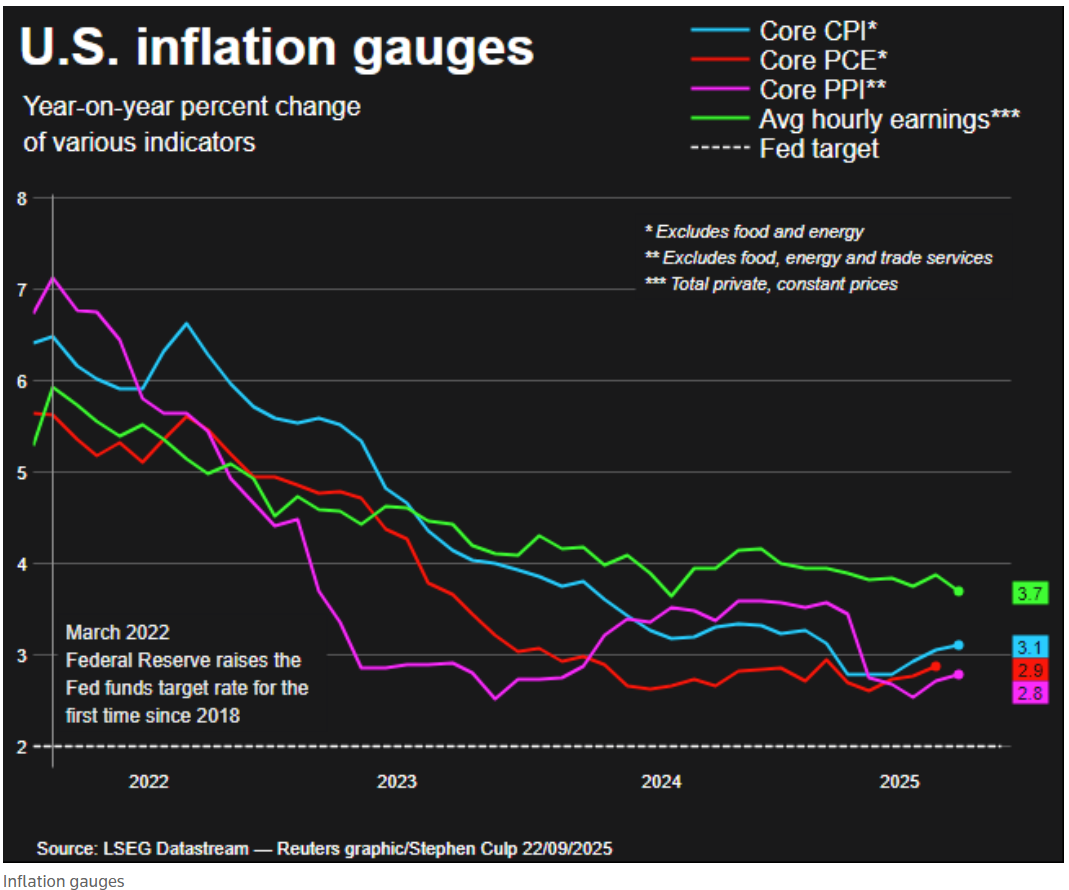
Core Viewpoint - The likelihood of the Federal Reserve changing its 2% inflation target is minimal, but discussions around alternative targets may intensify as the composition of the Federal Reserve Board changes and Powell's term ends in May next year [1][4]. Inflation Performance - The U.S. inflation rate is expected to show that it has exceeded the Federal Reserve's 2% target for 54 consecutive months, which is a rare occurrence for a central bank [1][3]. - The median expectation among Federal Reserve officials indicates that overall Personal Consumption Expenditures (PCE) inflation and core PCE inflation may not return to 2% until 2028, and even this timeline may be difficult to achieve [3]. Employment and Monetary Policy - The dual mandate of the Federal Reserve includes "full employment and price stability," but rising risks in the employment sector have prompted a restart of the rate-cutting cycle [3]. - Current financial conditions are among the most accommodative in years, with economic growth remaining robust, suggesting that rate cuts could further exacerbate inflationary pressures [3]. Trust in Inflation Targeting - The longer the Federal Reserve fails to meet its inflation target, the more likely public trust in the "inflation target itself" and the overall policy-making of the Federal Reserve may be undermined [3]. Potential Shift to Inflation Range - There is a possibility of adopting an "inflation range" as an alternative to the current target, which some Federal Reserve officials, including Atlanta Fed President Bostic, have shown openness to [5]. - Bostic suggested that a range of 1.75% to 2.25% could be a reasonable starting point, emphasizing that this approach would provide greater flexibility for policymakers [5]. Advantages and Disadvantages of Inflation Range - An "inflation range" could allow the Federal Reserve to avoid being technically in violation of its target even if inflation exceeds 2%, as long as it remains within the defined range [5]. - However, a wider range could lead to accumulated pressure if inflation spirals out of control, potentially forcing the Federal Reserve to implement overly aggressive and uncomfortable policy measures [6]. Global Context and Consumer Expectations - While the "inflation range" approach is more common in emerging markets, developed economies like Canada, Australia, and New Zealand have also adopted it, although central banks generally prefer more precise inflation targets [8]. - Consumer expectations for inflation are notably high, with a one-year expectation of 4.8% and a five-year expectation of 3.9%, which could lead to a "wage-price spiral" if not addressed [8].
芦哲:9月降息的确定性与年内降息的变数——海外周报
Sou Hu Cai Jing· 2025-08-25 12:35
Core Viewpoint - Recent US economic data exceeded expectations, initially reducing the likelihood of a rate cut in September, but Powell's dovish remarks at the Jackson Hole meeting paved the way for a potential cut [3][5]. Economic Data and Market Reaction - The Jackson Hole meeting dominated market sentiment, with US stocks rebounding after a four-day decline. The 10-year Treasury yield fell below 4.3% as a result of Powell's comments [4]. - For the week of August 18 to August 22, the 10-year Treasury yield rose by 5.4 basis points to 4.262%, while the 2-year yield decreased by 4.4 basis points to 3.707%. The US dollar index fell by 0.14% to 97.72 [4]. Jackson Hole Meeting Insights - Powell's speech indicated a shift in monetary policy stance, suggesting a lower threshold for a September rate cut. He noted that inflation risks have diminished, while unemployment has risen significantly [5]. - Employment growth has slowed, with an average of only 35,000 non-farm jobs added over the past three months, far below the monthly target of 168,000 for 2024 [5]. Monetary Policy Framework Adjustments - The Federal Reserve announced revisions to its monetary policy framework, moving away from the average inflation targeting (AIT) to a more flexible 2% inflation target. This change reflects the current high inflation environment [6]. - The focus on employment shortfalls has been removed, but the Fed will still monitor employment levels closely [6]. Strategic Implications - In an optimistic scenario, the expectation is for rate cuts in September and December, with an overall reduction of no more than 50 basis points for the year. The market currently prices in about 2.2 rate cuts for the year, which may be overly optimistic [7]. - Following the September FOMC meeting, the market is likely to increase bets on rate cuts in 2026, which could lead to a downward trend in the 2-year Treasury yield and the US dollar index [7].

只谈降息,不谈未来:鲍威尔为何只给市场“安慰剂”?
Jin Shi Shu Ju· 2025-08-25 05:32
Core Viewpoint - Mohamed El-Erian critiques Federal Reserve Chairman Jerome Powell's speech at the Jackson Hole Economic Symposium, stating that Powell avoided deep reflections on the Fed's future strategy and left critical issues for his successors to address [2][6] Summary by Sections Economic Strategy and Policy - Powell's speech focused primarily on the short-term outlook for monetary policy, describing the revision of the Fed's policy framework as a "gradual evolution" rather than a structural breakthrough [3][4] - The Fed is under significant institutional pressure due to persistent inflation above its target and signs of a weakening job market [3][4] Market Reactions - Powell's initial remarks, which suggested that changes in the baseline outlook and risk balance might necessitate policy adjustments, led to a rise in stock, bond, and other asset prices, despite later comments on inflation being largely overlooked by traders [3][4] Structural Economic Changes - El-Erian emphasizes that Powell did not adequately discuss structural changes in the economy, particularly in the labor market, which was a key theme of this year's symposium [4][5] - Powell's communication regarding the Fed's dual mandate of price stability and maximum employment was characterized as lacking clarity, especially in light of recent economic disruptions [4][5] Political Context - Powell avoided engaging in political debates surrounding the Fed's independence and did not address recent political pressures, including accusations against a current board member [5][6] - El-Erian believes that Powell missed an opportunity to reflect on his eight years as Fed Chair and the implications of economic structural changes for policy [5][6]
日本央行:将从可持续、稳定实现2%通胀目标的角度出发,适当实施货币政策。
news flash· 2025-07-31 02:59
Core Viewpoint - The Bank of Japan will appropriately implement monetary policy from the perspective of sustainably and stably achieving the 2% inflation target [1] Group 1 - The focus is on sustainable and stable achievement of the inflation target [1] - The monetary policy will be adjusted accordingly to meet the inflation goal [1]
日本央行:潜在消费者通胀率可能在2025财年到2027年预测期的下半年达到与2%目标基本一致的水平。
news flash· 2025-07-31 02:59
Core Viewpoint - The Bank of Japan (BOJ) indicates that the potential consumer inflation rate may align closely with the 2% target in the latter half of the forecast period from fiscal year 2025 to 2027 [1] Group 1 - The BOJ's assessment suggests a gradual approach towards achieving the inflation target, reflecting a cautious optimism about economic recovery [1] - The timeline for reaching the inflation target is set for the latter half of the fiscal years 2025 to 2027, indicating a medium-term outlook [1]