
就业目标

Search documents
罗志恒:2026年地方经济怎么干
Di Yi Cai Jing· 2026-02-25 03:41
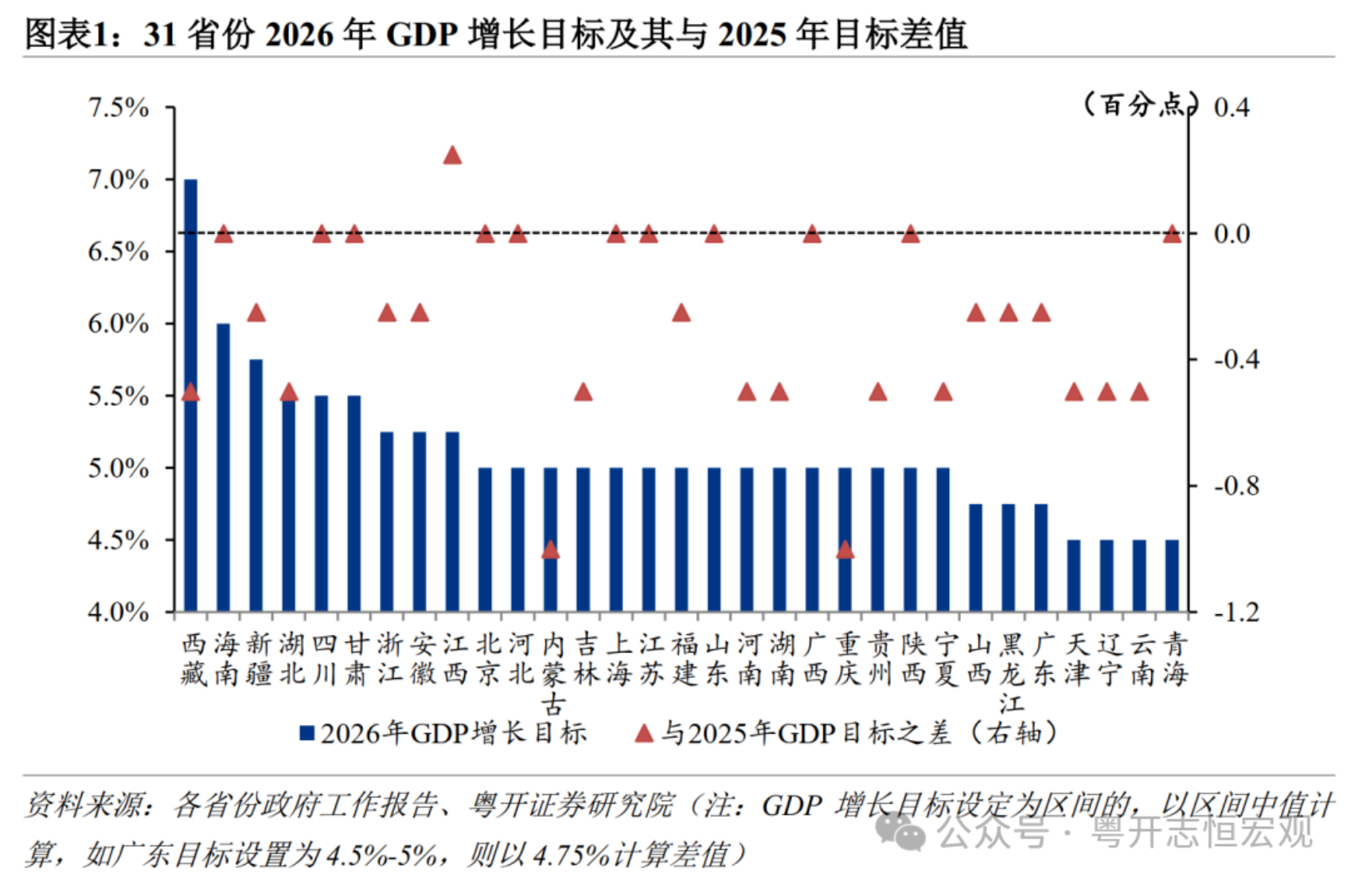
Core Viewpoint - Multiple provinces have adjusted their GDP growth and fiscal revenue targets for 2026, reflecting a shift towards quality development over speed, with an emphasis on sustainable economic growth and risk prevention [1][2][3]. GDP Growth Targets - The average GDP growth target for 31 provinces in 2026 is set at 5.04%, down by 0.2 percentage points from 2025 [2]. - 24 provinces have set their GDP growth targets between 4.5% and 5.5%, with Tibet leading at over 7% due to major infrastructure investments [2][3]. - Jiangxi is the only province to raise its growth target, from around 5% to 5%-5.5%, driven by advancements in new energy and equipment manufacturing [3]. Fiscal Revenue Targets - The average growth target for general public budget revenue across 31 provinces is 2.7%, a decrease of 0.1 percentage points from 2025 [10]. - 23 provinces have set their fiscal revenue growth targets between 2% and 4%, with Xinjiang aiming for a 10% increase, the highest among provinces [10][11]. - Major economic provinces like Guangdong and Jiangsu have set their fiscal revenue growth targets at 3% and 2%, respectively, which are lower than their GDP growth targets [11][14]. Industrial and Investment Goals - Most provinces have set industrial value-added growth targets above 5%, with Tibet aiming for the highest at 15% [16]. - Investment growth targets have been adjusted downwards in many provinces, reflecting a transition from investment-driven to consumption and innovation-driven growth [18]. - Guangdong has set a 5% investment growth target for 2026, aiming to stabilize and optimize investment structures [18]. Consumer and Employment Expectations - Retail sales growth targets have been lowered in most provinces, with 15 out of 19 provinces reducing their targets [21]. - Employment targets remain largely unchanged, with many provinces maintaining their urban employment goals around 5.5% [25].

如何解读2026年地方两会的经济增长线索︱重阳问答
重阳投资· 2026-02-13 07:32
Core Viewpoint - The economic growth targets set during the local two sessions for 2026 indicate a slight downward adjustment, with a weighted target growth rate of 5.03%, down from 5.27% last year, but still above 5% [2] Economic Growth Targets - The GDP growth target for 2026 is set at a weighted average of 5.03%, slightly lower than the previous year's 5.27%. Out of the provinces, 12 maintained their targets, 18 lowered them, and only Jiangxi increased its target slightly. Major provinces like Beijing and Shanghai kept their targets at 5%, while Guangdong and Zhejiang shifted to a range target with a slight decrease [2] - The possibility exists for the national GDP target to be adjusted from 5% to a range of 4.5-5% due to the adjustments made by 7 provinces [2] Inflation and Employment Goals - Inflation and employment targets remain stable, with the national CPI target expected to stay at 2% and the urban unemployment rate maintained in the 5-5.5% range. The focus remains on stabilizing prices and employment [3] Investment and Consumption Goals - The average target growth rate for retail sales is set at 4.71%, down by 0.6 percentage points from last year, with 15 out of 21 provinces lowering their targets. The emphasis has shifted from short-term stimulus to upgrading consumption structure and boosting service consumption [3] - For fixed asset investment, 15 provinces set quantitative growth targets, with 13 provinces lowering their targets, resulting in a weighted average growth rate decrease from 5.9% to 4.9%. The focus is now on improving investment quality and efficiency, particularly in technology and public welfare investments [3] Real Estate Market - Several provinces mentioned efforts to stabilize the real estate market, including encouraging the acquisition of existing properties for affordable housing and promoting urban renewal. However, the specifics on urban renewal initiatives were limited [3]

【播客】高盛:多省下调今年增长目标 全国GDP增速如何设定?
Datayes· 2026-02-04 11:44
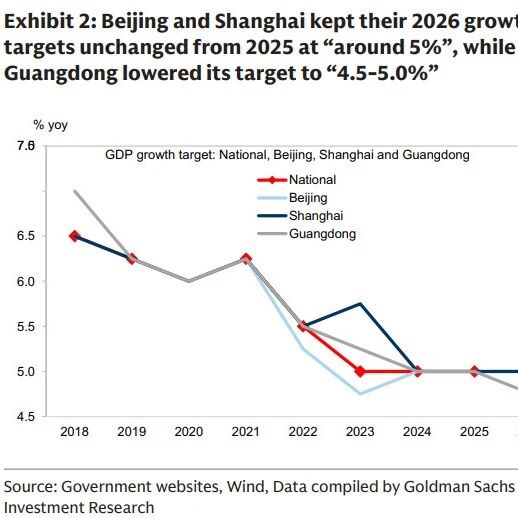
Group 1: Local "Two Sessions" Signals - The upcoming national "Two Sessions" will set the economic targets for 2026 and release the "14th Five-Year Plan" outline [1] Group 2: Economic Growth in 2025 and 2026 - In 2025, 55% of provinces achieved their growth targets, with a weighted average growth rate of 5.1%, slightly below the target of 5.3% [4] - For 2026, most provinces (19 out of 31) have lowered their growth targets, with the weighted average target expected to decrease to 5.1% from 5.3% in 2025 [4][7] - Beijing and Shanghai have maintained their growth targets at "around 5%", while Guangdong has lowered its target to "4.5%-5.0%" [5][6] Group 3: Inflation and Employment Targets - The inflation target for provinces is expected to remain around "2%", with the actual CPI average projected to rise from 0% in 2025 to 0.6% in 2026 [4] - Employment targets are anticipated to stay at "over 12 million new jobs" and an unemployment rate of "around 5.5%", aligning with the number of college graduates [4] Group 4: Fiscal Budget and Planning - The official deficit rate is expected to remain at 4%, with local government special bond quotas slightly increasing to 4.6 trillion yuan [4] - The broad fiscal deficit rate may expand to 12.0%, maintaining support for economic growth [4] - The "14th Five-Year Plan" will focus on technology, security, and livelihood, aiming for "high-quality development" and "high-level security" [4]
地方两会的“信息点”
一瑜中的· 2026-01-12 16:04
Group 1 - The provincial two sessions are typically held before the Lunar New Year, with 17 provinces confirming meetings in January, representing 57.3% of the national GDP for 2024 [1] - Among the six major economic provinces, four will hold their sessions in January, which collectively account for 44.4% of the national GDP [1] - Zhejiang will kick off the sessions on January 14, followed by Henan, Shandong, and Guangdong on January 26, while Jiangsu is scheduled for early February [1] Group 2 - The focus of the provincial two sessions includes setting GDP targets for the next five years, with Changsha establishing a range of 5%-5.5% annual growth, down from the previous target of around 7% [2] - Historical data shows that the weighted GDP targets of the 31 provinces are consistently higher than the national target by 0.3-0.6 percentage points from 2022 to 2025 [2] - The CPI targets are generally aligned with the national target, with Wuhan maintaining a target around 2% and Changsha lowering its target from around 3% to around 2% [3] Group 3 - Employment targets are assessed by comparing the total across the 31 provinces to the previous year, with Wuhan's new employment target remaining consistent with last year [3] - The growth rate of major projects in economic provinces is a key observation point, with previous years showing limited project increases, indicating potential investment momentum issues [3] - Other areas of interest include real estate investment, service consumption statements from provinces, and local consensus on industrial policies [3]

【宏观快评】:地方两会的信息点
Huachuang Securities· 2026-01-12 13:44
Group 1: Provincial Meetings Timing - Provincial meetings are typically held before the Lunar New Year, with 17 provinces confirming meetings in January, representing 57.3% of the national GDP for 2024[2] - Among the six major economic provinces, four will hold meetings in January, accounting for 44.4% of the national GDP[2] - Zhejiang will kick off the meetings on January 14, followed by Henan, Shandong, and Guangdong on January 26, with Jiangsu scheduled for early February[2] Group 2: Economic Goals and Targets - The future five-year GDP target for Changsha is set as a range of 5%-5.5%, down from the previous target of around 7%[3] - Historical data shows that the weighted GDP targets of 31 provinces are consistently 0.3-0.6 percentage points higher than the national target from 2022 to 2025[3] - CPI targets for provinces are generally aligned with the national target; Wuhan maintains a target of around 2%, while Changsha has lowered its target from around 3% to 2%[3] Group 3: Employment and Investment Insights - The employment target for Wuhan remains consistent with the previous year, indicating stability in national employment goals[4] - There is uncertainty regarding the growth rate of major projects in economic provinces for 2026, with mixed expectations on infrastructure investment[4] - Key areas of focus include urban village renovations in real estate and new statements on service consumption from provinces[4]
美国2%的通胀目标失效了?38万亿美债压顶,能否挽救4.6%失业率
Sou Hu Cai Jing· 2026-01-10 05:15
Group 1 - The core argument suggests that the U.S. may abandon its 2% inflation target, with employment issues remaining unresolved even if this occurs [1][2] - The Federal Reserve's dual mandate of price stability and full employment is facing structural conflict, as employment has become a dominant variable in the U.S. political system [2][5] - The Congressional Budget Office (CBO) predicts that the unemployment rate will drop to 4.6% this year and further to 4.4% by 2028, indicating a classic dilemma for the Federal Reserve [5] Group 2 - The current rise in unemployment is characterized as structural rather than cyclical, primarily due to AI replacing human jobs [6] - A McKinsey survey indicates that 78% of organizations are using AI in at least one business function, a 40% increase from 2023 [8] - Research shows that 38% of executives trust AI for business decision-making, and 44% prefer AI reasoning over their own insights, highlighting a shift in reliance on AI [10] Group 3 - The potential for monetary easing to stimulate employment may backfire, as it could accelerate the replacement of workers with AI tools rather than creating traditional jobs [10][12] - The abandonment of the 2% inflation target in favor of employment may not effectively address the structural challenges posed by AI, potentially leading to deeper systemic risks [12]

明年经济社会发展目标如何设定?
Zheng Quan Shi Bao· 2025-12-15 18:31
Economic Growth Targets - The central economic work conference emphasizes the need to balance qualitative improvements and quantitative growth in setting economic growth targets, suggesting a target range of 4.5% to 5% for next year [2] - The economic growth rate is crucial as it determines the overall economic output, while price levels affect the sustainability of this growth [2] Price Level and Inflation - Current price levels in China are low, but there has been a marginal improvement, with consumer prices rising by 0.7% year-on-year in November, marking a 0.5 percentage point increase from the previous month [3] - The central economic work conference indicates that promoting stable economic growth and reasonable price recovery will be key considerations for monetary policy, with expectations for consumer price growth to be set around 2% for next year [3] Employment Goals - The relationship between GDP growth and urban employment is strong, with estimates suggesting that a 1% increase in economic growth can create over 2 million jobs [4] - The target for urban employment in the coming year is expected to exceed 12 million, considering the increase in college graduates and the emphasis on employment stability in the central economic work conference [4] Overall Economic Strategy - The conference outlines the importance of setting reasonable targets for economic growth, price levels, and employment as a means to guide economic work and manage market expectations effectively [4][5]
美国纽约联储主席(在职时享有FOMC永久投票权、号称美联储三把手)威廉姆斯:12月货币政策是(就业目标+通胀目标之间关系)一场
Sou Hu Cai Jing· 2025-11-09 19:45
Core Viewpoint - The December monetary policy will be a "real balancing act" between employment and inflation targets, as inflation remains high without signs of decline, while the economy shows some resilience [1] Economic Conditions - Many Americans are struggling with housing and other living costs, indicating economic pressure on the middle and lower-income groups [1] - There is evidence that these groups are facing issues related to economic affordability, which poses risks to consumer confidence and spending [1]
【环球财经】纽约金价14日再创新高
Sou Hu Cai Jing· 2025-10-14 23:56
Core Insights - The most actively traded December 2025 gold futures price increased by $26.6, closing at $4159.6 per ounce, with a rise of 0.64% [1] - December gold futures reached a historical high of $4190.90 per ounce overnight, while December silver futures hit a record high of $52.495 per ounce, although both closed significantly lower than their overnight peaks [1] - Federal Reserve Chairman Jerome Powell indicated that the Fed will adjust interest rate policies based on economic outlook and risk balance, rather than following a predetermined path [1] - The market anticipates a 25 basis point rate cut from the Fed later this month, with another expected in December, following a previous cut of the same magnitude in September [1] - Despite recent consolidation risks for gold and silver, Bank of America maintains that both metals will continue their upward trend, forecasting prices of $5000 per ounce for gold and $65 for silver next year [1] - On a technical level, December gold futures bulls hold a strong overall technical advantage, with the next upward target being a breakout above the solid resistance level of $4300, while bears aim to break below the solid technical support level of $3900 [1] Silver Futures - The December silver futures price decreased by 8.4 cents, closing at $50.345 per ounce, reflecting a decline of 0.17% [2]
美国克利夫兰联储主席Hammack(2026年FOMC票委):降息源于风险平衡的转移。美联储(维持价格稳定+实现充分就业这双重
Sou Hu Cai Jing· 2025-09-22 16:31
Core Viewpoint - The Federal Reserve faces challenges in maintaining its dual mandate of price stability and full employment, with concerns about rising inflation and its persistence [1] Group 1: Inflation Concerns - The inflation rate in the U.S. may continue to rise, raising worries about both the level and duration of inflation [1] - The focus on inflation is described as being laser-like, indicating a strong commitment to addressing this issue [1] Group 2: Employment and Labor Market - The current unemployment rate of 4.3% is considered healthy, suggesting a balanced supply-demand relationship in the labor market [1] - The employment situation is close to the target, with expectations that the unemployment rate will continue to rise slightly [1]