
Glocal战略

Search documents
上汽集团2026年“开门红”:1月销量同比大涨23.9%
Nan Fang Du Shi Bao· 2026-02-02 10:01
Core Insights - SAIC Motor Corporation reported a strong start to 2026 with January vehicle sales reaching 327,000 units, a year-on-year increase of 23.9%, leading both wholesale and retail sales in the domestic automotive industry [1] Group 1: Sales Performance - In January, SAIC's self-owned brands sold 214,000 units, up 39.6%, accounting for 65.3% of total sales, an increase of 7.3 percentage points from the previous year [3] - SAIC Passenger Cars sold 77,000 units, a 53.8% increase year-on-year; SAIC Maxus sold 18,000 units, up 18.2%; and SAIC-GM-Wuling sold 105,000 units, a 37% increase [3] - New energy vehicle sales reached 85,000 units in January, a 39.7% increase year-on-year, with significant growth in various segments, including a 576.9% increase in SAIC Passenger Cars' new energy vehicle sales [3] Group 2: International Market - In January, overseas sales reached 105,000 units, a 51.7% increase year-on-year, with SAIC MG maintaining its position as the top-selling Chinese brand in Europe for 11 consecutive years [3] - SAIC MG delivered nearly 26,000 units in Europe in January, a year-on-year increase of approximately 15% [3] Group 3: Strategic Initiatives - SAIC Motor's overseas strategy 3.0, known as the "Glocal Strategy," aims to create a localized ecosystem and global automotive brand, transitioning from "product export" to "value chain export" [4] - Over the next three years, SAIC plans to launch 17 new overseas models, including SUVs, sedans, MPVs, and pickups, featuring advanced HEV hybrid systems and solid-state battery technologies [4] Group 4: Future Development Plans - SAIC aims to deepen reforms in 2026, focusing on user-centric innovation and the application of cutting-edge technologies such as AI, smart driving, and solid-state batteries [6] - The company is committed to enhancing its market presence both domestically and internationally, striving for a strong start to its "15th Five-Year Plan" [6]


中国车企2026“出海”KPI有多敢?
Zhong Guo Qi Che Bao Wang· 2026-01-27 02:36
Core Insights - The article highlights the significant growth of Chinese automotive brands in overseas markets, with a projected increase in exports from 1 million units in 2020 to 7 million units by 2025, driven by a focus on brand, channel, and localization strategies [2] Company Summaries Chery Automobile - Chery aims for overseas sales of 150,000 to 160,000 units in 2026, building on a record 134.4 million units in 2025, which was a 17.4% increase year-on-year [3] - Overseas sales accounted for 47.8% of total sales in 2025, with plans for further expansion in Southeast Asia, Europe, and Latin America [3] SAIC Motor Corporation - SAIC targets overseas sales of 150,000 units in 2026, a 40% increase from 2025's 107.1 million units [4] - The company has implemented a "Glocal" strategy, focusing on both global and local market needs, with significant sales in Europe and India [4] BYD - BYD's overseas sales reached 1.0496 million units in 2025, a 145% increase, with a target of 1.3 million units for 2026 [5][6] - Growth is driven by new model launches and local production in key markets like Southeast Asia and Europe [6] Changan Automobile - Changan aims for overseas sales of 750,000 units in 2026, up from 637,000 units in 2025, representing a 17.7% growth [7] - The company has established nine overseas factories and is focusing on local production and market penetration [7] Geely Automobile - Geely's overseas sales target for 2026 is 640,000 units, a more than 50% increase from 2025's 420,000 units [8] - The company plans to leverage its partnerships and local production capabilities to enhance its market presence [8] Dongfeng Motor Corporation - Dongfeng targets overseas sales of 600,000 units in 2026, a 103.4% increase from 2025's 295,000 units [9] - The company is focusing on local production and expanding its global sales network [9] Great Wall Motors - Great Wall aims for overseas sales of 600,000 units in 2026, building on 506,000 units in 2025 [10] - The company is expanding its product offerings in various international markets, including Latin America and Europe [10] GAC Group - GAC plans to achieve overseas sales of 250,000 units in 2026, up from over 130,000 units in 2025 [11] - The company is focusing on technological advancements and expanding its service and manufacturing networks [11] Leap Motor - Leap Motor targets overseas sales of 100,000 to 150,000 units in 2026, following a successful entry into international markets [12] - The company has expanded its presence in over 35 international markets with a strong retail network [12]
上汽集团年售车450余万辆自主占65% 海外销量107万辆推动“价值链出海”
Chang Jiang Shang Bao· 2026-01-06 23:40
Group 1 - The core objective of SAIC Group for 2025 was to achieve vehicle sales exceeding 4.5 million units, which has been successfully met with a total of 4.5075 million units sold, representing a year-on-year growth of 12.32% [1][2][3] - The sales of SAIC's self-owned brands reached 2.928 million units in 2025, marking a 21.6% increase and accounting for 65% of the total sales, an increase of 5 percentage points from 2024 [1][4] - The sales of new energy vehicles (NEVs) surged to 1.6428 million units, reflecting a significant growth of 33.12%, with the brand Zhiji contributing 81,000 units sold, a 23.68% increase [1][7] Group 2 - In the overseas market, SAIC Group achieved sales of 1.071 million units, a 3.1% increase, maintaining a leading position in the industry [1][8] - The company launched its overseas strategy 3.0, termed "Glocal," focusing on a combination of global and local strategies to enhance its localized ecosystem and global automotive brand presence [1][8] - SAIC's various subsidiaries reported significant sales growth, with SAIC General's sales reaching 535,000 units (up 22.99%), SAIC Passenger Cars at 886,700 units (up 25.42%), and SAIC-GM Wuling at 1.6151 million units (up 20.52%) [3][4]
汽车视点|销量增长12.3%!上汽发布2025成绩单,销量之外还有哪些“含金量”?
Xin Hua Cai Jing· 2026-01-04 08:01
Core Insights - In 2025, SAIC Motor Corporation achieved vehicle sales of 4.507 million units, a year-on-year increase of 12.3%, with retail sales reaching 4.67 million units, maintaining its leading position in the domestic industry [1] - The company has initiated comprehensive reforms, focusing on core business, optimizing structure, and integrating resources, which have led to significant improvements in overall performance and brand image [1] - SAIC is set to welcome its 100 millionth user in 2026, marking a significant milestone in its new phase of development [1] Sales Performance - SAIC's self-owned brands demonstrated strong momentum in 2025, with total sales reaching 2.928 million units, a year-on-year increase of 21.6%, accounting for 65% of the group's total sales, up 5 percentage points from 2024 [2] - The passenger vehicle segment achieved sales of 887,000 units, a 25.4% increase, while the Zhiji brand surpassed 81,000 units, growing by 23.7% [4] Financial Results - In Q3, SAIC reported total revenue of 169.4 billion yuan, a 16.2% increase, and a net profit attributable to shareholders of 2.08 billion yuan, up 644.9% [4] - For the first three quarters, total revenue reached 468.99 billion yuan, a 9% increase, with net profit totaling 8.1 billion yuan, a 17.3% increase [4] Technological Advancements - SAIC's new energy vehicle sales reached 1.643 million units in 2025, a 33.1% increase, driven by a strong commitment to technology and user-centric design [5] - The company has invested over 150 billion yuan in electrification and intelligence, holding nearly 26,000 effective patents [5] Strategic Collaborations - SAIC's partnerships with international automakers like Volkswagen and Audi have entered a new phase characterized by technology sharing and joint development [6] - The company plans to launch multiple new models in 2026, including an extended-range SUV and a pure electric SUV, enhancing its product lineup [6] Global Expansion - In 2025, SAIC's overseas vehicle sales reached 1.071 million units, a 3.1% increase, with the MG brand achieving over 300,000 units in Europe [8] - The company has established a comprehensive overseas strategy, including R&D centers and manufacturing bases in various countries, enhancing its global operational capabilities [8][9] Future Outlook - SAIC's "Glocal 3.0" strategy emphasizes global thinking and local action, transitioning from scale expansion to value creation [9] - The company plans to introduce 17 new overseas models in the next three years, covering various technology routes to meet diverse market demands [9]

夯实基本盘、打造突围点,上汽集团1—11月销量超去年全年
Zhong Guo Jing Ji Wang· 2025-12-02 06:20
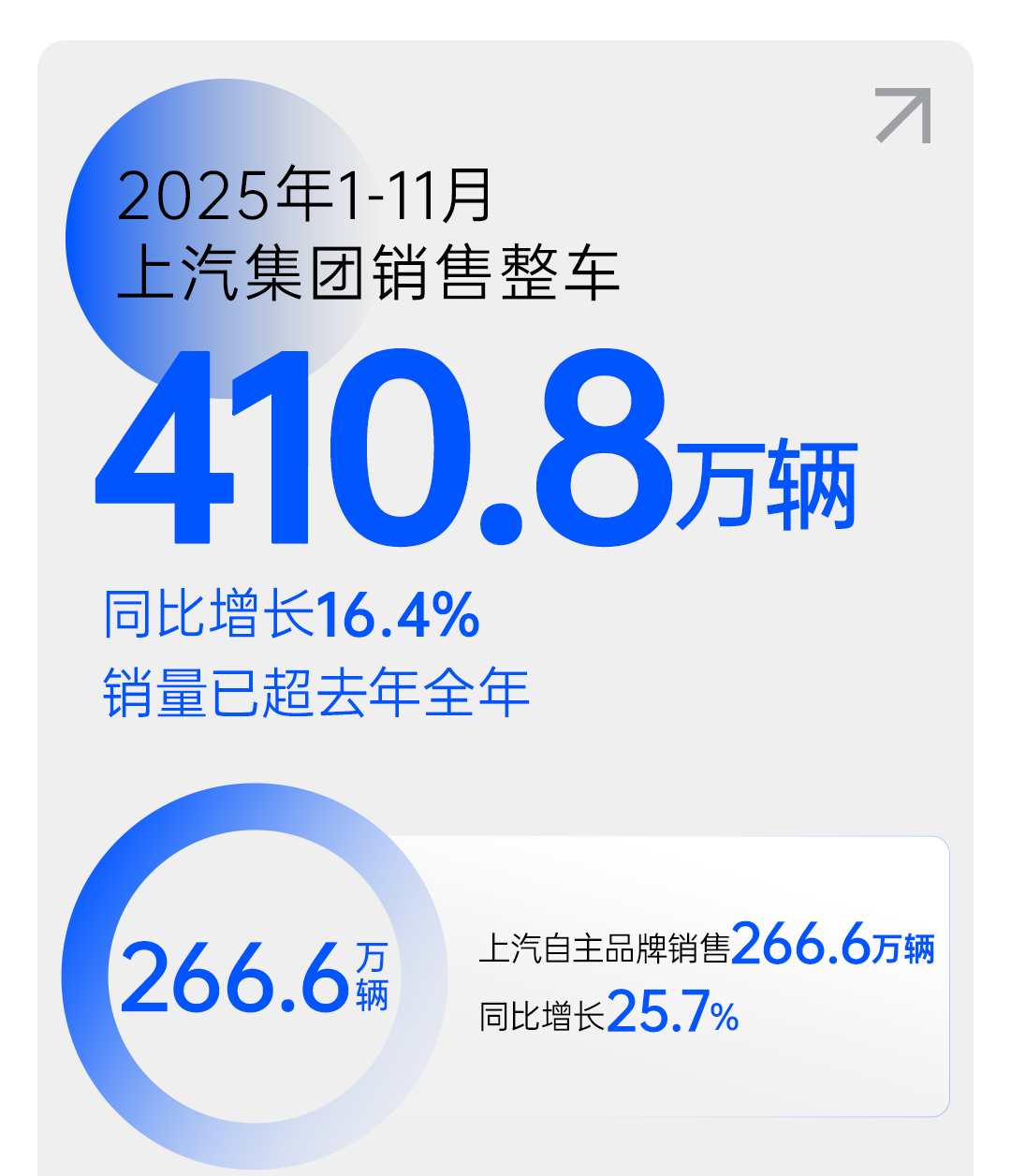
Core Viewpoint - SAIC Motor Corporation has established a new growth framework with three main drivers: strong performance from its self-owned brands, rapid growth in new energy vehicles, and expansion in overseas markets, leading to a significant increase in overall sales in 2024 and 2025 [1][2][3] Group 1: Sales Performance - From January to November 2023, SAIC Motor sold 4.108 million vehicles, a year-on-year increase of 16.4%, surpassing the total sales of the previous year [2] - The sales of SAIC's self-owned brands reached 2.666 million units, up 25.7%, accounting for 64.9% of total sales, an increase of 4.8 percentage points compared to the same period last year [5] - New energy vehicle sales totaled 1.499 million units, reflecting a growth of 38.8% [5] - Overseas sales amounted to 969,000 units, with a year-on-year increase of 3.4% [6] Group 2: New Growth Drivers - The "new three drivers" of SAIC's growth include self-owned brands, new energy vehicles, and overseas markets, with self-owned brands showing the most significant growth [3] - The MG brand has become the best-selling Chinese brand in Europe, with 285,000 units delivered, a growth of over 25% [6] - SAIC's new energy vehicle sales have been bolstered by product and technology advancements, including the introduction of the MG4 semi-solid battery version [5] Group 3: Traditional Pillars - The traditional three pillars—SAIC Volkswagen, SAIC General Motors, and SAIC-GM-Wuling—remain stable, contributing over 70% of total sales [7] - SAIC-GM-Wuling sold 1.491 million units, SAIC Volkswagen sold 936,130 units, and SAIC General Motors sold 487,250 units from January to November [7] - SAIC Volkswagen is expected to exceed one million units in annual sales, supported by its transition to new energy products [8] Group 4: Future Potential - SAIC has identified two potential growth areas: Audi and the newly launched brand, Shangjie [10] - The Audi brand is implementing a dual-brand strategy and aims to establish itself as a young, tech-savvy luxury car manufacturer [10] - The Shangjie brand, developed in collaboration with Huawei, has received significant investment, with an initial funding of 6 billion yuan and a dedicated team of over 5,000 people [13][15]
凤凰网财经《知行》深度对话宝洁:在进博会,看见消费创新的未来
Feng Huang Wang Cai Jing· 2025-11-19 12:49
Core Viewpoint - Procter & Gamble (P&G) emphasizes innovation as a core driver for its sustained leadership in the Chinese market, focusing on consumer insights and long-term value creation rather than short-term gains [1][17]. Group 1: Innovation Strategy - P&G has participated in the China International Import Expo for the seventh consecutive year, highlighting its commitment to the Chinese market [2]. - The company identifies three key elements of innovation: product innovation for better experiences, AI for efficient and agile innovation, and continuous innovation contributing to sustainable development [3][4]. - P&G's approach to innovation is centered around understanding Chinese consumers, maintaining a "Day 1 mindset" to combat complacency from past successes [4][5]. Group 2: Market Insights - The Chinese cosmetics market is identified as an incremental growth market, with the total transaction value surpassing 1 trillion yuan in 2023, projected to reach 1.0738 trillion yuan in 2024 [6][7]. - P&G believes that industry collaboration is essential for driving growth, moving from "wild growth" to a "high-level competition and cooperation" market [7]. Group 3: Technology Integration - P&G has integrated AI across its entire value chain, aiming to enhance consumer experiences while ensuring that AI serves as a tool for better living rather than an end goal [9][10]. - The company has established a comprehensive data feedback system to gather real-time consumer insights, which has significantly influenced its operational strategy and culture [8]. Group 4: Product Philosophy - P&G's innovation focuses on user experience rather than mere technological showcase, exemplified by products that address specific consumer needs, such as improved absorption in hair care products [10][11]. - The company recognizes the importance of catering to diverse consumer needs, adapting products to regional differences, such as climate variations affecting skincare [11]. Group 5: Sustainability Commitment - P&G aims for net-zero emissions by 2040, viewing green investment as a commitment to the future rather than a cost [13]. - The company has implemented various initiatives to promote sustainability, including a project that has recycled over 30,000 tons of plastic in collaboration with industry partners [13]. Group 6: Globalization and Localization - P&G's "Glocal" strategy focuses on making China an innovation hub, leveraging local consumer insights to drive global product development [14][15]. - The company is helping Chinese supply chain enterprises enter international markets, emphasizing the importance of localizing products to meet specific consumer needs [15]. Group 7: Future Industry Outlook - The future of the Chinese daily chemical industry is expected to shift from zero-sum competition to high-level cooperation, leading to long-term prosperity [16]. - The industry is anticipated to offer higher quality, more segmented, and safer beauty and health products, with an emphasis on collaborative development across various sectors [16].

凤凰网财经《知行》深度对话宝洁:创新点亮美好生活,解码全球化新范式
Feng Huang Wang Cai Jing· 2025-11-19 04:14
Core Insights - The core theme of the discussion revolves around Procter & Gamble's (P&G) continuous innovation and adaptation in the Chinese market, emphasizing the importance of consumer-centric strategies and long-term growth over short-term gains [1][17]. Group 1: Innovation Focus - P&G has participated in the China International Import Expo for the seventh consecutive year, highlighting its commitment to innovation as a core aspect of its business DNA [2][3]. - The company emphasizes three key elements of innovation: product innovation for better consumer experiences, the use of AI for efficient and agile innovation, and continuous innovation contributing to sustainable development [3][4]. - P&G's approach to innovation is driven by a "Day 1 mindset," focusing on understanding and meeting the needs of Chinese consumers rather than resting on past successes [4][5]. Group 2: Market Dynamics - The Chinese cosmetics market is identified as a growth market, with the total transaction value surpassing 1 trillion yuan in 2023, projected to reach 1.07 trillion yuan in 2024 [6][7]. - The market is characterized by an expanding consumer base, including the elderly and health-conscious individuals, indicating a shift towards a more inclusive consumer landscape [7]. - P&G's strategy involves not just competing for market share but also collaborating with the industry to expand the overall market size [7][8]. Group 3: Technology Empowerment - P&G has integrated AI across its entire value chain, aiming to enhance consumer experiences and operational efficiency [9][10]. - The company views AI as a tool to improve life quality rather than an end goal, emphasizing the importance of foundational scientific data for effective AI application [9][10]. Group 4: Product Philosophy - P&G's innovation is centered on user experience rather than mere technological showcase, with products designed to address specific consumer needs [10][11]. - The company recognizes the importance of catering to diverse consumer preferences, as evidenced by tailored products for different demographics and regional needs [11]. Group 5: Sustainability Commitment - P&G aims for net-zero emissions by 2040, viewing green investments as a commitment to the future rather than a cost [12][13]. - The company has implemented various initiatives to promote sustainability, including significant plastic recycling efforts and collaboration with industry partners [13]. Group 6: Globalization Strategy - P&G's "Glocal" strategy focuses on leveraging local consumer insights to drive global innovation, positioning China as a key innovation hub [14][15]. - The company aims to balance global and local needs by ensuring high-quality products that meet local consumer standards [15]. Group 7: Industry Future - The future of the Chinese daily chemical industry is expected to shift towards high-quality competition and collaboration, moving away from zero-sum games [16]. - The industry is anticipated to see increased product quality and safety, with a focus on meeting diverse consumer demands [16].
从“造车”到“懂车”,上汽的转型样本
Jing Ji Guan Cha Wang· 2025-11-12 02:05
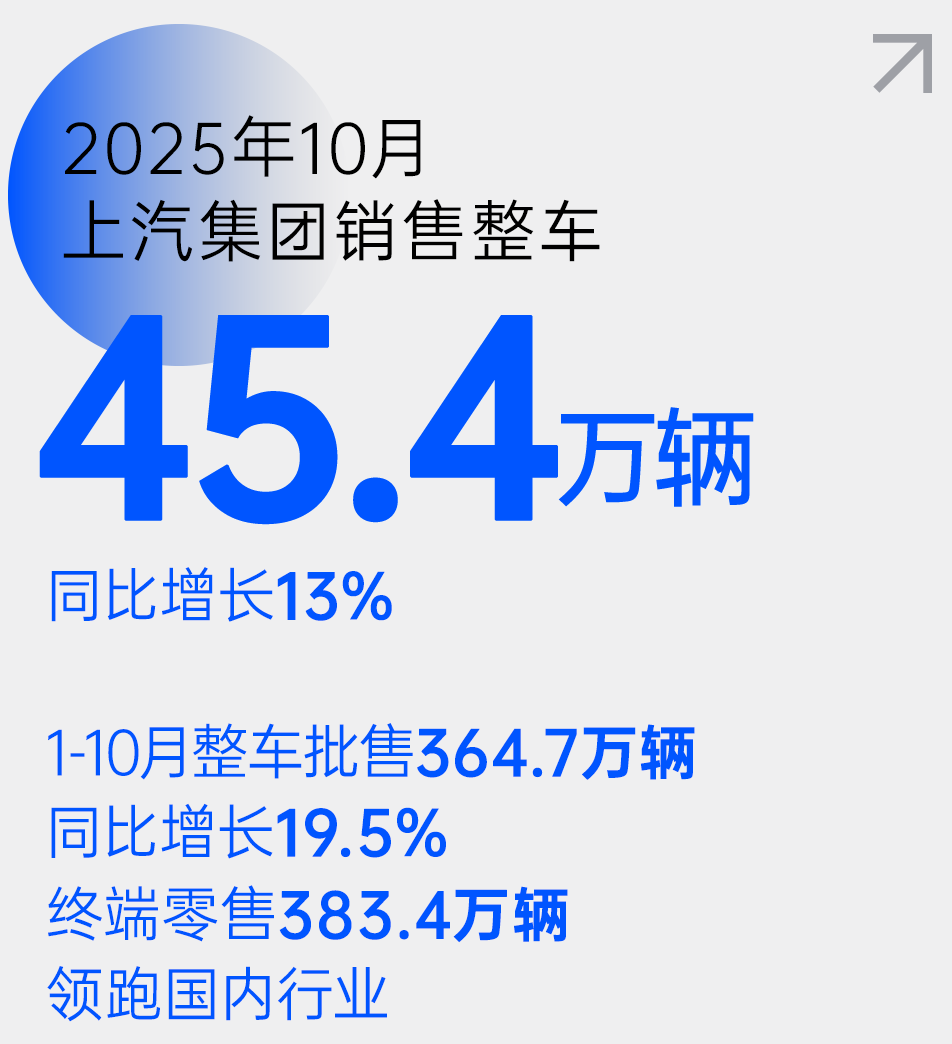
Core Insights - SAIC Motor Corporation achieved a net profit of 8.1 billion yuan in the first three quarters, representing a year-on-year increase of 17.3% [1] - The company's operating cash flow surged by 70.9% year-on-year, indicating strong internal growth capabilities [2] - The sales of SAIC's vehicles in October reached 454,000 units, a 13% increase year-on-year, with a cumulative sales of 3.647 million units from January to October, up 19.5% [4] Financial Performance - The net profit attributable to shareholders increased over sixfold in the third quarter, driven by improved operational efficiency [2] - The significant rise in operating cash flow supports the company's investments in technology and market expansion [2] Market Position and Strategy - SAIC's self-owned brands accounted for nearly two-thirds of total sales from January to October, indicating a shift away from traditional reliance on joint ventures [4] - The company has established a strong presence in the overseas market, particularly in Europe, with MG brand sales reaching 250,000 units, a growth of over 20% [6] Technological Innovation - SAIC has introduced a "smart brain" technology that enhances driving experience and safety, integrating advanced features into mass-produced vehicles [7][8] - The company is focusing on user-centric technology, transforming technical specifications into relatable benefits for consumers [10] User Engagement and Market Dynamics - The company's products have successfully challenged the notion that high technology must come with high prices, leading to increased consumer interest and sales [11] - Positive user feedback and market reputation have created a synergistic effect, enhancing brand loyalty and repeat purchase intentions [12] Long-term Vision - SAIC is committed to a long-term strategy of operational efficiency and technological advancement, positioning itself for sustainable growth in a competitive market [13]
上汽集团(600104):深度报告:2025轻装上阵,与华为合作未来可期
Guohai Securities· 2025-08-28 15:23
Investment Rating - The report upgrades the investment rating for the company to "Buy" [1] Core Insights - The company is expected to stabilize and recover in 2025 after a year of significant adjustments in 2024, focusing on self-owned brands and joint ventures [8] - The collaboration with Huawei on the "尚界" brand is anticipated to enhance sales and profitability, particularly in the mainstream market segment [8] - The company aims to achieve total revenue of 693 billion, 778.8 billion, and 841.1 billion yuan from 2025 to 2027, with net profits of 12.51 billion, 15.11 billion, and 18.19 billion yuan respectively, corresponding to P/E ratios of 17.5, 14.5, and 12.0 [8] Summary by Sections 1. 2024: Management Reform and Inventory Reduction - The company underwent significant management changes with a new chairman and president, focusing on inventory reduction and restructuring [10][11] - In 2024, the company achieved a wholesale volume of 205.3 million vehicles, a year-on-year increase of 12.4%, with self-owned brand sales reaching 130.4 million vehicles, up 21.1% [8] - The company successfully reduced inventory levels, with terminal deliveries exceeding wholesale sales, indicating improved market responsiveness [24] 2. 2025: Self-Improvement and Joint Venture Stabilization - The self-owned brand segment is expected to drive sales growth, with a target of over 290 million units sold in 2025, representing a year-on-year increase of over 20% [44] - The joint venture with Volkswagen is showing signs of stabilization, with a projected increase in sales volume in 2025 [62] - The "尚界" brand, positioned in the 200,000 yuan market, is expected to become a significant contributor to sales and profitability [68] 3. Financial Projections - The company forecasts total revenue of 627.59 billion yuan in 2024, with a significant recovery in subsequent years [9] - The net profit is projected to rebound sharply from a loss of 1.67 billion yuan in 2024 to a profit of 12.51 billion yuan in 2025 [9] - The company aims for a return on equity (ROE) to improve from 1% in 2024 to 6% by 2027 [9] 4. Strategic Focus on Mainstream Market - The "尚界" brand is set to launch its first SUV model, H5, with a competitive pricing strategy aimed at capturing market share in the mainstream segment [76] - The collaboration with Huawei is expected to enhance product offerings and market penetration, leveraging Huawei's technology and distribution channels [76] - The company plans to introduce over ten new models in the coming year, focusing on both domestic and international markets [45]
汽车视点 | 销量“七连涨”,产品技术密集落地!上汽集团“三箭齐发”
Zhong Guo Jin Rong Xin Xi Wang· 2025-08-21 02:55
Core Insights - SAIC Audi has launched its first strategic electric vehicle, the Audi E5 Sportback, with a pre-sale price ranging from 235,900 to 319,900 yuan, marking a significant step in its electrification strategy [1] - The company has shown a strong product launch momentum in August, with multiple new models and technologies being introduced across its brands [1] - SAIC Group's sales have been steadily increasing, with a notable 34.2% year-on-year growth in July, and a cumulative sales increase of 15% for the first seven months of the year [2] Sales Performance - In July, SAIC Group sold 338,000 vehicles, achieving a 34.2% year-on-year increase, while the cumulative sales for the first seven months reached 2.39 million units, up 15% [2] - The sales of SAIC's new energy vehicles in July reached 117,000 units, a significant 64.9% increase year-on-year, with a total of 764,000 units sold in the first seven months, reflecting a 43.5% growth [2] - The self-owned brands of SAIC have shown robust growth, with a 39.4% increase in July sales, totaling 1.52 million units for the first seven months, which is a 23.3% increase [10] Product Development - The new Roewe M7 DMH, designed by former Rolls-Royce designer Joseph Kaban, is set to launch soon, featuring a new generation DMH hybrid system with a pure electric range of 160 km [3] - MG brand continues to innovate with the launch of the 2026 MG5 and MG Cyberster, as well as the introduction of the MG Cyber X, a new electric model with a unique design [5] - The high-end brand Zhiji is also expanding, with the Zhiji L6 and LS6 models gaining market acceptance, and the LS6 set to debut with advanced range-extending technology [8] Market Strategy - SAIC Group's overseas sales reached 576,000 units in the first seven months, demonstrating resilience despite external challenges, and the MG brand has outperformed Tesla in Europe for the first time [18] - The company has adopted a "Glocal" strategy to enhance its global presence, focusing on local market needs while leveraging its global resources [18] - SAIC's new energy strategy includes the launch of the "Zhi Jing" brand, which aims to integrate advanced technology and design to compete in the high-end market [16][14]
