RISC - V

Search documents
财信证券晨会纪要-20260325
Caixin Securities· 2026-03-24 23:39
晨会纪要(R3) 晨会纪要 | 市场数据 | | | | --- | --- | --- | | 指数名称 | 收盘 | 涨跌% | | 上证指数 | 3881.28 | 1.78 | | 深证成指 | 13536.56 | 1.43 | | 创业板指 | 3251.55 | 0.50 | | 科创 50 | 1290.79 | 2.33 | | 北证 50 | 1268.13 | 1.94 | | 沪深 300 | 4474.72 | 1.28 | 2026 年 03 月 25 日 上证指数-沪深 300 走势图 -9% 1% 11% 21% 31% 2025-03 2025-06 2025-09 2025-12 上证指数 沪深300 | 黄红卫 | 分析师 | | --- | --- | | 执业证书编号:S0530519010001 | | | huanghongwei@hnchasing.com | | | 胡跃才 | 分析师 | | 执业证书编号:S0530525070001 | | | huyuecai@hnchasing.com | | | 晨会聚焦 | | --- | | 一、财信研究观点 | ...
Alibaba reveals new AI chip designed for 'agents'
CNBC· 2026-03-24 12:37
Alibaba on Tuesday announced a new chip designed for agentic capabilities as the Chinese tech giant steps up its semiconductor efforts to fuel its AI push.The XuanTie C950 is a type of chip called a central processing unit (CPU), which Alibaba said will be able to handle the processing of multi-step tasks carried out by AI agents. The term agent refers to an AI system that can carry out a task on behalf of users. The CPU will be installed in data centers and is designed for inferencing, the stage that allow ...



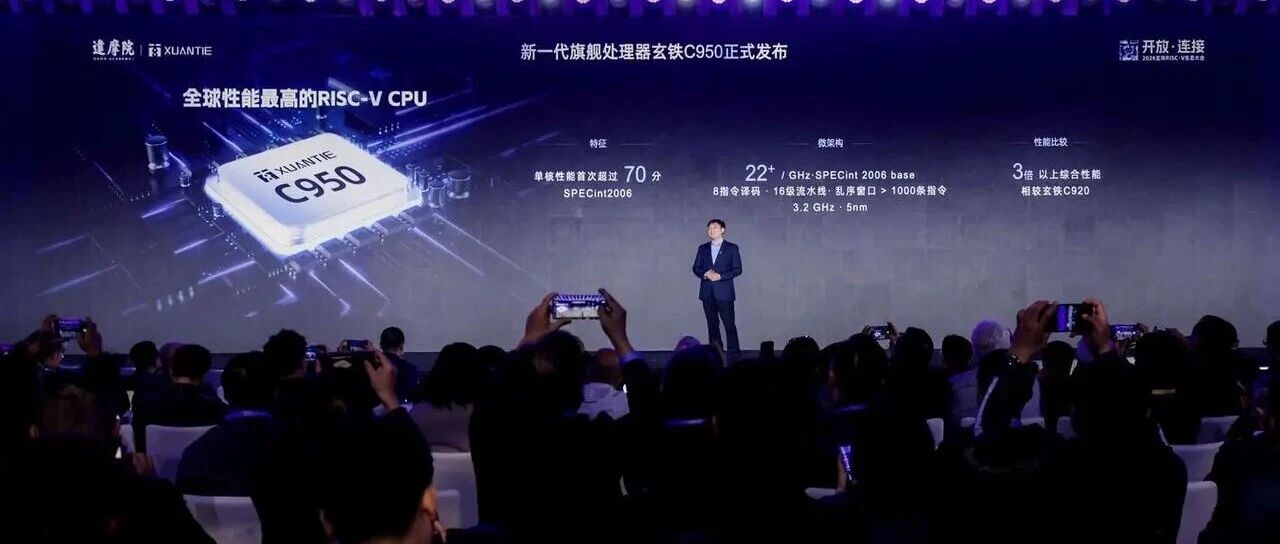
RISC-V冲入服务器CPU核心赛场,玄铁C950定义高性能标杆
雷峰网· 2026-03-24 10:55
" RISC-V比Arm到底好在哪? " 作者丨包永刚 编辑丨 林觉民 七年前,RISC-V能否进入高性能计算仍充满争议,今天这一问题正在被重新回答。 2026年,达摩院在2026年玄铁生态大会发布新一代旗舰CPU IP——C950,再次突破RISC-V性能的天 花板,在SPECint2006基准测试中突破70分,这款 全球最强RISC-V CPU,具备与x86和Arm在服务器 CPU主赛场竞争的能力 。 从C930跨过服务器CPU性能的门槛,到C950进入主流服务器CPU性能区间,RISC-V不仅回应了曾经的 质疑,也开始真正进入高性能CPU主赛场。 中国工程院院士倪光南在玄铁生态大会演讲中说:"RISC-V诞生十五年来走出了一条令人惊叹的高速发展 之路,正从'备选'迅速地走向'主流'。" 突破RISC-V的性能天花板只是起点,在补齐通用计算能力之后,RISC-V试图以可定制化能力迎接AI Agent的时代机遇,在标准化计算之外打开增量空间。 达摩院的新品恰逢其时,玄铁C950的处理器首次原生支持Qwen3-235B-A22B与DeepSeek V3-671B 这样的千亿参数大模型。 "想要把IP变成落地的 ...
一颗RISC-V芯片,计划颠覆CPU、GPU、DSP和FPGA
半导体芯闻· 2026-03-09 10:34
如果您希望可以时常见面,欢迎标星收藏哦~ 德国初创公司Ubitium 今天宣布,其首个通用 RISC-V 处理器的硅片流片工作已经完成。 该芯片采用三星晶圆代工的 8 纳米工艺制造,专为价值 1150 亿美元的嵌入式计算市场而设计,该 市场包括集成到汽车、工业机器和消费电子产品等设备中的计算机。 芯片流片是芯片制造前的最后一步,于 2025 年 12 月完成,这标志着这家旨在统一当前分散的专 用处理器堆栈的公司,从概念到物理芯片迈出了关键一步。 嵌入式计算长期以来依赖于各种芯片来完成不同的任务。现代汽车过去只使用少数芯片,但现在却 使用超过200个处理器,每个处理器都有其独特的软件栈、专有工具链和供应商。这种增长导致开 发周期延长,代码量超过1.5亿行,并使制造商面临脆弱的供应链风险。 该 公 司 成 立 于 2024 年 6 月 , 在 去 年 底 完 成 370 万 美 元 种 子 轮 融 资 后 加 速 发 展 。 这 笔 由 Runa Capital、Inflection和KBC Focus Fund共同领投的投资,使Ubitium得以验证其架构并为早期客户 准备初始开发套件。 Ubitium首席执行 ...

日本最大OSAT厂商,出海印度
半导体芯闻· 2026-03-06 10:24
Core Viewpoint - Mitsui & Co. has signed a strategic business partnership agreement with Kaynes Semicon Private Limited and AOI Electronics Co., Ltd. to support the expansion of semiconductor back-end processing in India, aligning with the "Make in India" initiative and receiving government approval as part of a qualified program [1][2]. Group 1 - The partnership will leverage AOI Electronics' expertise in semiconductor back-end processes to assist Kaynes in launching its OSAT business and facilitate the sales of manufactured products [1]. - Mitsui has obtained exclusive rights to handle the procurement of raw materials for Kaynes from Japanese and overseas suppliers, promoting collaboration with suppliers both within and outside India [1]. - Mitsui will explore further strategic participation and has secured rights for future acquisition of shares in Kaynes [1]. Group 2 - The strategic importance of semiconductors has led many countries to develop domestic production capabilities and restructure supply chains, with Mitsui contributing to a robust and diversified global semiconductor ecosystem through its support of Kaynes [2]. - Kaynes, a leading local company related to its parent company Kaynes Technology India Limited, received government approval to start its OSAT business in September 2024, aiming to commence operations in the second half of 2026 [2]. - This initiative will support the growth of Kaynes' business and contribute to the sustainable development of India's semiconductor industry, local job creation, and the establishment of a digital society foundation [2].
Everspin Technologies(MRAM) - 2025 Q4 - Earnings Call Transcript
2026-03-04 23:02
Financial Data and Key Metrics Changes - The company reported revenue of $14.8 million for Q4 2025, representing a 12% year-over-year increase and aligning with the high end of the guidance range of $14 million to $15 million [19] - Non-GAAP EPS for the quarter was $0.11 per diluted share, consistent with expectations and down from $0.13 per share in Q4 2024 [21][22] - GAAP gross margin decreased slightly to 50.8% from 51.3% in Q4 2024 due to lower licensing and other revenue [20] Business Line Data and Key Metrics Changes - MRAM product sales, including both Toggle and STT-MRAM revenue, were $13.5 million, up 22% year-over-year [19] - Licensing, royalty, patent, and other revenue decreased to $1.3 million from $2.2 million in Q4 2024 due to the completion of prior projects [19] Market Data and Key Metrics Changes - Demand in data center applications was driven by ongoing work with IBM on the FCM4 module and the introduction of the FCM5 [5] - Energy management and industrial automation saw a return to normal demand levels after previous inventory consumption [6] Company Strategy and Development Direction - The company aims to reach $100 million in annual revenue over the next 3 to 5 years, driven by new product ramps, particularly in the xSPI parts of the PERSYST product portfolio [15][16] - Everspin is focusing on chiplet technology and partnerships to enhance its market position, particularly in automotive and aerospace sectors [11][14] Management's Comments on Operating Environment and Future Outlook - The semiconductor industry is experiencing memory shortages, leading to increased demand for alternatives like Everspin's xSPI STT-MRAM to replace NOR Flash [17][18] - Management expressed confidence in the recovery of inventory levels in energy management and industrial automation, expecting no issues in 2026 [30] Other Important Information - The company ended Q4 2025 with cash and cash equivalents of $44.5 million, down slightly from the previous quarter [22] - There was no material tariff-related impact on results in Q4 2025, and none is expected in the coming quarters [23] Q&A Session Summary Question: Inquiry about the NOR Flash opportunity and potential revenue upside - Management indicated that the upside depends on the qualification cycle for potential customers, with ongoing discussions about being an alternative for NOR Flash [26][27] Question: Confidence in inventory levels in energy management and industrial automation - Management expressed confidence based on distributor backlog and customer forecasts, indicating that inventory issues should not recur in 2026 [28][30] Question: Updates on the strategic Rad-Hard project and contributions from the LEO satellite market - Management noted that the LEO satellite market is still developing, with expectations of increased demand for high-reliability products [34][38] Question: Material contributions from Microchip and FPGA engagements - Management highlighted steady progress with partners like Microchip and Lattice, focusing on product qualification and integration into standard offerings [39][41] Question: Breakdown of revenue contributors towards the $100 million target - Management identified PERSYST products as the major contributor, with equal contributions expected from licensing and Unisys in the long term [42][43]

日本继续豪赌芯片
半导体芯闻· 2026-02-26 10:22
Core Viewpoint - The Japanese government is focusing on developing a cutting-edge semiconductor industry cluster by establishing three bases for design, production equipment, and materials, aiming to enhance competitiveness through collaboration with overseas companies and research institutions [1][2]. Group 1: Government Initiatives - The Japanese government plans to set up three bases by 2026, equipped with advanced design software and development equipment for startups and universities, with TSMC and Rapidus as core partners [1]. - A semiconductor design base will be established in Tokyo, focusing on "physical AI" applications, with support from specialized technicians [1]. - A facility for equipment and materials will be built near the Rapidus factory in Chitose, Hokkaido, aiming to start operations by 2029, featuring the latest EUV lithography equipment from ASML [1][2]. Group 2: Financial Support and Investment - The construction of these bases will utilize a budget of 130.6 billion yen and funding from the National Institute of Advanced Industrial Science and Technology, allowing companies and research institutions to access equipment at low costs [2]. - The Japanese government is committed to covering substantial costs associated with semiconductor research and development, which can reach billions of yen, to foster private sector innovation [2]. Group 3: Industry Challenges and Opportunities - Japan's semiconductor industry has been declining due to an overemphasis on self-sufficiency, necessitating international collaboration to enhance competitiveness [3]. - The domestic production of cutting-edge semiconductors primarily serves overseas clients, highlighting the need for Japan to cultivate local companies capable of designing AI semiconductors to become reliable partners for Rapidus [2][3].
服务器CPU,AMD市占首超40%
半导体芯闻· 2026-02-14 08:56
Core Viewpoint - AMD has significantly increased its market share in the server CPU segment, achieving a revenue share of 41.3% in Q4 2025, marking a 1.8% increase from Q3 2025 and a 4.9% year-over-year growth in a multi-billion dollar market [2]. Group 1: Server Market - AMD holds a 40% revenue share in the server CPU market, with its EPYC processors capturing 41.3% of the revenue share in Q4 2025 [2]. - AMD's unit share in the server market is 28.8%, indicating higher average selling prices compared to Intel, which has a unit share of 71.2% and a revenue share of 58.7% [2][3]. - The year-over-year growth for AMD in the server market is 4.9%, reflecting strong performance in a competitive landscape [2]. Group 2: Desktop Market - In the desktop CPU market, AMD's revenue share is 42.6%, while its unit share is 36.4%, suggesting that AMD's Ryzen processors command higher average prices [3]. - The desktop segment has seen a quarter-over-quarter revenue growth of 1.6% and a year-over-year growth of 14.6%, indicating increasing popularity among gamers [3]. Group 3: Mobile/Notebook Market - In the mobile and notebook CPU market, Intel dominates with a revenue share of 75.1% and a unit share of 74%, reflecting its pricing strategy aligned with its market presence [4]. - AMD holds a 29.2% unit share and a 35.4% revenue share in the mobile CPU market, showcasing its competitive positioning despite Intel's overall lead [4].


北京君正:目前公司RISC-V CPU主要应用于消费类市场中
Mei Ri Jing Ji Xin Wen· 2026-02-11 03:53
Core Viewpoint - The company is currently focused on expanding its RISC-V CPU applications primarily in the consumer market, rather than participating in the Quintauris alliance initiated by automotive industry giants like Qualcomm and Infineon [1] Group 1 - The company received inquiries from investors regarding its participation in the Quintauris alliance [1] - The company confirmed that its RISC-V CPU is mainly applied in the consumer market [1] - The company plans to continue market expansion efforts [1]

台积电,巨额分红
半导体芯闻· 2026-02-10 10:29
Core Viewpoint - TSMC's board of directors approved eight key proposals, including maintaining a cash dividend of NT$6 per share and setting a record for employee performance bonuses and compensation totaling approximately NT$206.15 billion [1][2]. Group 1: Financial Performance and Dividends - TSMC's consolidated revenue for 2025 is projected to be approximately NT$3.81 trillion, with a net profit after tax of about NT$1.72 trillion, resulting in earnings per share of NT$66.25 [1]. - The cash dividend for the fourth quarter of 2025 is set at NT$6.0 per share, with the record date for common stock dividend set for June 17, 2026, and the ex-dividend date on June 11, 2026 [1]. Group 2: Employee Compensation - The total employee performance bonuses and compensation for 2025 is approximately NT$206.15 billion, with performance bonuses of about NT$103.07 billion already distributed quarterly, and the remaining compensation to be distributed in July [2]. Group 3: Capital Expenditure and Financial Strategy - TSMC approved a capital budget of approximately USD 44.96 billion to enhance advanced process capacity, upgrade packaging, and construct new facilities [2]. - The company also approved a capital increase of up to USD 30 billion for its wholly-owned subsidiary TSMC Global to reduce foreign exchange hedging costs [2]. - Additionally, TSMC plans to raise up to NT$60 billion in unsecured corporate bonds in the domestic market to support capacity expansion and green-related expenditures [2]. Group 4: Corporate Governance and Personnel Changes - TSMC has scheduled its 2026 annual shareholders' meeting for June 4, 2026, at the Sheraton Hsinchu Hotel [2]. - Several personnel promotions were approved, including the elevation of key executives to senior vice president positions within various operational and research departments [2].