
模拟芯片

Search documents
晶华微募投项目调整:短期放缓脚步 聚焦智能家电控制芯片谋长期突围
Zheng Quan Ri Bao Wang· 2025-07-14 08:51
Core Viewpoint - Jinhua Microelectronics plans to extend the implementation deadlines for three key projects until July 2027 and terminate one project due to market conditions and strategic adjustments, aiming to enhance operational efficiency and core competitiveness [1][2][3] Project Adjustments - The company has extended the deadlines for the "Smart Health Medical ASSP Chip Upgrade and Industrialization Project," "Industrial Control Instrument Chip Upgrade and Industrialization Project," and "R&D Center Construction Project" to July 2027, reflecting a commitment to long-term value in these areas [1][3] - The terminated project, "High-Precision PGA/ADC and Other Analog Signal Chain Chip Upgrade and Industrialization Project," had an investment of 31.4981 million yuan, with the decision made to avoid resource misallocation due to severe market competition [3] Market Environment - The semiconductor industry is undergoing a significant transformation, with a structural decline in demand and increased competition, leading to a prolonged destocking phase [2] - The global analog chip market is projected to decline by 8.7% in 2023, with a further slight decrease of 2.7% expected in 2024, before recovering by 6.7% in 2025 [2] Strategic Focus - The company is shifting its focus towards core business areas, particularly in medical health and industrial control, while also expanding into smart home appliance control chips [5][6] - The integration of its subsidiary, Shenzhen Jinhua Zhixin Microelectronics, into the development of smart home appliance control chips is seen as a strategic move to leverage existing technological expertise [6][8] Financial Performance - In 2024, the company reported a revenue of 135 million yuan, a year-on-year increase of 6.34%, despite challenges in the competitive landscape [9] - The industrial control and instrument chip business showed strong performance, with sales volume increasing by 41.36% and revenue by 26.11%, becoming a key driver of the company's growth [9] Market Opportunities - The company is well-positioned to benefit from policy support and market growth in the smart home sector, with the global smart home market expected to grow significantly [7][8] - The strategic adjustments and project optimizations are anticipated to create new development opportunities for the company in the long term [9]

模拟芯片行业深度研究报告:需求回暖进行时,国产替代与并购整合共筑成长动能
Huachuang Securities· 2025-06-30 06:14
Investment Rating - The report maintains a "Buy" recommendation for the analog chip industry, indicating a positive outlook for growth and investment opportunities [1]. Core Insights - The analog chip industry is experiencing a recovery in demand, driven by the end of inventory destocking and a resurgence in applications across automotive, industrial automation, and data centers. The market is expected to grow by 6.7% year-on-year in 2025, reaching a size of $84.34 billion [4][6]. - The industry is characterized by high technical barriers and a wide range of applications, with a significant portion of the market still dominated by overseas companies. However, domestic companies are expected to benefit from accelerated localization efforts and mergers and acquisitions [5][6]. - The report highlights the importance of mergers and acquisitions as a key strategy for growth in the analog chip sector, with domestic firms entering a phase of platform integration to enhance competitiveness [6][7]. Summary by Sections Section 1: Overview of the Analog Chip Industry - Analog chips serve as a bridge between the physical and digital worlds, featuring a long product lifecycle and high customization [11]. - The global analog chip market share has remained stable at around 19% of the integrated circuit market, with a projected market size of approximately $81.23 billion in 2023 [11][19]. Section 2: Demand Recovery and Growth Potential - The analog chip market is expected to recover from a downturn, with a projected growth of 6.7% in 2025, driven by structural demand from sectors like automotive and industrial automation [6][39]. - The report identifies key growth drivers, including the increasing penetration of electric vehicles and advancements in AI applications, which are expected to boost demand for high-performance analog chips [6][61]. Section 3: Domestic Replacement and Market Opportunities - The report notes that the domestic market is still largely dominated by foreign companies, but there is significant room for domestic firms to increase their market share through localization and innovation [6][39]. - The domestic analog chip self-sufficiency rate is projected to rise from 9% in 2019 to over 16% by 2024, indicating a positive trend towards local production [6][38]. Section 4: Key Investment Targets - The report suggests focusing on specific companies such as Naxin Microelectronics, Shengbang Co., Si Rui Pu, and Jiehuate, which are well-positioned to benefit from the industry's growth and localization trends [7][39].





突发!造芯十四年国产高端模拟厂商破产!
是说芯语· 2025-06-25 00:54
Core Viewpoint - The bankruptcy of Xinfeng Kuantai Technology (Beijing) Co., Ltd. highlights the challenges faced by domestic semiconductor companies in China, emphasizing that advanced technology alone is insufficient for success in the competitive semiconductor industry [1][8]. Company Overview - Xinfeng Kuantai was founded in October 2011 in Beijing, led by a team of experienced ADC technology experts from Silicon Valley, aiming to break the monopoly of American companies like ADI and TI in the high-performance ADC and AFE chip market, which exceeds $10 billion in size [2][3]. - The company achieved a significant breakthrough in November 2012 with the launch of its first high-speed ADC chip, VAT1002, marking a milestone in China's high-performance ADC industry [3][4]. Business Strategy - Xinfeng Kuantai had a clear commercialization path, targeting sales of 80 million yuan in 2013-2014, 200 million yuan in 2015-2016, and a cumulative sales goal of 1 billion yuan post-2017, indicating a strategic plan for growth [4]. Challenges Faced - Despite its strong technical team, Xinfeng Kuantai struggled to meet its revenue targets, with actual revenues remaining in the millions instead of the expected billions, due to operational issues and an immature local technical team [5][6]. - The high costs associated with developing high-end ADC chips, which can exceed 100 million yuan and take over five years to bring to market, compounded the company's difficulties, especially after its last public financing round in 2013 [6]. Bankruptcy Proceedings - On March 28, 2025, the Beijing First Intermediate People's Court accepted the bankruptcy liquidation case of Xinfeng Kuantai, marking the end of its operations amid intense competition from established international giants [7]. Industry Reflection - The downfall of Xinfeng Kuantai serves as a cautionary tale for the domestic semiconductor industry, underscoring the need for a comprehensive approach that includes technology development, market strategy, and sustainable funding to build resilience against competition [8].


贝克微(02149):模拟IC优质标的,具备可持续增长潜力,目标价上调至93港元
Zhao Yin Guo Ji· 2025-06-16 13:15
Investment Rating - The report maintains a "Buy" rating for the company, with a target price raised to HKD 93, based on a 25x forecasted P/E for 2025 [1][7][8]. Core Insights - The company is viewed as a high-quality target in the semiconductor sector, with sustainable growth potential. The management's clear and sustainable growth strategy has left a strong impression [1][7]. - The report highlights three key areas of investor focus: downstream demand outlook, geopolitical risks, and the company's investment plans for upstream manufacturing resources [1][7]. - The company is expected to achieve revenue and profit growth of 20%-30% despite macroeconomic uncertainties, driven by the expansion of new product categories [7][8]. Financial Summary - Sales revenue is projected to grow from RMB 464 million in FY23A to RMB 1,172 million in FY27E, with a CAGR of approximately 25.6% [2][14]. - Net profit is expected to increase from RMB 109.2 million in FY23A to RMB 342.1 million in FY27E, reflecting a strong growth trajectory [2][14]. - The gross margin is forecasted to stabilize around 53.9% from FY25E onwards, indicating consistent profitability [2][14]. Valuation Metrics - The company's current valuation stands at 19.3x P/E for 2025, with a PEG ratio of 0.77, which is considered attractive compared to the industry average of 66.1x [7][8][13]. - The target price of HKD 93 represents a potential upside of 27.4% from the current price of HKD 73 [3][7]. Market Performance - The company's stock has shown significant performance, with a 151.3% absolute return over the past six months [4]. - The stock's market capitalization is approximately HKD 1.314 billion, with a 52-week price range of HKD 73.00 to HKD 23.05 [3][4].
模拟芯片,触底了?
半导体行业观察· 2025-06-15 02:33
Core Viewpoint - The semiconductor market is projected to grow by 11.2% in 2025, maintaining the previous forecast, while 2026 is expected to see a growth of 8.5%, though there are concerns about potential negative growth [1][12]. Semiconductor Market Overview - The total semiconductor market is expected to reach $630.549 billion in 2025 and $700.874 billion in 2026, with a growth rate of 11.2% and 8.5% respectively [3][8]. - The actual shipment volume from January to April 2025 showed a year-on-year increase of 19.3% [1]. Discrete Devices - The discrete device market is forecasted to decline by 2.6% in 2025, a downward revision from a previous growth estimate of 5.8% [2]. - From January to April 2025, the market experienced a year-on-year decline of 6.9%, but a recovery is anticipated [2]. Optoelectronics - The optoelectronics market is expected to decline by 4.4% in 2025, revised down from a previous growth forecast of 3.8% [3]. - The market showed a 1.1% decline from January to April 2025, but there was a sudden shift to double-digit growth in April [3]. Sensors and Actuators - The sensor market is projected to grow by 4.5% in 2026, with a previous forecast of 7.0% being revised down [4]. - From January to April 2025, the market is expected to grow by 16.1%, indicating a resolution of inventory issues [4]. Integrated Circuits (IC) - The total IC market is expected to grow by 13.4% in 2025 and 9.1% in 2026, with significant contributions from various segments [8]. - The analog IC market is projected to grow by 2.6% in 2025, while the micro IC market is expected to decline by 1.0% [6][7]. Logic IC Market - The logic IC market is anticipated to grow by 23.9% in 2026, driven by strong demand for GPUs in AI applications [9]. - The market showed a year-on-year growth of 35.9% from January to April 2025, indicating robust performance [9]. Memory Market - The memory market is expected to grow by 11.7% in 2026, with a significant growth of 24.5% from January to April 2025 [10]. - Concerns exist regarding the sustainability of demand in the memory market, particularly in 2026 [11]. Overall Market Sentiment - The overall sentiment regarding the semiconductor market in 2025 is cautious, with a projected growth of 20-25% being more optimistic than the WSTS forecast [12].


基金经理请回答 | 对话田瑀:国产替代进行中,模拟芯片有哪些危和机?
中泰证券资管· 2025-06-06 07:02
Core Viewpoint - The long-term trend of domestic substitution for analog chips will not change regardless of tariffs, but tariffs may accelerate the pace of substitution [4][5]. Group 1: Domestic Substitution Dynamics - The urgency for domestic substitution increases with supply chain security concerns, especially during trade conflicts [5][6]. - Even without tariffs, companies are likely to seek domestic alternatives due to long-term supply chain safety [5][6]. - The high barriers to entry in the analog chip market make it difficult for companies to switch suppliers once they have established a relationship with a foreign brand [4][7]. Group 2: Market Share and Competition - Currently, foreign brands dominate the analog chip market, holding over two-thirds of the market share, while domestic brands have a much lower penetration rate [7][8]. - The gap in market share is primarily due to the historical development of the semiconductor industry, where foreign companies established a strong foothold before domestic companies could catch up [7][8]. - Government support is crucial for increasing domestic market share, as the high barriers to entry make it challenging for domestic firms to compete [7][8]. Group 3: Pricing and Cost Considerations - Even with significant tariff increases, the cost of analog chips remains a small portion of total product costs, leading companies to accept price hikes rather than immediately switch suppliers [9][10]. - Companies are likely to conduct research and development to find alternatives but will not rush to replace existing suppliers due to the associated costs and risks [9][10]. Group 4: Supplier Relationships and Customization - Many clients prefer to work with multiple suppliers for analog chips, often choosing foreign brands as primary suppliers due to established relationships and perceived quality [10][11]. - Domestic suppliers can gain an advantage through better communication and service, especially in industries requiring high customization [10][11]. Group 5: Technology and Experience - The technical challenges in analog chip production are more about experience and stability in complex environments rather than sheer technological complexity [12][13]. - Domestic companies are gradually closing the experience gap with foreign competitors, and the potential for catching up exists as they gain more opportunities [13][14]. Group 6: Financial Performance and Valuation - Recent profitability in domestic analog chip companies may not reflect true financial health due to the mismatch between expenses and revenue generation timelines [16][18]. - The long-term value of these companies should be assessed based on their potential to expand product lines and market share rather than short-term profits [19][20]. - The growth in the number of product SKUs is essential for domestic companies to compete effectively, as a broader product range allows for one-stop procurement for clients [17][20].

钛媒体科股早知道:这类技术正从实验室快速走向商业化应用
Tai Mei Ti A P P· 2025-06-04 00:01
Group 1: Quantum Communication - A Chinese research team has proposed a new theoretical framework for long-distance, large-scale, scalable quantum direct communication, successfully achieving a 300-kilometer quantum direct communication network among four nodes [2] - The fidelity of the shared quantum state between nodes remains above 85% after transmission, confirming the reliability of the scheme for long-distance communication [2] - The global quantum industry is projected to reach $5 billion in 2024 and exceed $800 billion by 2035, with a CAGR of 59% [2] Group 2: Analog Chip Market - The global inventory cycle for analog chips is believed to have bottomed out after nearly six quarters of adjustment, according to a report from CITIC Securities [3] - The analog chip market is driven by long-term demand from consumer electronics, automotive electronics, and industrial control, as well as emerging fields like AI and electric vehicles [3] Group 3: Brain-Computer Interface (BCI) Technology - The first clinical ward for brain-computer interface technology has been established at Beijing Tiantan Hospital, marking a significant step towards the clinical application of BCI technology [4][5] - The year 2025 is seen as a critical year for the formal entry of BCI technology into clinical settings in China, with plans for multiple invasive product trials by 2030 [5] - Major milestones in the BCI field include Neuralink receiving FDA approval for human clinical trials and the completion of the first wireless implantation surgery in China [5] Group 4: Stablecoin Regulation in Hong Kong - The Hong Kong government has officially enacted the Stablecoin Ordinance, establishing a licensing system for issuers of fiat-backed stablecoins [6] - This regulation aims to promote financial innovation while maintaining financial stability, marking a significant advancement in Hong Kong's digital asset landscape [6] - The regulatory framework for stablecoins is expected to enhance cross-border payment efficiency and compliance, facilitating the integration of stablecoins with real-world assets (RWA) [6]
【明日主题前瞻】300公里全连接,我国量子直接通信领域有新突破
Xin Lang Cai Jing· 2025-06-03 11:59
Group 1: Quantum Communication and Computing - A Chinese research team has achieved a breakthrough in quantum direct communication, successfully establishing a 300-kilometer quantum communication network with a fidelity of over 85% [1] - The global quantum industry is projected to grow from $5 billion in 2024 to over $800 billion by 2035, with a CAGR of 59% [2] - Companies like Geer Software and Keda Guokai are actively developing quantum technologies, including anti-quantum encryption and quantum key distribution [2] Group 2: Analog Chip Market - The global analog chip inventory cycle is believed to have bottomed out after nearly six quarters of adjustment, driven by demand in consumer electronics, automotive electronics, and industrial control [3] - Companies such as Shengbang and Sirepu are leading in the analog integrated circuit design industry, with extensive product offerings and significant customer bases [4] Group 3: Brain-Computer Interface (BCI) Development - The establishment of China's first clinical brain-computer interface ward marks a significant step towards the commercialization of BCI technology, with plans for multiple invasive products to undergo clinical trials by 2030 [5] - Companies like Chengyitong and Sanbo Neuroscience are advancing in both invasive and non-invasive BCI technologies, with products expected to launch in 2025 [6] Group 4: Stablecoin Regulation in Hong Kong - Hong Kong's Stablecoin Ordinance has officially become law, establishing a licensing system for stablecoin issuers and promoting financial innovation while maintaining stability [7] - Companies like Newland and Youbuxun are developing digital currency acceptance solutions and have obtained necessary licenses for cross-border payment operations [8] Group 5: Humanoid Robot Industry - The humanoid robot sector is experiencing a surge in orders, prompting companies to expand production capacity, with significant growth expected in 2025 [9][10] - Companies such as Far East and Zhongding are supplying critical components for humanoid robots, enhancing their capabilities and durability [11] Group 6: Low-altitude Economy - The low-altitude economy is gaining traction, with policies supporting its development and a projected market potential of over a trillion yuan in the coming years [12] - Companies like Zongshen Power and Lais Information are positioning themselves in the low-altitude sector, providing solutions for general aviation and air traffic management [13]
亚德诺(ADI.US)绩后大摩唱多:宏观不确定性下表现仍强劲 运营利润率改善趋势明显
智通财经网· 2025-05-26 12:44
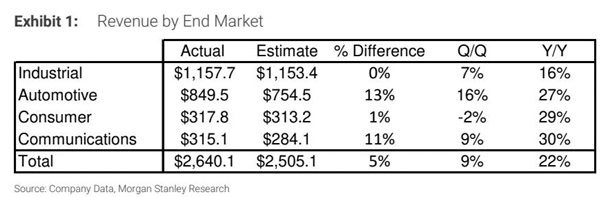
Core Viewpoint - Analog Devices, Inc. (ADI) reported better-than-expected Q2 results and provided optimistic guidance for Q3, reflecting strong performance in the analog chip and MCU sectors [1][2]. Financial Performance - Q2 revenue reached $2.64 billion, exceeding market consensus of $2.51 billion and Morgan Stanley's estimate of $2.50 billion, with a quarter-over-quarter growth of 8.9% and year-over-year growth of 22.3% [1][2]. - Adjusted gross margin was 69.4%, surpassing market consensus of 68.6% and Morgan Stanley's estimate of 69.1% [1]. - Adjusted earnings per share (EPS) were $1.85, higher than the market consensus of $1.69 and Morgan Stanley's estimate of $1.70 [1]. Segment Performance - Revenue breakdown for Q2 included: - Industrial: $1.16 billion, slightly above estimates [2]. - Automotive: $849.5 million, exceeding estimates by 13% [2]. - Consumer: $317.8 million, in line with expectations [2]. - Communications: $315.1 million, exceeding estimates by 11% [2]. Q3 Guidance - For Q3, ADI expects revenue of $2.75 billion, above market consensus of $2.60 billion and Morgan Stanley's estimate of $2.60 billion [2]. - Expected adjusted EPS for Q3 is $1.92, higher than market consensus of $1.79 and Morgan Stanley's estimate of $1.86 [2]. Long-term Outlook - Morgan Stanley raised revenue and margin forecasts for FY2025 and FY2026, reflecting increased confidence in cyclical recovery [3]. - The company anticipates strong performance across all end markets and regions, with industrial demand expected to align better with supply in Q3 [3]. - ADI's management acknowledged the impact of customer pull-ins, particularly in the automotive sector, contributing significantly to Q2 revenue outperformance [3]. Operational Efficiency - ADI's operational leverage is expected to normalize in the second half of FY2025, setting a solid foundation for FY2026 [4]. - The company has maintained an operating profit margin above 40% since Q2 FY2024, with guidance for Q3 FY2025 at 41.5% [4]. - Inventory management and communication with distributors have improved, supporting operational leverage [4]. Market Position - Despite a high valuation, ADI's stable performance amidst macroeconomic uncertainty positions it as a defensive play in the analog chip sector [5]. - Morgan Stanley maintains a positive outlook on the analog chip industry, believing it is in a recovery phase after hitting a bottom [5]. - ADI is viewed as the most defensive stock in the analog chip/MCU sector due to its strong balance sheet and effective supply-demand management [5].
华尔街到陆家嘴精选丨特朗普税改法案在众议院获批 美国债务风险几何?港股IPO缘何火热?苹果也要出智能眼镜了?
Di Yi Cai Jing· 2025-05-23 01:09
Group 1: Apple and AI Development - Apple plans to launch smart glasses by the end of 2026 to capture the augmented reality device market, while halting the development of camera-equipped smartwatches [8] - The smart glasses will feature a camera, microphone, and speaker, capable of analyzing the environment and executing tasks via Siri, including phone calls, music playback, real-time translation, and navigation [8] - The shift towards smart glasses represents a transition from a "screen-centric" to a "perception-centric" platform, aiming to redefine the next generation of human-computer interaction [8][9] Group 2: U.S. Debt and Economic Concerns - The U.S. House approved Trump's tax reform bill, which aims to reduce taxes by over $4 trillion over the next decade and increase the debt ceiling by $4 trillion [2] - Concerns about the sustainability of U.S. debt financing are rising, with the debt-to-GDP ratio nearing 100% and annual interest payments exceeding $1 trillion [3] - The combination of monetary stagnation and fiscal stimulus is reducing the long-term attractiveness of dollar assets, leading to potential depreciation of the dollar and increased demand for gold [3] Group 3: Hong Kong IPO Market - Hong Kong's IPO market raised a total of HKD 145 billion in the past year, a 2.7-fold increase year-on-year, with mainland companies contributing 75% of the financing [6][7] - The A+H dual listing model is becoming a key strategy for companies to optimize financing sources and hedge against external uncertainties [7] - The influx of capital into Hong Kong is driven by stricter regulations in the U.S. and a declining dollar, positioning Hong Kong as a "value discovery platform" for Chinese assets [7] Group 4: Autodesk's Financial Performance - Autodesk reported a 15% year-on-year revenue growth to $1.63 billion for Q1 of FY2026, primarily driven by strong subscription service performance [10] - The company raised its full-year revenue forecast to between $6.93 billion and $7.00 billion, indicating confidence in its cloud strategy and market position [10] - Concerns remain regarding the quality of growth, particularly in the construction sector, and the effectiveness of AI tools in driving user migration and revenue [11] Group 5: Analog Devices' Strong Results - Analog Devices reported Q2 revenue of $2.64 billion, a 22% increase year-on-year, with adjusted earnings per share of $1.85, exceeding expectations [12][13] - The growth is attributed to strong demand for analog chips in the automotive and industrial sectors, as well as the integration of generative AI and electric vehicles [12] - The company maintains a positive outlook for Q3, projecting revenue between $2.65 billion and $2.85 billion, reflecting confidence in its market position [12][13]
