电力装备

Search documents
【新华解读】同比增速转正!8月份我国规上工业企业利润缘何向好?
Xin Hua Cai Jing· 2025-09-27 10:33
Core Insights - The profit growth of China's industrial enterprises has turned positive, signaling an improvement in the industrial economy [1][5] - In August, the profit of large-scale industrial enterprises increased by 20.4% year-on-year, marking a significant recovery from a decline of 1.5% in July [1][2] - The positive trend is attributed to both base effect from last year's natural disasters and the effectiveness of macroeconomic policies [1][2] Group 1: Profit and Revenue Trends - From January to August, the profit of large-scale industrial enterprises grew by 0.9%, reversing a 1.7% decline in the first seven months [1] - The revenue of large-scale industrial enterprises increased by 2.3% year-on-year from January to August, with August's revenue growth accelerating to 1.9% [2][4] - The profit margin for large-scale industrial enterprises improved to 5.83%, up by 0.90 percentage points year-on-year [5] Group 2: Policy Impact - The "anti-involution" policy has positively influenced industrial pricing and competition, contributing to improved profit margins [3][4] - The ongoing construction of a unified national market and large-scale equipment updates are key factors driving the recovery of industrial enterprise profits [1][5] - Local governments have actively supported enterprises, which has also aided in improving profit data for August [4][5] Group 3: Industrial Production and Price Dynamics - The Producer Price Index (PPI) ended an eight-month decline, remaining flat month-on-month in August, with a year-on-year decrease of 2.9% [2][3] - Industrial added value grew by 6.2% year-on-year from January to August, with August's growth at 5.2% [2] - Equipment manufacturing saw an 8.1% increase in added value, significantly outpacing the overall industrial growth rate [3][4] Group 4: Future Outlook - Experts anticipate further improvement in profits for large-scale industrial enterprises, driven by seasonal consumption peaks and government support measures [5] - The upcoming "Golden September and Silver October" period is expected to boost consumer spending, potentially increasing orders for industrial enterprises [5]
金盘科技连续三年入选海南省先进装备制造首台套项目名单
Zhong Zheng Wang· 2025-09-23 13:28
Group 1 - The core viewpoint of the news is that Jinpan Technology has been recognized for its innovative achievements in advanced equipment manufacturing for the third consecutive year, highlighting its strong position in the high-end power equipment sector [1][2]. - Jinpan Technology's selected projects include a 10kV/2.4MW solid-state transformer for data centers, a 66kV pre-installed substation, and a 16MW-35kV dry-type transformer for offshore wind power, showcasing its technological advancements [1][2]. - The company aims to support the global renewable energy market with efficient and reliable solutions, contributing to economic benefits and promoting green development aligned with carbon neutrality goals [2]. Group 2 - Jinpan Technology has seen significant growth in its data center sales, with a compound annual growth rate of 79.22% from 2022 to 2024, and a remarkable year-on-year increase of 460.51% in the first half of 2025, exceeding 500 million yuan [3]. - The company plans to focus on the global energy revolution and AI data center demands, developing a matrix of standardized basic products and high-end customized products, while enhancing its research capabilities [3]. - Jinpan Technology's products are already utilized in numerous projects for major companies like Alibaba, Baidu, Huawei, China Mobile, and China Unicom, indicating its strong market presence [3].

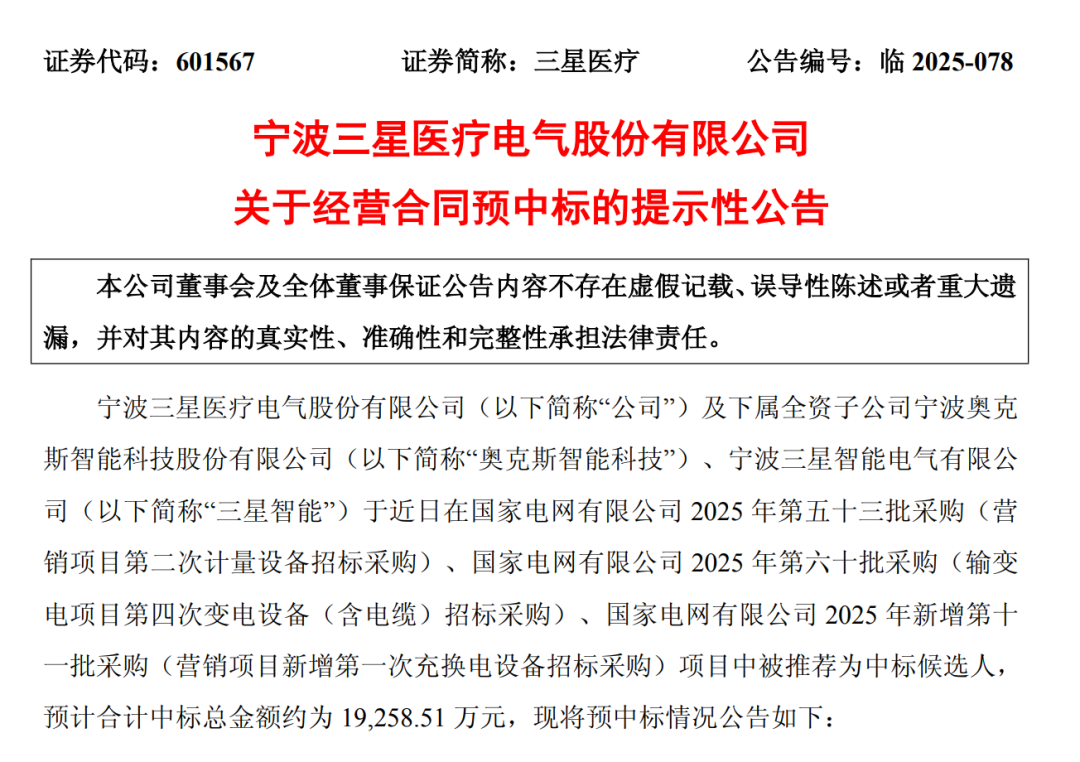
密集披露:中标大单
Shang Hai Zheng Quan Bao· 2025-09-22 14:03
Group 1 - Samsung Medical and its subsidiaries have been recommended as candidates for winning bids in multiple procurement projects from the State Grid Corporation of China, with a total expected bid amount of approximately 193 million yuan [1][4] - A total of 11 listed companies have announced their pre-bid status for State Grid projects in recent days, with a combined bid amount of about 1.18 billion yuan [1][4] - Baiyun Electric and its subsidiary Guilin Capacitor are recommended candidates for nine sub-projects under the State Grid's procurement, with a total bid amount of 162 million yuan, accounting for 3.25% of the company's projected 2024 revenue [4][5] Group 2 - The State Grid Corporation plans to invest over 650 billion yuan in 2025, marking a historical high, while the Southern Power Grid Company has also set a record investment of 175 billion yuan [7][8] - Recent policies from the Ministry of Industry and Information Technology and other departments aim to maintain a 6% annual revenue growth for traditional power equipment and steady growth for new energy equipment by 2026 [8] - The electric power equipment industry is expected to benefit from the ongoing green and low-carbon energy transition, with strong demand anticipated [8][9]


政策高频 | 金砖国家领导人线上峰会召开(申万宏观·赵伟团队)
赵伟宏观探索· 2025-09-20 07:13
Group 1 - The core viewpoint of the article emphasizes the importance of multilateralism, open cooperation, and collective development among BRICS nations to address global challenges and promote a fair international order [1][2] - President Xi Jinping proposed three key suggestions: uphold multilateralism to defend international fairness and justice, maintain an open and win-win international economic order, and strengthen unity and cooperation among BRICS countries [1][2] - The BRICS nations collectively represent nearly half of the world's population and about 30% of the global economy, highlighting their significant role in global trade and development [2] Group 2 - Vice Premier Zhang Guoqing emphasized the need for deep integration of technological and industrial innovation to enhance industrial innovation capabilities and foster high-quality development [3][4] - Zhang highlighted the importance of strengthening the innovation role of enterprises and promoting a collaborative ecosystem for innovation among large, medium, and small enterprises [4] - The State Council approved a pilot program for market-oriented allocation of factors in ten regions, aiming to eliminate barriers to the free flow and efficient allocation of resources, including traditional and innovative factors [5][6] Group 3 - The National Development and Reform Commission and the National Energy Administration issued guidelines to promote the integration of artificial intelligence and energy sectors, aiming for significant breakthroughs in core technologies by 2027 [7][8] - The guidelines focus on enhancing the safety, efficiency, and sustainability of energy systems through AI applications across various energy sectors, including electricity, coal, and oil [8] Group 4 - The 17th meeting of the National People's Congress Standing Committee discussed the implementation of the Labor Union Law and the economic development plan, emphasizing the need to release domestic demand and promote technological and industrial innovation [9][10] - The meeting highlighted the importance of ensuring food safety and enhancing the quality of life through various policy measures [10] Group 5 - The Ministry of Industry and Information Technology held a meeting to discuss the "14th Five-Year Plan," focusing on leveraging strategic opportunities from technological revolutions and industrial transformations to achieve high-quality development [11][12] - The meeting underscored the need for a balanced manufacturing sector and the integration of technological innovation with industrial development [12] Group 6 - The State Council issued an opinion on enhancing sports consumption and promoting the sports industry, aiming for a total scale exceeding 7 trillion yuan by 2030 [13][14] - The opinion includes measures to optimize sports event management and expand outdoor sports industries, fostering a robust sports economy [14] Group 7 - The Ministry of Industry and Information Technology, along with other departments, released a work plan for the power equipment industry, targeting a 6% annual revenue growth for traditional power equipment from 2025 to 2026 [15][16] - The plan emphasizes improving supply quality, expanding domestic demand, and promoting green and digital transformations in the power equipment sector [15][16]
今明两年电力装备行业铆劲稳增长 传统电力装备年均营收增速保持6%左右
Zhong Guo Neng Yuan Wang· 2025-09-19 02:59
Core Viewpoint - The Ministry of Industry and Information Technology, the State Administration for Market Regulation, and the National Energy Administration jointly issued the "Power Equipment Industry Stabilization Growth Work Plan (2025-2026)", aiming for a steady growth in revenue for traditional power equipment and an increase in revenue for new energy equipment during this period [1][2]. Group 1: Revenue Growth Projections - Traditional power equipment is expected to maintain an average annual revenue growth rate of around 6% from 2025 to 2026 [1][2]. - The revenue of new energy equipment is projected to show steady growth, with the annual revenue growth rate for national advanced manufacturing clusters in the power equipment sector expected to be around 7% [1][2]. - Leading enterprises in the power equipment industry are anticipated to achieve an average annual revenue growth rate of 10% [1][2]. Group 2: Industry Development and Opportunities - The power equipment industry is recognized as a dominant and foundational sector in the industrial economy, playing a crucial role in stabilizing economic growth [2]. - The installed capacity of power generation has reached 3.65 billion kilowatts, with significant breakthroughs in landmark achievements such as the 18 MW offshore wind turbine and the mass application of third-generation nuclear power units [2]. - The recent deployment of major energy projects domestically and the increasing demand from countries along the Belt and Road Initiative present new opportunities for the power equipment industry [2]. Group 3: Strategic Focus Areas - The plan emphasizes the integration of quality supply and effective demand, with a focus on accelerating the construction of new energy bases and key projects in the field of smart grid equipment [3][4]. - It aims to strengthen the connection between domestic and international markets, promoting global cooperation in the wind, solar, and energy storage sectors [3][4]. - The plan highlights the importance of economic growth and industrial upgrading, advocating for quality improvements to drive reasonable growth in quantity [3][4]. Group 4: Implementation Measures - The plan outlines several measures to enhance supply capabilities, including improving equipment quality and promoting green and intelligent transformation [4][5]. - It aims to expand effective domestic demand through major engineering projects and actively explore international markets to support global energy transitions [4][5]. - The plan includes measures to optimize the development environment, such as promoting innovation in product applications and enhancing industry standards [4][5]. Group 5: Support Mechanisms - The plan proposes four key support measures: strengthening organizational support, enhancing data monitoring and analysis, providing financial and tax support, and promoting policy awareness [5].
水发电力:深耕上合能源建设,助力区域合作发展
Qi Lu Wan Bao· 2025-09-18 08:07
Core Viewpoint - The Shanghai Cooperation Organization (SCO) member states are focusing on multi-field cooperation, with energy collaboration being a core topic at the recent summit in Tianjin [1] Company Summary - Water Power and Electricity, as a key player in China's power equipment sector, is actively involved in energy construction among SCO member countries, positioning itself as an important practitioner of regional energy cooperation [1] - The company has implemented a "technology + localization" strategy, successfully entering seven SCO member countries, including Pakistan, Uzbekistan, and Russia, with multiple key projects [1] - Notable projects include providing power equipment for the Olympic City project in Uzbekistan to ensure reliable power supply for the sports event, and participating in the construction of substations in Pakistan to alleviate local power shortages with "Chinese solutions," thereby empowering local livelihoods and economic development [1] - Looking ahead, Water Power and Electricity aims to deepen SCO cooperation with superior technology, products, and services, contributing to the region's low-carbon energy transition and ensuring that "Water Power Quality Products" continue to serve the development of SCO member countries [1]
电力装备行业周刊:电力装备行业稳增长工作方案印发,加快突破关键技术
Chan Ye Xin Xi Wang· 2025-09-17 05:49
Group 1: Industry Policies - The Ministry of Industry and Information Technology and other departments issued the "Power Equipment Industry Steady Growth Work Plan (2025-2026)", targeting a 6% annual revenue growth for traditional power equipment and stable revenue growth for new energy equipment [1] - The plan emphasizes the acceleration of major energy projects and the support for key product innovation projects in new energy and smart grid equipment [1] - The National Development and Reform Commission and the National Energy Administration released guidelines for the construction of power spot markets, focusing on reliable capacity assessment mechanisms for various power sources [2] Group 2: Financial Support and Funding - The Ministry of Industry and Information Technology, the Ministry of Finance, and the Financial Regulatory Bureau announced the implementation of the 2025 insurance compensation policy for major technical equipment [3] - The policy supports all fields listed in the "Guidance Directory for the Promotion and Application of Major Technical Equipment (2024 Edition)" [4] - In Shanghai's Pudong New Area, a call for project applications for new energy technology development funding was issued, with a subsidy of up to 30% of fixed asset investment for eligible projects [5][7] Group 3: Technological Advancements - The first intelligent inspection substation in Anshun has been launched, significantly improving operational efficiency by automating inspection processes [12][13] - The world's first plateau hydropower unit production and research base has been established in Tibet, aimed at enhancing the development of high-capacity hydropower units [14] - The first 630℃ unit has achieved a significant milestone in its commissioning, marking a breakthrough in high-efficiency coal-fired power generation technology [15] Group 4: Major Projects and Developments - The largest onshore wind power project in China, with a total installed capacity of 1.5 million kilowatts, has commenced commercial operation, showcasing advancements in wind energy technology [19][20] - A new digital intelligent substation in Shandong has been successfully put into operation, enhancing the local power grid structure [16][17] - The first commercial unit of the "Taihang 110" heavy-duty gas turbine has been produced, marking a new phase in the commercialization of domestically developed gas turbines [18] Group 5: Patent Applications and Innovations - Zhejiang Yingji Power Technology has applied for a patent for a self-driven steam heating system, aimed at improving energy efficiency in industrial steam supply [24] - China Yangtze Power and Dongfang Electric have jointly applied for a patent for an online monitoring method for turbine shaft seal temperatures, enhancing measurement accuracy [25][26] - Huaneng has obtained a patent for a flow path designed to suppress vortex formation in axial flow turbines, contributing to improved turbine performance [27]

8月经济总体平稳,四季度稳增长政策需提前谋划
2 1 Shi Ji Jing Ji Bao Dao· 2025-09-16 13:30
Group 1 - The core task remains to boost effective demand, highlighting the increasing necessity for stable growth policies in the fourth quarter [1][8] - The economic growth rate for China in the first half of the year was 5.3%, achieved amidst challenges such as global trade uncertainties and the transition of economic drivers [1][2] - The August data from the National Bureau of Statistics indicates a narrowing decline in various economic indicators compared to July, suggesting a potential for policy intervention [2][3] Group 2 - The social financing scale increased by 25,693 billion yuan in August, but this represents a year-on-year decrease of 4,630 billion yuan, indicating weak credit demand [3][4] - Government bond financing has decreased, and the effectiveness of proactive fiscal policies needs to be supported in key quarters and months [5][6] - Fixed asset investment growth was only 0.5% year-on-year from January to August, with infrastructure investment growing by 2% and real estate investment declining by 12.9% [6][7] Group 3 - The investment sentiment among enterprises remains subdued, correlating with the slow growth in fixed asset investment observed this year [4][6] - The retail sales of consumer goods in August reached 39,668 billion yuan, growing by 3.4% year-on-year, with certain sectors like sports and home appliances performing well [7][8] - The necessity for structural monetary policies is increasing, with potential measures including the restart of government bond purchases to inject medium to long-term liquidity [8]
8月经济总体平稳,四季度稳增长政策需提前谋划 | 宏观月报
2 1 Shi Ji Jing Ji Bao Dao· 2025-09-16 13:28
Economic Overview - China's economy achieved a growth rate of 5.3% in the first half of the year, despite challenges from global trade uncertainties and the transition of economic drivers [1] - The necessity for stable growth policies in the fourth quarter is increasing, as indicated by the recent economic data [2] Financing and Credit - The growth rate of social financing decreased in August, with a total increment of 25,693 billion yuan, which is a year-on-year decrease of 4,630 billion yuan [3] - The demand for credit remains weak, with new loans amounting to 6,233 billion yuan in August, down by 4,178 billion yuan year-on-year [3][4] - Government bond financing has also seen a decline, indicating that the effectiveness of active fiscal policies needs to be supported in key quarters [5] Investment Trends - Fixed asset investment growth was only 0.5% year-on-year from January to August, with infrastructure investment growing by 2% and manufacturing investment by 5.1%, while real estate investment fell by 12.9% [6][7] - The government is focusing on stabilizing investment in key industries, particularly manufacturing, to support economic recovery [7] Consumption Patterns - In August, the total retail sales of consumer goods reached 39,668 billion yuan, with a year-on-year growth of 3.4%, although certain sectors like dining faced challenges [7][8] - The recovery in consumption is expected to take time, and effective demand needs to be stimulated [8] Policy Recommendations - There is a growing need for the introduction of stable growth policies in the fourth quarter, with potential measures including the issuance of special government bonds and the use of policy financial tools [2][8] - Structural policy tools may be accelerated to support key industries and foreign trade, while fiscal policies may need to be intensified [8]
稳住70%工业基本盘!十大行业放大招
21世纪经济报道· 2025-09-16 13:19
Core Viewpoint - The article discusses the introduction of a new round of policies aimed at stabilizing economic growth in ten key industries, which are expected to support 70% of the industrial base and pave the way for future industrial upgrades [1][2]. Summary by Sections Key Industries Benefiting - The ten key industries identified include steel, non-ferrous metals, petrochemicals, chemicals, building materials, machinery, automobiles, power equipment, light industry, and electronic information manufacturing, collectively representing 70% of the industrial economy [1]. Rationale for Policy Introduction - The timing of the new policies is significant as it coincides with the conclusion of the 14th Five-Year Plan and the tenth anniversary of supply-side structural reforms. Despite exceeding growth expectations in the first half of the year, the third quarter has seen increased uncertainties, prompting the need for measures to stabilize the economy and allow for growth in the fourth quarter [2]. Policy Focus and Implementation - The policies are designed to be precise rather than broad, addressing both supply and demand, as well as technology and market needs. Key initiatives include promoting innovation, improving quality, and integrating artificial intelligence into traditional industries [2]. Demand and Supply Alignment - The policies aim to stimulate consumption and expand market scenarios, with a focus on major engineering projects and large-scale equipment updates. This dual approach is intended to align supply and demand effectively [2]. Guidance for Enterprises - The policies serve as a guide for enterprises, emphasizing the importance of avoiding irrational competition and instead focusing on technology, brand differentiation, and quality. Support for XR equipment, smart grids, and first-of-a-kind equipment trials is also highlighted [2]. Market Order and Fair Competition - The government is placing a strong emphasis on regulating market order and combating low-price competition to ensure a fair environment for all businesses to thrive [2].