
碳交易

Search documents
立足资源禀赋 抢抓政策机遇 海南创新驱动产业提质
Jing Ji Ri Bao· 2025-09-13 22:09
Group 1 - Hainan Province is focusing on tourism, modern services, high-tech industries, and tropical agriculture as its leading sectors, leveraging its resource endowment and free trade port policies to drive innovation and structural transformation [1] - In the first seven months of this year, Hainan's industrial added value above designated size increased by 10.4% year-on-year, while the total service import and export value reached 40.338 billion yuan, a year-on-year growth of 23.9% [1] - The Wenchang International Aerospace City aims to cultivate an aerospace industry cluster, targeting a revenue of 10 billion yuan by 2027, with plans for significant projects like an aerospace theme park [1] Group 2 - Sanya has achieved several "firsts" in innovative offshore international trade and carbon trading, indicating a significant upgrade in industrial development through institutional innovation [2] - The Secretary of the Hainan Provincial Committee emphasized that Hainan's open policy framework and competitive business environment present substantial opportunities for investment [2]
全国碳市场建设按下“升级键”
Zhong Guo Hua Gong Bao· 2025-09-12 01:43
Core Viewpoint - The release of the "Opinions" by the Central Committee and the State Council marks a significant step towards the establishment of a national carbon market, indicating a long-term policy direction for carbon market development [1] Group 1: Carbon Market Expansion - By 2027, the national carbon emission trading market is expected to cover major industrial sectors, with a focus on expanding the range of covered industries and greenhouse gases based on industry development and carbon emission characteristics [2] - The carbon market is driving structural transformation and upgrading of industries, with key emission enterprises expected to adopt renewable energy and improve energy efficiency, thus enhancing their green market competitiveness [2] - The expansion of the carbon market will lead to a rapid increase in the number of trading entities and the total amount of tradable quotas, promoting a resource allocation mechanism that encourages cross-industry competition [2] Group 2: Market Dynamics and Pricing Mechanism - The "Opinions" propose a combination of free and paid quota distribution to enhance market activity, transitioning from a focus on intensity control to a total quota control system by 2030 [4][5] - The establishment of a reasonable pricing mechanism is crucial for accurately reflecting market signals, with the carbon price serving as an indicator of resource scarcity [8][9] - A stable carbon price is essential for the effectiveness of market incentives, and the development of carbon finance is seen as a key mechanism for supporting green low-carbon transformation [9]
观车 · 论势 || 期待汽车业纳入碳市场
Zhong Guo Qi Che Bao Wang· 2025-09-10 05:48
Group 1 - The central government aims to accelerate the establishment of a unified national carbon market, targeting coverage of major industrial sectors by 2027 and a comprehensive voluntary emission reduction market by 2030 [1] - By July 2025, the national carbon emission trading market has seen a cumulative transaction volume of 681 million tons and a transaction value of 46.784 billion yuan, with nearly 100% compliance rate among 2,096 key emission units [2] - The introduction of carbon trading is intended to turn carbon emissions into valuable assets for enterprises, promoting sustainable development and profitability [2] Group 2 - The government plans to enhance market vitality by diversifying trading products and expanding trading participants while strengthening market regulation [3] - Currently, the carbon market includes key sectors such as electricity, steel, cement, and aluminum, with ongoing discussions about incorporating the automotive industry into the carbon trading framework [3] - A strategic cooperation agreement has been signed between Hubei Hongtai Group and relevant automotive organizations to develop a carbon emission management system and explore carbon asset development [4] Group 3 - The automotive industry is transitioning from a "dual credit" system to a carbon credit management approach, which may facilitate its inclusion in carbon trading [4] - The shift to carbon credit management requires adjustments in accounting mechanisms and standards, impacting both new energy and traditional fuel vehicles [4] - Successful integration of the automotive sector into the carbon trading market necessitates collaboration with local carbon markets and financial institutions to enhance market activity [4]
碳讨 | 建设“路线图”出炉 我国碳市场迎来首份中央文件
Xin Jing Bao· 2025-09-05 21:15
Core Viewpoint - The release of the "Opinions" marks the first central document in China's carbon market sector, outlining a clear timetable and roadmap for the development of the national carbon market by 2027 and 2030 [1][2]. Group 1: National Carbon Market Development - The national carbon market consists of a mandatory carbon emissions trading market and a voluntary greenhouse gas reduction trading market, which are interconnected to form a comprehensive carbon market system [2][3]. - As of August 22, 2023, the mandatory carbon market has seen a cumulative trading volume of over 680 million tons, with a transaction value of 47.41 billion yuan, while the voluntary market has recorded 2.49 million tons of certified voluntary emission reductions, amounting to 210 million yuan [2]. Group 2: Market Expansion and Coverage - By 2027, the mandatory carbon market aims to expand its coverage to include major industrial sectors, while the voluntary market will extend to biomass utilization and solid waste treatment, achieving full coverage in key areas [1][2]. - The government plans to gradually shift from intensity control to total control of carbon emissions, establishing a clear and transparent carbon emissions quota management system [3]. Group 3: International Cooperation and Leadership - The "Opinions" emphasize the importance of international cooperation in climate governance, positioning the improvement of the national carbon market as a significant step in demonstrating China's commitment to global climate leadership [4][5]. - China's experience in carbon trading and voluntary reduction markets is seen as valuable for other developing countries facing similar challenges in balancing economic development and carbon reduction [5][6]. Group 4: Financial Empowerment and Market Vitality - The "Opinions" propose enhancing market vitality by diversifying trading products and expanding trading participants, including the introduction of financial institutions into the carbon market [7][8]. - Financial institutions are encouraged to develop green financial products related to carbon emissions rights and certified voluntary emission reductions, thereby supporting greenhouse gas reduction efforts [7][8].
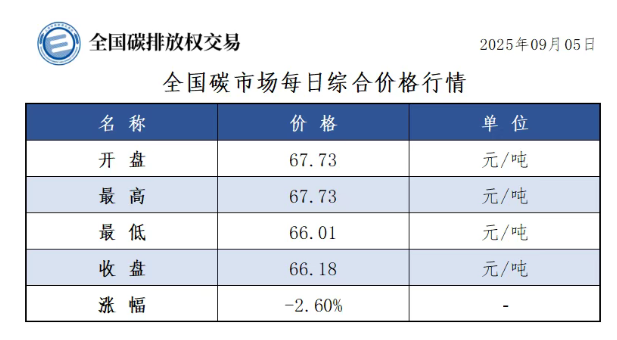
9月5日全国碳市场综合价格收盘价66.18元/吨,较前一日下跌2.60%
Xin Hua Cai Jing· 2025-09-05 09:22
Core Points - The national carbon market opened at a price of 67.73 yuan per ton, with a closing price of 66.18 yuan per ton, reflecting a decrease of 2.60% from the previous day [1][2][4] - The total trading volume for carbon emission allowances today was 478,812 tons, with a total transaction value of approximately 31.64 million yuan [2][4] - Cumulative trading volume in the national carbon market reached 704,047,174 tons, with a total transaction value of approximately 48.37 billion yuan as of September 5, 2025 [4] Trading Details - The highest price recorded today was 67.73 yuan per ton, while the lowest was 66.01 yuan per ton [1][2] - The trading volume for different transaction types included 181,735 tons in listed agreement trading, 295,077 tons in bulk agreement trading, and 2,000 tons in single-direction bidding [2][3] - The single-direction bidding today had a maximum selling volume of 200 tons, with a transaction price of 67.30 yuan per ton [3]

恩施深化碳交易改革工作方案出炉森林碳票引领绿色发展新路径
Zhong Guo Huan Jing Bao· 2025-09-04 01:01
Core Viewpoint - The Enshi Prefecture in Hubei Province has issued a work plan to deepen carbon trading reforms, aiming to integrate into national and provincial carbon markets by the end of 2025, with a focus on establishing a forest carbon credit trading system [1][2] Group 1: Carbon Market Integration - Enshi Prefecture will organize training for cement companies on carbon emission management and guide them in registration and material submission [1] - The region will promote the construction of CCER projects and encourage the development of methodologies for afforestation carbon sinks and energy-saving projects [1] Group 2: Carbon Credit System - The plan includes exploring the establishment of a forest carbon credit system, with pilot projects to clarify application, registration, circulation, and offset management processes [2] - A linkage mechanism will be created for carbon credit consumption and discounts, allowing individuals and organizations purchasing carbon credits to enjoy benefits such as ticket reductions and accommodation discounts [2] Group 3: Carbon Footprint and Product Management - The plan proposes pilot projects for carbon footprint accounting and encourages carbon labeling for agricultural products like tea and mineral water to enhance their green competitiveness [2] - Cement companies will be encouraged to achieve compliance targets through a combination of carbon quota trading and CCER project offsets [2] Group 4: Financial Support and Collaboration - Enshi Prefecture will innovate green financial tools such as carbon quota collateralized loans and carbon account-linked loans to broaden financing channels for ecological products [2] - A multi-departmental collaborative mechanism will be established to ensure effective implementation of reforms, with a focus on task lists, responsibility assignments, and diverse financing channels [2]
21专访丨北京绿色交易所董事长王乃祥:碳市场扩围后 企业CCER需求增加
2 1 Shi Ji Jing Ji Bao Dao· 2025-09-03 23:11
Core Viewpoint - The recent issuance of the "Opinions on Promoting Green and Low-Carbon Transition and Strengthening the Construction of the National Carbon Market" aims to establish a transparent, unified, and widely participatory national voluntary greenhouse gas emission reduction trading market, which is expected to create significant green market opportunities and promote societal participation in low-carbon development [1][7]. Market Overview - The national voluntary greenhouse gas emission reduction trading market will start on January 22, 2024, with a cumulative trading volume of approximately 2.5 million tons and a transaction value exceeding 210 million yuan by August 25, 2025 [1][2]. - The first batch of CCER (Certified Emission Reduction) was registered on March 6, 2024, with a total reduction of 9.48 million tons, and the trading on March 7 resulted in a volume of 748,800 tons and a transaction value of 60.24 million yuan, with an average price of 80.45 yuan per ton [2][4]. Demand and Supply Dynamics - The demand for CCER is expected to increase as the national carbon emission trading market expands to include industries such as steel, cement, and aluminum smelting, while the current supply of CCER remains relatively limited, leading to higher transaction prices [1][5][6]. Quality and Standards - The quality of carbon credits is crucial for the sustainable development of the voluntary emission reduction trading market, with a focus on simplifying development processes and reducing costs to encourage more projects to participate [6][11]. - The market emphasizes the importance of high-quality carbon credits, with measures in place to ensure integrity and transparency, including strict penalties for fraudulent activities [6][11]. Financial Instruments and Innovations - Over 2,900 enterprises have opened accounts in the CCER trading system, including more than 100 financial institutions, indicating a growing interest in carbon finance [9]. - The market is exploring the development of carbon financial products linked to carbon emissions rights and CCER, such as sustainable loans and carbon pledge financing, to enhance the financial attributes of carbon assets [8][9]. Challenges and Support for Enterprises - The main challenge in achieving carbon neutrality for enterprises is the accounting of supply chain carbon emissions and the international recognition of standards [10]. - The Beijing Green Exchange provides various services to assist enterprises, especially small and medium-sized ones, in navigating the complexities of carbon neutrality, including carbon accounting and compliance with international standards [10][11].
“金山银山”是这样炼成的(解码“绿水青山就是金山银山”③)
Ren Min Ri Bao Hai Wai Ban· 2025-09-03 00:30
Core Viewpoint - China has explored three pathways to transform ecological wealth into economic wealth: "Protecting Green for Gold," "Gathering Green for Gold," and "Borrowing Green for Gold" [2][4]. Group 1: Protecting Green for Gold - This pathway emphasizes ecological protection as a prerequisite for obtaining economic returns through mechanisms like ecological compensation and transfer payments. The transformation model corresponds to the ecological compensation model [2]. - A notable case is the ecological compensation mechanism in Hainan's Qitian Reservoir, where a funding pool of 600 million yuan was established, resulting in significant compensation for ecological protection efforts [2]. Group 2: Gathering Green for Gold - This approach focuses on converting ecological advantages into industrial advantages, exemplified by the development of the wine industry in Ningxia, which produces 140 million bottles of wine annually with a total output value of 45 billion yuan [3]. - The green industry cluster effect is increasingly evident, as seen in Jiangsu's Yancheng, which has developed a major offshore wind power industry cluster, accounting for 40% of the national capacity for complete machines and 20% for blades [3]. Group 3: Borrowing Green for Gold - This pathway involves innovative mechanisms for realizing the value of ecological products, such as the "Forest Ecological Bank" in Nanping, Fujian, where farmers can deposit forestry resources, turning them into assets and capital [3]. - The carbon trading market is emerging as a new channel for "Borrowing Green for Gold," with significant transaction volumes and values reported in both mandatory and voluntary carbon markets [4].
专访王乃祥:碳市场扩围后,企业CCER需求增加丨首席气候官
2 1 Shi Ji Jing Ji Bao Dao· 2025-09-02 12:58
Core Viewpoint - The recent issuance of the "Opinions on Promoting Green and Low-Carbon Transition and Strengthening the Construction of the National Carbon Market" aims to establish a transparent, unified, and widely participatory national voluntary greenhouse gas emission reduction trading market, which is expected to create significant green market opportunities and promote societal participation in low-carbon development [1][7]. Group 1: Market Overview - The national voluntary greenhouse gas emission reduction trading market will start on January 22, 2024, with a cumulative trading volume of approximately 2.5 million tons and a transaction value exceeding 210 million yuan by August 25, 2025 [1][2]. - The first batch of CCER (Certified Emission Reduction) was registered on March 6, 2024, with a total reduction of 9.48 million tons, and the first trading day saw a transaction volume of 748,800 tons and a transaction value of 60.24 million yuan, with an average price of 80.45 yuan per ton [2][4]. Group 2: Demand and Supply Dynamics - The demand for CCER is expected to increase as the national carbon emission trading market expands to include industries such as steel, cement, and aluminum smelting, while the current supply of CCER remains relatively limited, leading to higher transaction prices [1][5]. - The average daily transaction price of CCER generally ranges between 80 and 90 yuan per ton, reflecting market participants' high recognition of CCER quality and the positive outlook for the voluntary carbon market [5][6]. Group 3: Policy and Regulatory Framework - The national voluntary greenhouse gas emission reduction trading market complements the national carbon emission trading market, forming a comprehensive carbon market system that supports the achievement of China's dual carbon goals [3][6]. - The "Opinions" propose to establish a carbon pricing mechanism with clear rules and reasonable price levels by 2030, enhancing the connection between the voluntary and mandatory carbon markets [3][6]. Group 4: Financial Innovations - Over 2,900 enterprises have opened accounts in the CCER trading system, including more than 100 financial institutions, indicating a growing interest in carbon asset management and trading [9]. - The development of carbon financial products, such as sustainable loans and carbon pledge financing, is being explored to enhance the financial attributes of carbon assets and support green low-carbon development [8][9]. Group 5: Quality Assurance and Market Integrity - Ensuring high-quality carbon credits is essential for the sustainable development of the national voluntary greenhouse gas emission reduction trading market, with measures in place to simplify development processes and reduce costs while maintaining integrity [6][7]. - The market emphasizes voluntary participation and integrity management, with strict penalties for fraudulent activities to maintain transparency and fairness [6][7].
专访王乃祥:碳市场扩围后,企业CCER需求增加
2 1 Shi Ji Jing Ji Bao Dao· 2025-09-02 12:52
Core Insights - The expansion of the national carbon emissions trading market, including the steel, cement, and aluminum smelting industries, has led to an increased demand for Certified Emission Reductions (CCER) [1][2][4] - The national voluntary greenhouse gas reduction trading market aims to mobilize a broader range of industries to voluntarily engage in greenhouse gas reduction actions, creating significant green market opportunities [1][7] - As of August 25, 2025, the cumulative trading volume of CCER reached approximately 2.5 million tons, with a transaction value exceeding 210 million yuan [1][3] Market Dynamics - The demand for CCER is expected to rise due to the inclusion of new industries, while the current supply remains relatively limited, resulting in higher transaction prices [2][6] - The average transaction price of CCER has been consistently between 80-90 yuan per ton, reflecting market participants' recognition of CCER quality [6][8] Policy and Regulatory Framework - The national voluntary greenhouse gas reduction trading market is designed to complement the national carbon emissions trading market, forming a comprehensive carbon market system [4][10] - The government emphasizes the importance of maintaining high-quality carbon credits, which is crucial for the sustainable development of the voluntary carbon market [7][11] Financial Institutions and Market Participation - Over 2,900 enterprises have opened accounts in the CCER trading system, including more than 100 financial institutions such as banks and brokerages [9][10] - Financial institutions are encouraged to explore and develop green financial products related to carbon emissions rights and CCER, enhancing the financial attributes of carbon assets [8][9] Challenges and Innovations - The main challenge in achieving carbon neutrality for enterprises is the accounting of supply chain carbon emissions and the international recognition of standards [10][11] - The Beijing Green Exchange is actively developing digital tools and platforms to assist small and medium-sized enterprises in achieving carbon neutrality [11]