
道路运输

Search documents
制造业PMI环比连续改善 产需指数均位于扩张区间
Zheng Quan Shi Bao· 2025-06-30 18:02
Group 1 - In June, the manufacturing Purchasing Managers' Index (PMI) rose to 49.7%, while the non-manufacturing business activity index reached 50.5%, indicating a recovery in both sectors [1] - The manufacturing PMI showed a month-on-month increase of 0.2 percentage points, marking the second consecutive month of improvement, with production index at 51% and new orders index at 50.2% [1] - The overall manufacturing sector is showing signs of stabilization, with 11 out of 21 surveyed industries in the expansion zone, an increase of 4 from the previous month [2] Group 2 - The construction industry saw a significant increase in business activity index to 52.8%, up 1.8 percentage points from the previous month, driven by rising investment-related construction activities [2] - The recent stabilization in raw material purchasing prices and finished product sales prices indicates a positive trend in the manufacturing sector, ending a three-month decline [2] - Despite a decline in business activity indices for sectors related to consumer travel, the market expectation index remains high at 56.0%, suggesting potential recovery in service-related industries as the summer consumption peak approaches [3]
49.7%!6月份制造业PMI出炉→
新华网财经· 2025-06-30 09:24
Core Viewpoint - The overall economic climate in China is showing signs of expansion, with key indices indicating a recovery in both manufacturing and non-manufacturing sectors in June. Group 1: Manufacturing Sector - The Manufacturing Purchasing Managers' Index (PMI) rose to 49.7% in June, with 11 out of 21 surveyed industries in the expansion zone, an increase of 4 from the previous month [3] - Production and new orders indices were at 51.0% and 50.2%, respectively, indicating accelerated manufacturing activities and improved market demand [3] - The purchasing volume index increased to 50.2%, up by 2.6 percentage points, reflecting enhanced procurement willingness among enterprises [3] - Large enterprises showed a PMI of 51.2%, indicating significant support for the manufacturing sector, while medium and small enterprises had PMIs of 48.6% and 47.3%, respectively [4] - Key industries such as equipment manufacturing, high-tech manufacturing, and consumer goods continued to expand, with PMIs of 51.4%, 50.9%, and 50.4% [4] Group 2: Non-Manufacturing Sector - The Non-Manufacturing Business Activity Index reached 50.5%, indicating continued expansion, with a slight increase of 0.2 percentage points from the previous month [5] - The service sector's business activity index was at 50.1%, showing stability, although some consumer-related sectors experienced a decline in activity [5] - The construction industry saw a significant increase, with a business activity index of 52.8%, up by 1.8 percentage points, indicating a recovery in construction activities [5] Group 3: Composite PMI - The Composite PMI Output Index rose to 50.7%, reflecting an overall acceleration in production and business activities across sectors [7][8]


制造业PMI连续两个月回升,新订单指数回到扩张区间
证券时报· 2025-06-30 08:13
Core Viewpoint - The manufacturing and non-manufacturing sectors in China showed signs of recovery in June, with the Manufacturing PMI at 49.7%, Non-Manufacturing Business Activity Index at 50.5%, and Composite PMI Output Index at 50.7%, indicating overall economic expansion [1][3]. Manufacturing Sector - The Manufacturing PMI improved month-on-month from 49.0% in April to 49.7% in June, indicating a gradual recovery despite remaining below the critical 50% threshold [3]. - In June, the Production Index was at 51%, and the New Orders Index rose to 50.2%, marking a return to the expansion zone after two months below 50% [3]. - The easing of external pressures from US-China trade relations contributed to the stabilization of manufacturing activities, with market demand showing signs of recovery [3][4]. Non-Manufacturing Sector - The Non-Manufacturing Business Activity Index increased to 50.5% in June, reflecting continued expansion, although some sectors related to consumer travel saw a decline [10]. - The Business Activity Expectation Index stood at 56.0%, indicating optimism among service sector enterprises regarding future growth [11]. - Financial services showed robust activity, with the Business Activity Index and New Orders Index both exceeding 60%, suggesting increased financial support for the real economy [8]. Construction and Investment - The Construction Business Activity Index rose to 52.8% in June, with investment-related construction activities showing significant improvement [6]. - The ongoing implementation of special bonds for infrastructure projects is expected to stimulate further construction demand [7]. Overall Economic Outlook - The overall economic environment is expected to improve in the second half of the year, driven by policy measures and a gradual recovery in both manufacturing and non-manufacturing sectors [1][13].

信号出现!制造业PMI连续两个月回升,新订单指数回到扩张区间
券商中国· 2025-06-30 07:44
Core Viewpoint - The overall economic climate in China is showing signs of expansion, with key indices such as the manufacturing PMI, non-manufacturing business activity index, and composite PMI output index all experiencing a rebound in June, indicating a positive trend in economic activity [1][2]. Manufacturing Sector - In June, the manufacturing PMI rose to 49.7%, marking a 0.2 percentage point increase from the previous month, continuing a two-month upward trend despite remaining below the critical 50% threshold [3]. - The production index for enterprises was at 51%, indicating stable expansion, while the new orders index returned to the expansion zone at 50.2%, up 0.4 percentage points from the previous month [4]. - The easing of external disturbances due to a temporary thaw in US-China trade relations has allowed the manufacturing sector to stabilize, with market demand showing signs of recovery [5][6]. Construction Sector - The construction industry business activity index reached 52.8% in June, up 1.8 percentage points from the previous month, indicating a rise in investment-related construction activities [7]. - The rapid progress in infrastructure project construction is highlighted by the ongoing implementation of special bonds for land acquisition and government investment funds, which are expected to stimulate further demand for infrastructure [9]. Financial Sector - The financial industry business activity index and new orders index both increased to over 60%, reflecting heightened supply and demand activities as the quarter ends, with financial support for the real economy continuing to strengthen [10]. Non-Manufacturing Sector - The non-manufacturing business activity index was at 50.5% in June, showing a slight increase, although sectors related to consumer travel experienced a decline in activity [11]. - Despite some short-term pullbacks, there is optimism regarding the upcoming summer consumption peak, with financial policies aimed at supporting service sectors expected to provide new momentum for growth [13].

2025年6月PMI点评:外部扰动减弱,内生动能修复
EBSCN· 2025-06-30 07:43
Manufacturing Sector - The manufacturing PMI for June 2025 is 49.7%, up from 49.5% in May, aligning with market expectations[2] - The production index increased by 0.3 percentage points to 51.0%, while the new orders index rose by 0.4 percentage points to 50.2%[5] - Large and medium enterprises showed improved sentiment, with large enterprises' PMI rising to 51.2% and medium enterprises' PMI to 48.6%, while small enterprises' PMI fell to 47.3%[5] Economic Recovery Indicators - External disturbances have weakened, leading to a recovery in new export orders, which continue to rise[3] - High-energy-consuming industries are stabilizing, with their PMI increasing by 0.8 percentage points to 47.8%[15] - The service sector's business activity index slightly decreased to 50.1%, primarily due to the end of holiday effects, but remains in the expansion zone[27] Price and Inventory Trends - The raw material purchase price index rose to 48.4%, and the factory price index increased to 46.2%, both recovering from previous declines[23] - The raw material inventory index increased by 0.6 percentage points to 48.0%, indicating improved production activity[23] Construction Sector - The construction sector's business activity index rose significantly to 52.8%, reflecting a positive trend in housing construction activities[32] - The government is implementing policies to stabilize the real estate market, which is expected to further improve supply-demand dynamics[33]
【权威解读】6月份制造业采购经理指数继续回升 非制造业商务活动指数扩张有所加快
中汽协会数据· 2025-06-30 07:19
Group 1: Manufacturing Purchasing Managers Index (PMI) Recovery - In June, the manufacturing PMI rose to 49.7%, with 11 out of 21 surveyed industries in the expansion zone, an increase of 4 industries from the previous month, indicating an overall expansion in manufacturing sentiment [2] - The production index and new orders index were at 51.0% and 50.2%, respectively, both showing improvements of 0.3 and 0.4 percentage points from the previous month, suggesting accelerated production activities and improved market demand [2] - The purchasing volume index increased to 50.2%, up by 2.6 percentage points, reflecting enhanced procurement willingness among enterprises due to the recovery in production and demand [2] Group 2: Price Index Recovery - The main raw material purchase price index and factory price index were at 48.4% and 46.2%, respectively, both rising by 1.5 percentage points, indicating an overall improvement in manufacturing market prices [3] - The increase in prices was influenced by rising international crude oil prices, particularly affecting the petroleum, coal, and other fuel processing industries, while the black metal smelting and rolling processing industries saw a decline in price indices due to falling iron ore prices and insufficient terminal demand [3] Group 3: Business Activity Index in Non-Manufacturing Sector - The non-manufacturing business activity index was at 50.5%, up by 0.2 percentage points, indicating continued expansion in the non-manufacturing sector [5] - The service industry business activity index was at 50.1%, slightly down by 0.1 percentage points, with certain sectors like telecommunications and financial services showing strong growth, while consumer-related sectors experienced a decline [5] - The construction industry business activity index rose to 52.8%, an increase of 1.8 percentage points, indicating a recovery in construction activities, particularly in civil engineering [5] Group 4: Comprehensive PMI Output Index - The comprehensive PMI output index was at 50.7%, up by 0.3 percentage points, indicating an overall acceleration in production and business activities across enterprises [6] - The manufacturing production index and non-manufacturing business activity index were at 51.0% and 50.5%, respectively, contributing to the overall expansion reflected in the comprehensive PMI output index [6]

刚刚发布,49.7%!
天天基金网· 2025-06-30 03:29
Group 1: Manufacturing PMI Overview - In June, the Manufacturing Purchasing Managers' Index (PMI) was 49.7%, an increase of 0.2 percentage points from the previous month, indicating continued improvement in manufacturing sentiment [1][18] - The production index was 51.0%, up 0.3 percentage points, suggesting accelerated production activities in manufacturing [2][19] - The new orders index rose to 50.2%, an increase of 0.4 percentage points, indicating improved market demand [3][19] Group 2: Manufacturing Sub-indices - The raw materials inventory index was 48.0%, up 0.6 percentage points, indicating a continued narrowing of the decline in raw material inventory levels [3][19] - The employment index decreased to 47.9%, down 0.2 percentage points, reflecting a slight decline in employment sentiment within manufacturing [3][19] - The supplier delivery time index was 50.2%, an increase of 0.2 percentage points, indicating faster delivery times from suppliers [3][19] Group 3: Non-Manufacturing PMI Overview - The non-manufacturing business activity index was 50.5%, up 0.2 percentage points, indicating continued expansion in the non-manufacturing sector [6][22] - The construction industry business activity index rose to 52.8%, an increase of 1.8 percentage points, indicating accelerated expansion in construction activities [7][23] - The service industry business activity index was 50.1%, a slight decrease of 0.1 percentage points, indicating stability in the service sector [7][23] Group 4: Non-Manufacturing Sub-indices - The new orders index for non-manufacturing was 46.6%, up 0.5 percentage points, indicating a slight recovery in market demand [10][22] - The input prices index was 49.9%, up 1.7 percentage points, indicating stable input prices for non-manufacturing activities [10][22] - The business activity expectation index was 55.6%, down 0.3 percentage points, indicating continued optimism among non-manufacturing enterprises [11][22] Group 5: Comprehensive PMI Overview - The comprehensive PMI output index was 50.7%, an increase of 0.3 percentage points, indicating an overall acceleration in production and business activities [16][24] - The manufacturing production index and non-manufacturing business activity index were 51.0% and 50.5%, respectively, contributing to the overall expansion [24][18]

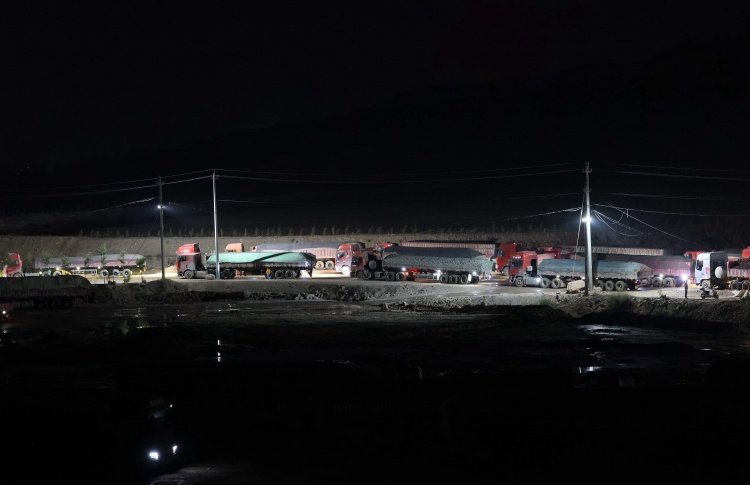
疯狂的超载货车:遮挡号牌上路,厂家可定制加宽加高“百吨王”
Xin Jing Bao· 2025-06-24 00:42
Core Viewpoint - The article highlights the rampant issue of overloaded trucks, particularly the so-called "hundred-ton kings," in Henan's Baofeng County, where trucks are frequently seen violating traffic regulations and carrying weights significantly exceeding legal limits. Group 1: Overloading Issues - Many six-axle trucks are found to exceed the legal weight limit of 49 tons, with some reported to carry over 100 tons, indicating a serious overloading problem [1][9] - The local mining company, Yongshun Bauxite Company, is identified as a major source of these overloaded trucks, allowing them to operate beyond legal weight limits [3][4] - The article mentions that the average weight of trucks leaving Yongshun Bauxite Company can reach up to 108 tons, with some trucks even exceeding 180 tons [5][22] Group 2: Regulatory Failures - The article points out that many weight detection points along the routes are not operational, allowing overloaded trucks to pass without being checked [10][12] - There are reports of trucks deliberately obscuring their license plates to evade detection, which is a common practice among overloaded vehicles [14][16] - The local government and regulatory bodies are criticized for their failure to enforce weight regulations effectively, leading to a culture of non-compliance [20][24] Group 3: Economic Incentives for Overloading - The financial benefits of overloading are significant, with truck operators claiming that they would incur losses if they adhered to legal weight limits [22][23] - The article discusses how the competitive nature of the transport market, driven by excess supply, has led to a decrease in freight rates, further incentivizing illegal overloading practices [23][24] - Companies are reportedly customizing trucks to carry more than the legal limits, with some manufacturers offering specialized vehicles designed for overloading [25][28] Group 4: Legal Consequences - The article mentions that severe overloading can lead to criminal charges, as seen in a case where a transport company faced legal action for repeatedly violating weight regulations [20][22] - New regulations have been introduced to classify vehicles exceeding 100 tons as a significant safety hazard, which could lead to stricter enforcement in the future [22][24] - The article emphasizes the need for improved regulatory measures and industry self-regulation to address the overloading crisis effectively [24][31]
《四川省道路交通安全责任制规定》7月16日起施行 探索借助技术手段 规范配送员驾驶行为
Si Chuan Ri Bao· 2025-06-16 08:11
同时,针对近年全省道路交通事故特别是较大以上事故暴露出的深层次隐患和基层反映强烈的管理 问题,以及违法超限超载治理难点、新兴行业领域监管盲点、企业安全主体责任履行痛点,《规定》通 过明确各方责任、建立协同监管机制、加强数据共享、开展联合执法等系列"组合拳",不断细化工作措 施和责任要求。 《规定》还进一步优化了监管机制。压实属地责任,建立领导干部分级分类赶赴道路交通事故现 场、问题严重地区挂牌及指导帮扶等系列制度;强化重点监管,针对十二类道路运输车辆管理、货物源 头单位履责、事故调查发现的隐患整改等重点工作,增加了相应监管措施;解决职责争议,对新兴行 业、领域以及部门监管职责存在交叉或争议的,由同级地方人民政府确定监督管理部门或者牵头部门, 并督促落实。(记者 范芮菱 唐子晴) 四川省道路交通安全责任制规定 《四川省道路交通安全责任制规定》(以下简称《规定》)已于日前公布,将于7月16日起施行。 《规定》有哪些亮点?6月10日,四川省公安厅对此进行解读。 《规定》围绕"明责、履责、追责",细化明确政府、部门、单位职责,填补监管空白、完善责任体 系。例如,明确县级以上地方人民政府有关部门应当将道路交通安全工作纳 ...
江西长运: 江西长运2024年年度股东大会资料
Zheng Quan Zhi Xing· 2025-06-11 08:11
Group 1 - The annual shareholders' meeting of Jiangxi Changyun Co., Ltd. is scheduled for June 19, 2025, at 10:00 AM, with both on-site and online voting options available [3][4] - The meeting will be presided over by Chairman Wang Xiao, and participants must arrive 10 minutes before the meeting to register [2][3] - The company aims to maintain order and efficiency during the meeting, with specific rules for participation and voting outlined [1][2] Group 2 - In 2024, the company achieved a passenger volume of 74.35 million, an increase of 4.42% year-on-year, and a net profit of 11.03 million, marking a turnaround from losses [5][22] - The board of directors has focused on enhancing service differentiation, accelerating digital transformation, and improving operational efficiency [4][5] - The company has implemented various measures to strengthen risk management and governance, including the establishment of specialized committees [12][14] Group 3 - The company's total assets as of December 31, 2024, amounted to 3.46 billion, reflecting a 5.26% increase from the beginning of the year, while total liabilities increased to 2.61 billion [21][22] - The net profit margin for 2024 was reported at 1.21%, a significant improvement from a loss of 6.21% in the previous year [24][22] - The company plans to apply for a comprehensive credit limit of up to 3.5 billion for 2025 to support its operational and capital needs [28] Group 4 - The company will not distribute cash dividends for 2024 due to accumulated losses exceeding one-third of its paid-in capital [26][29] - The board has proposed a three-year dividend return plan for 2024-2026, focusing on improving shareholder returns as the company stabilizes [29][30] - The company is committed to enhancing its governance structure and operational efficiency to better serve its stakeholders [16][18]
