
零售业

Search documents
美国非农数据不及预期,金价回暖
Mei Ri Jing Ji Xin Wen· 2025-08-04 11:29
Market Overview - As of last Friday (August 1), London spot gold closed at $3362.64 per ounce, with a weekly increase of $26.42 per ounce, representing a 0.79% rise [1] - The highest gold price reached $3362.64 per ounce, while the lowest dipped to $3275.05 per ounce during the week [1] - The market is currently experiencing fluctuations in gold prices, with potential benefits if a rate cut is initiated [1] Economic Data - The U.S. non-farm payroll data for July was below expectations, with an increase of 73,000 jobs compared to the anticipated 104,000 [2] - Significant downward revisions were made to the May and June data, totaling a reduction of 258,000 jobs [2] - The labor force participation rate in July was 62.2%, lower than expected, while the unemployment rate was 4.2%, in line with expectations but higher than the previous value [2] Federal Reserve Actions - The Federal Reserve maintained the interest rate at 4.25%-4.5% during the July FOMC meeting, with a hawkish tone from Chairman Powell [4] - The Fed's statement acknowledged economic uncertainty and the need to monitor inflation risks, while not providing a clear response regarding a potential rate cut in September [4] Long-term Trends - The trend of "de-dollarization" globally is expected to support gold prices, as central banks continue to increase their gold reserves [7] - China's central bank reported an increase in gold reserves to 73.9 million ounces, marking the eighth consecutive month of gold accumulation [7] - The potential impact of the U.S. government's legalization of stablecoins may influence the demand for gold as a hedge against currency depreciation [6]
中证沪港深互联互通信息产业指数报4228.35点,前十大权重包含中芯国际等
Jin Rong Jie· 2025-08-04 09:01
Core Points - The CSI Hong Kong-Shanghai-Shenzhen Information Industry Index has shown significant growth, with a 5.35% increase over the past month, 10.78% over the past three months, and 19.28% year-to-date [1] - The index is based on a combination of the CSI Hong Kong-Shanghai-Shenzhen Comprehensive Index and the CSI Hong Kong-Shanghai-Shenzhen 500 Index, reflecting the overall performance of securities listed in the Hong Kong, Shanghai, and Shenzhen markets [1] Index Holdings - The top ten weighted stocks in the index include Tencent Holdings (9.61%), Alibaba-W (9.27%), Xiaomi Group-W (5.76%), China Mobile (3.16%), SMIC (1.43%), Kuaishou-W (1.33%), Zhongji Xuchuang (1.21%), Luxshare Precision (1.20%), Xinyi Semiconductor (1.18%), and SMIC (1.14%) [1] - The market share of the index holdings is distributed as follows: Hong Kong Stock Exchange (38.20%), Shenzhen Stock Exchange (36.19%), and Shanghai Stock Exchange (25.61%) [1] Industry Composition - The industry composition of the index holdings is as follows: Electronics (26.13%), Semiconductors (17.77%), Media (17.58%), Computers (12.39%), Retail (9.51%), Communication Equipment and Technical Services (9.28%), and Telecommunications Services (7.34%) [2] - The index sample is adjusted biannually, with adjustments occurring on the next trading day after the second Friday of June and December [2]





把货“藏”在加拿大,商家赌特朗普对华关税认怂,网友:很明智!
Sou Hu Cai Jing· 2025-08-04 08:57
Group 1 - The core issue is the impact of the U.S. imposing tariffs as high as 245% on Chinese goods, which significantly affects retail businesses reliant on Chinese supply chains [1][4][6] - Retailers are increasingly using Canadian warehouses to store goods temporarily, taking advantage of tax exemptions and the ability to reclaim tariffs if goods are exported within four years [4][6][8] - The volume of containers shipped from China to Canada has surged by 50%, as retailers find this strategy more cost-effective compared to paying high tariffs in the U.S. [6][8][11] Group 2 - The high tariffs are causing increased prices for everyday goods, which are ultimately passed on to consumers, leading to a rise in living costs for ordinary Americans [11][19][32] - Major retailers like Walmart, Target, and Home Depot are feeling the pressure and have even approached the White House to discuss tariff issues, although the outcomes remain uncertain [15][17][19] - Concerns are growing about the long-term sustainability of small and medium-sized businesses that rely on Chinese suppliers, with fears of a significant shake-up in the retail industry [15][19][29] Group 3 - The ongoing tariff situation is creating a challenging environment for retailers as they prepare for the holiday season, with uncertainty about future tariff policies [17][19][32] - The trade war is causing broader economic concerns, with warnings from hedge fund managers about potential negative impacts on the U.S. economy if tariffs are not lifted [19][20][29] - The global economic repercussions are evident, with significant declines in stock markets across Asia and concerns about the feasibility of shifting supply chains to other countries [22][25][29]


深圳前海上半年实际使用外资同比增长15.9% 货物进出口总值同比增长11.5%
Nan Fang Ri Bao Wang Luo Ban· 2025-08-04 08:07
Group 1 - The Qianhai Cooperation Zone has seen a 15.9% year-on-year increase in actual foreign investment in the first half of 2025, accounting for 59% of Shenzhen's total [1] - The total import and export value of the Qianhai Shekou Free Trade Zone increased by 11.5% year-on-year, representing about two-thirds of the Guangdong Free Trade Zone's total [1] - The number of multinational company headquarters in Qianhai has reached 52, making up 30.8% of Shenzhen's total [1] Group 2 - Actual foreign investment in Qianhai reached 12.326 billion yuan, with the top three industries being finance (29.5%), business services (29.4%), and software and information technology services (17.5%) [1] - Foreign investment in the finance sector grew by 19.5%, while high-tech services saw a significant increase of 72.4% [1] - The actual foreign investment in the Qianhai Shekou Free Trade Zone reached 10.702 billion yuan, a year-on-year increase of 40.5% [1] Group 3 - The Qianhai region has innovated cross-border supply chain mechanisms, establishing a "front store and back warehouse" model with Hong Kong, enhancing warehouse utilization by 52.8% [2] - Hong Kong has become the largest trading partner of Qianhai, with imports and exports to Hong Kong reaching 59.24 billion yuan in the first half of 2025, a 90.2% year-on-year increase [2] - The total retail sales of consumer goods in Qianhai reached 33.917 billion yuan, growing by 17.0% year-on-year, with retail and catering sectors increasing by 16.5% and 7.8% respectively [2]
利好突袭,涨停!
Zhong Guo Ji Jin Bao· 2025-08-04 05:11
Market Overview - On August 4, the A-share market showed mixed performance, with the Shanghai Composite Index rising by 0.2% while the Shenzhen Component Index and the ChiNext Index fell by 0.28% and 0.49% respectively [1] - The total trading volume for the market was 932.3 billion yuan, a slight decrease from the previous day, with nearly 2800 stocks rising [2] Sector Performance - The aerospace and military, precious metals, textile and apparel, banking, and machinery sectors performed well, with active stocks in military information technology, gold and jewelry, and industrial mother machines [3] - The Hong Kong market was positive, with the Hang Seng Index up by 0.49%, the Hang Seng China Enterprises Index up by 0.51%, and the Hang Seng Technology Index up by 0.93% [3][4] - Notable gainers in the Hong Kong market included Huahong Semiconductor, which rose over 6% [3] Machinery Sector Insights - The machinery sector saw significant gains, with stocks like Dongjie Intelligent hitting the daily limit up, and several others such as Bidetech and Shanhua Intelligent also reaching their daily limits [5] - The China Machinery Industry Federation reported that the machinery industry's export value maintained double-digit growth in the first half of the year, with exports to Belt and Road countries increasing by 23.9% and to RCEP countries by 16.7% [6][7] Gaming and Media Stocks - Gaming stocks showed positive performance, with Giant Network reaching its daily limit and Shenzhou Taiyue rising by 8% [7] - Media stocks were also active, with Jishi Media hitting the daily limit and Guangxi Media rising over 5% [7][8] Pharmaceutical Sector Decline - The pharmaceutical and biotechnology sector experienced a downturn, with stocks like Aoxiang Pharmaceutical and Saily Medical hitting the daily limit down, and others like Sinovac Biotech falling nearly 11% [9][10] Retail Sector Weakness - The retail sector faced declines, with Dalian Friendship hitting the daily limit down and other stocks like Maoye Commercial and Kairuide dropping over 6% [11] InnoTech's Market Position - InnoTech saw a significant rise in its stock price, reaching a peak of 65.6 HKD per share, up nearly 14% after announcing a partnership with NVIDIA to promote 800 VDC power architecture in AI data centers [12] - InnoTech holds a 31% market share in the global GaN power device market, maintaining its leading position, and plans to expand its monthly production capacity from 13,000 wafers to 20,000 by the end of 2025, with a long-term goal of reaching 70,000 wafers [12]

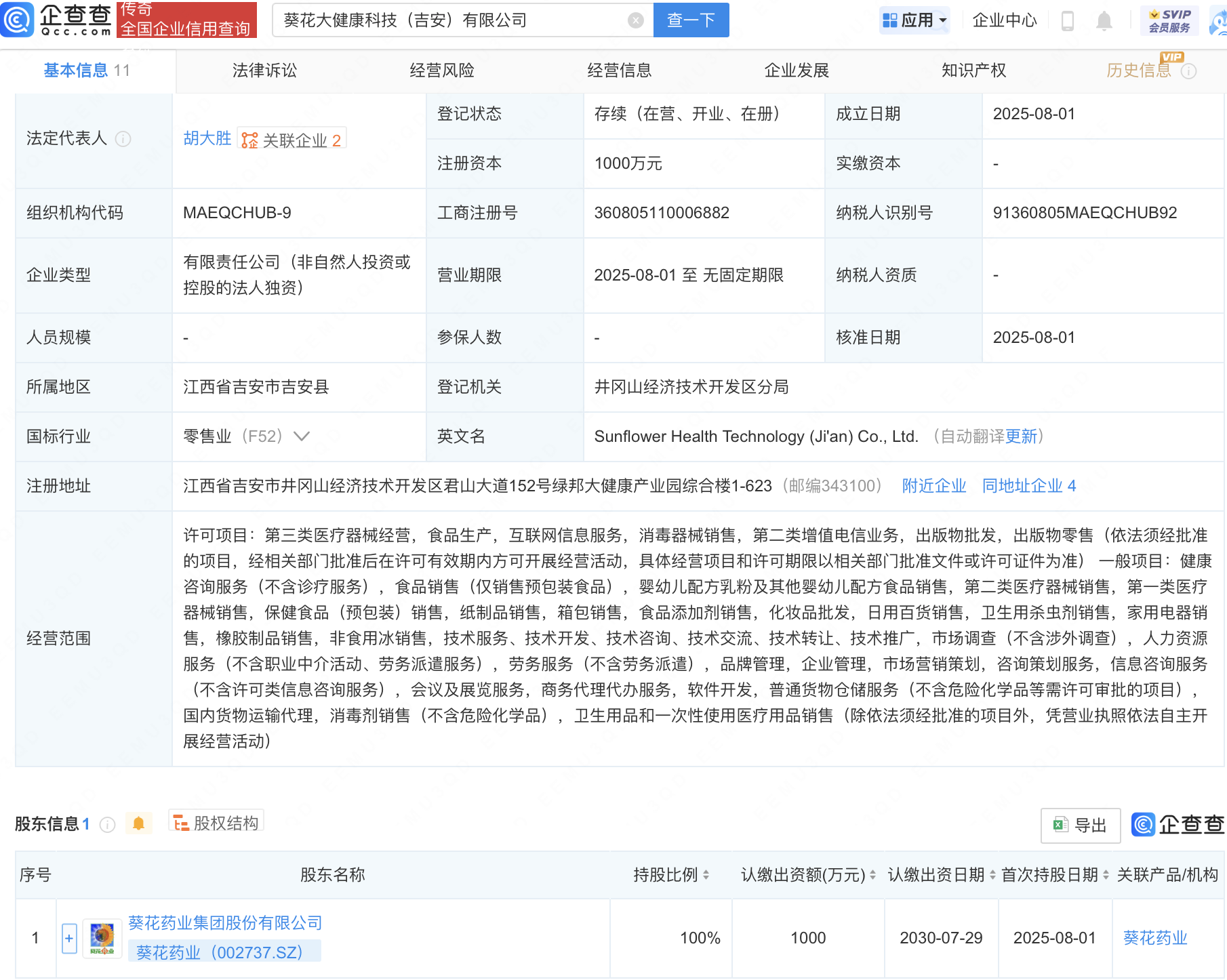
葵花药业新设大健康科技子公司
Qi Cha Cha· 2025-08-04 01:44
Core Insights - Sunflower Health Technology (Jian) Co., Ltd. has been established with a registered capital of 10 million yuan, focusing on the operation of Class III medical devices, food production, internet information services, and sales of disinfectant equipment among other activities [1][2]. Company Information - The company is wholly owned by Sunflower Pharmaceutical Group Co., Ltd. (002737) [1][2]. - The legal representative is Hu Dasheng, and the company is currently in operation with a registration status of "active" [2]. - The registered address is located in the Jiangxi Province, specifically in the Jinggangshan Economic and Technological Development Zone [2]. Business Scope - The business scope includes the operation of Class III medical devices, food production, internet information services, and sales of disinfectant equipment, among other services [1][2]. - Additional activities include the sale of pre-packaged food, infant formula, health food, and various technical services [2].

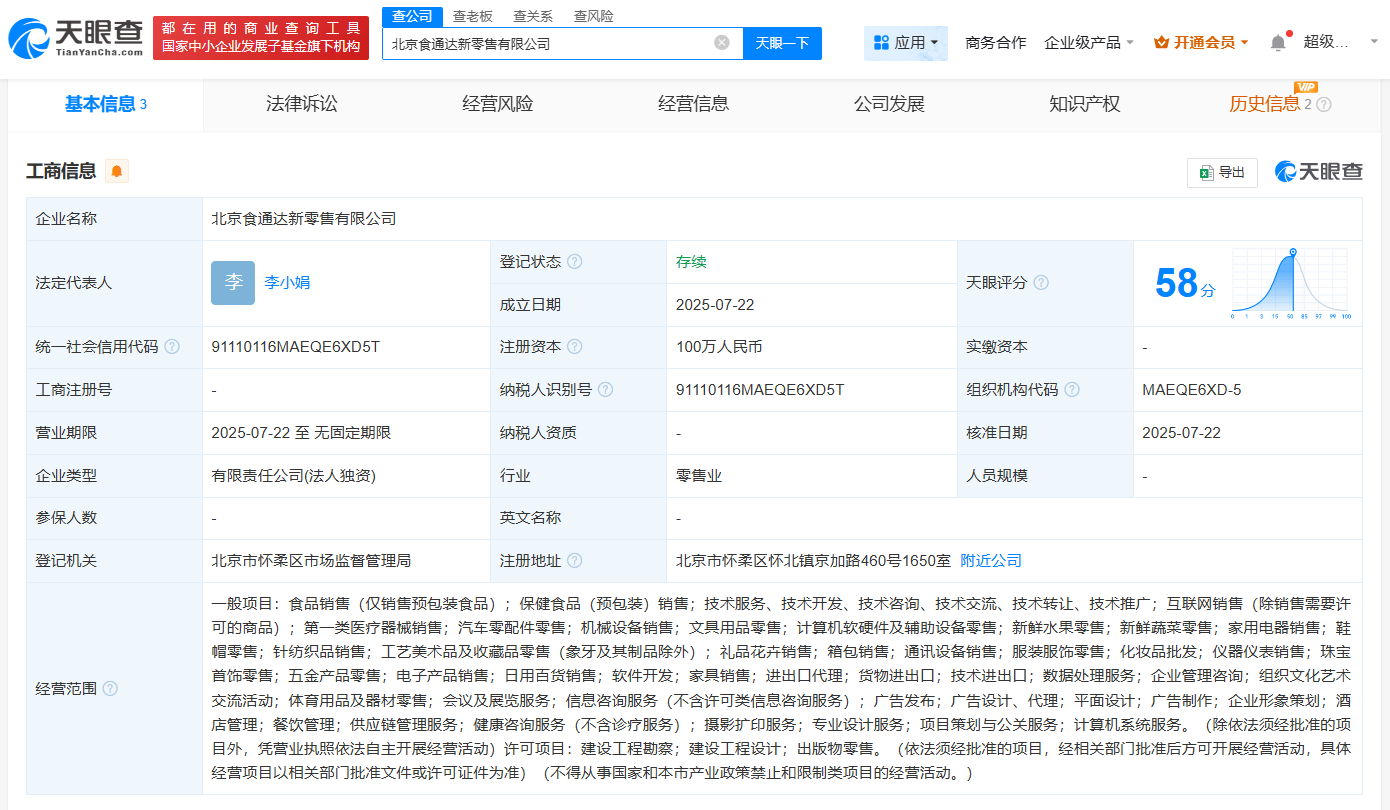
汪小菲食通达集团涉足新零售,新公司注册资本达百万
Sou Hu Cai Jing· 2025-08-04 01:02
从经营范畴来看,北京食通达新零售有限公司不仅涉足传统的食品销售领域,还积极拥抱互联网销售的新趋势,致力于通过线上平台拓展市场。同时,公司 还计划组织文化艺术交流活动,这显示出其在企业文化建设和社会责任方面的积极态度。供应链管理服务的加入,更是体现了公司在提升运营效率、优化资 源配置方面的决心。 同时,我们也期待北京食通达新零售有限公司能够在汪小菲董事长的领导下,充分发挥其在供应链管理、文化艺术交流等方面的优势,为消费者提供更加优 质、便捷的服务体验。未来,这家新兴企业能否在新零售领域掀起新的浪潮,让我们拭目以待。 近期,一家名为北京食通达新零售有限公司的新企业正式宣告成立,引发了业界的广泛关注。该公司的法人代表为李小娟,注册资本达到100万元人民币, 业务范围涵盖了多个领域,包括食品销售、互联网销售、组织文化艺术交流活动以及供应链管理服务等。 | | 母公司 香寺板 查关系 查风险 都在用的商业查询丁具 | | | | --- | --- | --- | --- | | | 北京食通达新零售有限公司 × 天眼一下 船 应用 ▼ 国家中小企业发展子基金旗下机构 | 商务合作 企业级7 | | | 基本信息 3 ...
【宏观】为什么美国非农就业大幅下修?——2025年7月美国非农数据点评(高瑞东/周欣平)
光大证券研究· 2025-08-03 23:06
Core Viewpoint - The significant downward revision of June non-farm payroll data indicates substantial disruptions to the U.S. economy caused by tariffs, suggesting that the resilience of the U.S. economy should not be overestimated, and the direction of interest rate cuts remains certain [5][9]. Group 1: Non-Farm Payroll Data - In July 2025, the U.S. added 73,000 non-farm jobs, below the expected 110,000, with the previous month's figure revised down from 147,000 to 14,000 [4]. - The unemployment rate in July was 4.2%, matching expectations but up from 4.1% in the previous month [4]. - Average hourly earnings increased by 3.9% year-over-year, slightly above the expected 3.8% [4]. Group 2: Employment Sector Performance - In July, the financial activities sector added 15,000 jobs, education and healthcare added 79,000 jobs, and retail added 16,000 jobs, all showing improvement compared to previous values [6]. - The manufacturing sector has seen negative job growth for three consecutive months, indicating a lack of production willingness among companies [6]. Group 3: Labor Market Dynamics - The labor force participation rate fell to 62.2% in July, down from 62.3% in the previous month, indicating a significant decline in employment willingness among the younger demographic [8]. - The number of unemployed individuals increased by 221,000 in July, contributing to the rise in the U3 unemployment rate to 4.2% [8]. - There was an increase in temporary unemployment by 80,000 and a rise in those completing temporary jobs by 31,000, suggesting an uptick in layoffs [8]. Group 4: Future Economic Outlook - Cumulative downward revisions of 258,000 jobs for May and June, along with the July job addition of 73,000, indicate a clear weakening trend in non-farm employment [9]. - Market expectations suggest that the Federal Reserve may cut interest rates three times in 2025, with an 80% probability of the first cut occurring in September [9].

“多重夹击”!美国企业再掀裁员潮
Yang Shi Xin Wen Ke Hu Duan· 2025-08-03 20:10
Group 1 - In July, over 60,000 layoffs were announced by U.S. companies, more than double the number from the same month last year, driven by factors such as artificial intelligence (AI) and tariff policies [1] - AI technology has become one of the top five reasons for job losses in the U.S. this year, with over 27,000 positions directly replaced by AI since 2023, and more than 10,000 jobs cut in July alone due to accelerated AI adoption [1] - A total of over 800,000 private sector jobs have been announced for reduction as of July, marking the highest level for the same period since 2020, with the tech industry being the hardest hit, cutting nearly 90,000 jobs, a 36% year-on-year increase [1] Group 2 - The rapid advancement of AI and uncertainty in work visa policies are reshaping the employment landscape, particularly affecting young job seekers, with a 15% decline in entry-level job postings for recent graduates, while AI-related job postings surged by 400% [2] - Over 292,000 jobs have been cut this year due to federal spending cuts, impacting government, non-profit organizations, and the healthcare sector [2] - Retailers have announced over 80,000 job cuts, a nearly 250% year-on-year increase, driven by the government's tariff policies, which may lead to rising prices, reduced shelf goods, and further job losses [2]
深读100:县域消费市场正在发生深刻变化;品质重塑汽车行业价值坐标
Mei Ri Jing Ji Xin Wen· 2025-08-03 13:39
Group 1 - The county-level consumer market is undergoing profound changes, with shopping habits and consumption concepts aligning more closely with those of first- and second-tier cities due to the proliferation of the internet and improvements in logistics systems [1] - The future of county retail is expected to be characterized by the integration of online and offline channels, differentiated positioning, and community-based services [1] Group 2 - The automotive industry is focusing on rebuilding its value framework by addressing safety and trust issues, emphasizing that extreme parameters on paper can lead to short-term gains, while rigorous quality testing is essential for long-term success [1] - The resurgence of hybrid vehicles is noted as several automakers are slowing down their pure electric strategies and shifting towards hybrid power, with market data indicating a growing consumer enthusiasm for hybrid models during the electric transition period [1] Group 3 - Successful technology investment requires a strong industry background, a keen sense of history, and the willingness to operate against human instincts, as the uncertainty in technology necessitates a strong resolve for contrarian investment strategies [1]