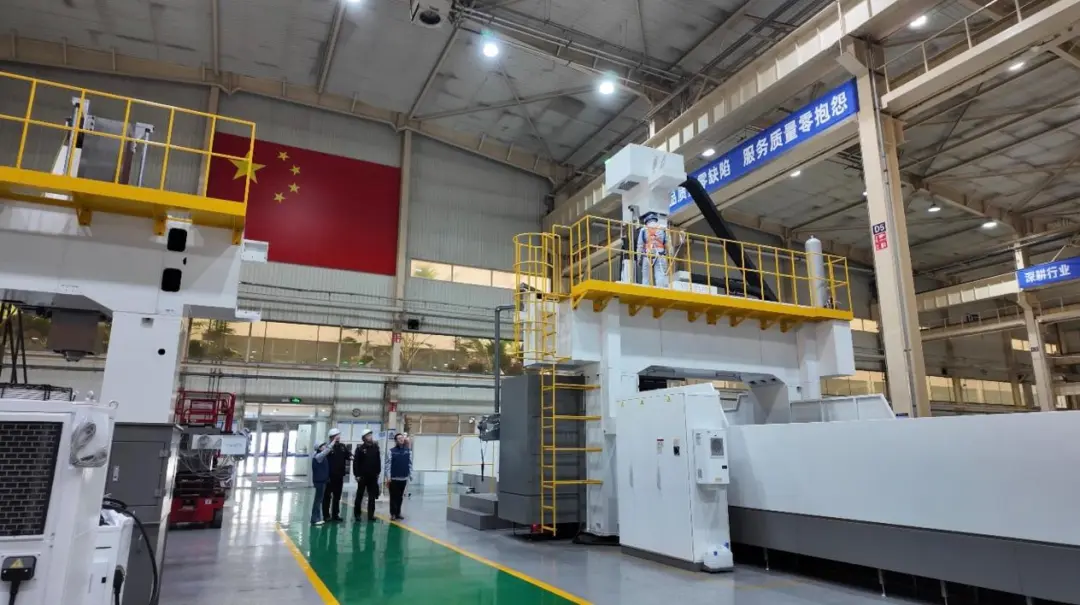
制造业

Search documents
50.1%!制造业PMI时隔8个月重返扩张区间
Xin Lang Cai Jing· 2026-01-04 14:56
Group 1 - The manufacturing Purchasing Managers' Index (PMI) returned to the expansion zone for the first time in eight months, with a reading of 50.1% in December 2025, indicating a recovery in market demand [1] - The manufacturing new orders index increased by 1.6 percentage points to 50.8% in December 2025, driven by effective growth stabilization policies and strong export resilience [2] - The production index within the manufacturing PMI rose significantly by 1.7 percentage points to 51.7%, contributing the most to the overall PMI increase [2] Group 2 - Large enterprises reported a PMI of 50.8%, up 1.5 percentage points, while medium-sized enterprises saw a PMI of 49.8%, up 0.9 percentage points, indicating a recovery in business conditions [3] - Small enterprises experienced a decline in PMI to 48.6%, down 0.5 percentage points, reflecting a tighter relationship with consumer demand, which remains weak [3] - The main raw materials purchasing price index was at 53.1%, indicating continued expansion despite a slight decrease, while the factory price index rose by 0.7 percentage points to 48.9% [3] Group 3 - The service sector's business activity index was at 49.7%, showing a slight recovery but remaining in contraction territory for two consecutive months [4] - The construction PMI rose to 52.8%, marking a significant increase of 3.2 percentage points, returning to the expansion zone for the first time in five months [5] - The recovery in the construction sector is attributed to the completion of the 500 billion yuan policy financial tool and favorable weather conditions in southern provinces [5]
锚定北方地区经济重要增长极,10万亿大省再出发
Feng Huang Wang Cai Jing· 2026-01-04 06:15
Core Insights - Shandong Province has achieved a significant milestone by surpassing a GDP of 10 trillion yuan in 2025, becoming the third province in China and the first in Northern China to reach this level, showcasing its economic strength and commitment to high-quality development [2][4] Economic Performance - The GDP of Shandong is projected to exceed 10 trillion yuan, reflecting a robust economic foundation characterized by a strong industrial base, with industrial added value increasing from 2.3 trillion yuan to 3.3 trillion yuan during the 14th Five-Year Plan, representing a growth of over 40% [2][3] - The manufacturing sector remains a cornerstone of Shandong's economy, contributing approximately 28% to the GDP, with an average annual growth rate of 7.5% in industrial added value, consistently outperforming the national average [2][3] Technological Advancements - Shandong is enhancing its competitive edge through technological innovations, with key developments in artificial intelligence, integrated circuits, and low-altitude economy, leading to an expected revenue of over 120 billion yuan in the AI core industry by 2025, accounting for nearly 10% of the national total [3][5] - The province has made significant strides in research and development, with the coverage of R&D institutions in large-scale industrial enterprises rising from 13.3% in 2020 to nearly 40%, and R&D investment by enterprises constituting 88.5% of the total social R&D expenditure, ranking first in the country [3][5] Regional Development - The economic growth of Shandong is supported by a collaborative development model, with cities like Jinan, Qingdao, and Yantai leading the way as trillion-yuan cities, while other cities strive to advance towards this goal [4][5] - The provincial government aims to enhance the economic status of Qingdao to a 2 trillion yuan city and support other cities like Weifang, Linyi, and Jining in their growth towards trillion-yuan economies [4] Corporate Contributions - In 2025, 52 companies from Shandong, including Shandong Energy Group and Haier Smart Home, made it to the list of China's top 500 enterprises, representing over 10% of the total, highlighting the province's strong corporate presence [4][5] - Companies in Shandong are increasingly focusing on green, high-end, and intelligent development, with notable examples including Shengquan Group and Lusheng Robotics, which are leading in their respective high-tech fields [5] Future Outlook - Shandong is positioned to continue its upward trajectory, with a focus on stability, quality improvement, and efficiency as it embarks on the 15th Five-Year Plan, reinforcing its role as a key economic growth engine in Northern China [5][6]
海南封关成照妖镜,东南亚国家现行了,新加坡直言:不准自给自足
Sou Hu Cai Jing· 2026-01-04 06:13
Core Insights - Hainan Island is transforming into a massive "duty-free store" and "free processing zone," allowing foreign goods to enter with zero tariffs and processed goods with over 30% added value to enter the mainland market duty-free [1][3]. Group 1: Economic Impact - In the first week of the closure, imported duty-free goods exceeded 400 million yuan, and duty-free shopping on the island reached 1.1 billion yuan, a year-on-year increase of over 50% [3]. - The explosive growth of international transshipment trade saw container volumes surge by 213%, positioning Hainan as a new hub connecting China with the world [3]. - Hainan's port container throughput has set new records, indicating a significant shift in trade dynamics in the region [3]. Group 2: Competitive Landscape - Vietnam, which has been a popular destination for manufacturing due to its labor cost advantages, is experiencing a decline in orders from Chinese markets, with some electronic factories seeing a 23% drop in orders post-Hainan's closure [6]. - Hainan's favorable conditions, such as a corporate tax rate as low as 15% and quick registration processes, contrast sharply with Vietnam's lengthy approval periods for tax incentives [6][8]. - Singapore, historically a key player in transshipment trade, is facing challenges as goods are now being shipped directly to Hainan, bypassing Singapore, leading to an 11.3% decline in transshipment trade volume [12]. Group 3: Strategic Responses - Vietnam is responding by planning to establish free trade zones in key cities by 2026, aiming to replicate Hainan's model, although it faces inherent limitations in market size and industrial depth compared to Hainan [8][14]. - Singapore is focusing on enhancing its high-end services and maintaining its competitive edge by investing in financial technology and smart port systems, rather than competing in low-end manufacturing [19][21]. - The shift in trade dynamics is prompting both Vietnam and Singapore to rethink their strategies, with Vietnam aiming to evolve from a low-cost manufacturing base to a more resilient manufacturing and market integration model [31]. Group 4: Global Economic Implications - Hainan's model represents a new phase of globalization, moving from linear division of labor to a regional integration approach that optimizes efficiency and cost for businesses [26][28]. - The competition is shifting towards a comprehensive evaluation of market potential, policy efficiency, infrastructure, and industrial chain collaboration capabilities [35]. - The changes initiated by Hainan's closure are not just affecting regional players but are also reshaping the global economic landscape, highlighting the need for adaptation among countries like Vietnam and Singapore [37].


3分钟看清元旦全球要闻(申万宏观·赵伟团队)
赵伟宏观探索· 2026-01-04 01:40
Global Macro Assets - Major overseas stock indices showed mixed performance during the New Year holiday, with the US indices collectively declining: Nasdaq down 1.6%, Dow Jones down 1.4%, and S&P 500 down 1.1% [2][7] - Long-term government bond yields in major developed countries mostly rebounded, with the 10Y US Treasury yield rising by 5.0 basis points to 4.19% [9][12] - Oil prices continued to weaken, with WTI and Brent crude down 1.8% and 2.4% respectively, while gold prices quickly retreated by 3.7% after reaching a historical high [12][13] Overseas Fundamentals & Data - The Federal Reserve's December meeting minutes revealed a division of opinions among officials regarding future interest rate cuts, with some supporting a pause in rate cuts [15][19] - Initial jobless claims in the US for the week ending December 27 were 199,000, lower than the expected 218,000 [17][18] - The US military conducted a large-scale airstrike in Venezuela, marking an escalation in military pressure on President Maduro's regime [20][19] - President Trump announced a delay in tariff increases on imported furniture and kitchen cabinets from January 1, 2026, to January 1, 2027 [25][26] Domestic Events & Data - The intensity of domestic travel during the New Year holiday increased significantly, with a year-on-year increase of 20.3% in cross-regional daily passenger flow [30][37] - Domestic tourism, particularly "ice and snow tourism" and "winter escape tourism," saw a notable rise, while cross-border travel experienced a decline [43][28] - The average ticket price for economy class flights during the New Year holiday was 597 yuan, showing a slight decrease of 1.1% year-on-year [50] - The film market showed steady recovery, with average daily box office revenue increasing by 42.5% compared to the same period in 2025 [53]


金观平:壮大实体经济发展的央企力量
Jing Ji Ri Bao· 2026-01-04 01:03
Group 1 - The core direction for central enterprises is to focus on the real economy, strengthen key core technology breakthroughs, and promote deep integration of technological and industrial innovation, which is essential for high-quality development and advancing Chinese-style modernization [1][2] - The "14th Five-Year Plan" emphasizes the importance of building a modern industrial system and consolidating the foundation of the real economy as a strategic task, highlighting the need to focus economic development efforts on the real economy [1][2] - Central enterprises are seen as the backbone for implementing major national strategies, driving technological innovation, and leading industrial structure upgrades, thus playing a pivotal role in strengthening the real economy [1][2] Group 2 - The development direction of central enterprises must revolve around the real sectors such as industrial manufacturing, with a clear stance against the trend of capital moving away from the real economy, which has previously led to significant risks [2][3] - The State-owned Assets Supervision and Administration Commission has issued guidelines to hold central enterprises accountable for failing to serve their main business and for moving away from the real economy, establishing clear operational boundaries [2] - Central enterprises are encouraged to enhance the management of their primary responsibilities, improve the efficiency of state capital allocation, and focus on developing advanced manufacturing as the backbone of a modern industrial system [2][3] Group 3 - The material and technological foundation for Chinese-style modernization is industrial modernization, which requires central enterprises to deepen their engagement in the real economy and focus on key core technology breakthroughs [3][4] - There is a need to strengthen the role of technological innovation, increase investment in basic research, and focus on long-term, high-investment fields where other enterprises may lack the capability or willingness to engage [3] - Central enterprises should aim to become sources of original technology and lead the modern industrial chain, concentrating efforts on overcoming significant technological challenges and producing major innovative scientific achievements [3] Group 4 - Focusing on the real economy involves not just adhering to traditional models but driving industries towards high-end, intelligent, and green transformations through innovation [4] - Traditional industries must undergo transformation and upgrading through equipment renovation, technological breakthroughs, and process enhancements to strengthen the supply of high-end products and services [4] - The integration of modern information technology with traditional industries is crucial, including the establishment of digital workshops and smart factories, as well as promoting green manufacturing practices [4]
经济乐观情绪削弱避险需求 美债收益率在开年首个交易日上涨
Xin Hua Cai Jing· 2026-01-04 00:45
Group 1 - The core viewpoint of the articles indicates that the U.S. Treasury yields are rising, with the 10-year yield reaching 4.19% and the 30-year yield hitting a new high of 4.87%, reflecting a positive economic sentiment despite some signs of manufacturing slowdown [1][2] - Recent data shows that the U.S. job market is performing better than expected, with initial jobless claims falling to 199,000, which is below the anticipated 220,000, indicating a resilient labor market [1] - The manufacturing sector's Purchasing Managers' Index (PMI) for December stands at 51.8, indicating continued expansion but a decline from November's 52.2, suggesting a slowdown in manufacturing recovery momentum [1][2] Group 2 - The December manufacturing production growth has slowed significantly, with new orders experiencing their first decline in a year, indicating potential demand fatigue [2] - The Federal Reserve's recent decision to cut interest rates by 25 basis points reflects concerns over inflation and employment risks, with officials emphasizing the need for careful assessment of the economic impact of monetary policy changes [3] - There is a consensus among Federal Reserve officials that future monetary policy should be adjusted based on the latest economic data and overall risk conditions, highlighting the uncertainty in the job market and inflation outlook [3]
浙商宏观:预计流动性驱动下A股将在2026年继续走强,低波红利与科技成长交织的结构化行情
Sou Hu Cai Jing· 2026-01-03 11:56
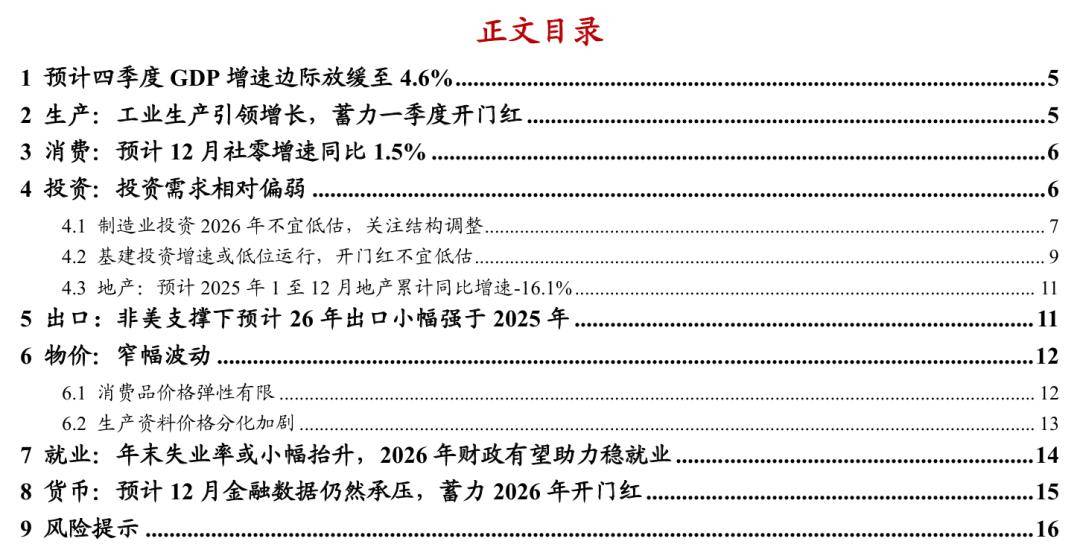
Economic Overview - The GDP growth rate for Q4 2025 is expected to slow to 4.6%, with a strong production sector and moderate demand recovery [1][14] - Industrial production is projected to maintain steady growth, significantly supporting the overall GDP growth target [2][15] - External demand remains resilient, with export growth expected to continue positively [1][5] Production - The industrial added value growth rate for December is estimated at 5.0%, with an annual growth rate of 5.9% for 2025, significantly higher than GDP growth [2][15] - Improvement in demand is noted, driven by pre-holiday inventory buildup and construction progress [2][16] - Manufacturing enterprises are experiencing improved production and market demand, with production growth slightly outpacing demand [2][16] Consumption - The retail sales growth rate for December is expected to be 1.5%, a slight increase from 1.3% [3][19] - Policies supporting the replacement of old products are anticipated to bolster consumer spending, particularly in durable goods [3][19] - The automotive sector continues to face challenges with declining sales and increased discounts, impacting overall retail recovery [3][20] Investment - Fixed asset investment for 2025 is projected to decline by 3.3%, with manufacturing investment showing resilience at 1.2% growth, while infrastructure and real estate investments are under pressure [4][23] - The investment environment has been notably weak since June 2025, with a focus on stabilizing growth in 2026 [4][25] - Manufacturing and broad infrastructure investments are expected to jointly drive growth in early 2026, with a projected increase of 2.5% for the year [4][25][30] Export - December export growth is anticipated at 3.9%, with an annual growth rate of 6.6% for 2026, supported by stable external demand from non-developed countries [5][5] - The stabilization of US-China trade relations and reduced trade friction with Europe and Japan are expected to benefit exports [5][5] Prices - The Consumer Price Index (CPI) growth rate for December is expected to be 0.7%, while the Producer Price Index (PPI) is projected at -1.9% [6][6] - The overall price level is expected to remain stable, with core CPI showing signs of recovery [6][6] Employment - The urban unemployment rate for December is projected to rise slightly to 5.2%, influenced by seasonal factors [7][7] - Continued policy support is expected to help stabilize employment, particularly for vulnerable groups [7][7] Monetary Policy - Financial data for December indicates continued pressure, with new loans and social financing expected to decline [8][8] - The central economic work conference emphasizes the need for flexible monetary policy to support economic stability and reasonable price recovery [8][8]
德国就业人数五年来首次下降
Xin Hua Cai Jing· 2026-01-03 03:26
Group 1 - The core point of the articles indicates that Germany's employment is projected to decline in 2025, marking the first decrease since 2020, with an average employment number dropping by approximately 5,000 compared to 2024 [1] - In 2025, the manufacturing sector is expected to see a significant reduction of 143,000 jobs, a decline of 1.8%, while the construction sector will lose 23,000 jobs, a decrease of 0.9% [1] - The service sector, however, is projected to avoid a sharp decline, with an increase of 164,000 jobs, representing a growth of 0.5%, particularly in public services, education, and health, which will see an increase of 205,000 jobs, a growth of 1.7% [1] Group 2 - The unemployment rate in Germany is expected to rise significantly, with an increase of 161,000 unemployed individuals, marking a growth of 10.8%, leading to an unemployment rate increase from 3.1% to 3.5% [1] - The analysis from the Federal Statistical Office suggests that the slowdown in economic growth and demographic changes are impacting the labor market, with fewer young workers entering the workforce to replace retiring baby boomers [2] - The participation rate in the labor market is being supported by the net immigration of foreign workers and the increasing employment of older individuals and women [2]
欧元区制造业深陷收缩,12月PMI跌至48.8创九个月新低
智通财经网· 2026-01-02 13:41
智通财经APP获悉,调查显示,欧元区制造业活动在12月进一步萎缩。上个月,由于新订单进一步减 少,欧元区制造业活动陷入更深层次的收缩,产量出现了10个月来的首次下降。 法国成为了罕见的亮点,其制造业PMI跃升至42个月以来的高点。在非欧盟成员国英国,受益于财政大 臣瑞秋·里夫斯预算案带来的缓解,需求回升推动12月制造业活动创下15个月来最快的增长速度。 标普全球的欧元区制造业采购经理人指数(PMI)从11月的49.6降至12月的48.8。这是九个月来的最低读 数,且连续第二个月低于50这一荣枯分界线。 调查显示,欧元区20国的制造业活动呈现出普遍性的下滑。作为欧元区最大的经济体,德国在受监测的 八个国家中表现最弱,PMI读数创下10个月新低。意大利和西班牙也重新跌回了收缩区间。 汉堡商业银行首席经济学家赛勒斯·德拉鲁比亚表示:"欧元区制造产品的需求再次放缓。企业似乎既没 有能力也不愿为来年积累动力,反而表现出审慎态度,这对经济而言无异于毒药。" ...
辽宁省安委办组织开展元旦期间安全督导检查 筑牢节日安全防线
Xin Lang Cai Jing· 2026-01-02 12:19
Core Viewpoint - The article emphasizes the importance of safety production during the New Year holiday, highlighting the need for strict supervision and risk management across various industries to ensure safety and stability [1]. Group 1: Safety Production Measures - The provincial safety committee has issued a safety production work prompt, urging relevant departments to enhance safety inspections in key sectors such as mining, hazardous chemicals, transportation, and construction [1]. - There is a focus on the "three managements and three musts" principle to strengthen safety oversight and ensure that major risks and issues are closely monitored [1]. - Emergency management departments will conduct "safety check-ups" in manufacturing enterprises during the holiday, focusing on risk rectification, safety measures implementation, and emergency preparedness [1]. Group 2: Specific Industry Inspections - In the hazardous chemicals sector, experts will assess key enterprises to address safety concerns, particularly in light of winter weather conditions [4]. - Inspections will include checking the safety status of critical facilities at gas stations, ensuring compliance with unloading management systems, and enhancing employee emergency training [6]. - Transportation safety is highlighted as a critical area, with comprehensive checks being conducted at passenger transport stations to enforce regulations and ensure vehicle safety [8][12]. Group 3: Risk Management and Compliance - Companies are required to implement full-process management for special operations, including strict approval and monitoring procedures [3]. - The article stresses the need for companies to take responsibility for safety, rectify identified hazards promptly, and prepare for emergencies [5]. - Inspections will also focus on ensuring compliance with safety protocols, such as the proper storage of flammable materials and the functionality of safety equipment [9][11].