
券商

Search documents
利空,全球股市跳水!瑞银、大摩,唱多中国股市
Sou Hu Cai Jing· 2025-11-18 15:12
Group 1: Global Market Trends - Global stock markets experienced a significant decline, termed "Black Tuesday," with the Nikkei 225 index dropping 3.22%, marking its largest single-day drop since April, closing below 49,000 points. The KOSPI index fell by 3.32%, led by declines in chip stocks [1][3] - Gold and silver prices also plummeted, while Bitcoin fell below $90,000 for the first time in seven months, erasing all gains made in 2025 over the past month [2] - A-shares and Hong Kong stocks opened lower and continued to decline, with the Shanghai Composite Index experiencing its first three consecutive days of decline since mid-September [3] Group 2: Economic Factors - The expectation of a Federal Reserve interest rate cut has cooled, with the probability of a 25 basis point cut in December now below 50% according to the CME FedWatch Tool [4][5] - Japanese government bonds faced significant selling pressure, with the 10-year bond yield rising above 1.75%, nearing its highest level since 2008. This increase in yield is closely linked to global liquidity and capital flows [6] Group 3: AI Market Concerns - There are growing concerns about a potential AI bubble, particularly ahead of Nvidia's upcoming earnings report, which follows a previous strong performance but resulted in a significant stock price drop [7][8] Group 4: Chinese Market Outlook - UBS forecasts a prosperous year for the Chinese stock market in 2026, driven by favorable factors including innovation. The MSCI China Index is projected to reach a target of 100 by the end of next year, indicating a 14% upside from current levels [10] - Earnings per share for Chinese companies are expected to grow by 10% in 2026, supported by measures against "involution" and a decrease in depreciation expenses. The focus remains on internet, hardware technology, and brokerage sectors, while high-dividend stocks are being removed from the watchlist [11] Group 5: Baidu's AI Revenue - Baidu reported a total revenue of 31.2 billion yuan for Q3 2025, with core revenue at 24.7 billion yuan. The company disclosed its AI business revenue for the first time, showing a year-on-year growth of over 50% [12] - AI cloud revenue grew by 33%, while AI application revenue reached 2.6 billion yuan, and AI native marketing service revenue surged by 262% to 2.8 billion yuan [12]


新股孖展统计 | 11月18日
智通财经网· 2025-11-18 12:05
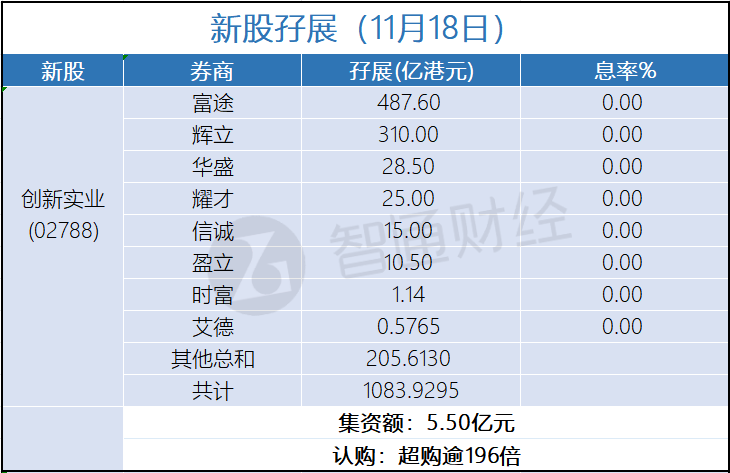
智通财经APP获悉,创新实业(02788)正在招股中。截止11月18日,富途、辉立、耀才等券商合计为创新 实业借出1083.9295亿港元,超购逾196倍。 | 新股仔展(11月18日) | | | | | --- | --- | --- | --- | | 新股 | 券商 | | 息率% | | 创新实业 | 富途 | 487.60 | 0.00 | | 辉立 | | 310.00 | 0.00 | | 化成 | | 28.50 | 0.00 | | 耀才 | | 25.00 | 0.00 | | (02788) | 信诚 | 15.00 HEI | 0.00 | | 閣立 | | 10.50 | 0.00 | | 时富 | | 1.14 | 0.00 | | 艾德 | | 0.5765 | 0.00 | | 其他总和 | | 205.6130 | | | 并计 | | 1083.9295 | | | | | 集资额:5.50亿元 | | | | | 认购:超购逾196倍 | | ...
瑞银发布2026年展望:中国股市将迎来又一个丰年
Zheng Quan Ri Bao Wang· 2025-11-18 11:08
Core Viewpoint - UBS Investment Bank's China equity strategy head Wang Zonghao projects a target of 100 for the MSCI China Index by the end of 2026, indicating a potential upside of 14% from current levels, driven by favorable market conditions and supportive policies [1] Group 1: Market Drivers - The Chinese stock market is expected to experience a prosperous year in 2025, supported by developments in innovative sectors such as AI, ongoing support for private enterprises and capital markets, fiscal expansion, and ample liquidity under a loose monetary policy [1] - Potential inflows from domestic and foreign institutional investors are anticipated to continue, further bolstering the market [1] Group 2: Earnings and Growth Projections - The projected growth includes a 5% increase in revenue, consistent with nominal GDP growth, and a 10% increase in earnings per share [1] Group 3: Sector and Stock Preferences - In terms of style and sector allocation, the strategy includes not only dividend stocks but also some "overseas" stocks, which are expected to see accelerated revenue and profit growth in 2025, outpacing the overall market [1] - The outlook remains positive for technology and internet stocks, as well as domestic brokerage firms [1] Group 4: Impact of Global Trends - Despite potential pullbacks in global AI-related stocks that may affect Chinese tech stocks, certain factors could mitigate this impact, such as the lower correlation of Chinese stocks with global AI stocks compared to other emerging markets like South Korea [1] - The domestic substitution process in the technology sector is unlikely to be hindered by any slowdown in the global tech industry, and Chinese tech stocks are still valued lower than their global peers [1]
西部证券女掌门再连任:从董秘到董事长的华丽转身
Sou Hu Cai Jing· 2025-11-18 09:53
Core Viewpoint - The re-election of Xu Chaohui as the chairman of Western Securities marks a significant milestone in her career, as she faces the challenge of leading the company through a period of declining revenue while leveraging her extensive experience in the financial sector [1][4][5]. Group 1: Leadership and Background - Xu Chaohui has been re-elected as the chairman of Western Securities for a three-year term, continuing her leadership role since 2022 [4]. - Her career trajectory showcases a transformation from a corporate secretary to a strategic decision-maker, highlighting her as one of the few female chairpersons in the A-share listed brokerage sector [5]. - Xu holds multiple roles, including positions at Shaanxi Investment Group, which enhances her resource management capabilities and provides her with a comprehensive understanding of the challenges and opportunities facing Western Securities [5]. Group 2: Financial Performance - Western Securities reported a revenue decline of 2.17% year-on-year for the first three quarters of 2025, with total revenue of 4.335 billion yuan, making it the only brokerage among 43 listed firms to experience such a decline [6]. - Despite the revenue drop, the net profit attributable to shareholders increased by 70.63% to 1.243 billion yuan, indicating a situation of "increased profit without increased revenue" [6]. - The third quarter showed improvement, with revenue rising by 40.33% to 1.546 billion yuan and net profit surging by 510.16% to 459 million yuan [6]. Group 3: Challenges and Strategic Focus - The primary challenges for Western Securities include insufficient scale and a significant drop in fair value changes, which shifted from a gain of 117 million yuan to a loss of 252 million yuan, a decline of 316.65% [6][7]. - Other business income also fell by 59.90%, from 1.83 billion yuan to 734 million yuan, due to changes in revenue recognition methods for certain commodity trading contracts [6][7]. - The new management team, including newly appointed General Manager Qi Bing, will support Xu in addressing these operational challenges and restructuring the business for sustainable revenue growth [8].

瑞银:予恒指明年目标三万点 偏好互联网、科技硬件及券商板块
Zhi Tong Cai Jing· 2025-11-18 07:24
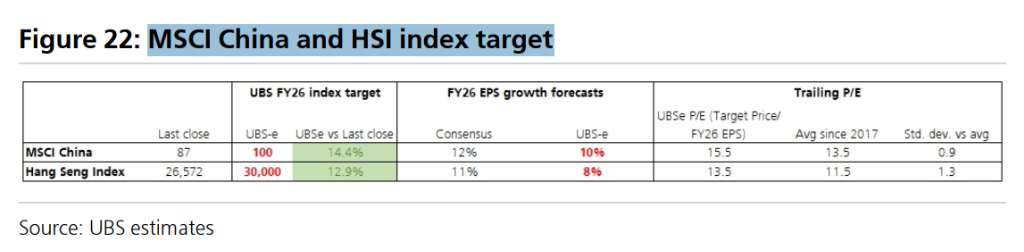
Group 1 - UBS expects the Chinese stock market to perform positively in 2026, driven by several favorable factors from 2025, including advancements in innovation, particularly in artificial intelligence, a relaxed policy environment for private enterprises and capital markets, continued fiscal expansion and ample liquidity under loose monetary policy, and potential capital inflows from domestic and foreign institutional investors [1] - The bank predicts that the performance of the stock market in 2026 will be more driven by earnings growth, with an estimated 10% increase in earnings per share for MSCI China, primarily due to the impact of anti-involution policies and reduced depreciation and amortization expenses [1] - UBS sets a target of 30,000 points for the Hang Seng Index next year, corresponding to a forecasted price-to-earnings ratio of 13.5 times, with an expected 8% growth in earnings per share for the index [1] Group 2 - UBS notes that high-dividend stocks have performed well over the past five years, but their attractiveness has decreased, with almost no financial stocks offering a dividend yield above 6% [2] - The bank has shifted to allocate some investments in "outbound" concept stocks, which have shown resilient profits and earnings amid tariff uncertainties [2] - UBS does not have a clear preference between A-shares and H-shares, as both have supportive factors: A-shares benefit from inflows of domestic and foreign capital and earnings improvements from anti-involution policies, while H-shares benefit from AI themes and continued inflows from foreign and southbound funds [2]
瑞银:预计明年中国股市将迎来又一个丰年
Ge Long Hui· 2025-11-18 06:45
Core Viewpoint - UBS Investment's 2026 outlook report indicates that the Chinese stock market is expected to experience another prosperous year, supported by various favorable drivers including developments in innovative sectors [1] Summary by Categories Market Outlook - The MSCI China Index is projected to reach a target of 100 by the end of next year, representing a 14% upside from current levels [1] Earnings Growth - Earnings performance in 2026 is anticipated to be driven more by profit growth, with an expected 10% increase in earnings per share, supported by anti-involution measures and a decrease in depreciation and amortization expenses [1] Sector Preferences - The report expresses a positive outlook on sectors such as internet, hardware technology, and brokerage firms, while removing high-dividend stocks from the focus due to reduced yield [1] Global Economic Context - With an improvement in global growth expected next year, there is an optimistic view on certain "outbound" stocks [1]
瑞银发布《中国股票策略2026年展望》:盈利成核心驱动力 科技与“出海”方向受青睐 股市有望延续积极表现
Zhi Tong Cai Jing· 2025-11-18 05:14
Core Viewpoint - UBS's report on the outlook for the Chinese stock market in 2026 indicates a shift from valuation-driven growth in 2025 to earnings improvement as the main driver for market performance in 2026, with a target for the MSCI China Index set at 100 points, representing a potential increase of approximately 14% from the closing level on November 14, 2025 [1][2]. Earnings Improvement as Key to Market Performance - The main upward momentum for the Chinese stock market in 2025 was driven by valuation recovery, but in 2026, the focus will shift to earnings growth, with an expected 10% increase in overall EPS for MSCI China Index constituents [2]. - The "anti-involution" effect driven by policy changes is expected to contribute approximately 3 percentage points to EPS growth in 2026, as regulatory measures promote orderly competition and improve resource allocation [2][3]. - A decline in depreciation and amortization is anticipated to support profit margins, as capital expenditure shifts from expansion to efficiency [3]. - Continuous optimization of cost structures in technology, internet, and advanced manufacturing sectors will enhance earnings sustainability and certainty [4]. Industry Allocation Recommendations - UBS recommends focusing on five key sectors for investment based on earnings certainty, policy support, and global market share enhancement: - **Technology Hardware**: Demand for servers, storage, and optical modules remains strong, with Chinese supply chains gaining competitiveness [5]. - **Internet Sector**: Recovery in advertising, e-commerce, and local services, combined with improved cost structures and cash flow among industry leaders, makes this sector attractive [6]. - **Brokerage Sector**: With capital market reforms and increased trading activity, brokerage firms are expected to see improvements across various business lines [7]. - **Photovoltaic Supply Chain**: Following a supply clearing in 2025, profitability in this sector is expected to improve significantly due to rising global demand for renewable energy [8]. - **"Going Global" Enterprises**: High-quality leading companies in appliances, automotive, consumer electronics, and machinery are expected to enhance their global market share [9]. External Risks and Valuation Advantage - UBS identifies two potential risks for the global market in 2026: potential valuation corrections in AI-related stocks and possible fluctuations in US-China relations affecting market sentiment [10]. - However, the sensitivity of Chinese stocks to these risks is considered limited, with lower correlation to global AI giants and a more favorable valuation position compared to other major markets [11][12]. Market Outlook - The Chinese stock market in 2026 is expected to exhibit structural opportunities rather than rapid unilateral trends, driven by improving fundamentals, stable policies, and deepening capital market reforms [13].

瑞银看好明年中国股市继续上涨,策略聚焦“出海”、“反内卷”,“全球AI股回调”是主要风险
Hua Er Jie Jian Wen· 2025-11-18 03:17
继2025年录得强劲表现后,中国股市在2026年能否"再一次飞跃"? 据追风交易台消息,11月17日,瑞银发布的最新研报《2026年中国股票策略展望:再一次飞跃?》认为,明年中国市场有望延续2025年的积极势头。 该行预测MSCI中国指数到2026年底将达到100点,较报告发布时的收盘价约有14%的上涨潜力。同时,恒生指数的目标位被设定在23000点,约有13%的 上涨潜力。 | | | UBS FY26 index target | | FY26 EPS growth forecasts | | Trailing P/E | | | | --- | --- | --- | --- | --- | --- | --- | --- | --- | | | Last close | UBS-e UBSe vs Last close | | Consensus | UBS-e | UBSe P/E (Target Price/ FY26 EPS | Avg since 2017 | | | | | | | | | | | Std. dev. vs avg | | MSCI China | 87 | 100 | 14 ...
瑞银:预计明年中国股市将迎来又一个丰年 股价表现更多由盈利驱动
Feng Huang Wang· 2025-11-18 03:17
Core Viewpoint - UBS Investment Bank's China equity strategy head Wang Zonghao forecasts a prosperous year for the Chinese stock market in 2026, driven by factors such as innovation development and supportive policies for private enterprises and capital markets [1] Group 1: Market Outlook - The MSCI China Index is projected to reach a target of 100 by the end of next year, indicating a 14% upside from current levels [1] - Factors supporting the market include continuous fiscal expansion, ample liquidity under loose monetary policy, and potential capital inflows from domestic and international institutional investors [1] Group 2: Earnings and Sector Focus - Earnings growth for Chinese companies is expected to be around 10% in 2026, driven by anti-involution measures and a decrease in depreciation and amortization expenses [1] - The focus is on sectors such as internet, hardware technology, and brokerage firms, while high-dividend stocks are being removed from the watchlist due to declining yields [1] Group 3: Global Influences and Technology Sector - The potential pullback in global AI-related stocks may negatively impact Chinese tech stocks; however, certain factors may mitigate this effect [1] - The correlation between Chinese and global AI stocks is lower than that of other emerging markets like South Korea, and the domestic substitution process in the tech industry is unlikely to be affected by a slowdown in the global tech sector [1] - Chinese tech stocks are still valued lower than their global peers [1]
国泰海通将落子印尼券商东南亚布局再提速
Zheng Quan Shi Bao· 2025-11-18 01:33
Group 1 - Cathay Securities announced the acquisition of an Indonesian securities company, marking its continued expansion in Southeast Asia after establishing a presence in Singapore and Vietnam [1] - Cathay Securities has been active in Southeast Asia since 2015, with its subsidiary, Cathay International, setting up a branch in Singapore and acquiring a 50.97% stake in Vietnam Investment Securities in late 2019 [1] - Southeast Asia is a key region for Chinese securities firms, with China Galaxy Securities being one of the early entrants, expanding its international network through acquisitions in Malaysia and other countries [1] Group 2 - China Galaxy reported that its overseas brokerage business ranks first in Malaysia, second in Singapore, fourth in Indonesia, and fifth in Thailand, with a total of 34 equity and bond financing transactions completed, amounting to SGD 1.8 billion [2] - Huatai Securities' Singapore subsidiary received a capital markets services license and exemption for financial advisory qualifications in 2023, allowing it to conduct securities trading and corporate financing legally [2] - Huatai Securities emphasized its commitment to internationalization, integrating domestic and overseas operations to seize strategic opportunities in the global industrial chain restructuring [2] Group 3 - Southeast Asia's overseas markets are increasingly driving the performance growth of securities firms, with 15 A-share listed securities firms reporting international business revenue of CNY 20.12 billion, a year-on-year increase of 3.35% [3] - 12 out of 15 securities firms reported positive growth in their overseas business, with 12 firms experiencing revenue growth exceeding 10% [3] - The report from Guosen Securities highlights that leading firms like CITIC Securities and Huatai Securities are enhancing their international competitiveness, while smaller firms are also experiencing rapid growth in international business [3]
