
机械

Search documents
港股热度持续升温,场内热点轮动加速
Yin He Zheng Quan· 2025-07-20 11:13
Group 1 - The Hong Kong stock market continues to gain momentum with accelerated rotation of market hotspots, as evidenced by the performance of major indices [1][2] - For the week of July 14 to July 18, the Hang Seng Index rose by 2.84%, the Hang Seng Tech Index increased by 5.53%, and the Hang Seng China Enterprises Index climbed by 3.44% [2][4] - Among the ten sectors in the Hong Kong stock market, all but the real estate sector saw gains, with healthcare, information technology, and consumer staples leading the way with increases of 9.52%, 4.16%, and 3.92% respectively [2][7] Group 2 - The average daily trading volume on the Hong Kong Stock Exchange for the week was HKD 246.725 billion, an increase of HKD 4.213 billion from the previous week [2][13] - Southbound capital recorded a net inflow of HKD 21.456 billion, which is a decrease of HKD 4.899 billion compared to the previous week [2][13] - The price-to-earnings (PE) and price-to-book (PB) ratios for the Hang Seng Index as of July 18 were 11.04 and 1.16, respectively, both of which are at the 81% and 82% percentile levels since 2019 [2][18] Group 3 - The report highlights that the overall valuation of the Hong Kong stock market is relatively low compared to global equity markets, with the Hang Seng Index's risk premium at 4.62%, which is at the 8% percentile since 2010 [2][20] - The report suggests that sectors benefiting from favorable policies, such as stablecoin concept stocks, innovative pharmaceuticals, AI industry chains, and "anti-involution" industries, should be closely monitored [2][37] - The performance of companies exceeding expectations in their mid-year reports is expected to rebound, indicating potential investment opportunities [2][38]
韩国股民,狂买中国资产!
Sou Hu Cai Jing· 2025-07-20 07:54
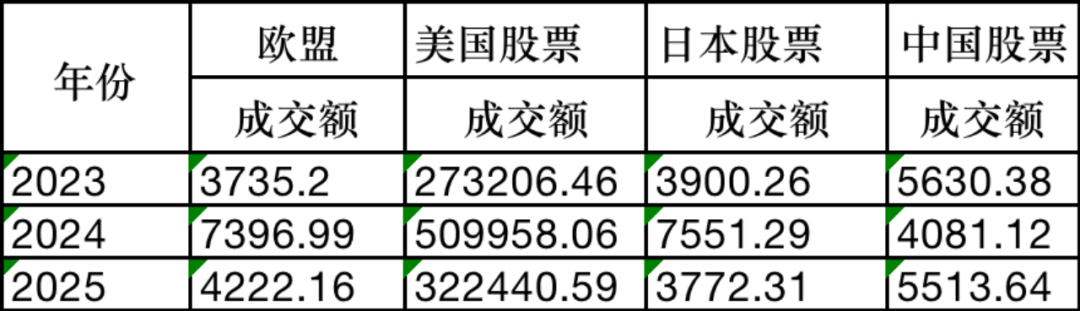
Group 1 - Korean investors have shown increasing interest in Chinese stocks, with a cumulative trading volume of approximately $5.514 billion in 2023, making China the second most favored overseas market for Korean investors, following the United States [1] - The trading volume of Korean investors in Chinese mainland and Hong Kong stocks surged to $782 million in February 2023, nearly doubling from the previous month, marking the highest level since August 2022 [2] - The recent launch of AI models in China has attracted global capital, further fueling Korean investors' enthusiasm for the Chinese market [2] Group 2 - The Hong Kong IPO market has seen a significant increase in activity, with total fundraising exceeding 100 billion HKD in the first half of 2023, surpassing levels from the past three years [3] - Notable IPOs include CATL raising 41.006 billion HKD and Hengrui Medicine raising 11.374 billion HKD, among others, indicating strong investor interest across various sectors [4] Group 3 - Citigroup's report indicates that despite macroeconomic fluctuations, Asian stock markets are performing better than global counterparts, with a constructive mid-term outlook for Chinese stocks, particularly in the consumer sector [7] - Morgan Stanley predicts sustained global investor interest in Chinese assets, while Goldman Sachs forecasts that AI advancements could lead to a 2.5% annual increase in overall earnings for Chinese stocks over the next decade [7] - JPMorgan anticipates a continued revaluation of Chinese tech stocks, projecting an average annual return of 7.8% over the next 10 to 15 years [7]

策略研究周度报告:港股热度持续升温,场内热点轮动加速-20250720
Yin He Zheng Quan· 2025-07-20 06:50
Group 1 - The Hong Kong stock market continues to gain momentum with accelerated rotation of market hotspots, as evidenced by the performance of major indices [1][2] - For the week of July 14 to July 18, the Hang Seng Index rose by 2.84%, the Hang Seng Tech Index increased by 5.53%, and the Hang Seng China Enterprises Index climbed by 3.44% [2][4] - Among the ten sectors in the Hong Kong stock market, all but the real estate sector saw gains, with healthcare, information technology, and consumer staples leading the way with increases of 9.52%, 4.16%, and 3.92% respectively [2][7] Group 2 - The average daily trading volume on the Hong Kong Stock Exchange for the week was HKD 246.725 billion, an increase of HKD 4.213 billion from the previous week [2][13] - Southbound capital recorded a net inflow of HKD 21.456 billion, which is a decrease of HKD 4.899 billion compared to the previous week [2][13] - The price-to-earnings (PE) and price-to-book (PB) ratios for the Hang Seng Index as of July 18 were 11.04 and 1.16, respectively, both reflecting increases of 2.69% from the previous week [2][18] Group 3 - The report highlights that the overall valuation of the Hong Kong stock market is relatively low compared to global equity markets, with the Hang Seng Index's risk premium at 4.62%, indicating a favorable investment environment [2][20] - The report suggests focusing on sectors that may benefit from favorable policies, such as stablecoin concept stocks, innovative pharmaceuticals, AI industry chains, and sectors showing better-than-expected interim performance [2][37][38] - The report notes that the performance of the Chinese economy remains resilient, with GDP growth of 5.3% year-on-year in the first half of 2025, and a strong industrial output growth of 6.8% in June [2][36]
多晶硅本月涨超30%!“反内卷”带动工业品期货连续反弹
券商中国· 2025-07-19 23:23
Core Viewpoint - The recent rebound in domestic industrial commodity prices is attributed to the implementation of policies aimed at reducing "involution" in various industries, with expectations for sustained price strength, though caution is advised regarding potential adjustments due to rapid price increases [1]. Group 1: Policy and Market Response - The Central Financial Committee's sixth meeting emphasized the need to address low-price disorderly competition and promote product quality, interpreted as a swift response to "involution" in the market [2]. - The Ministry of Industry and Information Technology (MIIT) is focusing on high-quality development in the photovoltaic industry, indicating strong governmental support for this sector [2]. - Industrial commodity futures have seen a continuous rebound since July, with the Wenhua Industrial Commodity Index rising by 4.18% this month, and specific sectors like coal, building materials, and steel experiencing significant gains of 12.17%, 9.99%, and 8.61% respectively [3]. Group 2: Sector-Specific Developments - The photovoltaic sector has led the price increases, with polysilicon futures rising over 30% this month, followed by coking coal, glass, alumina, and iron ore, all exceeding 10% gains [3]. - The recent policy signals regarding the photovoltaic industry have heightened market expectations for supply-side reforms and structural adjustments, driving up industrial silicon prices [3]. - The emphasis on addressing "involution" is expected to impact various sectors, including steel, petrochemicals, and new energy vehicles, with a focus on industries characterized by high inventory, capital expenditure, and low capacity utilization [4][5]. Group 3: Future Outlook and Challenges - The government plans to implement specific measures for key industries such as steel, non-ferrous metals, and construction materials to stabilize growth and promote structural adjustments [6]. - Despite the positive policy environment, challenges remain in maintaining stable industrial economic performance and addressing structural contradictions within the industry [5][6].

利好!A股公司,密集披露!
Zheng Quan Shi Bao· 2025-07-19 11:06
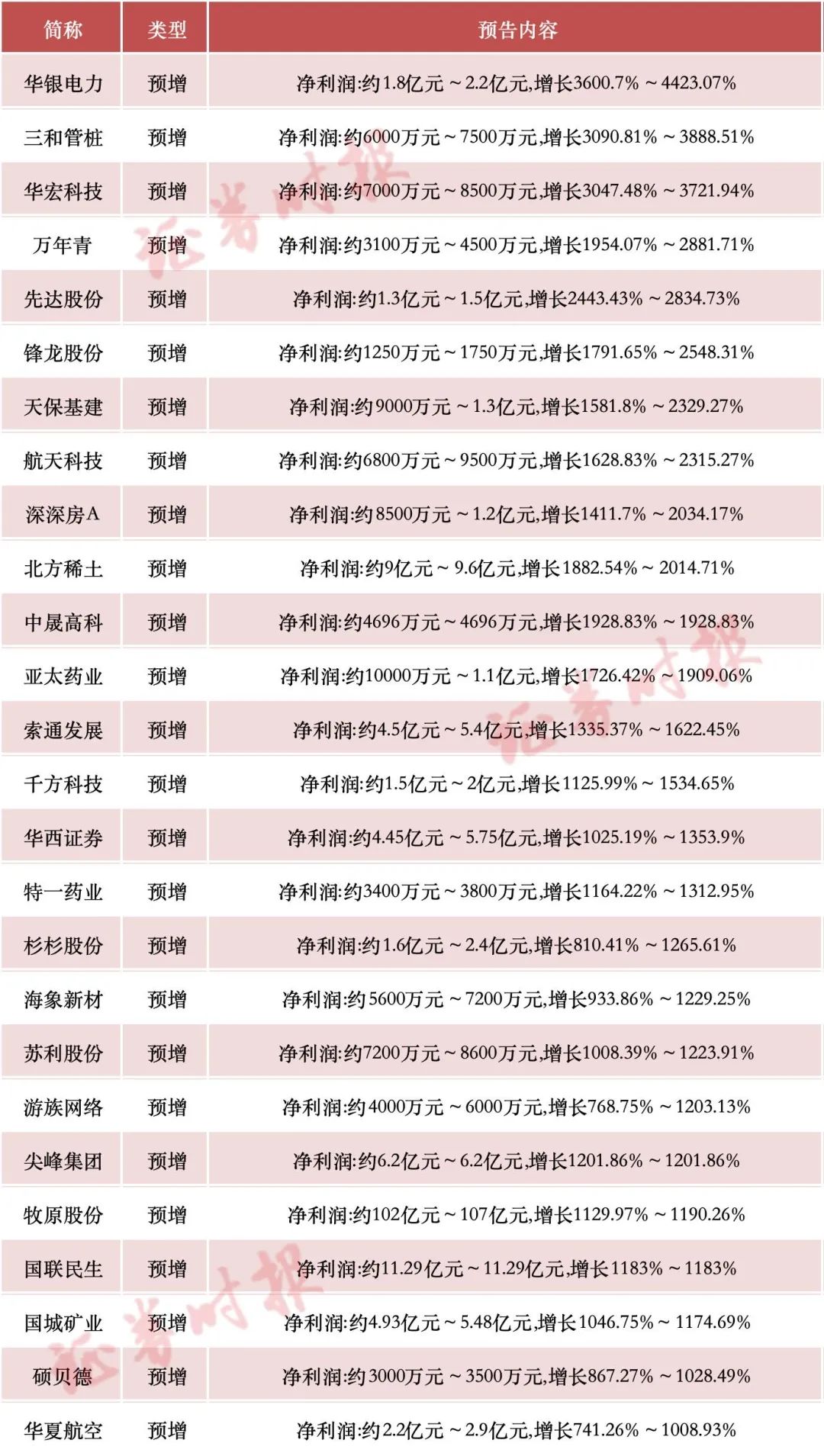
Core Insights - Over 1500 A-share listed companies have announced their half-year performance forecasts, with 676 companies expecting positive results, representing approximately 43% of the total [1][4] - 26 companies anticipate a net profit increase exceeding 1000% for the period [7] - 193 companies are expected to turn losses into profits [3][12] - The sectors with the highest concentration of companies expecting positive results include hardware equipment, chemicals, and machinery [15] Performance Forecasts - Among the companies forecasting positive results, 418 are expecting an increase, 59 slight increases, 6 to maintain profits, and 193 to turn losses into profits [4] - Notable companies with significant profit increases include: - Huayin Power: Net profit expected to be between 180 million to 220 million RMB, an increase of 3600.7% to 4423.07% [8] - Sanhe Pile: Net profit expected to be between 60 million to 75 million RMB, an increase of 3090.81% to 3888.51% [10] - Huahong Technology: Net profit expected to be between 70 million to 85 million RMB, an increase of 3047.48% to 3721.94% [10] Companies Turning Profits - 193 companies are expected to turn losses into profits, accounting for nearly 30% of the companies forecasting positive results [12] - New Hope is projected to achieve a net profit of 680 million to 780 million RMB, driven by improvements in pig farming and feed business [12][13] Industry Concentration - The majority of companies expecting positive results are concentrated in the hardware equipment (77 companies), chemicals (61 companies), and machinery (51 companies) sectors [15] - Historical trends indicate that during the mid-year reporting season, companies with stable profit growth are more likely to attract investor interest and outperform the market [15]
利好!A股公司,密集披露!
证券时报· 2025-07-19 10:38
Core Viewpoint - The article highlights the performance forecast of A-share listed companies for the first half of the year, indicating a significant number of companies are expected to report positive earnings, with a notable concentration in specific industries [2][3][4]. Summary by Sections Overall Performance - As of now, over 1500 A-share listed companies have announced their half-year performance forecasts, with 676 companies expecting positive earnings, accounting for approximately 43% of the total [2][4]. - 26 companies anticipate a net profit increase exceeding 1000% [8]. - 193 companies are expected to turn losses into profits [14]. Earnings Forecast Types - Among the companies forecasting positive earnings, 418 are expecting an increase, 59 slight increases, 6 are maintaining earnings, and 193 are turning losses into profits [5]. - Notable companies include: - China Salt Chemical: Revenue of 5.998 billion yuan, a decrease of 5.76% year-on-year, with a net profit of 52.71 million yuan [5]. - Shentong Technology: Revenue of 816 million yuan, a year-on-year increase of 22.46%, with a net profit of 64.28 million yuan, up 111.09% [5]. Companies with Significant Profit Increases - A list of companies with expected net profit increases exceeding 2000% includes: - Huayin Power: Net profit forecast of 180-220 million yuan, an increase of 3600.7%-4423.07% [9]. - Sanhe Pile: Net profit forecast of 60-75 million yuan, an increase of 3090.81%-3888.51% [12]. - Other companies like Huahong Technology and Wannianqing also show significant increases [11]. Companies Turning Losses into Profits - 193 companies are expected to turn losses into profits, with 24 of them forecasting net profits of 200 million yuan or more [14]. - New Hope is leading with a forecasted net profit of 680-780 million yuan, attributed to improvements in pig farming and feed business [15]. Industry Concentration - The companies expecting positive earnings are primarily concentrated in the hardware equipment, chemical, and machinery industries, with 77, 61, and 51 companies respectively [18]. - Historical trends indicate that during the mid-year reporting season, companies with stable profit growth are more likely to attract investor interest and outperform the market [18].




上半年规上工业稳定向好 数字产业增势提速 钢铁、有色金属、石化、建材等十大重点行业稳增长方案即将出台
Zheng Quan Shi Bao· 2025-07-18 17:11
Group 1 - In the first half of the year, China's industrial added value above designated size grew by 6.4% year-on-year, with the manufacturing added value accounting for 25.7% of GDP [1] - The number of industrial enterprises above designated size reached 520,000, and profits in the manufacturing sector increased by 5.4% year-on-year [1] - The digital industry, driven by rapid advancements in digital technologies such as 5G and AI, achieved a business revenue growth of 9.3%, an increase of 3.4 percentage points compared to the same period last year [1] Group 2 - In the automotive industry, production and sales reached 15.621 million and 15.653 million units respectively, marking year-on-year growth of 12.5% and 11.4% [2] - New energy vehicles saw production and sales of 6.968 million and 6.937 million units, with year-on-year growth of 41.4% and 40.3%, making up 44.3% of total new car sales [2] - The Ministry of Industry and Information Technology plans to introduce stability growth plans for key industries such as steel, non-ferrous metals, petrochemicals, and building materials [2]
由创新高个股看市场投资热点
量化藏经阁· 2025-07-18 12:12
Group 1 - The report tracks stocks, industries, and sectors that are reaching new highs, serving as market indicators and highlighting the effectiveness of momentum and trend-following strategies [1][4] - As of July 18, 2025, the distance to the 250-day new high for major indices is as follows: Shanghai Composite Index 0.00%, Shenzhen Component Index 5.06%, CSI 300 4.64%, CSI 500 3.65%, CSI 1000 0.91%, CSI 2000 0.00%, ChiNext Index 10.71%, and STAR 50 Index 10.59% [5][21] - Among the first-tier industry indices, non-ferrous metals, steel, basic chemicals, communications, and defense industries are closest to their 250-day new highs, while coal, food and beverage, real estate, consumer services, and transportation industries are further away [8][21] Group 2 - A total of 1,001 stocks reached a 250-day new high in the past 20 trading days, with the highest number of new highs in the pharmaceutical, basic chemicals, and machinery industries, totaling 129, 122, and 114 stocks respectively [2][13] - The highest proportion of new high stocks is found in the banking, comprehensive finance, and steel industries, with respective proportions of 88.10%, 40.00%, and 33.96% [13][15] - By sector distribution, the manufacturing and cyclical sectors had the most new high stocks, with 289 and 245 stocks respectively, representing 18.65% and 21.88% of their respective sector stock counts [15][22] Group 3 - The report identifies 46 stable new high stocks, including Shenghong Technology, Borui Pharmaceutical, and Shijia Photon, with the most new high stocks in the manufacturing and technology sectors, totaling 14 and 13 stocks respectively [3][19][22] - The manufacturing sector's highest number of new highs is in the machinery industry, while the technology sector's highest is in the computer industry [19][22] - The selection criteria for stable new high stocks include analyst attention, relative strength of stock prices, price path stability, and continuity of new highs [18][22]

热点追踪周报:由创新高个股看市场投资热点(第203期)-20250718
Guoxin Securities· 2025-07-18 11:40
Quantitative Models and Construction Methods 1. Model Name: 250-Day New High Distance - **Model Construction Idea**: This model tracks the distance of a stock or index from its 250-day high to identify market trends and hotspots. It is based on the premise that stocks nearing their 52-week high tend to outperform, as supported by prior research (e.g., George@2004, William O'Neil's CANSLIM system, and Mark Minervini's "Stock Market Wizard").[11][18][21] - **Model Construction Process**: The 250-day new high distance is calculated as follows: $ 250 \text{ Day New High Distance} = 1 - \frac{\text{Close}_{t}}{\text{ts\_max(Close, 250)}} $ - $\text{Close}_{t}$: Latest closing price - $\text{ts\_max(Close, 250)}$: Maximum closing price over the past 250 trading days If the latest closing price reaches a new high, the distance is 0. If the price has fallen from the high, the distance is positive, indicating the percentage drop.[11] - **Model Evaluation**: This model effectively identifies market leaders and trends, aligning with momentum and trend-following strategies.[11][18] 2. Model Name: Stable New High Stock Screening - **Model Construction Idea**: This model focuses on identifying stocks with stable momentum characteristics, emphasizing smooth price paths and consistent new highs. Research suggests that smoother momentum stocks outperform those with jumpy price paths (e.g., Bali et al., 2011; Da et al., 2012).[25][27] - **Model Construction Process**: Stocks are screened from the pool of those hitting 250-day highs in the past 20 trading days based on the following criteria: - **Analyst Attention**: At least 5 "Buy" or "Overweight" ratings in the past 3 months - **Relative Strength**: Top 20% in 250-day price performance - **Price Stability**: Evaluated using two metrics: - **Price Path Smoothness**: Ratio of price displacement to price path length - **New High Consistency**: Average 250-day new high distance over the past 120 days - **Trend Continuation**: Average 250-day new high distance over the past 5 days Stocks meeting these criteria are ranked, and the top 50% are selected.[25][27] - **Model Evaluation**: This model captures stocks with strong and stable momentum, leveraging underreaction to smooth price paths for enhanced returns.[25][27] --- Model Backtesting Results 1. 250-Day New High Distance - **Indices**: - Shanghai Composite: 0.00% - Shenzhen Component: 5.06% - CSI 300: 4.64% - CSI 500: 3.65% - CSI 1000: 0.91% - CSI 2000: 0.00% - ChiNext Index: 10.71% - STAR 50 Index: 10.59%[12][13][15] 2. Stable New High Stock Screening - **Selected Stocks**: 46 stocks, including Shenghong Technology, Borui Pharmaceutical, and Shijia Photon[28][33] - **Sector Distribution**: - Manufacturing: 14 stocks (e.g., machinery) - Technology: 13 stocks (e.g., computers)[28][33] --- Quantitative Factors and Construction Methods 1. Factor Name: 250-Day New High Distance - **Factor Construction Idea**: Measures the relative position of a stock's price to its 250-day high, serving as a momentum indicator.[11] - **Factor Construction Process**: $ 250 \text{ Day New High Distance} = 1 - \frac{\text{Close}_{t}}{\text{ts\_max(Close, 250)}} $ - $\text{Close}_{t}$: Latest closing price - $\text{ts\_max(Close, 250)}$: Maximum closing price over the past 250 trading days[11] - **Factor Evaluation**: Effectively identifies momentum leaders and market trends.[11][18] 2. Factor Name: Price Path Smoothness - **Factor Construction Idea**: Quantifies the smoothness of a stock's price trajectory, with smoother paths indicating stronger momentum.[25][27] - **Factor Construction Process**: $ \text{Price Path Smoothness} = \frac{\text{Price Displacement}}{\text{Price Path Length}} $ - **Price Displacement**: Net change in price over a period - **Price Path Length**: Sum of absolute daily price changes over the same period[27] - **Factor Evaluation**: Highlights stocks with stable momentum, leveraging underreaction to smooth price paths.[25][27] 3. Factor Name: New High Consistency - **Factor Construction Idea**: Measures the average proximity to 250-day highs over a specified period, indicating sustained momentum.[27] - **Factor Construction Process**: $ \text{New High Consistency} = \text{Mean(250 Day New High Distance over 120 Days)} $[27] - **Factor Evaluation**: Captures stocks with consistent momentum, emphasizing sustainability.[27] 4. Factor Name: Trend Continuation - **Factor Construction Idea**: Measures short-term proximity to 250-day highs, indicating recent momentum strength.[27] - **Factor Construction Process**: $ \text{Trend Continuation} = \text{Mean(250 Day New High Distance over 5 Days)} $[27] - **Factor Evaluation**: Identifies stocks with strong short-term momentum, complementing longer-term factors.[27] --- Factor Backtesting Results 1. 250-Day New High Distance - **Indices**: - Shanghai Composite: 0.00% - Shenzhen Component: 5.06% - CSI 300: 4.64% - CSI 500: 3.65% - CSI 1000: 0.91% - CSI 2000: 0.00% - ChiNext Index: 10.71% - STAR 50 Index: 10.59%[12][13][15] 2. Price Path Smoothness - **Selected Stocks**: 46 stocks, including Shenghong Technology, Borui Pharmaceutical, and Shijia Photon[28][33] 3. New High Consistency - **Selected Stocks**: 46 stocks, with top sectors being manufacturing (14 stocks) and technology (13 stocks)[28][33] 4. Trend Continuation - **Selected Stocks**: 46 stocks, with top sectors being manufacturing (14 stocks) and technology (13 stocks)[28][33]
重大利好!汽车、钢铁等十大重点行业稳增长方案即将出台
Zheng Quan Shi Bao· 2025-07-18 09:49
Group 1 - The core viewpoint of the news is the significant growth in China's industrial and information technology sectors in the first half of 2025, with a focus on digital technology advancements and manufacturing performance [1] - In the first half of 2025, the industrial added value of large-scale enterprises in China increased by 6.4% year-on-year, with the manufacturing sector accounting for 25.7% of GDP [1] - The number of large-scale industrial enterprises reached 520,000, and profits in the manufacturing sector grew by 5.4% year-on-year [1] - The digital industry saw a business revenue increase of 9.3% year-on-year, with a growth rate improvement of 3.4 percentage points compared to the previous year [1] - Significant advancements in technology and industry integration were noted, including the certification of the AG600 amphibious firefighting aircraft and the rapid application of humanoid robots across various fields [1] - The production of industrial robots and service robots increased by 35.6% and 25.5% year-on-year, respectively [1] - The equipment manufacturing sector accounted for 35.5% of the total industrial added value, demonstrating its role as a stabilizer in industrial development [1] - Fixed asset investments in key manufacturing sectors such as railways, shipbuilding, aerospace, and automobiles achieved double-digit growth [1] - Investment in equipment and tools increased by 17.3% year-on-year, contributing 86% to the overall investment growth [1] Group 2 - In the automotive industry, production and sales reached 15.621 million and 15.653 million units, respectively, with year-on-year growth of 12.5% and 11.4% [2] - New energy vehicles saw production and sales of 6.968 million and 6.937 million units, with year-on-year growth of 41.4% and 40.3%, respectively, making up 44.3% of new car sales [2] - The Ministry of Industry and Information Technology plans to ensure stable industrial economic operations and promote the integration of technological and industrial innovation [2] - Upcoming growth stabilization plans for key industries such as steel, non-ferrous metals, petrochemicals, and building materials are expected to be released [2] - The Ministry will also issue digital transformation plans for various industries, focusing on 82 typical scenarios for intelligent upgrades [2] - Future industry innovations will include the development of humanoid robots, the metaverse, and brain-computer interfaces, aiming to cultivate new industries and drive new growth [2]