
晶圆代工

Search documents
A股或“迎芯”!粤芯半导体,申报IPO获受理
中国基金报· 2025-12-19 13:45
Core Viewpoint - Yu Xin Semiconductor has submitted its IPO application to the ChiNext board and has been accepted, with a post-financing valuation of 25.3 billion yuan [2] Financial Performance - The financial data disclosed in the prospectus shows that Yu Xin Semiconductor's operating revenues for 2022, 2023, 2024, and the first half of 2025 are projected to be 1.545 billion yuan, 1.044 billion yuan, 1.681 billion yuan, and 1.053 billion yuan respectively, with a significant year-on-year growth of 61.09% expected in 2024 [5] - The company has maintained positive net cash flow from operating activities from 2022 to the first half of 2025 [5] Profitability Challenges - Yu Xin Semiconductor has not yet achieved profitability, with increasing losses projected for the years 2022 to 2025, amounting to -1.043 billion yuan, -1.917 billion yuan, -2.253 billion yuan, and -1.201 billion yuan respectively [6][7] - The company indicates that the time to reach breakeven is relatively long due to the capital-intensive nature of the wafer manufacturing industry and the characteristics of analog chips [6][8] Shareholder Structure - The company currently has no controlling shareholder or actual controller, with the founding shareholders being Yu Xin Zhong Cheng Equity Investment Partnership and Science City Investment Group [11] - Yu Xin Zhong Cheng holds an 80% stake, while Science City Group holds 20% [14] Future Plans and Investment - Yu Xin Semiconductor plans to raise 7.5 billion yuan through the IPO, with 3.5 billion yuan allocated for the production line project of 12-inch integrated circuit analog specialty processes and 2.5 billion yuan for the development of specialty process technology platforms, together accounting for 80% of the total fundraising [20] - The company aims to transform from a "pure analog foundry" to a composite technology platform that integrates analog and digital technologies, focusing on collaboration with design companies and the terminal industry chain [22]

英特尔晶圆代工,初露曙光
半导体行业观察· 2025-12-19 01:40
Core Insights - The article discusses the increasing interest of major design companies like NVIDIA, AMD, Apple, and Broadcom in Intel's wafer fabrication and packaging technologies, particularly the 14A process node and EMIB packaging technology, due to capacity constraints from other suppliers like TSMC [1][2]. Group 1: Intel's Technological Developments - Intel's 14A process node is critical for its wafer fabrication success, promising improvements in performance per watt and chip density, and utilizing advanced packaging technologies like EMIB and Foveros [2]. - The EMIB technology, which has been in mass production since 2017, offers cost-effectiveness and design flexibility, making it suitable for custom ASICs and AI processors [6][7]. - Intel is expanding its EMIB product line to enhance power delivery capabilities, integrating new technologies like MIM capacitors and TSV for improved performance [6]. Group 2: Market Dynamics and Competitive Landscape - The supply chain challenges faced by TSMC, particularly in advanced packaging capacity, are driving companies to consider Intel as a viable alternative for packaging solutions [5][6]. - Major chip design companies, including AWS and MediaTek, are reportedly choosing Intel's wafer fabrication services, indicating a shift in supplier preferences due to capacity constraints in the industry [5]. - The demand for advanced packaging solutions is surging, particularly in AI and high-performance computing sectors, leading to a bottleneck in supply from major providers [5]. Group 3: Strategic Implications for Intel - Securing design commitments from companies like NVIDIA and AMD could solidify Intel's position in the wafer fabrication market and justify ongoing investments in its technology roadmap [2]. - Intel's focus on advanced packaging solutions is seen as a strategic move to regain market share and enhance its competitive edge against dominant players like TSMC [4][5]. - The potential collaboration with companies for downstream packaging using TSMC-manufactured chips highlights Intel's ambition to expand its role in the foundry market [4].


北水动向 北水成交净买入79.09亿 内资全天抢筹科网股 加仓南方恒生科技(03033)超7亿港元
Jin Rong Jie· 2025-12-17 11:41
Group 1 - Northbound capital recorded a net purchase of HKD 79.09 billion on December 17, with HK Stock Connect (Shanghai) net buying HKD 22.18 billion and HK Stock Connect (Shenzhen) net buying HKD 56.91 billion [1] - The most net bought stocks included Xiaomi Group-W (01810) with a net purchase of HKD 10.62 billion, Meituan-W (03690), and Southern Hang Seng Technology (03033) [1] - Xiaomi Group plans to invest HKD 200 billion in R&D over the next five years, aiming to become a global leader in hard technology [1] Group 2 - Meituan-W (03690) received a net purchase of HKD 7.5 billion, Alibaba-W (09988) HKD 5.43 billion, Tencent (00700) HKD 4.57 billion, and Kuaishou-W (01024) HKD 1.84 billion [2] - Southern Hang Seng Technology (03033) also saw a net purchase of HKD 7.45 billion, with a general market sentiment of caution among southbound funds, waiting for a more aggressive approach in the new year [2] - Longi Green Energy (06869) had a net purchase of HKD 4.13 billion, with plans to use approximately 80% of the net proceeds from a recent share placement for overseas business development [2] Group 3 - China Life (02628) recorded a net purchase of HKD 3.13 billion, with recent trends in long-term interest rates potentially improving the valuation outlook for listed insurance companies [3] - SMIC (00981) saw a net purchase of HKD 2.17 billion, with recent data showing it is closing the market share gap with Samsung in the semiconductor foundry sector [3] - Zijin Mining (02899) and Industrial and Commercial Bank of China (01398) received net purchases of HKD 3.57 billion and HKD 2.392 million, respectively, while China Mobile (00941) and CNOOC (00883) faced net sales of HKD 5.14 billion and HKD 1.32 billion [3]






三星晶圆代工市占,跌破7%
半导体行业观察· 2025-12-15 01:33
Core Viewpoint - TrendForce's latest survey indicates that TSMC's market share surged to 71% in Q3, solidifying its position as the global leader in foundry services, while Samsung's market share decreased by 0.5 percentage points to 6.8%, widening the gap between the two companies [2][3]. Group 1: Samsung's Strategy and Partnerships - Samsung is in discussions with AMD for 2nm foundry orders, aiming to catch up with TSMC, which has been the preferred choice for major clients like Apple and Tesla [2][3]. - The collaboration with AMD includes the production of next-generation CPUs, potentially the EPYC Venice CPU, using Samsung's second-generation 2nm process [2][3]. - Samsung's foundry division is expected to finalize contracts with AMD around January, with a high likelihood of mass production [3]. Group 2: Financial Goals and Performance - Samsung has set a target to achieve profitability in its semiconductor foundry business by 2027, focusing on securing orders from major tech companies [5][6]. - The foundry division has been operating at a loss since 2022, with estimated quarterly losses ranging from 1 trillion to 2 trillion KRW [6]. - Samsung aims to capture a 20% market share by 2027, based on sales, as part of its long-term business plan [5]. Group 3: Operational Improvements and Future Prospects - Samsung's foundry business has seen a rebound in performance due to securing contracts from Tesla and Apple, with Q3 losses dropping below 1 trillion KRW [6]. - The company is also enhancing production capacity at its Austin facility, which utilizes mature processes and has recently gained new clients [6]. - Samsung plans to maximize profits at its upcoming Taylor factory in the U.S. by starting production in 2024, with equipment installation expected to be completed by Q2 [7].

存储器涨价等因素扰动供应链转趋保守 机构预计第四季晶圆代工产值季增幅收窄
Zheng Quan Shi Bao Wang· 2025-12-12 12:52
Core Insights - The global wafer foundry industry is experiencing growth driven by the AI boom, with the top ten foundries' revenue increasing by 8.1% to nearly $45.1 billion in Q3 2025 [1][2] - However, due to international conditions and rising memory prices, the supply chain is becoming conservative regarding demand for mainstream terminal applications in 2026, leading to a forecasted slowdown in capacity utilization growth in Q4 [1][7] Group 1: Industry Performance - The top ten foundries' revenue growth in Q3 2025 was significantly supported by high-performance computing (HPC) and consumer electronics, particularly from advanced processes of 7nm and below [2] - TSMC's revenue reached approximately $33.1 billion, a 9.3% increase, with a market share rise to 71%, driven by smartphone and HPC demand [2] - Samsung's revenue remained stable at about $3.18 billion, with a market share of 6.8%, while SMIC's revenue grew by 7.8% to $2.38 billion, ranking third [2] Group 2: Future Outlook - The wafer foundry industry is projected to grow by 19% in 2026, with AI-related demand driving advanced process markets to a 28% annual increase [2] - TSMC is advancing to 2nm production and plans to move towards 1nm technology, with advanced packaging capacity expected to grow by 27% next year [3] - The semiconductor industry is focusing on increasing capacity and technological trends, especially with the rise of ASIC chips and domestic chip innovations from companies like Huawei and Cambrian [3] Group 3: Consumer Electronics Impact - Consumer electronics are a significant driver for wafer foundry performance, affecting the rankings of the top ten foundries [4] - Nexchip's revenue increased by 12.7% to $409 million, allowing it to surpass Tower Semiconductor to rank eighth [4] - UMC's revenue grew by 3.8% to nearly $1.98 billion, benefiting from demand for smartphones and PCs, while GlobalFoundries' revenue remained stable at about $1.69 billion [5] Group 4: Q4 Expectations - The growth rate for Q4 is expected to slow due to conservative demand forecasts influenced by international conditions and rising memory prices [7] - SMIC's Q4 revenue guidance indicates a modest growth of 2%, reflecting cautious customer production planning amid price pressures [7] - Hua Hong Group anticipates Q4 sales revenue between $650 million and $660 million, with limited growth expected [8]

12.12犀牛财经晚报:银行理财规模逼近34万亿元 再创新高
Xi Niu Cai Jing· 2025-12-12 10:41
Monetary Policy - As of the end of November, the broad money supply (M2) in China reached 336.99 trillion yuan, reflecting a year-on-year growth of 8% [1] - The narrow money supply (M1) stood at 112.89 trillion yuan, with a year-on-year increase of 4.9% [1] - The currency in circulation (M0) amounted to 13.74 trillion yuan, showing a year-on-year growth of 10.6% [1] - A net cash injection of 917.5 billion yuan occurred in the first eleven months of the year [1] Banking and Financial Services - The total scale of bank wealth management products has reached a historic high of approximately 33.8 trillion yuan, nearing 34 trillion yuan [2] - In the first eleven months, 14 wealth management companies collectively grew by about 3.43 trillion yuan, with "fixed income plus" products contributing an additional 1.32 trillion yuan [2] - The market saw a significant increase of 1.67 trillion yuan in the fourth quarter alone, accounting for nearly half of the annual growth [2] Regulatory Developments - The China Securities Investment Fund Industry Association has drafted a consultation document to standardize fund sales behavior, aiming to prevent misleading practices and protect investor rights [2] - The document outlines clear requirements for fund promotion, sales information disclosure, and performance assessment [2] Corporate Actions - Taihao Technology plans to use 13.67 billion yuan from its capital reserves to cover significant losses, a move that reflects a broader trend among A-share companies to address accumulated losses amid new regulatory changes [4] - Over 30 listed companies have announced similar plans to utilize capital reserves to offset losses, with total amounts exceeding 30 billion yuan [4] Market Trends - The top ten wafer foundries reported a quarter-on-quarter revenue increase of 8.1% in Q3 2025, driven by demand for AI and consumer electronics [4] - The global wafer foundry industry is expected to face challenges in 2026 due to international market conditions and conservative demand forecasts [4] Industry Developments - A new company, Beijing Guanghe Qiancheng Technology, has been established by leading silicon material firms, marking a significant step towards reducing overcapacity in the photovoltaic industry [5] - Future silicon material production capacity is planned to be capped at 1.5 million tons [5] Legal and Compliance Issues - The China Securities Regulatory Commission has penalized three individuals for manipulating the stock of Shandong Jincheng Pharmaceutical Group, resulting in fines and market bans [3] - Huayi Brothers' founder has received a consumption restriction order due to an advertising contract dispute, with the company facing a financial penalty of over 11.4 million yuan [8] IPO and Market Activity - Youyan Composite Materials has received approval for its IPO on the Sci-Tech Innovation Board [9] - Shouyao Holdings is planning to issue H-shares and list on the Hong Kong Stock Exchange [10] Corporate Changes - The chairman of Jinling Hotel has resigned due to work changes, leaving the company without any executive positions held by him [11] - *ST Chang Pharmaceutical's subsidiary has recently ceased operations due to financial difficulties and competitive pressures in the photovoltaic sector [12] Project Announcements - Jiangsu Guoxin's subsidiary has successfully completed the trial operation of a new 1000MW coal-fired power generation unit [13] - *ST Zhisheng has won a 1.04 billion yuan contract for a smart city governance project, significantly impacting its projected annual revenue [17]
全球TOP 10晶圆厂:中国大陆三家入选
半导体芯闻· 2025-12-12 10:24
Group 1 - The global wafer foundry industry is expected to see a revenue increase of 8.1% quarter-on-quarter, reaching approximately $45.1 billion in Q3 2025, driven by demand for AI high-performance computing (HPC) and new consumer electronics chips [3] - Despite the positive outlook for Q3 2025, there are concerns about potential geopolitical disruptions affecting demand in 2026, leading to a more conservative supply chain outlook for mainstream terminal demand [3] - TSMC's market share increased to 71% in Q3 2025, supported by strong demand from Apple for iPhone and NVIDIA's Blackwell platform, with both wafer shipments and average selling prices rising [3] Group 2 - UMC's capacity utilization slightly improved in Q3 2025 due to demand for mature process ICs from smartphones and PCs, resulting in a market share of 4.2% [4] - GlobalFoundries experienced a slight decrease in market share to 3.6% despite a small increase in shipments, attributed to a one-time adjustment in average selling prices [4] - The "China for China" trend benefited Hefei Jinghe, which saw increased demand for DDIC, CIS, and PMIC, allowing it to surpass Tower Semiconductor in rankings [4]
机构:2025年第三季度前十大晶圆代工产值季增8.1%
Zheng Quan Shi Bao Wang· 2025-12-12 09:11
Core Insights - The global wafer foundry industry is expected to continue benefiting from demand driven by AI high-performance computing and new consumer electronics chipsets, particularly those using advanced processes of 7nm and below [1] - The top ten wafer foundry companies reported a quarterly revenue increase of 8.1%, nearing $45.1 billion in the third quarter of 2025 [1] - However, the outlook for 2026 is cautious due to international market conditions, with supply chain dynamics leading to a conservative demand forecast for mainstream end applications [1] Industry Summary - The demand for high-priced wafers produced using advanced processes is significantly contributing to revenue growth in the wafer foundry sector [1] - The revenue growth of the top ten foundries indicates a strong performance in the current market, but potential limitations in capacity utilization growth are anticipated for the fourth quarter [1] - The increase in memory prices and tight capacity since mid-2025 may further constrain the growth momentum for wafer foundry capacity utilization in 2026 [1]
TrendForce:全球十大晶圆代工企业2025Q3总营收环比增长8.1%
Sou Hu Cai Jing· 2025-12-12 08:38
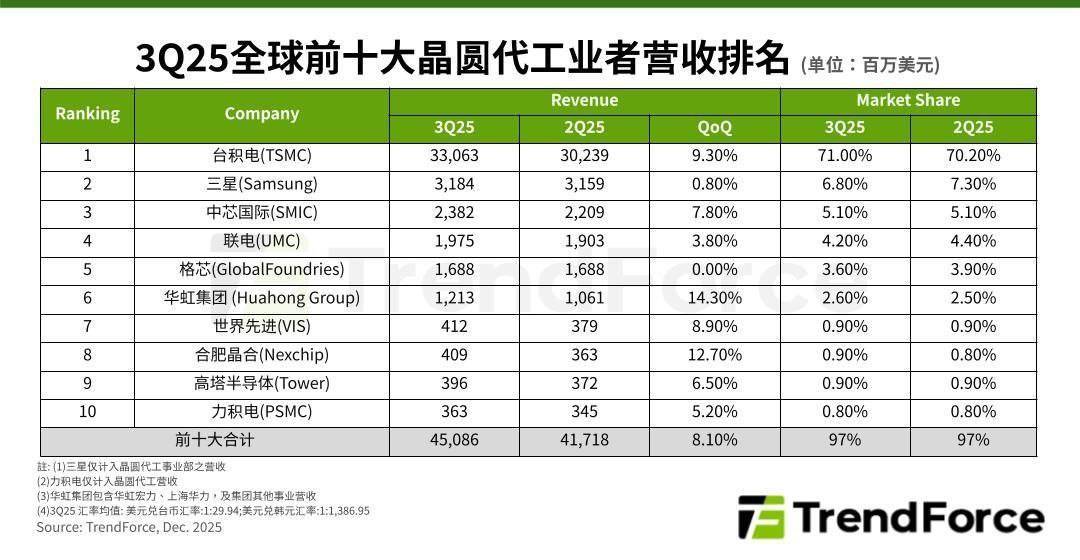
Core Insights - TrendForce reports that the global top ten foundry companies achieved a revenue increase of 8.1% quarter-on-quarter in Q3 2025, reaching $45.086 billion (approximately 318.586 billion RMB) [1][2] Group 1: Revenue and Market Share - TSMC remains the largest foundry with a revenue of $33.063 billion in Q3 2025, reflecting a 9.3% increase from the previous quarter and holding a market share of 71% [2] - Samsung follows with a revenue of $3.184 billion, showing a 0.8% increase and a market share of 6.8% [2] - SMIC reported a revenue of $2.382 billion, up 7.8%, maintaining a market share of 5.1% [2] - UMC's revenue reached $1.975 billion, increasing by 3.8%, with a market share of 4.2% [2] - GlobalFoundries had stable revenue at $1.688 billion, with a market share of 3.6% [2] - Huahong Group saw significant growth with a 14.3% increase in revenue to $1.213 billion, capturing a 2.6% market share [2] - The total revenue for the top ten foundries indicates a strong demand driven by AI HPC and new consumer electronics [2] Group 2: Future Outlook - For Q4 2025, TrendForce anticipates a more conservative outlook for the foundry industry due to international conditions and rising memory prices, which may limit growth momentum in capacity utilization [3] - Despite a potential rebound in demand from automotive and industrial control sectors, the overall revenue growth for the top ten foundries is expected to slow down significantly [3]

集邦咨询:第三季前十大晶圆代工厂合计营收环比增8.1% 接近451亿美元
Zhi Tong Cai Jing· 2025-12-12 08:13
Core Insights - The global wafer foundry industry saw a revenue increase of 8.1% quarter-over-quarter in Q3 2025, reaching nearly $45.1 billion, driven by demand from AI high-performance computing (HPC) and consumer electronics [1] Group 1: Major Players' Performance - TSMC's revenue was supported by smartphone and HPC demand, with a quarterly increase of 9.3% to nearly $33.1 billion, resulting in a slight market share increase to 71% [2] - Samsung's revenue remained flat at approximately $3.18 billion, with a market share of 6.8%, despite a slight increase in capacity utilization [2] - SMIC's revenue grew by 7.8% to $2.38 billion, ranking third due to improved capacity utilization and wafer shipments [2] - UMC's revenue increased by 3.8% to nearly $1.98 billion, supported by demand for ICs from smartphones and PCs, with a market share of 4.2% [2] Group 2: Other Notable Companies - GlobalFoundries' revenue held steady at approximately $1.69 billion, maintaining its fifth position, but its market share slightly decreased to 3.6% due to competitive pressures [3] - HuaHong Group's revenue exceeded $1.21 billion, with a market share of 2.6%, benefiting from increased wafer shipments and ASP growth [4] - Vanguard's revenue increased by 8.9% to $412 million, driven by demand for PMICs from smartphones and PCs [4] - Nexchip's revenue rose by 12.7% to $409 million, surpassing Tower Semiconductor to become the eighth-largest player, supported by increased customer market share and demand [4] - Tower's revenue was approximately $396 million, with a quarterly increase of 6.5%, ranking ninth [4] - PSMC's revenue grew by 5.2% to $363 million, driven by stronger demand for DRAM and improved foundry pricing [4]
