光伏设备

Search documents
A股收评:三大指数集体下跌,沪指跌0.4%创业板指跌逾1%,水产养殖、预制菜、有机硅领跌,银行地产领涨!逾3800股下跌,成交1.72万亿缩量200亿
Ge Long Hui· 2025-11-20 07:19
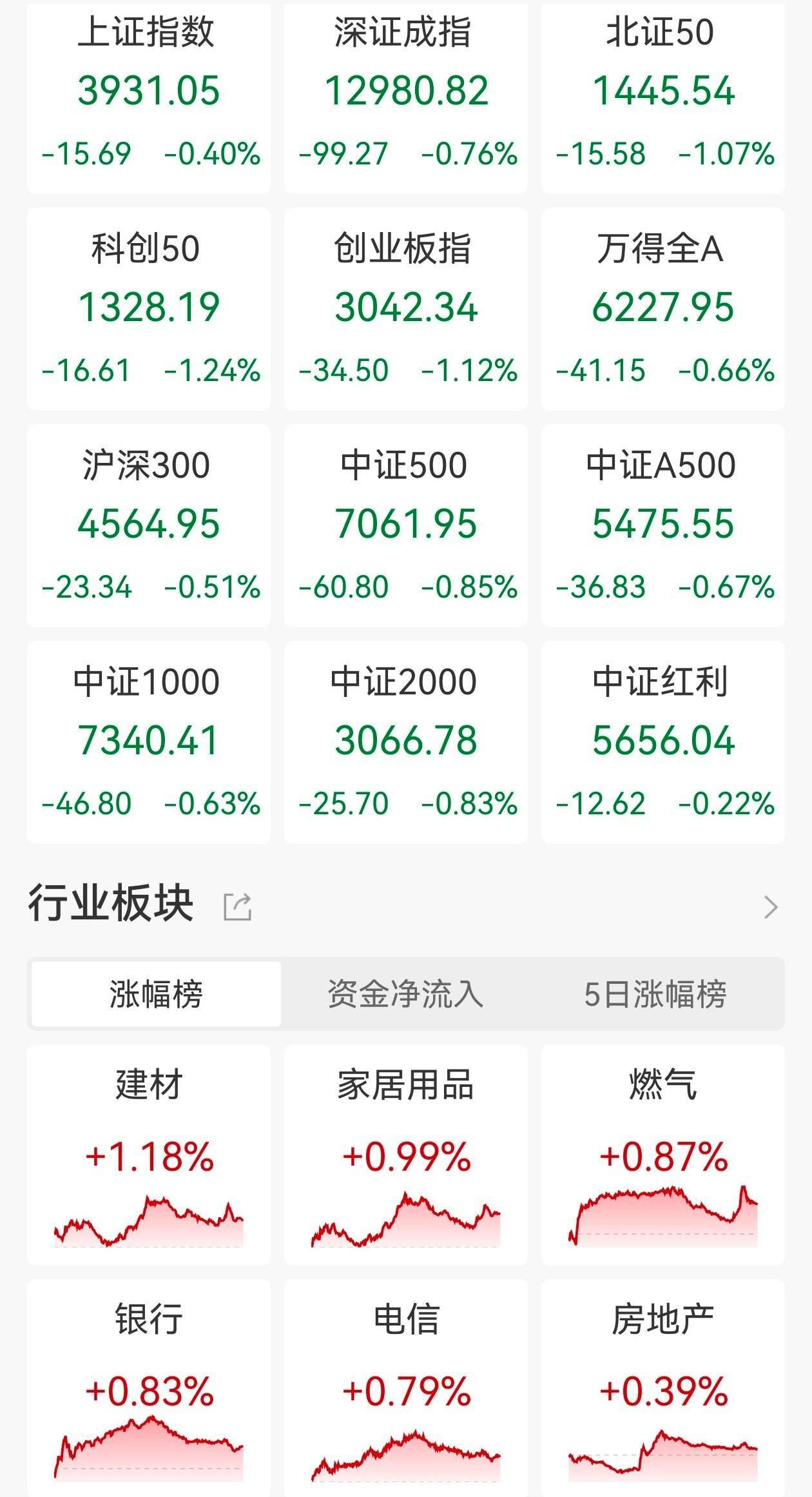
Market Overview - The three major A-share indices collectively declined, with the Shanghai Composite Index down 0.4% to 3931 points, the Shenzhen Component Index down 0.76%, and the ChiNext Index down 1.12% [1][2] - The total market turnover was 1.72 trillion yuan, a decrease of 20 billion yuan compared to the previous trading day, with over 3800 stocks declining [1] Index Performance - Shanghai Composite Index: 3931.05, down 15.69 points (-0.40%) [2] - Shenzhen Component Index: 12980.82, down 99.27 points (-0.76%) [2] - ChiNext Index: 3042.34, down 34.50 points (-1.12%) [2] - Other indices such as the CSI 300 and CSI 500 also experienced declines [2] Sector Performance - The aquaculture sector saw significant declines, with Tianma Technology hitting the daily limit down [3] - The prepared food concept also fell, with Guolian Aquatic Products down over 11% [3] - The organic silicon sector dropped, with Dongyue Silicon Materials down over 9% [3] - Beauty and personal care concepts weakened, with Liren Lizhuang hitting the daily limit down [3] - The photovoltaic equipment sector experienced fluctuations, with Guosheng Technology hitting the daily limit down [3] - Other sectors such as batteries, fluorochemicals, shipbuilding, and education also faced notable declines [3] Gaining Sectors - The Hainan sector rose, with Hainan Haiyao hitting the daily limit up [3] - The cement and building materials sector was active, with Yatai Group and Guotong Shares both hitting the daily limit up [3] - Banking stocks strengthened, with China Bank reaching a historical high [3] - Lithium mining, SPD concepts, and real estate services sectors showed gains [3]


A股收评:三大指数齐跌!创业板指跌逾1%,水产养殖、预制菜、有机硅板块跌幅居前
Ge Long Hui· 2025-11-20 07:16
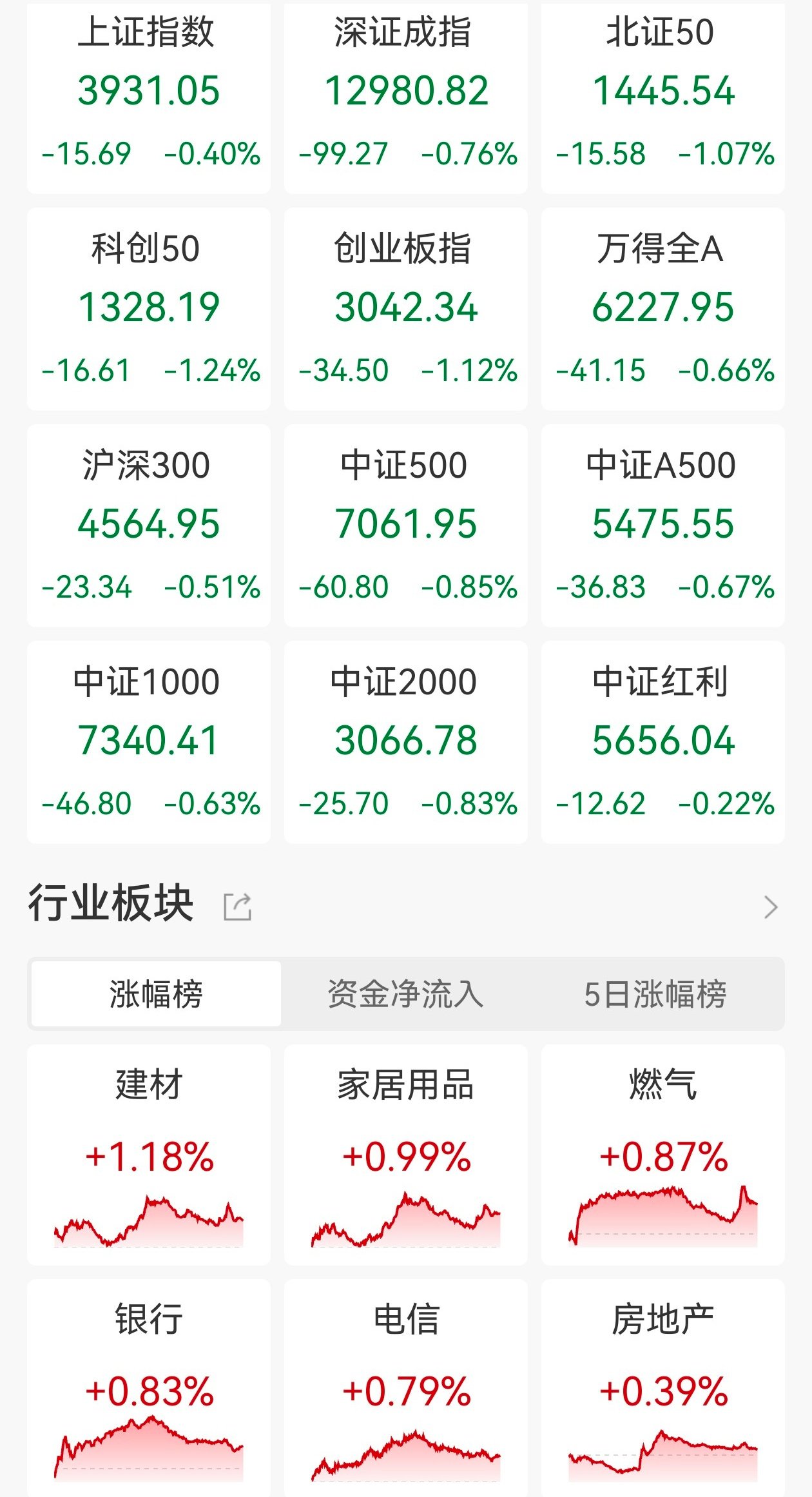
Market Overview - The three major A-share indices collectively declined today, with the Shanghai Composite Index down 0.4% to 3931 points, the Shenzhen Component Index down 0.76%, and the ChiNext Index down 1.12% [1] - The total market turnover was 1.72 trillion yuan, a decrease of 20 billion yuan compared to the previous trading day, with over 3800 stocks declining [1] Sector Performance - The aquaculture sector experienced a significant drop, with Tianma Technology hitting the daily limit down [1] - The prepared dishes concept also fell, with Guolian Aquatic Products down over 11% [1] - The organic silicon sector saw declines, with Dongyue Silicon Material down over 9% [1] - The beauty care and cosmetics sector weakened, with Liren Lizhuang hitting the daily limit down [1] - The photovoltaic equipment sector fluctuated downwards, with Guosheng Technology hitting the daily limit down [1] - Other sectors with notable declines included batteries, fluorochemical, shipbuilding, and education [1] Gainers - The Hainan sector rose, with Hainan Haiyao hitting the daily limit up [1] - The cement and building materials sector was active, with Yatai Group and Guotong Shares both hitting the daily limit up [1] - Bank stocks strengthened, with Bank of China and Industrial and Commercial Bank of China reaching historical highs [1] - Sectors with notable gains included lithium mining, SPD concept, and real estate services [1] Performance Metrics - Shanghai Composite Index: 3931.05, down 15.69 points (-0.40%) [1] - Shenzhen Component Index: 12980.82, down 99.27 points (-0.76%) [1] - ChiNext Index: 3042.34, down 34.50 points (-1.12%) [1] - Other indices also showed declines, including the CSI 300 and CSI 500 [1]
德业股份跌2.01%,成交额6.50亿元,主力资金净流出6113.59万元
Xin Lang Zheng Quan· 2025-11-20 06:34
Core Viewpoint - DeYe Co., Ltd. experienced a stock price decline of 2.01% on November 20, with a current price of 78.17 CNY per share and a total market capitalization of 709.60 billion CNY [1] Financial Performance - For the period from January to September 2025, DeYe Co., Ltd. achieved a revenue of 8.846 billion CNY, representing a year-on-year growth of 10.36%, and a net profit attributable to shareholders of 2.347 billion CNY, which is a 4.79% increase compared to the previous year [2] - The company has distributed a total of 5.242 billion CNY in dividends since its A-share listing, with 4.901 billion CNY distributed over the last three years [3] Stock Market Activity - The stock has seen a year-to-date increase of 35.69%, but has declined by 6.77% over the last five trading days [1] - As of September 30, 2025, the number of shareholders increased by 40.19% to 73,400, while the average number of circulating shares per person decreased by 28.40% to 12,375 shares [2] Shareholder Composition - As of September 30, 2025, the third-largest shareholder is Hong Kong Central Clearing Limited, holding 33.3664 million shares, an increase of 1.0752 million shares from the previous period [3] - New entrants among the top ten shareholders include E Fund CSI 300 ETF and Guangfa Small Cap Growth Mixed Fund [3] Business Overview - DeYe Co., Ltd. specializes in the research, production, and sales of evaporators, condensers, variable frequency control chips, dehumidifiers, and air source heat pump hot air machines [1] - The main revenue sources are inverters (47.77%), energy storage battery packs (25.69%), heat exchangers (15.68%), dehumidifiers (7.36%), and other products (3.16%) [1]

大为股份:正在推进办理锂矿探转采相关手续;丰元股份:高压实磷酸铁锂进入量产 | 新能源早参
Mei Ri Jing Ji Xin Wen· 2025-11-19 23:17
Group 1 - Dawi Co., Ltd. is advancing the procedures for converting exploration rights to mining rights for its lithium battery new energy project in Chenzhou, Hunan, with a significant milestone achieved on June 2025 when the provincial land resources department completed the reserve filing [1] - The completion of the exploration rights conversion marks a critical step in resource development, potentially enhancing the company's upstream supply chain capabilities in the lithium battery industry, although subsequent approvals remain uncertain [1] - The recent stock price fluctuation of 22.53% over two trading days reflects market sentiment, and investors are advised to monitor the progress of government approvals and lithium price trends impacting company performance [1] Group 2 - Jiejia Weichuang announced the early termination of the share reduction plan by senior management, signaling positive sentiment regarding the company's future development [2] - As of now, senior management has reduced their holdings by 5,000 shares and 2,000 shares respectively, with no further reductions planned within the original timeframe [2] - This decision may help stabilize market expectations amid increased volatility in the photovoltaic equipment industry, reflecting management's confidence [2] Group 3 - Fengyuan Co., Ltd. has successfully entered the mass production phase of its high-pressure dense lithium iron phosphate products, with a total production capacity of 225,000 tons and an additional 75,000 tons under construction [3] - The company plans to adjust its production capacity in real-time based on industry trends and customer demand, showcasing operational rationality [3] - The successful mass production of high-pressure dense products demonstrates technological strength and aligns with high-end market demands, although risks of industry overcapacity and intense price competition remain [3]

大为股份:正在推进办理锂矿探转采相关手续;丰元股份:高压实磷酸铁锂进入量产
Mei Ri Jing Ji Xin Wen· 2025-11-19 23:16
Group 1 - Daway Co., Ltd. announced that its lithium battery new energy project in Chenzhou is progressing, with the completion of the exploration rights transfer to mining rights process, marking a key step in resource development [1] - The company is currently working on the necessary procedures for the transfer, with the timeline dependent on government approvals [1] - The stock price has shown significant volatility, reflecting market sentiment, and investors are advised to monitor the approval progress and lithium price trends [1] Group 2 - Jiejia Weichuang's senior management has terminated their share reduction plan early, signaling positive sentiment towards the company's future [2] - The early termination of the reduction plan may help stabilize market expectations amid increased volatility in the photovoltaic equipment industry [2] - Investors should continue to focus on the company's order fulfillment and the pace of industry recovery [2] Group 3 - Fengyuan Co., Ltd. has successfully entered mass production of its high-density lithium iron phosphate products, with a total production capacity of 225,000 tons and an additional 75,000 tons under construction [3] - The company plans to adjust its production capacity in response to industry trends and customer demand, showcasing operational rationality [3] - The successful mass production of high-density products highlights the company's technical strength and adaptability to high-end market needs, although risks of industry overcapacity and price competition remain [3]

阿特斯(688472):CSIQ披露25Q4及26年展望,CSIQ在手订单充沛、26年储能出货翻倍
Soochow Securities· 2025-11-19 14:03
Investment Rating - The investment rating for the company is "Buy" (maintained) [1] Core Insights - The company, CSIQ, has a strong order backlog and expects a doubling of energy storage shipments in 2026 [1] - The company anticipates Q4 2025 sales between $1.3 billion and $1.5 billion, with a gross margin of 14%-16% [8] - CSIQ's energy storage orders as of October 31, 2025, amount to $3.1 billion, reflecting a growth of approximately $100 million since June 30, 2025 [8] - The company is expected to achieve significant growth in energy storage shipments, projecting 14GWh-17GWh for 2026, representing a year-on-year increase of 73%-115% [8] - The report indicates a slight increase in expense ratios but a significant improvement in cash flow, with operating cash flow for the first three quarters of 2025 reaching 5.47 billion yuan, a 120.9% increase year-on-year [8] - The profit forecast for 2025 has been adjusted downwards to 1.5 billion yuan due to slower-than-expected global photovoltaic demand recovery, while the profit forecasts for 2026 and 2027 have been raised to 3.24 billion yuan and 4.27 billion yuan, respectively [8] Financial Projections - Total revenue projections for the company are as follows: - 2023: 51.31 billion yuan - 2024: 46.17 billion yuan - 2025: 42.39 billion yuan - 2026: 50.42 billion yuan - 2027: 58.72 billion yuan [1] - Net profit projections are as follows: - 2023: 2.90 billion yuan - 2024: 2.25 billion yuan - 2025: 1.50 billion yuan - 2026: 3.24 billion yuan - 2027: 4.27 billion yuan [1] - The earnings per share (EPS) estimates are: - 2023: 0.79 yuan - 2024: 0.61 yuan - 2025: 0.41 yuan - 2026: 0.88 yuan - 2027: 1.16 yuan [1]

阳光电源:5名高管完成合计减持32.97万股
Hua Er Jie Jian Wen· 2025-11-19 10:31
Summary of Key Points Core Viewpoint - A total of 5 directors and executives have reduced their holdings in the company, amounting to 329,700 shares, which represents 0.0161% of the total share capital [1] Reduction Overview - Reducing Personnel: 5 directors and executives (Zhao Wei, Chen Zhiqiang, Peng Chaocai, Lu Yang, Tian Shuai) [1] - Total Reduction Scale: 329,700 shares [1] - Reduction Period: From August 18, 2025, to November 17, 2025 [1] Detailed Reduction Information - Zhao Wei: Reduced 150,000 shares at an average price of 114.50 CNY/share, accounting for 0.0073% [1] - Chen Zhiqiang: Reduced 131,200 shares at an average price of 188.65 CNY/share, accounting for 0.0064% [1] - Peng Chaocai: Reduced 27,500 shares at an average price of 97.44 CNY/share, accounting for 0.0013% [1] - Lu Yang: Reduced 10,500 shares at an average price of 191.32 CNY/share, accounting for 0.0005% [1] - Tian Shuai: Reduced 10,500 shares at an average price of 185.75 CNY/share, accounting for 0.0005% [1] Key Notes - The method of reduction was through centralized bidding transactions [1] - The shares reduced were sourced from pre-IPO shares and equity incentive shares [1] - The reduction plan was executed strictly according to the pre-disclosed plan [1] - This reduction does not affect the company's control or ongoing operations [1]

捷佳伟创:高管金晶磊、谭湘萍提前终止减持计划
Xin Lang Cai Jing· 2025-11-19 09:57
Core Viewpoint - The company announced that executives Jin Jinglei and Tan Xiangping have terminated their previously planned share reduction from September 29 to December 28, 2025 [1] Summary by Relevant Sections - **Executive Actions** - Jin Jinglei sold 5,000 shares at an average price of 101.28 yuan per share on November 13, 2025, representing 0.0014% of the total share capital [1] - Tan Xiangping sold 2,000 shares at an average price of 100.76 yuan per share from November 6 to November 12, 2025, representing 0.0006% of the total share capital [1] - **Remaining Shares** - The remaining unsold shares will not be reduced during the planned period [1]
协鑫科技(03800):技术力量助推开拓新发展周期
Guolian Minsheng Securities· 2025-11-19 09:04
Investment Rating - The report initiates coverage on GCL-Poly Energy Holdings Limited with a "Buy" rating [6][20]. Core Views - GCL-Poly focuses on the new energy high-tech sector, gradually becoming a leader in the polysilicon industry, forming a silicon-based industrial system centered on granular silicon, with collaborative development in semiconductor silicon and photovoltaic silicon wafers [4][12]. - The company’s granular silicon products are rapidly improving in quality, meeting the higher quality demands of the N-type era, and its cost competitiveness is expected to stand out during the industry's supply-side adjustment period [4][14]. - The report anticipates that GCL-Poly's profitability will gradually improve as the industry recovers, supported by its low-carbon attributes and cost advantages [15][20]. Summary by Sections Company Overview - GCL-Poly is a leading global photovoltaic high-tech materials company, primarily engaged in the production of photovoltaic polysilicon and wafers, perovskite components, and high-purity silicon for semiconductors [24][25]. - The company has developed advanced self-research granular silicon technology and is focusing on low-carbon products, gradually forming two major industrial systems: silicon-based materials and perovskite battery materials [25]. Industry Analysis - The photovoltaic industry is currently in a phase of supply-demand adjustment, with a focus on high-tech and low-energy consumption [31]. - The report predicts that the photovoltaic demand growth will slow down, with domestic photovoltaic installations expected to reach 300 GW in 2025, reflecting a 15% year-on-year increase [31][33]. - The industry is experiencing intensified competition, leading to a decline in product prices, with polysilicon prices remaining at historical lows [33][34]. Competitive Advantages - GCL-Poly's granular silicon products are expected to gain market share due to their lower production energy consumption compared to traditional rod silicon, with cash costs projected to drop to 24.16 CNY/kg by Q3 2025 [14][18]. - The company’s granular silicon has demonstrated superior performance in terms of minority carrier lifetime and has been validated for use in N-type monocrystalline applications, achieving 100% mass production by leading silicon wafer manufacturers [14][18]. - The report highlights that GCL-Poly's granular silicon has a significantly lower carbon footprint, reducing carbon emissions by approximately 75% compared to traditional methods [63]. Financial Forecasts - The report forecasts GCL-Poly's revenues for 2025-2027 to be 148.5 billion CNY, 195.0 billion CNY, and 216.2 billion CNY, respectively, with year-on-year growth rates of -1.6%, 31.3%, and 10.8% [15][20]. - The net profit attributable to shareholders is expected to improve from a loss of 7.2 billion CNY in 2025 to a profit of 29.4 billion CNY by 2027, reflecting a significant recovery in profitability [15][20].

光伏设备板块11月19日跌0.3%,安彩高科领跌,主力资金净流出11.66亿元
Zheng Xing Xing Ye Ri Bao· 2025-11-19 08:52
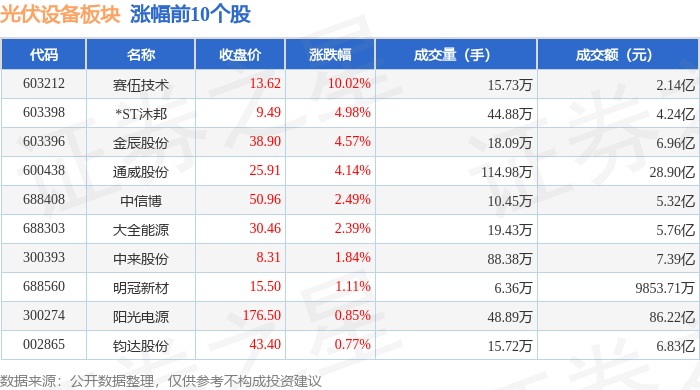
Market Overview - The photovoltaic equipment sector experienced a decline of 0.3% on November 19, with AnCai High-Tech leading the drop [1] - The Shanghai Composite Index closed at 3946.74, up 0.18%, while the Shenzhen Component Index closed at 13080.09, unchanged [1] Stock Performance - Notable gainers in the photovoltaic equipment sector included: - Saiwu Technology: Closed at 13.62, up 10.02% with a trading volume of 157,300 shares and a turnover of 214 million yuan [1] - ST Mubang: Closed at 9.49, up 4.98% with a trading volume of 448,800 shares and a turnover of 424 million yuan [1] - Jincheng Co.: Closed at 38.90, up 4.57% with a trading volume of 180,900 shares and a turnover of 696 million yuan [1] - Major decliners included: - AnCai High-Tech: Closed at 5.49, down 6.79% with a trading volume of 422,900 shares and a turnover of 236 million yuan [2] - Weidao Nano: Closed at 60.10, down 5.06% with a trading volume of 137,800 shares and a turnover of 842 million yuan [2] - Gudewei: Closed at 58.36, down 4.17% with a trading volume of 83,800 shares and a turnover of 493 million yuan [2] Capital Flow - The photovoltaic equipment sector saw a net outflow of 1.166 billion yuan from institutional investors, while retail investors contributed a net inflow of 1.162 billion yuan [2][3] - Key stocks with significant capital flow included: - Tongwei Co.: Net inflow of 298 million yuan from institutional investors, with a net outflow of 44.6 million yuan from retail investors [3] - Saiwu Technology: Net inflow of 99.11 million yuan from institutional investors, with a net outflow of 45.41 million yuan from retail investors [3] - Longi Green Energy: Net inflow of 52.50 million yuan from institutional investors, with a net outflow of 87.44 million yuan from retail investors [3]