
制造业

Search documents
鹏欣资源:12月26日召开董事会会议
Mei Ri Jing Ji Xin Wen· 2025-12-29 10:42
Group 1 - The core point of the article is that Pengxin Resources announced the convening of its 17th meeting of the 8th Board of Directors on December 26, 2025, to review various proposals, including adjustments to the Board's specialized committee members [1] - For the first half of 2025, the revenue composition of Pengxin Resources is as follows: trade business accounts for 51.07%, manufacturing accounts for 48.68%, and other businesses account for 0.25% [1] - As of the time of reporting, the market capitalization of Pengxin Resources is 17.1 billion yuan [1]

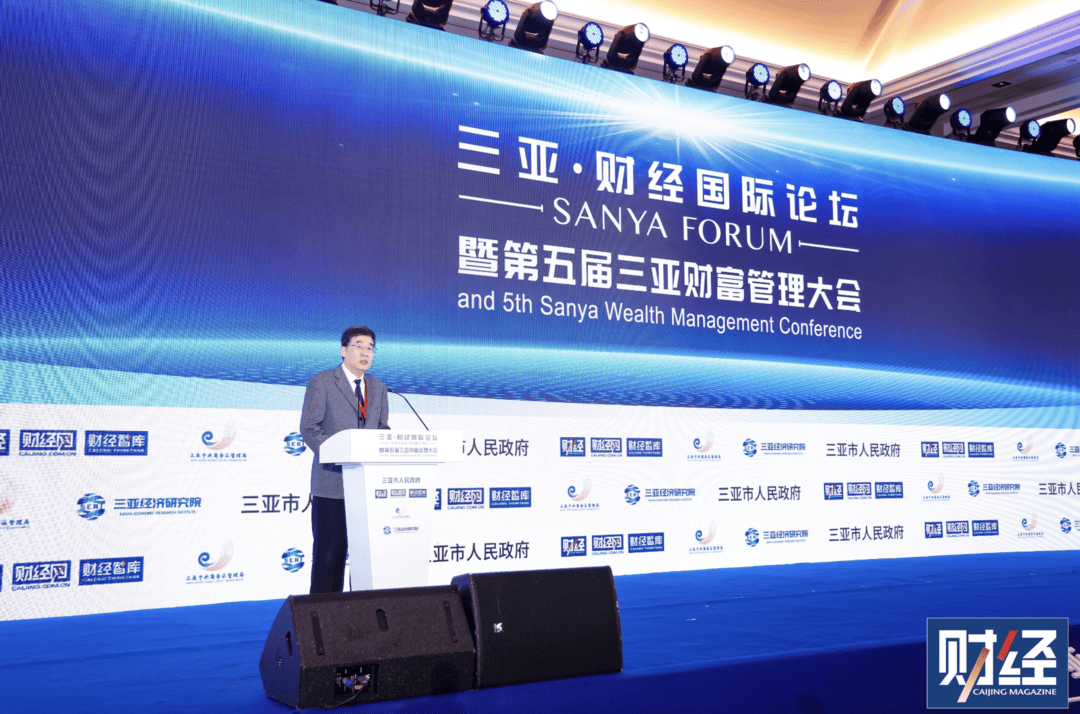
张军扩:需求已成经济增长决定性因素,扩大投资依然重要
Sou Hu Cai Jing· 2025-12-29 10:12
Group 1 - The core issue affecting China's economic growth is the demand problem, which has been prioritized in economic work for two consecutive years [2] - The overall economic performance in China shows resilience and stability, but the imbalance between strong supply and weak demand remains a significant challenge [2] - The main contradiction in economic operation is shifting from the supply side to the demand side, necessitating a focus on resolving demand issues for sustainable economic development [2] Group 2 - The acceleration of domestic demand expansion policies has led to positive outcomes, but consumption demand is constrained by both short-term fluctuations and long-term structural factors [3] - Short-term measures should include strong stimulus policies to break negative cycles, while long-term strategies must address deep-rooted issues to ensure stable growth [3] - The shift in consumer behavior from goods to services highlights the need for increased support in service consumption, particularly in education, healthcare, and elder care [3] Group 3 - Investment remains crucial alongside consumption, as effective investment is necessary to meet consumption demands and expand consumption space [4] - There is significant potential for effective investment, particularly in urban development and addressing social welfare gaps [4] - The decline in private and foreign investment underscores the need for policy innovation and improved business environments to boost investor confidence [5][6]

松炀资源:12月29日召开董事会会议
Mei Ri Jing Ji Xin Wen· 2025-12-29 09:53
Group 1 - The core point of the article is that Songyang Resources (SH 603863) held its 28th meeting of the fourth board of directors on December 29, 2025, to review proposals including the acceptance of financial assistance from related parties [1] - For the year 2024, the revenue composition of Songyang Resources is 100% from manufacturing [1] - As of the time of reporting, the market capitalization of Songyang Resources is 4.2 billion yuan [1] Group 2 - The article also highlights a breakthrough in China's new type of chips that bypasses the limitations of lithography machines, supporting AI training and embodied intelligence, with mass production possible at 28nm and above mature processes [1]

2025年1—11月份全国固定资产投资基本情况 - 国家统计局
Guo Jia Tong Ji Ju· 2025-12-29 09:36
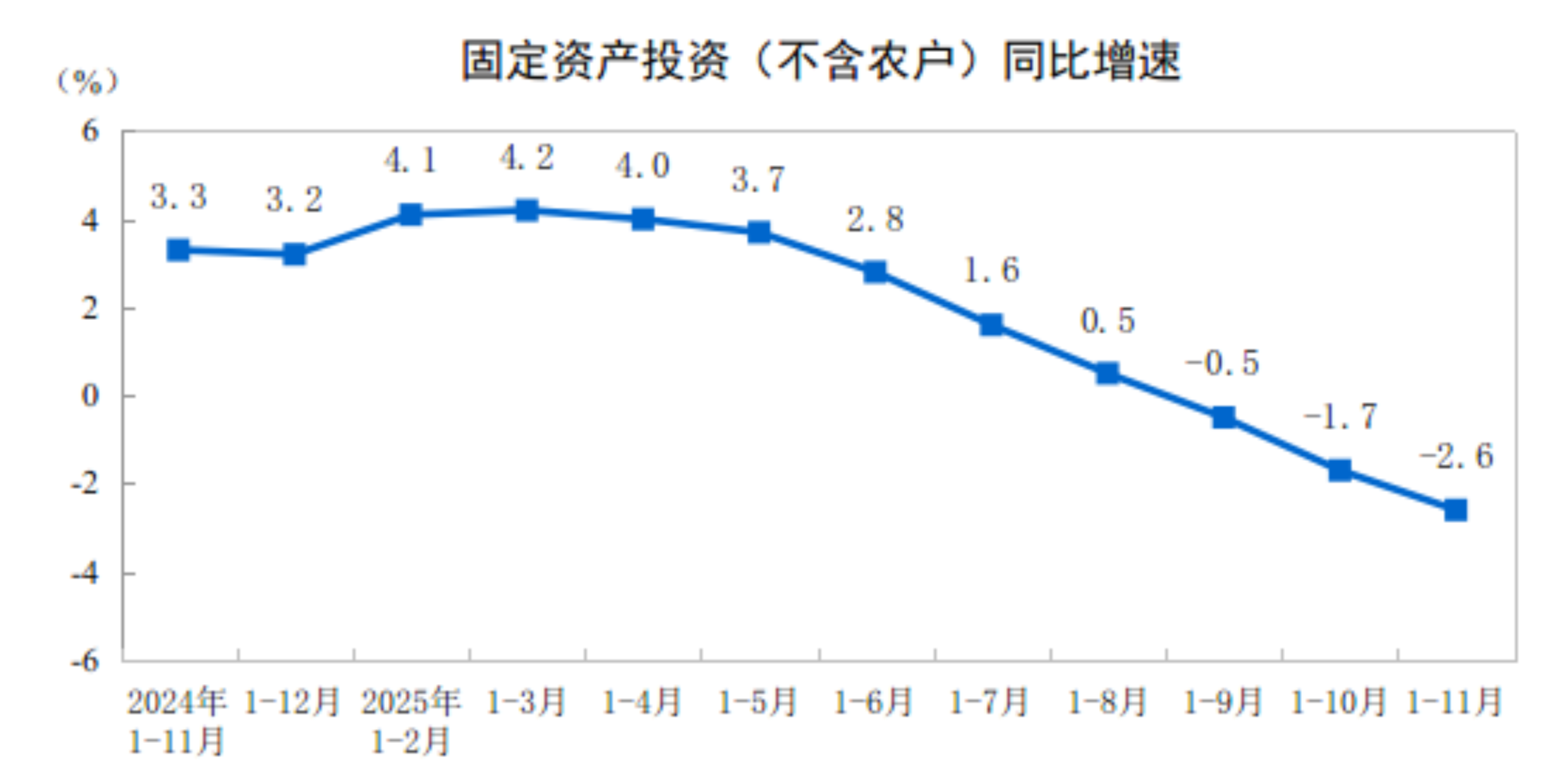
Core Viewpoint - In the first eleven months of 2025, China's fixed asset investment (excluding rural households) reached 444,035 billion yuan, showing a year-on-year decline of 2.6% [1][4]. Investment by Industry - Investment in the primary industry was 8,770 billion yuan, with a year-on-year growth of 2.7% [3][5]. - Investment in the secondary industry totaled 162,243 billion yuan, increasing by 3.9% [3][5]. - Investment in the tertiary industry was 273,022 billion yuan, reflecting a decline of 6.3% [3][5]. - Within the secondary industry, industrial investment grew by 4.0%, with mining investment also increasing by 4.0%, manufacturing investment rising by 1.9%, and investment in electricity, heat, gas, and water production and supply increasing by 10.7% [3][6]. Investment by Region - Eastern region investment decreased by 6.6%, central region investment fell by 1.7%, western region investment declined by 0.2%, and northeastern region investment saw a significant drop of 14.0% [3][6]. Investment by Registration Type - Domestic enterprises' fixed asset investment decreased by 2.6%, investment from Hong Kong, Macau, and Taiwan enterprises fell by 2.2%, while foreign enterprises' investment dropped sharply by 14.1% [3][6]. Detailed Investment Data - The overall fixed asset investment (excluding rural households) showed a decline of 2.6% year-on-year, with state-controlled investment down by 1.1% and private investment down by 5.3% [5][6]. - Specific categories such as construction and installation projects saw a decline of 6.4%, while equipment and tool purchases increased by 12.2% [5][6]. Industry-Specific Performance - In the manufacturing sector, notable growth was observed in the automotive manufacturing industry at 15.3% and in the railway, shipbuilding, aerospace, and other transportation equipment manufacturing at 22.4% [6][7]. - Conversely, the pharmaceutical manufacturing industry experienced a decline of 8.2%, and the chemical raw materials and chemical products manufacturing sector saw a drop of 13.1% [6][7]. Summary of Investment Trends - The overall trend indicates a contraction in fixed asset investment across various sectors, with significant regional disparities and varying performance across industries, highlighting potential areas for investment focus and concern [1][3][4].
2025年11月份规模以上工业增加值增长4.8% - 国家统计局
Guo Jia Tong Ji Ju· 2025-12-29 09:36
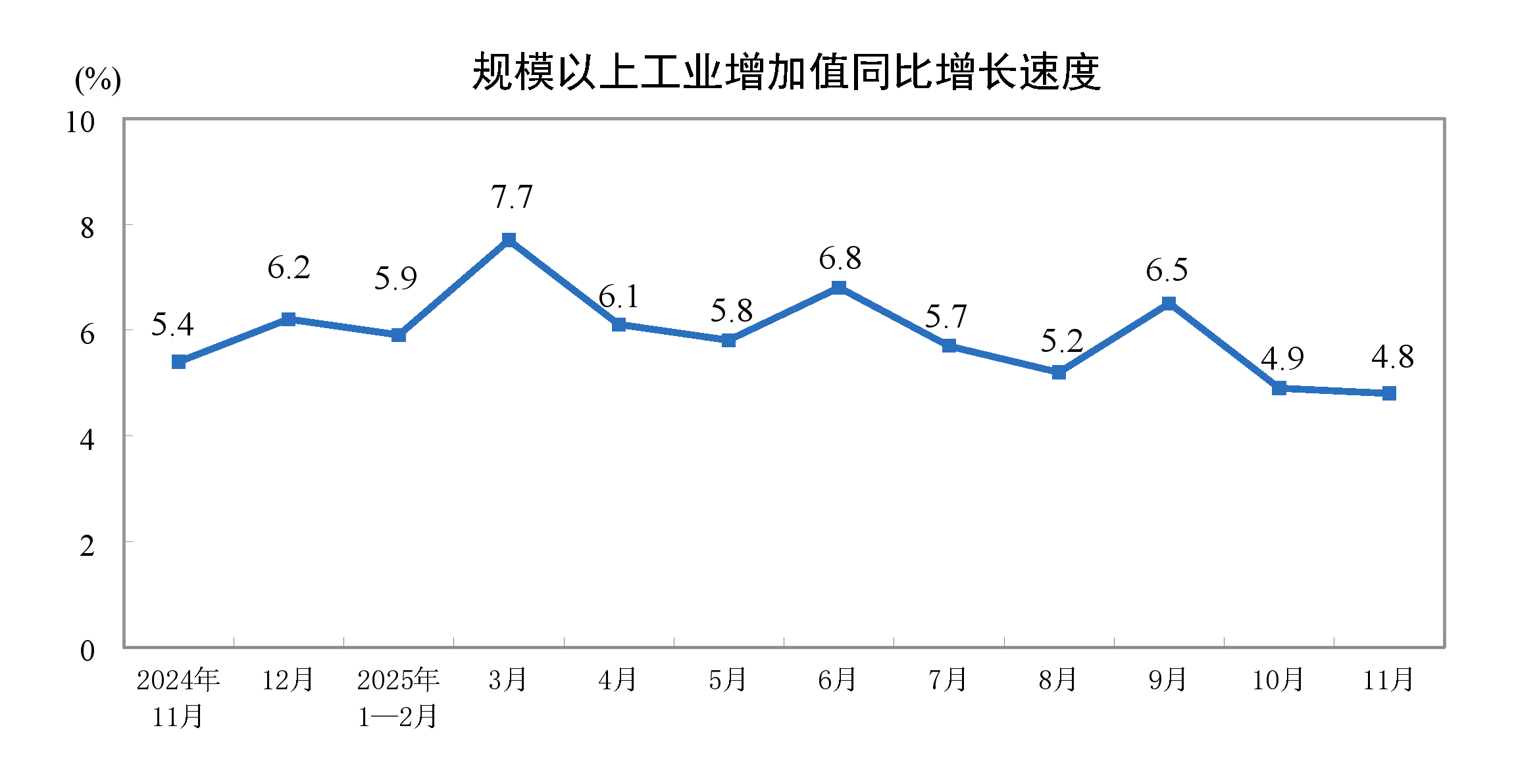
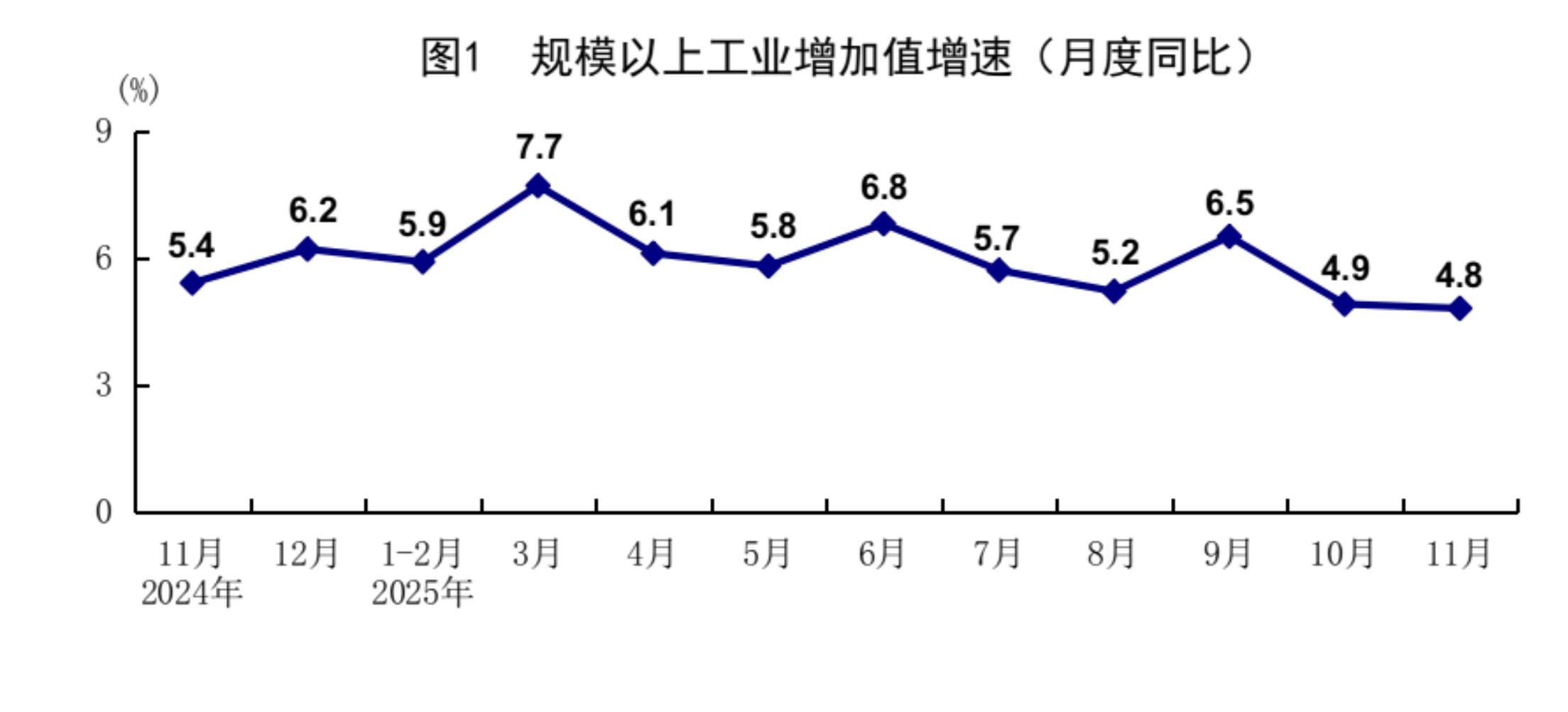
Core Insights - In November, the industrial added value of large-scale enterprises increased by 4.8% year-on-year, with a month-on-month growth of 0.44% [1] - From January to November, the industrial added value grew by 6.0% year-on-year [1] Group 1: By Industry - In November, the mining industry saw a year-on-year increase of 6.3%, manufacturing grew by 4.6%, and the production and supply of electricity, heat, gas, and water increased by 4.3% [3] - Among 41 major industries, 30 reported year-on-year growth in added value, with coal mining and washing growing by 7.5%, oil and gas extraction by 5.1%, and food processing by 1.7% [3] - The automotive manufacturing sector experienced significant growth of 11.9%, while the production of new energy vehicles surged by 17.0% [4][11] Group 2: By Economic Type - In November, state-controlled enterprises' added value increased by 4.2%, while joint-stock enterprises grew by 5.2%, foreign and Hong Kong, Macao, and Taiwan-invested enterprises by 3.4%, and private enterprises by 3.2% [3] Group 3: Product Output - Out of 623 industrial products, 310 saw year-on-year output growth in November, including ethylene at 309,000 tons (up 7.3%) and automotive production at 3.519 million units (up 2.4%) [4][14] - The sales rate of products from large-scale industrial enterprises was 96.5%, a decrease of 0.8 percentage points year-on-year [4][16] - The export delivery value of large-scale industrial enterprises was 1.361 trillion yuan, a nominal decrease of 0.1% year-on-year [4][16]
11月份国民经济延续稳中有进发展态势 - 国家统计局
Guo Jia Tong Ji Ju· 2025-12-29 09:36
(2025年12月15日) 国家统计局 11月份,在以习近平同志为核心的党中央坚强领导下,各地区各部门认真贯彻落实党中央、国务院决策 部署,坚持稳中求进工作总基调,深入实施更加积极有为的宏观政策,纵深推进全国统一大市场建设, 着力推动高质量发展,生产供给基本平稳,就业形势总体稳定,市场价格继续改善,新质生产力稳步发 展,经济运行延续总体平稳、稳中有进发展态势。 一、全年粮食实现丰收,稳定在1.4万亿斤以上 全年全国粮食产量14298亿斤,比上年增加167.5亿斤,增长1.2%,稳定在1.4万亿斤以上。其中,秋粮 产量10732亿斤,比上年增加163.6亿斤,增长1.5%。全国谷物产量13204亿斤,比上年增加158.4亿斤, 增长1.2%。粮食播种面积增加、单产提高。全国粮食播种面积17.91亿亩,比上年增加134.8万亩,增长 0.1%;粮食单产399.1公斤/亩,每亩产量比上年增加4.4公斤,增长1.1%。 二、工业生产稳定增长,装备制造业和高技术制造业增长较快 11月份,全国规模以上工业增加值同比增长4.8%,环比增长0.44%。分三大门类看,采矿业增加值同比 增长6.3%,制造业增长4.6%,电力、热 ...
2025年1—11月份全国规模以上工业企业利润增长0.1% - 国家统计局
Guo Jia Tong Ji Ju· 2025-12-29 09:36
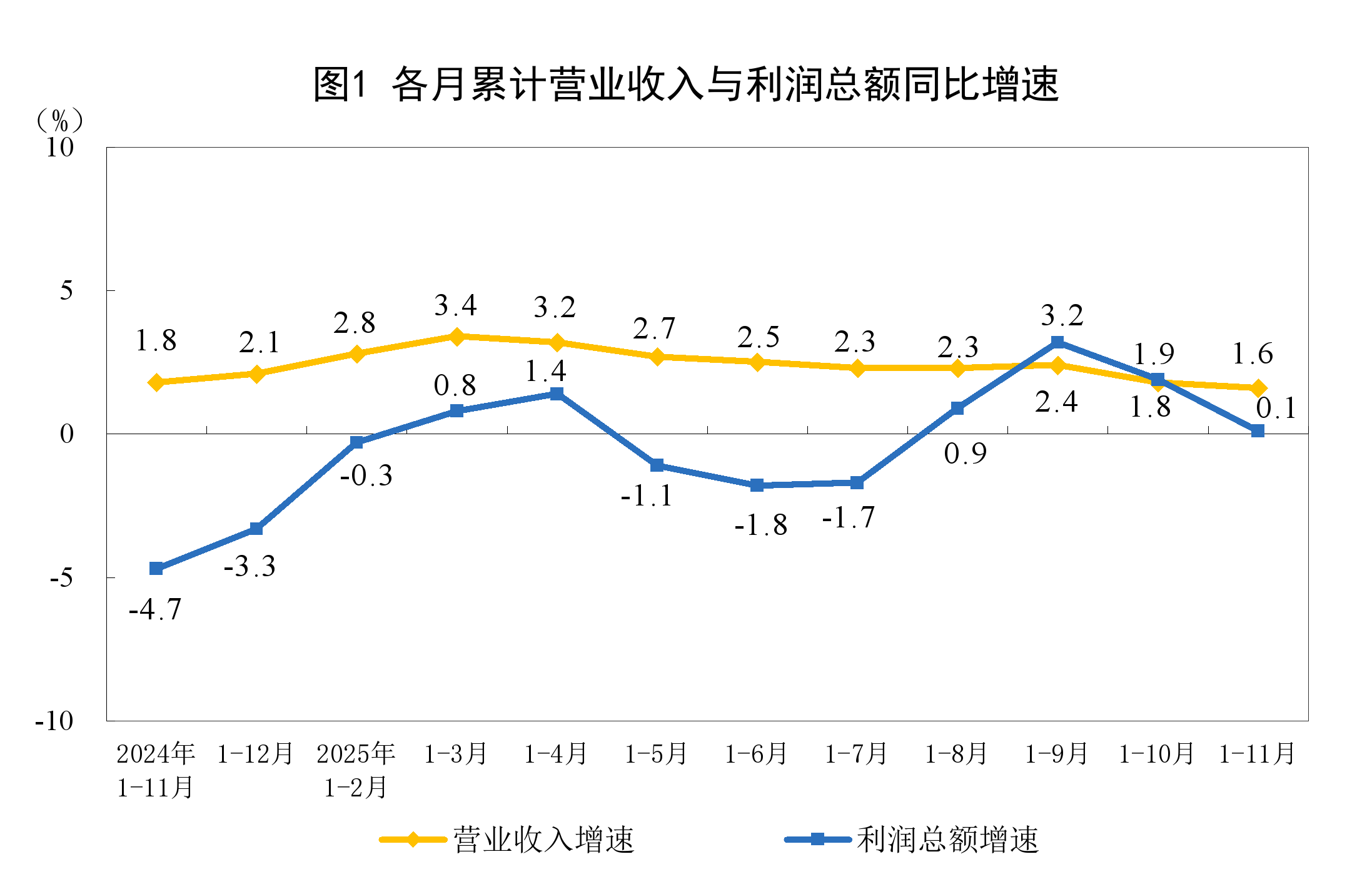
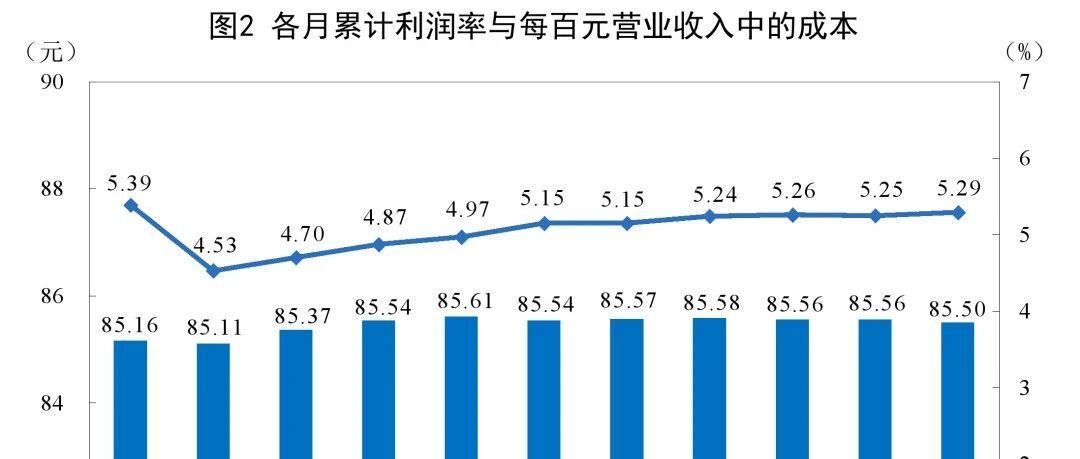
Core Insights - The total profit of industrial enterprises above designated size in China reached 66,268.6 billion yuan from January to November, showing a slight year-on-year increase of 0.1% [1] - The profit performance varied across different types of enterprises, with state-owned enterprises experiencing a decline of 1.6%, while foreign and Hong Kong, Macao, and Taiwan-invested enterprises saw a growth of 2.4% [1][2] - The mining industry faced a significant profit drop of 27.2%, while the manufacturing sector reported a profit increase of 5.0% [1][2] Profit by Industry - The computer, communication, and other electronic equipment manufacturing industry saw a profit increase of 15.0%, while the power, heat, gas, and water production and supply industry grew by 11.8% [2] - The automotive manufacturing industry reported a profit growth of 7.5%, while the textile industry experienced a decline of 8.2% [2] - The coal mining and washing industry faced a drastic profit decrease of 47.3% [2] Financial Metrics - From January to November, the total operating revenue of industrial enterprises was 125.34 trillion yuan, reflecting a year-on-year growth of 1.6%, while operating costs increased by 1.8% to 107.17 trillion yuan [2] - The operating profit margin was recorded at 5.29%, a decrease of 0.08 percentage points compared to the previous year [2] - By the end of November, total assets of industrial enterprises amounted to 189.28 trillion yuan, with total liabilities reaching 109.96 trillion yuan, resulting in an asset-liability ratio of 58.1% [2][3] Efficiency Indicators - The cost per 100 yuan of operating revenue was 85.50 yuan, an increase of 0.18 yuan year-on-year, while expenses per 100 yuan of operating revenue decreased by 0.06 yuan to 8.39 yuan [3] - The average revenue per 100 yuan of assets was 74.4 yuan, down by 2.4 yuan year-on-year, while the average revenue per employee increased by 57,000 yuan to 1.865 million yuan [3] - The inventory turnover days for finished products increased to 20.5 days, and the average collection period for accounts receivable extended to 70.4 days [3]
杭氧股份:12月29日召开董事会会议
Mei Ri Jing Ji Xin Wen· 2025-12-29 08:06
截至发稿,杭氧股份市值为300亿元。 每经头条(nbdtoutiao)——直击茅台经销商大会:2000多人周末齐聚!重大变革公布:涉及茅台酒价 格、分销等,董事长陈华:经销商不能再"躺着赚钱" 每经AI快讯,杭氧股份(SZ 002430,收盘价:30.68元)12月29日晚间发布公告称,公司第八届第三十 五次董事会会议于2025年12月29日以通讯方式召开。会议审议了《关于注销山西晋南钢铁新材料气体有 限公司的议案》等文件。 2025年1至6月份,杭氧股份的营业收入构成为:气体行业占比62.68%,制造业占比35.97%,其他业务 占比0.7%,工程总包占比0.66%。 (记者 曾健辉) ...

【数据发布】2025年1—11月份全国规模以上工业企业利润增长0.1%
中汽协会数据· 2025-12-29 07:59
Core Viewpoint - In the first eleven months, the total profit of industrial enterprises above designated size reached 66,268.6 billion yuan, with a year-on-year growth of 0.1% [1][4]. Group 1: Profit and Revenue Overview - In the first eleven months, state-controlled enterprises achieved a total profit of 20,083.6 billion yuan, down 1.6% year-on-year; joint-stock enterprises reported a profit of 49,565.6 billion yuan, down 0.4%; foreign and Hong Kong, Macao, and Taiwan-invested enterprises saw a profit of 16,355.3 billion yuan, up 2.4%; private enterprises reported a profit of 19,319.9 billion yuan, down 0.1% [1]. - The mining industry recorded a total profit of 7,896.3 billion yuan, a decline of 27.2% year-on-year; the manufacturing sector achieved a profit of 50,317.9 billion yuan, an increase of 5.0%; the electricity, heat, gas, and water production and supply industry reported a profit of 8,054.4 billion yuan, up 8.4% [1]. Group 2: Industry-Specific Profit Trends - In November, the computer, communication, and other electronic equipment manufacturing industry saw a profit increase of 15.0%; the electricity and heat production and supply industry grew by 11.8%; the non-ferrous metal smelting and rolling processing industry increased by 11.1%; the automotive manufacturing industry grew by 7.5% [2]. - Conversely, the coal mining and washing industry experienced a profit decline of 47.3%; the oil and natural gas extraction industry fell by 13.6%; the textile industry decreased by 8.2% [2]. Group 3: Financial Metrics - In the first eleven months, the total operating revenue of industrial enterprises above designated size was 125.34 trillion yuan, a year-on-year increase of 1.6%; operating costs amounted to 107.17 trillion yuan, up 1.8%; the operating profit margin was 5.29%, down 0.08 percentage points year-on-year [2]. - By the end of November, total assets of industrial enterprises above designated size reached 189.28 trillion yuan, a year-on-year growth of 4.8%; total liabilities were 109.96 trillion yuan, up 5.0%; total equity was 79.32 trillion yuan, increasing by 4.5%; the asset-liability ratio stood at 58.1%, up 0.1 percentage points year-on-year [2][3]. Group 4: Efficiency Indicators - By the end of November, accounts receivable amounted to 28.40 trillion yuan, a year-on-year increase of 5.5%; finished goods inventory was 6.92 trillion yuan, up 4.6% [3]. - The average cost per 100 yuan of operating revenue was 85.50 yuan, an increase of 0.18 yuan year-on-year; the average expense per 100 yuan of operating revenue was 8.39 yuan, a decrease of 0.06 yuan year-on-year [3].
2026年宏观经济形势展望:增长动能巩固,名义增速修复
Shanxi Securities· 2025-12-29 07:26
Economic Growth Outlook - China's economy is expected to maintain a reasonable growth rate of around 5% in 2026, with overall economic growth risks decreasing[2] - The decline in real estate investment is anticipated to narrow, supported by proactive policies aimed at stabilizing the housing market[3] - Consumption, infrastructure investment, and manufacturing upgrades are expected to be the main drivers of growth, with these sectors projected to grow faster than in 2025[2] Inflation and Price Trends - CPI is expected to show moderate improvement, driven by rising pork and service prices, while PPI is projected to narrow its decline and potentially rebound by Q4 2026[3] - The overall price level recovery will be gradual, characterized by "moderate recovery and structural differentiation," contributing to further nominal economic growth[3] Policy Environment - The macroeconomic policy will continue to be "proactive and effective," emphasizing coordination and flexibility, with increased counter-cyclical adjustments[2] - Fiscal policy is expected to remain "more proactive," with a projected deficit rate of around 4% and a deficit scale of approximately 5.9 trillion yuan[61] - Monetary policy will maintain an "appropriately loose" stance, with expectations of a 0.5 percentage point reduction in the reserve requirement ratio[67] Risks and Challenges - Potential risks include policy underperformance, unstable consumer expectations, escalating US-China strategic tensions, and geopolitical conflicts[4]