
装备制造业

Search documents
国家统计局:6月份规模以上工业企业利润同比降幅较5月份有所收窄 以装备工业为代表的新动能行业利润增长较快
news flash· 2025-07-27 01:37
Core Insights - In June, the decline in profits for large-scale industrial enterprises narrowed compared to May, with new momentum industries like equipment manufacturing showing rapid profit growth [1] Group 1: Industrial Performance - In June, large-scale industrial enterprises achieved a total profit of 715.58 billion yuan, a year-on-year decline of 4.3%, which is a narrowing of 4.8 percentage points from May [1] - The revenue of large-scale industrial enterprises grew by 1.0% year-on-year in June, maintaining the same growth rate as in May, which supports the recovery of corporate profits [1] - Cumulatively, from January to June, the revenue of large-scale industrial enterprises increased by 2.5%, while profits decreased by 1.8% [1] Group 2: Equipment Manufacturing Sector - In June, the equipment manufacturing sector's revenue grew by 7.0% year-on-year, accelerating by 0.3 percentage points compared to May [2] - Profits in the equipment manufacturing sector shifted from a decline of 2.9% in May to a growth of 9.6% in June, contributing 3.8 percentage points to the overall profit growth of large-scale industrial enterprises [2] - Among the eight industries in equipment manufacturing, four reported profit growth, with the automotive industry experiencing a remarkable profit increase of 96.8% due to promotional activities and investment returns [2] Group 3: High-end, Intelligent, and Green Manufacturing - The high-end, intelligent, and green manufacturing sectors saw rapid profit growth in June, providing stable support for high-quality industrial development [3] - Profits in high-end equipment manufacturing sectors such as electronic materials, aircraft manufacturing, and marine engineering equipment grew by 68.1%, 19.0%, and 17.8% respectively [3] - Profits in intelligent and automated product manufacturing increased significantly, with smart consumer devices and measuring instruments growing by 40.9% and 12.5% respectively [3] Group 4: Policy Impact - The "Two New" policies have shown continuous positive effects, with an expansion in supported categories and subsidies leading to significant profit improvements in related industries [4] - In June, profits in medical equipment manufacturing, printing, and general parts manufacturing grew by 12.1%, 10.5%, and 9.5% respectively [4] - The replacement policies for consumer goods have also been effective, with profits in smart drones and computer manufacturing increasing by 160.0% and 97.2% respectively [4]
6月份规模以上工业企业利润降幅收窄
news flash· 2025-07-27 01:32
Core Insights - In June, the profit decline of large-scale industrial enterprises narrowed compared to May, with new momentum industries like equipment manufacturing showing rapid profit growth [1] - The total profit of large-scale industrial enterprises in June reached 715.58 billion yuan, a year-on-year decrease of 4.3%, which is a 4.8 percentage point improvement from May [1] - Cumulatively, from January to June, the revenue of large-scale industrial enterprises grew by 2.5%, while profits decreased by 1.8% [1] Industry Performance - The equipment manufacturing sector demonstrated significant revenue and profit growth, contributing notably to overall industrial profit [1] - In June, the revenue of the equipment manufacturing industry increased by 7.0%, accelerating by 0.3 percentage points from May [1] - Profits in the equipment manufacturing sector shifted from a 2.9% decline in May to a 9.6% increase in June, boosting the overall profit of large-scale industries by 3.8 percentage points [1] Sector Breakdown - Among the eight industries within equipment manufacturing, four reported profit growth [1] - The automotive industry experienced a remarkable profit increase of 96.8%, driven by promotional activities and investment gains from key enterprises [1] - Other sectors such as electrical machinery, instruments, and metal products saw profit increases of 18.7%, 12.3%, and 6.2% respectively [1]
【广发宏观吴棋滢】6月财政数据简评
郭磊宏观茶座· 2025-07-26 11:34
Core Viewpoint - The overall performance of public finance in the first half of 2025 is stable, with a slight decline in revenue growth, indicating the need for continued improvement in tax and government fund income through PPI and land market enhancements [5][23]. Group 1: Public Finance Revenue - In the first half of 2025, public finance revenue showed a cumulative year-on-year decline of 0.3%, slightly lower than the previous year's growth of 1.3% [1][6]. - Tax revenue decreased by 1.2% year-on-year, an improvement compared to last year's decline of 3.4%, while non-tax revenue growth significantly slowed from 25.4% last year to 3.7% this year [1][8]. - The decline in non-tax revenue is attributed to a high base last year and a reduced reliance on non-tax income by the government [1][6]. Group 2: Monthly Performance - In June, tax revenue increased by 1.0% year-on-year, slightly higher than the previous value, while non-tax revenue fell by 3.7%, indicating an expanded decline [2][9]. - Domestic value-added tax and corporate income tax recorded year-on-year increases of 5.0% and 2.7%, respectively, contributing positively to June's fiscal revenue growth [2][11]. - The equipment manufacturing industry, modern services, and cultural sports entertainment sectors showed strong tax performance, reflecting the economic recovery in these areas [2][11]. Group 3: Fiscal Expenditure - Narrow fiscal expenditure in June saw a year-on-year decline of 0.4%, down from 2.6% previously, influenced by a decrease in non-tax revenue and a lull in infrastructure funding [3][12]. - Technology spending led the expenditure categories with an 18.1% year-on-year increase, while infrastructure-related expenditures showed weak performance, particularly in transportation and agriculture [3][14]. - The overall expenditure progress for the first half of the year was at 47.6%, indicating a slower pace compared to previous years, with expectations for acceleration in the second half [3][13]. Group 4: Government Fund Income - Government fund income in the first half of 2025 decreased by 2.4% year-on-year, primarily due to continued weakness in the land market, with land transfer income down 6.5% [4][19]. - In June, government fund budget revenue surged by 20.8%, marking a significant increase, although July data showed a notable decline, raising questions about the sustainability of this recovery [4][19]. - Government fund budget expenditure rose sharply by 79.2% year-on-year, largely driven by the issuance of special bonds, indicating a significant increase in overall fiscal spending [4][20].


上半年财政账单出炉:税收下降1.2%,土地收入下降6.5%
Sou Hu Cai Jing· 2025-07-26 11:24
Group 1 - In the first half of the year, the securities transaction stamp duty increased by 54.1% year-on-year, while corporate income tax decreased by 1.9%, personal income tax increased by 8%, domestic consumption tax increased by 1.7%, vehicle purchase tax decreased by 19.1%, and tariffs decreased by 7.7% [2] - The national government fund budget revenue for the first half of the year was 1.9442 trillion yuan, a year-on-year decrease of 2.4%. The income from the transfer of state-owned land use rights was 1.4271 trillion yuan, down 6.5% year-on-year [2] - From April, monthly tax revenue has shown year-on-year growth, with April increasing by 1.9%, May by 0.6%, and June by 1% [2] Group 2 - Non-tax revenue growth has slowed, with declines of 2.2% and 3.7% in May and June respectively. Revenue from the paid use of state resources increased by 4.8%, while administrative fees grew by 1% [3] - The Ministry of Finance has implemented a more proactive fiscal policy, focusing on boosting consumption and stabilizing employment and the economy. In the first half of the year, central government transfers to local governments reached 9.29 trillion yuan, accounting for 89.8% of the annual budget [3] - A total of 2.6 trillion yuan in new local government bonds were issued in the first half of the year to support major projects [3] Group 3 - The Ministry of Finance has increased efforts to ensure basic livelihoods and introduced new measures to boost consumption, including childcare subsidies and gradually implementing free preschool education [4] - Two batches of long-term special bond funds totaling 162 billion yuan were allocated for the replacement of old consumer goods [4] - A pilot project for providing consumption subsidies to elderly individuals with moderate to severe disabilities has been initiated to alleviate their care costs [4]

1月至6月全国财政运行整体平稳 重点领域支出保障良好
Yang Guang Wang· 2025-07-26 00:42
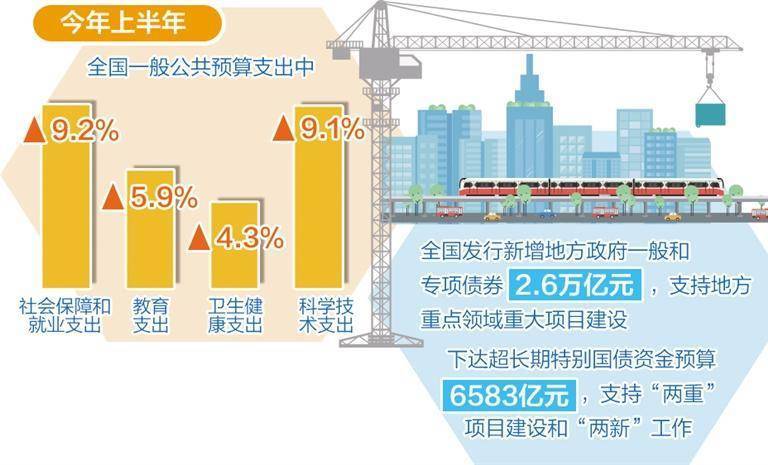
Group 1 - The central government has implemented a more proactive fiscal policy in the first half of the year, increasing expenditure intensity and optimizing expenditure structure to ensure support for key areas [1][2] - National general public budget expenditure reached 14.13 trillion yuan, a year-on-year increase of 3.4% [1] - Key areas of expenditure include social security and employment (up 9.2%), education (up 5.9%), health (up 4.3%), and science and technology (up 9.1%) [1] Group 2 - National general public budget revenue for the first half of the year was 11.56 trillion yuan, with major tax categories showing stable growth [1] - From April, monthly tax revenue has maintained year-on-year growth for three consecutive months, with domestic VAT, consumption tax, and personal income tax increasing by 2.8%, 1.7%, and 8% respectively [1] - Central government transfer payments to local governments reached 9.29 trillion yuan, accounting for 89.8% of the annual budget [2] Group 3 - The issuance of new local government general and special bonds amounted to 2.6 trillion yuan to support major projects [2] - The sales of consumer goods under the "old for new" program reached 1.6 trillion yuan, indicating positive results in stimulating consumption [2] - The Ministry of Finance has allocated additional special bond funds to support local consumption initiatives, with 690 million yuan allocated in the third batch [2]
3.4%,财政支出力度持续加大
Sou Hu Cai Jing· 2025-07-25 22:16
Group 1: Fiscal Revenue and Expenditure - In the first half of the year, the national general public budget revenue was 11.56 trillion yuan, a year-on-year decrease of 0.3%, with the decline narrowing by 0.8 percentage points compared to the first quarter [2] - National general public budget expenditure reached 14.13 trillion yuan, an increase of 3.4% year-on-year, indicating strong support for key areas [2] - Tax revenue for the first half was 9.29 trillion yuan, down 1.2% year-on-year, but showed a recovery trend with three consecutive months of growth starting in April [3] Group 2: Tax Revenue Performance - Major tax categories showed stable growth, with domestic VAT, domestic consumption tax, and individual income tax increasing by 2.8%, 1.7%, and 8% respectively [3] - Export tax rebates amounted to 1.27 trillion yuan, an increase of 132.2 billion yuan compared to the same period last year, supporting foreign trade exports [3] - The equipment manufacturing and modern service industries performed well in tax revenue, with significant increases in various sectors [3] Group 3: Non-Tax Revenue Trends - Non-tax revenue reached 2.27 trillion yuan, growing by 3.7% year-on-year, but the growth rate fell by 5.1 percentage points compared to the first quarter [4] - Revenue from the paid use of state resources increased by 4.8%, driven by local governments activating assets [4] - Administrative fees grew by 1%, while penalty income decreased by 4.3%, indicating a mixed performance in non-tax revenue sources [4] Group 4: Fiscal Policy and Spending - The government is implementing a more proactive fiscal policy to ensure sustained economic support, with increased spending intensity and optimized expenditure structure [5] - Social security and employment expenditures grew by 9.2%, education spending increased by 5.9%, and health spending rose by 4.3% in the first half [6] - A total of 2.43 trillion yuan was spent from government fund budgets, driving a 30% increase in government fund budget expenditure [6] Group 5: Support for Consumption and Employment - The government allocated 300 billion yuan in special bonds to support consumption upgrades, with funds already disbursed to promote consumer spending [7] - Employment support measures include reduced insurance rates and expanded subsidies, with 66.74 billion yuan allocated for employment assistance [8] - The basic pension for retirees was increased by 2%, and the minimum standard for urban and rural residents' pensions was raised by 20 yuan [8] Group 6: Healthcare and Social Services - Per capita financial subsidies for public health services increased to 99 yuan per year, enhancing public health service levels [9] - Financial support for urban and rural residents' medical insurance was raised to 700 yuan per year, with additional funds allocated for medical assistance [9] - The government is focusing on improving elderly care services and establishing a childcare subsidy system to reduce family costs [9]
下半年“国补”资金地方额度已定,提振消费增量政策蓄势待发
2 1 Shi Ji Jing Ji Bao Dao· 2025-07-25 13:21
Group 1 - In the first half of 2025, China's general public budget revenue was approximately 11.56 trillion yuan, a year-on-year decrease of 0.3%, with the decline narrowing by 0.8 percentage points compared to the first quarter [1] - National general public budget expenditure reached 14.13 trillion yuan, showing a year-on-year growth of 3.4%, indicating strong fiscal spending [1] - The issuance of government bonds and local bonds increased significantly, with 7.88 trillion yuan in national bonds issued, a year-on-year increase of 35.28% [1][3] Group 2 - The fiscal policy has been notably proactive, with a planned deficit rate of 4%, corresponding to a deficit scale of 5.66 trillion yuan, and a total of 11.86 trillion yuan in new government bonds to be issued, which is an increase of 2.9 trillion yuan compared to last year [3][4] - The issuance of special bonds and local government bonds totaled 2.6 trillion yuan, supporting major projects in local areas [4] - The retail sales of consumer goods increased by 5% year-on-year, significantly supported by the consumption upgrade policy [6] Group 3 - The export tax rebate reached 1.27 trillion yuan, a year-on-year increase of 11.6%, which positively supported foreign trade but negatively impacted fiscal revenue [2][3] - The fiscal revenue quality is improving, with tax revenue showing positive growth for three consecutive months starting from April [2][3] - The government plans to accelerate the implementation of policies to boost consumption, including support for new consumption models and enhancing the consumer environment [7]
“两新”政策实施成效显著 上半年5大类消费品以旧换新销售额已超2024年
Zheng Quan Ri Bao Wang· 2025-07-25 13:13
Core Insights - The article emphasizes the significant market potential for equipment updates and consumer goods replacement in China, with an annual market scale exceeding 5 trillion yuan [1] - The implementation of the "Two New" policy is expected to drive substantial growth in equipment updates and consumer goods sales, particularly in the automotive and home appliance sectors [2] Group 1: Market Size and Growth - By the end of 2024, the total assets of large-scale industrial enterprises in China will exceed 178 trillion yuan, with a substantial number of aging vehicles and home appliances indicating a strong demand for upgrades [1] - The total number of equipment updates in key sectors is projected to exceed 20 million units in 2024, with significant year-on-year growth in related manufacturing sectors [2] Group 2: Recycling and Utilization - In 2024, the number of new intelligent community recycling facilities will reach over 11,000, with a significant increase in the recycling of scrapped vehicles and household appliances [3] - The recycling of major renewable resources is expected to exceed 400 million tons, reflecting a 7.2% year-on-year growth [3] Group 3: Policy Implementation and Support - The article outlines the need for enhanced coordination and effective implementation of the "Two New" policy, including the acceleration of project construction and fund allocation [3][4] - Financial support mechanisms will be strengthened, including interest subsidies for equipment update loans and increased green credit for sustainable consumer goods [4]
上半年,济南市规模以上制造业增加值同比增长9.0%
Qi Lu Wan Bao Wang· 2025-07-25 12:38
Core Insights - Jinan's industrial production showed stable and rapid growth in the first half of 2025, with a year-on-year increase of 8.2% in industrial added value, outperforming national and provincial averages by 1.8 and 0.5 percentage points respectively [1] - The manufacturing sector in Jinan also experienced steady growth, with a 9.0% increase in added value, contributing significantly to the overall industrial growth [1] Group 1: Manufacturing Sector Performance - The added value of Jinan's manufacturing industry grew by 9.0% year-on-year, exceeding the overall industrial growth by 0.8 percentage points, and contributing 7.4 percentage points to the city's industrial growth [1] - Key industries such as computer communication and other electronic equipment manufacturing, as well as automobile manufacturing, saw substantial increases of 80.7% and 33.1% respectively, together contributing 9.9 percentage points to the overall industrial growth [1] - Conversely, the black metal smelting and rolling processing industry experienced a decline of 13.2% [1] Group 2: Key Sector Growth - The equipment manufacturing sector recorded a remarkable 24.8% increase in added value, significantly higher than the overall industrial and manufacturing growth rates by 16.6 and 15.8 percentage points respectively, contributing 11.0 percentage points to the overall industrial growth [3] - High-tech manufacturing also showed strong performance with a 25.0% increase in added value, surpassing the overall industrial growth rate by 16.8 percentage points and contributing 4.8 percentage points to the overall industrial growth [3] Group 3: Production and Sales Coordination - Jinan's industrial products maintained stable supply, with significant increases in production for key products such as new energy vehicles, which saw a doubling in output, and server production, which grew by 11.5% [3] - The production of generator sets increased by 42.7%, while crude steel and steel product outputs declined by 10.2% and 14.1% respectively [3] - The industrial sales rate in Jinan reached 98.8%, exceeding the provincial average by 4.4 percentage points, and showing improvements compared to both the previous quarter and the same period last year [3]

今年以来财政运行总体平稳 财政支出力度持续加大
Sou Hu Cai Jing· 2025-07-25 11:01
Group 1 - The overall fiscal operation in China is stable, with a total public budget revenue of 11.56 trillion yuan in the first half of the year, a year-on-year decrease of 0.3%, but the decline has narrowed by 0.8 percentage points compared to the first quarter [1] - Tax revenue is gradually recovering, with a total tax revenue of 9.29 trillion yuan in the first half, down 1.2% year-on-year, but showing monthly growth for three consecutive months starting from April [1] - Major tax categories such as domestic VAT, domestic consumption tax, and individual income tax have shown stable growth rates of 2.8%, 1.7%, and 8% respectively [1] Group 2 - Non-tax revenue growth has slowed, with a total of 2.27 trillion yuan in the first half, a year-on-year increase of 3.7%, which is a decline of 5.1 percentage points compared to the first quarter [2] - Local public budget revenue has increased by 1.6% in the first half, with 27 out of 31 provinces achieving growth [2] Group 3 - Fiscal expenditure has increased, with total public budget expenditure reaching 14.13 trillion yuan in the first half, a year-on-year growth of 3.4% [3] - Key areas such as social security and employment, education, and health have seen significant increases in expenditure, with growth rates of 9.2%, 5.9%, and 4.3% respectively [3] - The issuance and use of bond funds have accelerated, with 2.43 trillion yuan spent on government special bonds in the first half, driving a 30% increase in government fund budget expenditure [3]