
水泥

Search documents
上峰水泥半导体投资迎来密集收获期 双轮驱动战略显成效
Zheng Quan Shi Bao Wang· 2025-10-24 11:03
Core Insights - Shangfeng Cement has made significant progress in the semiconductor investment sector, with its affiliate Angrui Microelectronics receiving rapid approval from the China Securities Regulatory Commission (CSRC) for its listing application, setting a new record for the Sci-Tech Innovation Board [1] - The company is transitioning its strategy from "one main business and two wings" to a "dual-wheel drive" model, indicating a successful upgrade in its investment strategy [1][3] Investment Achievements - Angrui Microelectronics, a company focused on RF and analog integrated circuit design, has been recognized as a national-level "little giant" enterprise and is backed by a specialized equity investment fund [1] - The company has also successfully completed the issuance of Yisiwei Material Technology, which will be listed on the Sci-Tech Innovation Board on October 28, 2025, raising approximately 4.636 billion yuan [2] Financial Performance - Despite a challenging national cement market, Shangfeng Cement reported a net cash flow of 476 million yuan in the first half of 2025, reflecting a year-on-year increase of 23.99% [2] - The net profit contribution from equity investment business reached 22.6% in 2024, with cumulative profits from equity investments amounting to 530 million yuan over five years [2] Strategic Planning - The company plans to reserve over 3 billion yuan in equity assets over the next five years, aiming for significant valuation appreciation as equity investments enter a harvest phase [3] - The profit contribution ratio of the "one main business and two wings" strategy is approximately 6:2:2, showcasing the evolution from a single cement producer to a composite enterprise integrating industry and capital [3]

二十届四中全会公报点评:窥探未来五年的投资方向
Shanghai Securities· 2025-10-24 10:30
Economic Planning and Investment Opportunities - The "15th Five-Year Plan" (2026-2030) is crucial for achieving socialist modernization by 2035, presenting significant investment opportunities[3] - The emphasis on "technological self-reliance" and "domestic substitution" is expected to drive long-term investment logic, particularly in critical sectors[4] Key Investment Sectors - Focus on semiconductors, software and IT services, high-end equipment manufacturing, and AI chips as areas with strong growth potential[4] - The construction of a unified national market is vital for enhancing domestic demand and reducing reliance on external markets[5] Industry Outlook - Cyclical industries like coal, steel, chemicals, and cement may experience a turnaround, presenting investment value as low-end supply exits the market[6] - The push for a comprehensive green transition will accelerate opportunities in renewable energy sectors such as photovoltaics, energy storage, and electric vehicles[7] Risks and Considerations - Potential risks include underwhelming growth policies, escalating US-China trade conflicts, and geopolitical uncertainties[8]
水泥板块10月24日跌0.85%,海南瑞泽领跌,主力资金净流入5228.53万元
Zheng Xing Xing Ye Ri Bao· 2025-10-24 08:27
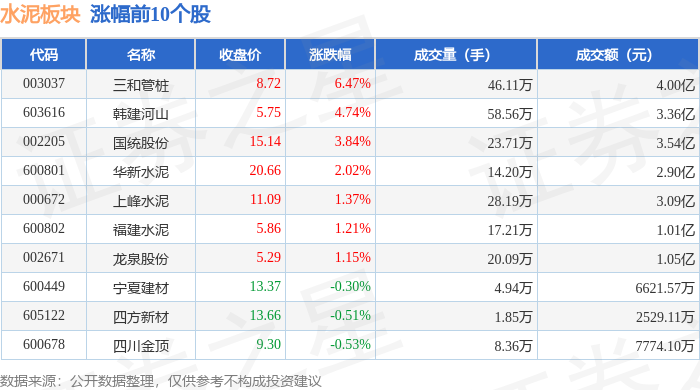
Core Points - The cement sector experienced a decline of 0.85% on October 24, with Hainan Ruize leading the drop [1] - The Shanghai Composite Index closed at 3950.31, up 0.71%, while the Shenzhen Component Index closed at 13289.18, up 2.02% [1] Cement Sector Performance - Notable gainers in the cement sector included: - Sanhe Yingshang (003037) with a closing price of 8.72, up 6.47% and a trading volume of 461,100 shares, totaling 400 million yuan [1] - Hanjian Heshan (603616) closed at 5.75, up 4.74% with a trading volume of 585,600 shares [1] - Guotong Co. (002205) closed at 15.14, up 3.84% with a trading volume of 237,100 shares [1] - Other companies like Huaxin Cement (600801) and Shangfeng Cement (000672) also saw modest gains of 2.02% and 1.37% respectively [1] Capital Flow Analysis - The cement sector saw a net inflow of 52.29 million yuan from institutional investors and a net inflow of 67.39 million yuan from retail investors, while individual investors experienced a net outflow of 120 million yuan [3]


华龙证券:玻纤“复价模式”开启 建材行业盈利能力有望持续提升
智通财经网· 2025-10-24 08:09
Group 1: Core Insights - The real estate policies continue to be implemented, which is expected to drive valuation recovery and improvement in the building materials industry [1][2] - In September, the cement market entered the traditional peak season, but the recovery in demand remains insufficient, with a significant year-on-year decline in cement production [2][3] - The glass fiber industry is seeing price increases initiated by Shandong Glass Fiber, which is expected to enhance industry profitability [1][4] Group 2: Cement Industry - The cement market showed a month-on-month recovery in September, but the year-on-year average shipment rate declined by nearly 4 percentage points [3] - The weak demand recovery in September is attributed to investment declines and frequent rainfall affecting construction progress [2][3] - The average price of cement in September 2025 is reported at 346.77 yuan/ton, reflecting a slight increase from June [3] Group 3: Glass Industry - The float glass market is expected to enter a phase of fluctuation after a price increase, with some year-end demand but overall weak market conditions [3] - Supply pressures remain, and the daily production is expected to stay above 160,000 tons [3] - Key companies to watch in the glass industry include Qibin Group and Jinjing Technology [3] Group 4: Glass Fiber Industry - Shandong Glass Fiber announced price adjustments for certain products, increasing prices by 5%-10% [4] - The China Glass Fiber Industry Association has called for a fair competitive environment, which may lead to improved profitability in the industry [4] - Key companies to monitor in the glass fiber sector include China Jushi and Zhongcai Technology [4] Group 5: Consumer Building Materials - Continuous real estate policy implementation is expected to improve industry valuation and fundamentals, with recommended companies including Weixing New Materials and Beixin Building Materials [4]

9月基建表现疲软,四季度基建或受益增量资金和政策催化 | 投研报告
Zhong Guo Neng Yuan Wang· 2025-10-24 02:04
Group 1: Construction and Infrastructure Investment - In the first nine months of 2025, real estate development investment decreased by 13.9%, while narrow infrastructure and broad infrastructure investments increased by 1.1% and 3.3% respectively [1][2] - In September 2025, real estate development investment fell by 21.3%, narrow infrastructure by 4.7%, and broad infrastructure by 8.0% [1][2] - The overall performance of infrastructure in the third quarter was weak due to a high base, but the fourth quarter is expected to benefit from early fiscal fund allocations and the acceleration of 500 billion yuan in new policy financial tools [1][2] Group 2: Real Estate and Construction Performance - From January to September 2025, the sales area of real estate decreased by 5.5%, with a monthly decline of 11.9% [2] - The completion area of real estate saw a monthly increase of 0.38% in September, marking the first positive monthly growth since 1999 [2] - The construction area decreased by 9.4% year-on-year, with a monthly decline of 16.44% [2] Group 3: Cement Industry Insights - Cement production from January to September 2025 was 1.259 billion tons, down 5.2% year-on-year, with September's production at 154 million tons, a decline of 8.6% [2][3] - The average cement shipment rate was 41.3%, down 2.6 percentage points year-on-year, indicating weak demand [2] - Cement prices showed fluctuations, with an average price of 351 yuan per ton, down 64 yuan year-on-year, but slightly up by 4 yuan from early September [2] Group 4: Glass Industry Demand - Flat glass production from January to September 2025 was 72.881 million heavy boxes, down 5.2% year-on-year, with September's production at 8.148 million heavy boxes, a decline of 9.7% [3] - There was a slight improvement in demand for float glass in September, with a good trading atmosphere and a decrease in producer inventory [3] - The average price for 5mm float white glass was 67.8 yuan per heavy box, showing a year-on-year increase of 1.9 yuan [3]
天风研究:9月基建表现疲软,四季度基建或受益增量资金和政策催化
Ge Long Hui· 2025-10-24 01:43
Group 1 - Infrastructure investment in September showed weakness, with a focus on potential recovery in Q4 due to early fiscal fund allocation and new policy financial tools totaling 500 billion [2][6] - Real estate completion growth turned positive for the first time in 24 years in September, while overall infrastructure performance remained average [3][6] - Cement demand is gradually weakening, with a notable decline in production and shipment rates, indicating a need to monitor recovery dynamics in cement profitability [4][6] Group 2 - The glass market showed signs of demand improvement in September, with a slight increase in trading atmosphere and a reduction in producer inventory, although overall market sentiment remains cautious [5][6] - The average price of cement in China was 351 yuan per ton, reflecting a year-on-year decrease of 64 yuan, but a slight increase from early September [4][6] - The construction sector is expected to benefit from increased funding and policy support, particularly for undervalued high-dividend construction stocks [2][6]
山金期货黑色板块日报-20251024
Shan Jin Qi Huo· 2025-10-24 01:28
Report Investment Rating - No investment rating information provided in the report Core Views - For the steel sector, although the apparent demand for rebar has rebounded this week, it remains weaker than the same period last year. Rebar production has increased, but the decline in total inventory is slow. Hot-rolled coil inventory has significantly increased and is now much higher than the same period. Coke and coking coal prices are strong, providing some support for costs. However, due to the sharp decline in steel mill profits and the approaching end of the consumption peak, steel mills may reduce production, potentially triggering a negative feedback loop. Technically, the futures prices of rebar and hot-rolled coil have closed above the 10-day moving average for two consecutive days, indicating a possible end to the downward trend [2]. - For the iron ore sector, the high iron ore demand is supported by the high iron output of sample steel mills. However, due to the decline in steel mill profits, steel mills may reduce production, which will suppress raw material prices. On the supply side, global shipments are at a high level, and the increase in port inventories during the peak consumption season has a certain suppressing effect on futures prices. The slow destocking of steel inventories also dampens the overall market sentiment. Technically, the 01 contract has rebounded slightly, and there are resistances at the 60-day and 10-day moving averages. Attention should be paid to whether it can break through these two important resistance levels [5]. Summary by Directory I. Rebar and Hot-Rolled Coil - **Supply and Demand**: This week's data shows that the apparent demand for rebar continues to rebound but is weaker than the same period last year. Rebar production has increased, but the total inventory decline is slow. Hot-rolled coil inventory has significantly increased and is much higher than the same period. Coke and coking coal prices are strong, providing some support for costs. However, due to the sharp decline in steel mill profits and the approaching end of the consumption peak, steel mills may reduce production, potentially triggering a negative feedback loop [2]. - **Technical Analysis**: On the daily K-line chart, the futures prices of rebar and hot-rolled coil have closed above the 10-day moving average for two consecutive days, indicating a possible end to the downward trend [2]. - **Operation Suggestion**: Short positions can be held lightly, and profits should be taken in a timely manner when the price drops [2]. - **Data Summary**: - **Prices**: Rebar and hot-rolled coil futures and spot prices have increased to varying degrees. For example, the closing price of the rebar main contract is 3,071 yuan/ton, up 0.10% from the previous day and 0.72% from last week [3]. - **Production**: The national building materials steel mill rebar production is 207.07 million tons, an increase of 5.91 million tons from last week, a growth rate of 2.94%. Hot-rolled coil production is 322.46 million tons, an increase of 0.62 million tons from last week, a growth rate of 0.19% [3]. - **Inventory**: The five major varieties of social inventory are 1,099.7 million tons, a decrease of 26.14 million tons from last week, a decline of 2.32%. Rebar social inventory is 437.48 million tons, a decrease of 18.93 million tons from last week, a decline of 4.15%. Hot-rolled coil social inventory is 337.57 million tons, a decrease of 3.77 million tons from last week, a decline of 1.10% [3]. - **Apparent Demand**: The apparent demand for the five major varieties is 892.73 million tons, an increase of 17.32 million tons from last week, a growth rate of 1.98%. Rebar apparent demand is 226.01 million tons, an increase of 6.26 million tons from last week, a growth rate of 2.85% [3]. II. Iron Ore - **Supply and Demand**: High iron ore demand is supported by the high iron output of sample steel mills. However, due to the decline in steel mill profits, steel mills may reduce production, which will suppress raw material prices. On the supply side, global shipments are at a high level, and the increase in port inventories during the peak consumption season has a certain suppressing effect on futures prices. The slow destocking of steel inventories also dampens the overall market sentiment [5]. - **Technical Analysis**: The 01 contract has rebounded slightly, and there are resistances at the 60-day and 10-day moving averages. Attention should be paid to whether it can break through these two important resistance levels [5]. - **Operation Suggestion**: Short positions can be continued to be held [5]. - **Data Summary**: - **Prices**: Iron ore spot and futures prices have increased to varying degrees. For example, the settlement price of the DCE iron ore main contract is 777 yuan/dry ton, up 0.39% from the previous day and 0.45% from last week [5]. - **Shipments**: Australian iron ore shipments are 1,729.5 million tons, an increase of 65.3 million tons from last week, a growth rate of 3.92%. Brazilian iron ore shipments are 749 million tons, an increase of 22.1 million tons from last week [5]. - **Inventory**: Port inventories are 14,278.27 million tons, an increase of 253.77 million tons from last week, a growth rate of 1.81%. The inventory of imported sintered powder ore in 64 sample steel mills is 1,291.42 million tons, a decrease of 0.44 million tons from last week, a decline of 0.03% [5]. III. Industry News - **Coal**: Mongolian coal imports have decreased significantly due to political struggles in Mongolia. On Wednesday, the number of customs clearance vehicles at the Ganqimaodu Port was 570, a decrease of 43.95% compared to the average daily number in October, and it is expected to gradually recover next week [6]. - **Cement**: In the fourth quarter, the intensity of staggered production in the cement industry has increased, and the monthly average kiln shutdown in some areas exceeds 20 days. Recently, cement prices in many places have shown an upward trend [6]. - **Steel Inventory**: In mid-October, the social inventory of steel products in 21 cities was 9.36 million tons, a decrease of 100,000 tons from the previous period, a decline of 1.1%. The inventory fluctuated slightly [7]. - **Coking Coal**: The utilization rate of the approved production capacity of 523 coking coal mine samples was 85.1%, a decrease of 2.3% from the previous period. The daily average output of raw coal was 1.91 million tons, a decrease of 51,000 tons from the previous period [7]. - **Rebar**: As of the week of October 23, rebar production increased from a decline, and the factory and social inventories decreased for two consecutive weeks, while the apparent demand increased for two consecutive weeks [7]. - **Iron Ore Production**: In the third quarter of 2025, the iron ore output of Fortescue Metals Group was 50.8 million tons, a decrease of 7% from the previous quarter and an increase of 6% from the same period last year [8]. - **Global Steel Production**: In September 2025, global crude steel production decreased by 1.6% year-on-year to 141.8 million tons. China's steel production was 73.49 million tons, a year-on-year decrease of 4.6% [8]. - **Glass Inventory**: As of October 23, the total inventory of national float glass sample enterprises was 66.613 million heavy boxes, an increase of 2.337 million heavy boxes or 3.64% from the previous period, an increase for three consecutive weeks after the festival, reaching a three-month high [8].
玻纤“复价模式”开启,行业盈利能力有望持续提升 | 投研报告
Zhong Guo Neng Yuan Wang· 2025-10-24 01:28
Core Viewpoint - The construction materials industry is experiencing a continued demand decline, with specific challenges in the cement sector, despite some policy support aimed at stabilizing the market [2][3]. Cement Industry - In September, the national average cement shipment rate showed a slight month-on-month increase but a nearly 4 percentage point year-on-year decline, indicating ongoing demand shrinkage [1][3]. - The average cement price in September 2025 is reported at 346.77 yuan/ton, reflecting a 5.43 yuan/ton increase from June, yet the overall demand remains weak [1][3]. - Factors contributing to the weak demand include investment declines and project funding shortages, which hinder construction progress, alongside frequent rainfall affecting operations [3]. Glass Industry - The float glass market is expected to transition into a fluctuating trend after recent price increases, with some year-end demand but overall supply pressure remaining [4]. - The anticipated daily production is expected to maintain above 160,000 tons, but demand is primarily driven by essential purchases due to funding and payment issues [4]. - Key companies to watch in the glass sector include Qibin Group and Jinjing Technology [4]. Fiberglass Industry - A price adjustment announcement from Shandong Fiberglass indicates a 5%-10% increase in prices for certain fiberglass products, signaling a potential recovery in the industry [5]. - The China Fiberglass Industry Association has initiated a joint effort to establish a fair competitive environment, which may enhance profitability across the sector [5]. - Notable companies in this space include China Jushi and Zhongcai Technology [5]. Consumer Building Materials - Continuous real estate policy implementations are expected to drive industry valuation recovery and fundamental improvements, with recommended companies including Weixing New Materials and Beixin Building Materials [5].
股市必读:华新水泥(600801)10月23日主力资金净流出1748.36万元,占总成交额4.96%
Sou Hu Cai Jing· 2025-10-23 17:58
Group 1 - The stock price of Huaxin Cement (600801) closed at 20.25 yuan on October 23, 2025, down by 1.56% with a turnover rate of 1.31% and a trading volume of 175,700 lots, amounting to a total transaction value of 352 million yuan [1] - On October 23, the net outflow of main funds was 17.48 million yuan, accounting for 4.96% of the total transaction value, while retail investors saw a net inflow of 14.74 million yuan, representing 4.18% of the total transaction value [1][3] Group 2 - Huaxin Cement announced the approval of a public bond issuance plan on March 19, 2025, with a scale not exceeding 3 billion yuan, and a term of no more than 10 years [2] - The company successfully issued 1.5 billion yuan of technology innovation bonds (second phase) with a coupon rate of 1.99% and a term of 3 years, with the raised funds intended for repaying interest-bearing debts [2][3] - The issuer's credit rating is AAA, which indicates a strong creditworthiness [2]

四中全会公报火线解读
2025-10-23 15:20
Summary of Key Points from the Conference Call Industry and Company Overview - The conference call primarily discusses the implications of the Fourth Plenary Session of the 19th Central Committee of the Communist Party of China, focusing on the modernization of the economy and various sectors including manufacturing, culture, and rural development. Core Insights and Arguments 1. **Economic Growth and Policy Measures** The session emphasizes achieving a GDP growth target of around 5% for 2025, supported by fiscal and quasi-fiscal policies, including the introduction of 500 billion new policy financial tools and revitalizing local debt limits to boost economic growth in Q4 [5][12][16]. 2. **Focus on Advanced Manufacturing** The session highlights the importance of advanced manufacturing as a backbone of the modern industrial system, stressing the need for self-reliance in technology and innovation [2][14]. 3. **Rural Modernization and Infrastructure Investment** Plans to enhance rural living conditions and increase investment in public services and infrastructure are outlined, aiming for coordinated regional development in key areas like Beijing-Tianjin-Hebei, Yangtze River Delta, and Guangdong-Hong Kong-Macau [7][11]. 4. **Cultural Strengthening** The importance of cultural output and confidence is emphasized, with a focus on stimulating national cultural innovation, which presents opportunities for the cultural and media sectors [9][11]. 5. **Trade and Global Supply Chain Stability** China aims to maintain a multilateral trade system, implementing zero tariffs for least developed countries and enhancing trade cooperation with Africa and ASEAN, showcasing the advantages of Chinese manufacturing [6][16]. 6. **Investment in Human Capital** The principle of "investing in people" is highlighted, with increased support for social welfare programs such as childcare subsidies, aimed at reducing living costs and stimulating consumption [10][11]. 7. **Market Outlook for A-shares** The A-share market is expected to remain stable in the short term, with a focus on sectors like technology, data economy, and traditional industries such as steel and cement, reflecting a shift from risk to livelihood in real estate [13][16][21]. 8. **Structural Changes in the A-share Market** A structural divergence is noted within the A-share market, with significant differences in performance between new productivity sectors and traditional real estate, indicating varying investment opportunities [18][19]. 9. **New Structural Reforms** New structural reforms are anticipated to impact sectors such as photovoltaics, lithium batteries, and new energy vehicles, which are closely linked to the transition from old to new economic drivers [20]. Other Important Insights - **Short-term Economic Risks** Short-term risks in the A-share market are considered manageable, with a focus on specific themes and styles to capture potential opportunities [21]. - **Consumer Demand Expansion** The expansion of consumer demand is seen as crucial in the current policy environment, with certain stocks showing significant returns compared to traditional indices [19]. - **Future of Space Economy and Marine Industry** The development of the space economy and marine industry is viewed as having vast potential, driven by national priorities in aerospace and deep-sea technology [8]. This summary encapsulates the key points discussed in the conference call, providing insights into the strategic direction of China's economic policies and their implications for various sectors and the A-share market.