
电动汽车

Search documents
对美国而言,这远不止经济上的不便,更是地缘战略上的耻辱
Hu Xiu· 2025-10-16 09:55
Core Viewpoint - The article discusses the escalating tensions between the U.S. and China regarding technology and material supply chains, highlighting how U.S. measures to isolate China have inadvertently revealed America's own vulnerabilities in critical materials and technologies [1][2][4]. Group 1: U.S. Measures and China's Response - The U.S. has implemented tariffs, export bans, and sanctions aimed at isolating China and maintaining its technological dominance [1]. - In response, China has enacted stringent export controls on key materials such as lithium batteries, graphite anodes, and rare earth technologies, marking a significant escalation in the global materials sovereignty struggle [3][5]. - These measures are framed as necessary for national security and are intended to prevent the proliferation of weapons [3]. Group 2: Impact on U.S. Industries - The export restrictions target critical sectors including clean energy, military, and semiconductors, which are vital to U.S. economic and technological ambitions [6]. - Over 78% of materials used in U.S. military equipment are sourced from China, indicating a deep reliance on Chinese supply chains [8]. - The inability of the U.S. to quickly replace these materials could lead to significant delays in military production and maintenance [8]. Group 3: Economic Implications - The new export controls could severely impact the U.S. economy, with projections suggesting that GDP growth could be limited to 0.1% in the first half of 2025 without the influence of AI-related capital expenditures [9]. - Supply chain issues in the AI sector could hinder its expansion and lead to increased costs, affecting various industries from electric vehicles to consumer electronics [10][12]. - The U.S. electric vehicle revolution is heavily dependent on a battery supply chain dominated by China, which poses risks to production costs and decarbonization efforts [11][13]. Group 4: Geopolitical Dynamics - The article suggests that the U.S. is facing a strategic embarrassment as it becomes increasingly reliant on a country it seeks to undermine [21]. - European nations may find opportunities to enhance their own industrial capabilities in response to the U.S.-China tensions, potentially leading to a re-industrialization effort [23][24]. - Global South countries are also positioned to leverage their resource wealth, potentially collaborating with China or Europe while avoiding U.S. conditions [25][26]. Group 5: Structural Challenges for the U.S. - The U.S. faces significant challenges in rebuilding its industrial ecosystem, including time, material resources, and technical knowledge [14][16][17]. - Developing new mining and refining capabilities could take a decade, and the U.S. lacks the necessary infrastructure to process its own mineral resources effectively [15][16]. - The article emphasizes the asymmetry in global economic structures, where China leads in actual product production while the U.S. dominates narrative control [27].

突发!蔚来被新加坡主权基金起诉 相关指控三年前已澄清
Mei Ri Jing Ji Xin Wen· 2025-10-16 08:51
Core Viewpoint - NIO's stock price has significantly declined following a lawsuit filed by Singapore's sovereign wealth fund, GIC, alleging securities fraud against the company and its executives [1][2] Group 1: Lawsuit Details - GIC has accused NIO of inflating revenue and profits through its partnership with Wuhan Weinan Battery Asset Co., misleading investors and causing financial losses [1] - The lawsuit is based on allegations from a short-seller report by Grizzly Research in June 2022, which claimed NIO manipulated its financials to present a misleadingly strong performance [2][3] Group 2: Previous Investigations - NIO conducted an independent internal review in August 2022, which found no wrongdoing regarding the allegations made in the short-seller report, supported by third-party legal and accounting experts [3] - The SEC also inquired about NIO's accounting practices related to Wuhan Weinan, but no further action was taken after NIO's response [3] Group 3: Market Reactions and Context - Major financial institutions, including Deutsche Bank and Morgan Stanley, have publicly disagreed with the conclusions of the Grizzly Research report, defending NIO's business model [3] - GIC has a history of filing lawsuits against companies for investment losses, indicating a strategic approach to risk management during market volatility [4]

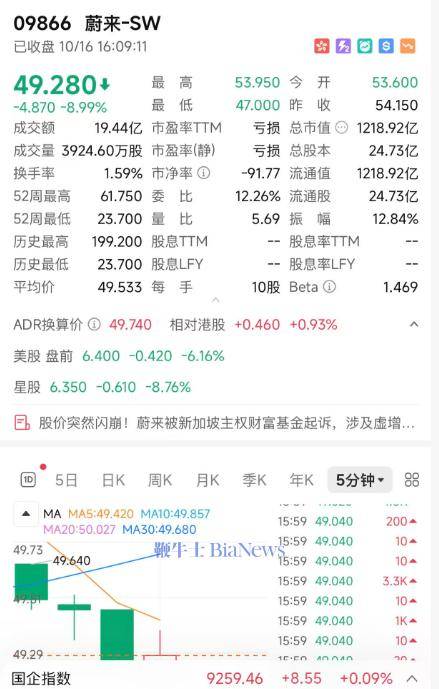
蔚来股票大跌8.99%
Sou Hu Cai Jing· 2025-10-16 08:47
Group 1 - NIO's stock price experienced a significant decline, closing at 49.280 HKD, down 4.870 HKD, representing a drop of 8.99% [1][2] - The trading volume reached 19.44 billion HKD, with a total market capitalization of 1218.92 billion HKD [1][2] - The stock hit a high of 53.950 HKD and a low of 47.000 HKD during the trading session [2] Group 2 - The Singapore sovereign wealth fund, GIC, has filed a lawsuit against NIO and its executives in a U.S. court, alleging securities fraud and inflated revenues [1][2]
突发!千亿巨头闪崩,什么情况? 全市场超4100只个股下跌,煤炭、银行等传统行业回暖...
雪球· 2025-10-16 08:08
Market Overview - The market experienced a pullback after reaching a high, with the three major indices briefly turning negative during the session. The Shanghai Composite Index rose by 0.1%, while the Shenzhen Component fell by 0.25%, and the ChiNext Index increased by 0.38% [1] Trading Volume - The trading volume in the Shanghai and Shenzhen markets was 1.93 trillion yuan, a decrease of 141.7 billion yuan compared to the previous trading day. Over 4,100 stocks in the market declined [2] Sector Performance - The coal, insurance, and port shipping sectors saw the largest gains, while precious metals, semiconductors, and wind power sectors experienced the most significant declines [3] Automotive Sector - The automotive sector faced significant pressure, with NIO's stock plunging over 13% at one point, ultimately closing down more than 8%. Other companies like XPeng Motors and Xiaomi also saw declines of over 3% and nearly 4%, respectively [4][5] - The decline in the automotive sector was attributed to a lawsuit filed by Singapore's Government Investment Corporation (GIC) against NIO and its executives, alleging securities fraud related to inflated revenue and profits through misleading accounting practices [8] Coal Sector - The coal sector led the market with an index increase of nearly 3%. Major companies like Dayou Energy achieved a limit-up, marking their fifth increase in four days. Other companies such as China Coal Energy and Zhengzhou Coal Electricity also saw significant gains [9][10] - A recent cold wave sweeping across northern China has triggered heating supply demands, leading to increased coal prices. The annual contract prices for various coal grades have risen by 2 yuan per ton compared to the previous month [12] - In September 2025, China imported 46.03 million tons of coal, marking a new high for the year. Analysts expect that the tightening supply and seasonal demand will support coal prices and improve profitability for coal companies in the fourth quarter [12][13] Pharmaceutical Sector - The pharmaceutical sector showed renewed activity, with companies like Guizhou Bai Ling and others experiencing significant stock price increases. Guizhou Bai Ling's stock reached its limit-up after receiving approval for clinical trials of a new diabetes treatment [14][18] - The innovative drug sector is expected to maintain high revenue growth, with analysts recommending attention to companies in the CXO, upstream scientific reagents, and medical equipment segments for investment opportunities [18]

突发!蔚来汽车遭起诉,股价暴跌
Shen Zhen Shang Bao· 2025-10-16 07:22
Core Viewpoint - NIO Inc. faces significant stock price decline following a lawsuit filed by Singapore's sovereign wealth fund, GIC Private Limited, alleging securities fraud against the company and its executives [2][3] Group 1: Stock Performance - NIO's stock price dropped over 12% during trading, with a notable decline of 10.2% in Singapore, reaching $6.25 [1] - As of the latest update, NIO's shares in Hong Kong fell over 9%, trading at 49.22 HKD [2] Group 2: Legal Issues - GIC has filed a lawsuit in the U.S. against NIO and its executives, claiming that the company exaggerated revenue and profits through its joint venture, Wuhan WeNeng Battery Asset Co., Ltd. [2] - The lawsuit alleges that NIO misled investors, resulting in GIC suffering losses estimated between $500 million to $2 billion from its investment in NIO [2] - The lawsuit is a response to a short-selling report released by Grizzly Research in June 2022, which raised concerns about NIO's financial practices [3] Group 3: Financial Data - Following the establishment of WeNeng in August 2020, NIO's revenue surged from 2.85 billion CNY in Q4 2020 to 6.64 billion CNY, marking a 133% increase [2] - GIC purchased 54.45 million shares of NIO between August 2020 and July 2022, with significant losses attributed to the stock's decline [2] Group 4: Market Reaction - The lawsuit has drawn considerable attention in the capital markets, as it marks the first instance of a sovereign wealth fund suing a Chinese concept stock independently [3] - NIO's recent sales performance has been mixed, with overall sales showing resilience in the electric vehicle market, but flagship model ET9's sales have been disappointing [3]
工信部公开征集对《电动汽车芯片环境及可靠性通用规范》等154项行业标准计划项目的意见
Zheng Quan Shi Bao Wang· 2025-10-16 06:29
Core Viewpoint - The Ministry of Industry and Information Technology (MIIT) has announced the public disclosure of 154 industry standard project applications, including the "General Specifications for Environmental and Reliability of Electric Vehicle Chips" [1] Group 1 - The MIIT is following its overall plan for standardization work by proposing new industry standards [1] - Stakeholders are invited to provide feedback on the proposed standard projects during the public notice period [1] - The feedback can be submitted through a designated form to the Science and Technology Department of the MIIT [1]
报告:全球电动车渗透率达25%,中国领跑,补能基建提速但仍存痛点
Zhong Guo Neng Yuan Wang· 2025-10-16 06:25
Core Insights - The report by Roland Berger highlights steady growth in electric vehicle (EV) usage and charging infrastructure globally, with the overall sales penetration rate of electric vehicles increasing from 20% in 2023 to 25% in 2024 [1] Group 1: Global Electric Vehicle Market - The global electric vehicle sales penetration rate is projected to rise, with China leading at a penetration rate increase from 36% in 2023 to 49% in 2024 [2] - Norway ranks second in EV sales penetration but shows weaknesses in infrastructure development [1][2] - The United States has a significant EV ownership but faces challenges due to policy fluctuations, with sales penetration slightly increasing from 10% in 2023 to 11% in 2024 [2] Group 2: Regional Performance - The Asia-Pacific region is dominated by China, which accounts for over 90% of EV sales, while South Korea's ranking has declined due to low user satisfaction with its charging network [2] - In Europe, Germany's EV sales penetration dropped from 26% in 2023 to 22% in 2024, while the UK has seen strong growth, moving up to fourth place globally [3] - The Middle East and North Africa are still in the early stages of electrification, with countries like Saudi Arabia and Qatar lagging behind [3] Group 3: Charging Infrastructure - Global public charging stations increased by 33%, but the ratio of EVs to charging stations has slightly decreased due to faster growth in EV sales compared to infrastructure [4] - China maintains a high public charging station availability ratio, with 79% of respondents indicating increasing convenience in public charging [4] - The total number of public charging stations is expected to grow from 3.8 million at the end of 2023 to over 5 million by the end of 2024, with over two-thirds of new stations located in China [4] Group 4: User Experience and Challenges - The report identifies that the availability of home charging facilities is crucial for EV adoption, but the proportion of home charging has decreased from 87% in 2023 to 85% [6] - Approximately 85% of EV users utilize home charging, but about half of charging activities still occur outside the home, highlighting the importance of public charging infrastructure [6][7] - Key user concerns include long charging times and insufficient infrastructure, with 47% dissatisfied with charging speed and 45% citing a lack of facilities [7]
美国电动汽车大撤退,压力给到特斯拉
Feng Huang Wang· 2025-10-16 05:31
Core Insights - Tesla is facing a decline in market share and demand, with its share in the U.S. electric vehicle market dropping to 43.1% as of September, down from 49% at the end of last year [2] - Traditional automakers like General Motors and Ford are scaling back their electric vehicle ambitions due to policy changes, which may create opportunities for Tesla to regain market share [3][5] - Despite the challenges, Tesla's stock has rebounded over 7% this year, partly due to Elon Musk's significant stock purchases [3] Industry Challenges - The expiration of the federal tax credit for electric vehicles has led to a predicted 50% drop in demand for pure electric vehicles, according to Ford's CEO [1][2] - Major automakers are reporting significant financial impacts, with GM announcing a $1.6 billion write-down related to electric vehicle investments [1] - The overall market for electric vehicles is expected to face a downturn, with analysts predicting a revenue decline for Tesla in Q4 and a potential annual revenue drop for 2025 [4] Tesla's Strategic Focus - Elon Musk is shifting focus towards autonomous taxi services and humanoid robots, which he believes will be crucial for Tesla's future growth [7] - Tesla is attempting to mitigate the impact of subsidy cancellations by introducing simplified, lower-cost versions of its Model Y SUV and Model 3 sedan [2][4] - Despite the introduction of lower-priced models, there is skepticism about their ability to significantly revitalize demand in the current market [4][6]


记者手记丨从“中国制造”到“中国创造”
Xin Hua Wang· 2025-10-16 04:58
Core Insights - The article emphasizes the growing international influence of Chinese brands, highlighting their transition from "Made in China" to "Created in China" and the shift from speed to quality in production [1][2] Group 1: Chinese Brand Development - The number of Chinese brands in the "Global 500" has increased from 13 in 2008 to 69, showcasing significant growth and recognition on the international stage [1] - Brands like BYD have gained visibility and popularity in markets like the UK, becoming one of the fastest-growing electric vehicles [1] - The emergence of companies like DeepSeek and the popularity of products like Pop Mart's trendy toys illustrate the diverse appeal of Chinese brands, targeting emotional needs and fashion trends [1] Group 2: Cultural and Economic Impact - The charm of Chinese cities and their cultural heritage is highlighted as a factor in understanding the success of Chinese brands [2] - The "Belt and Road" initiative is noted for enhancing China's international image by contributing to infrastructure and improving living standards in various regions [2] - The growing recognition of Chinese brands in the UK has created a sense of pressure for local brands to compete internationally, reflecting the dynamics of economic globalization [2]
申银万国期货早间策略-20251016
Shen Yin Wan Guo Qi Huo· 2025-10-16 02:50
1. Report Industry Investment Rating - Not provided in the content 2. Core View of the Report - After the high - level oscillation in September, the stock index is expected to enter a direction - selection phase again, and it is likely to maintain a bullish trend. Domestically, the liquidity environment is expected to remain loose, and residents may increase their allocation of equity assets. Externally, with the Fed's interest rate cuts and RMB appreciation, foreign funds are also expected to flow into the domestic market. In terms of market style, although technology growth has been the core theme in the current upward market trend, considering the possible intensification of Q4's growth - stabilization policies and the potential resonance of global monetary and fiscal policies, the market style in Q4 may shift towards value and become more balanced compared to Q3 [2] 3. Summary by Relevant Catalogs 3.1 Stock Index Futures Market - **IF Contracts**: The previous day's closing prices of IF contracts (current month, next month, next quarter, and far - quarter) were 4601.60, 4586.60, 4576.40, and 4555.00 respectively, with increases of 70.60, 73.20, 77.20, and 77.80. The trading volumes were 40430.00, 16606.00, 86223.00, and 12308.00, and the open interests were 35819.00, 24260.00, 160428.00, and 56592.00, with changes of - 9895.00, 5467.00, - 2013.00, and - 848.00 respectively. The increases of the CSI 300 corresponding to these contracts were 1.56%, 1.62%, 1.72%, and 1.74% [1] - **IH Contracts**: The previous day's closing prices of IH contracts were 2999.40, 2998.20, 2997.40, and 2998.40, with increases of 41.00, 46.00, 44.40, and 44.60. The trading volumes were 17842.00, 6567.00, 41717.00, and 5176.00, and the open interests were 13703.00, 6914.00, 63594.00, and 13300.00, with changes of - 5392.00, 1526.00, - 1687.00, and - 796.00 respectively. The increases of the SSE 50 corresponding to these contracts were 1.39%, 1.56%, 1.50%, and 1.51% [1] - **IC Contracts**: The previous day's closing prices of IC contracts were 7278.20, 7196.20, 7140.20, and 6977.00, with increases of 118.40, 124.20, 121.60, and 120.00. The trading volumes were 38456.00, 19428.00, 105607.00, and 19123.00, and the open interests were 34255.00, 32793.00, 141518.00, and 52944.00, with changes of - 9786.00, 5875.00, - 10422.00, and - 2023.00 respectively. The increases of the CSI 500 corresponding to these contracts were 1.65%, 1.76%, 1.73%, and 1.75% [1] - **IM Contracts**: The previous day's closing prices of IM contracts were 7455.80, 7362.60, 7275.20, and 7060.20, with increases of 117.60, 128.20, 126.60, and 134.20. The trading volumes were 55423.00, 28745.00, 178569.00, and 30417.00, and the open interests were 47911.00, 46218.00, 191595.00, and 84507.00, with changes of - 11189.00, 7939.00, - 2448.00, and - 280.00 respectively. The increases of the CSI 1000 corresponding to these contracts were 1.60%, 1.77%, 1.77%, and 1.94% [1] - **Inter - month Spreads**: The current inter - month spreads of IF (next month - current month), IH (next month - current month), IC (next month - current month), and IM (next month - current month) were - 15.00, - 1.20, - 82.00, and - 93.20 respectively, compared to the previous values of - 25.20, - 3.60, - 87.40, and - 110.00 [1] 3.2 Stock Index Spot Market - **Major Indexes**: The previous day's values of the CSI 300, SSE 50, CSI 500, and CSI 1000 were 4606.29, 3001.35, 7294.00, and 7483.45 respectively, with increases of 1.48%, 1.36%, 1.38%, and 1.50%. The trading volumes (in billions of lots) were 284.77, 63.38, 217.56, and 244.85, and the total trading amounts (in billions of yuan) were 6073.26, 1571.06, 3974.59, and 4037.98 respectively [1] - **Industry Indexes**: Among different industries, the increases of energy, raw materials, industry, optional consumption, major consumption, medical and health, real - estate finance, information technology, telecommunications, and public utilities were 0.32%, 1.18%, 1.98%, 1.49%, 0.45%, 1.77%, 1.06%, 2.75%, 1.11%, and - 0.20% respectively [1] 3.3 Futures - Spot Basis - **IF Contracts**: The previous day's basis values of IF (current month - CSI 300), IF (next month - CSI 300), IF (next quarter - CSI 300), and IF (far - quarter - CSI 300) were - 4.69, - 19.69, - 29.89, and - 51.29 respectively, compared to the previous two - day values of 1.34, - 23.86, - 31.86, and - 52.86 [1] - **IH Contracts**: The previous day's basis values of IH (current month - SSE 50), IH (next month - SSE 50), IH (next quarter - SSE 50), and IH (far - quarter - SSE 50) were - 1.95, - 3.15, - 3.95, and - 2.95 respectively, compared to the previous two - day values of 3.90, 0.30, - 2.70, and - 0.10 [1] - **IC Contracts**: The previous day's basis values of IC (current month - CSI 500), IC (next month - CSI 500), IC (next quarter - CSI 500), and IC (far - quarter - CSI 500) were - 15.80, - 97.80, - 153.80, and - 317.00 respectively, compared to the previous two - day values of - 41.45, - 128.85, - 184.85, and - 350.65 [1] - **IM Contracts**: The previous day's basis values of IM (current month - CSI 1000), IM (next month - CSI 1000), IM (next quarter - CSI 1000), and IM (far - quarter - CSI 1000) were - 27.65, - 120.85, - 208.25, and - 423.25 respectively, compared to the previous two - day values of - 33.15, - 143.15, - 227.35, and - 451.15 [1] 3.4 Other Domestic and Overseas Indexes - **Domestic Indexes**: The previous day's values of the Shanghai Composite Index, Shenzhen Component Index, Small and Medium - sized Board Index, and ChiNext Index were 3912.21, 13118.75, 8106.60, and 3025.87 respectively, with increases of 1.22%, 1.73%, 1.77%, and 2.36% [1] - **Overseas Indexes**: The previous day's values of the Hang Seng Index, Nikkei 225, S&P, and DAX Index were 25910.60, 46847.32, 6671.06, and 24181.37 respectively, with increases of 1.84%, - 2.58%, 0.40%, and - 0.23% [1] 3.5 Macroeconomic Information - The US side said that whether to impose a 100% tariff on China depends on China's actions. The Chinese Ministry of Foreign Affairs responded, urging the US to correct its wrong practices and resolve issues through dialogue and negotiation. China also opposes the EU's protectionist and discriminatory practices in the name of enhancing competitiveness [2] - In September, M2 increased by 8.4% year - on - year, M1 increased by 7.2% year - on - year, and the "scissors gap" between M1 and M2 reached a new low for the year. In the first three quarters, RMB loans increased by 14.75 trillion yuan, and the cumulative increase in social financing scale was 30.09 trillion yuan, 4.42 trillion yuan more than the same period last year [2] - In September, China's CPI increased by 0.1% month - on - month and decreased by 0.3% year - on - year. Core CPI increased by 1% year - on - year, with the increase expanding for the fifth consecutive month and returning to 1% for the first time in nearly 19 months. PPI remained flat month - on - month and decreased by 2.3% year - on - year, with the decline narrowing by 0.6 percentage points compared to the previous month [2] - In September, the average interest rate of newly issued corporate loans was about 3.1%, about 40 basis points lower than the same period last year, and the average interest rate of newly issued personal housing loans was about 3.1%, about 25 basis points lower than the same period last year [2] 3.6 Industry Information - Six departments including the National Development and Reform Commission issued an action plan to double the service capacity of electric vehicle charging facilities in three years, aiming to build 28 million charging facilities nationwide by the end of 2027, providing over 300 million kilowatts of public charging capacity to meet the charging needs of over 80 million electric vehicles [2] - In September, the trading volume of the national second - hand car market was 1.7944 million, a month - on - month increase of 5.1% and a year - on - year increase of 8.2%, with a trading amount of 110.466 billion yuan [2] - Chengdu expanded the scope of beneficiaries of the "commercial - to - provident" loan policy,取消了本市缴存限制,符合条件的异地缴存人也可申请办理,and all commercial banks that have signed cooperation agreements with the Chengdu Housing Provident Fund Center can participate [2]