房地产

Search documents
新华视点丨2026年,各部委要干哪些民生实事?
Xin Hua She· 2026-01-26 06:23
Employment - The government will implement actions to stabilize and expand employment, focusing on key groups and enhancing service quality for high-quality employment [2] - Policies will include employment subsidies, guaranteed loans, and support for labor-intensive industries to maintain existing jobs [2] - There will be an emphasis on protecting the rights of flexible and new employment forms, ensuring their access to social insurance [2] Housing - The housing sector will see a shift towards a "current housing sales system" to mitigate delivery risks and enhance consumer protection [3] - Policies will include the acquisition of existing properties for affordable housing and the regulation of pre-sale fund management [3] - Reforms will also focus on improving the housing provident fund system and enhancing property service quality [3] Fertility - The goal is to achieve "no out-of-pocket" expenses for childbirth within the policy framework by 2026, with an emphasis on increasing medical expense coverage [4][5] - The number of individuals covered by maternity insurance reached 259 million by the end of November 2025, with direct disbursement of maternity benefits to insured individuals [5] - Future plans include expanding coverage to flexible workers and migrant workers, and incorporating prenatal check-ups into the basic service package [5] Elderly Care - A comprehensive and accessible elderly care service system will be developed to address the needs of the aging population, projected to reach 320 million by the end of 2025 [6][7] - Initiatives will focus on care for disabled and elderly individuals living alone, and the promotion of rural elderly care services [7] Education - A new round of "Double First Class" construction will be initiated to enhance the quality of local universities and align them with regional strategic needs [8] - The education sector will focus on optimizing resource allocation in response to demographic changes and supporting the development of schools in under-resourced areas [8] Consumption - The government will optimize the implementation of the old-for-new consumption policy to stimulate consumer spending and upgrade product offerings [9][10] - A budget of 62.5 billion yuan will be allocated to support the old-for-new policy, with a focus on promoting green and smart products [10] Agriculture - The agricultural sector aims to maintain food security and enhance production capacity, with a focus on increasing farmers' income and improving rural living conditions [11] - The government will continue to support agricultural technology innovation and rural reform to modernize the agricultural industry [11]
宏观量化经济指数周报20260126:二手房销售景气度明显回暖-20260126
Soochow Securities· 2026-01-26 06:13
Economic Indicators - As of January 25, 2026, the ECI supply index is at 50.06%, up 0.10 percentage points from the previous week, while the demand index remains stable at 49.84%[8] - The ECI investment index is at 49.83%, unchanged from last week, and the consumption index is at 49.65%, down 0.01 percentage points[8] - The ECI export index has increased to 50.22%, up 0.02 percentage points from last week[8] Industrial Production - The operating rate for automotive full steel tires has improved by 20.6 percentage points year-on-year, while the cement shipment rate has increased by 13.4 percentage points compared to the same period last year[2] - The overall industrial production shows significant improvement due to the timing of the Spring Festival, with various industries experiencing better operating rates compared to last year[17] Real Estate Market - The sales growth of second-hand homes continues to recover, with a year-on-year increase of approximately 10.9% for the week of January 17-23, 2026, marking the first positive year-on-year change since October 2025[2] Consumer Market - The retail sales of passenger cars are expected to rebound from a year-on-year decline of -14.0% in December 2025 to a growth of 0.3% in January 2026[2] - The "trade-in" policy has shown positive effects, with significant improvements in appliance sales during the week of January 12-18, 2026[2] Export Performance - The cumulative cargo throughput at monitored ports in January 2026 is recorded at an average of 25,967.4 million tons, reflecting a year-on-year growth of approximately 3.5%[2] - January exports are expected to maintain strong resilience, supported by a higher number of working days compared to the previous year[2] Inflation Trends - The average wholesale price of pork has increased to 18.48 yuan/kg, showing a marginal recovery, while the average price of 28 key monitored vegetables is at 5.65 yuan/kg, also reflecting a slight increase[44] - The CPI is expected to continue rising due to the seasonal demand for food products and the increase in international oil prices[2] Monetary Policy - The MLF (Medium-term Lending Facility) has been preemptively rolled over with an excess of 9,000 billion yuan, indicating a total liquidity injection of 1 trillion yuan in January 2026[16] - The ELI index stands at -0.71%, having increased by 0.07 percentage points from the previous week, indicating a slight improvement in liquidity conditions[13] Risk Factors - Uncertainties remain regarding U.S. tariff policies and the potential for policy measures to fall short of market expectations[59] - The sustainability of improvements in the real estate market is still under observation[59]
华联期货周报:2025年GDP增长5%,新旧产业分化凸显-20260126
Hua Lian Qi Huo· 2026-01-26 03:31
1. Report Industry Investment Rating - Not provided in the given content 2. Core Viewpoints of the Report - In 2025, China's GDP reached 1,401,879 billion yuan, a year - on - year increase of 5.0% at constant prices, achieving the annual growth target. The quarterly growth rate showed a "high at first and stable later" trend. The tertiary industry was prominent, with the added value of the second and first industries also growing [9]. - The decline in China's real estate development investment intensified in 2025, with the investment in residential properties also facing increasing pressure. The sales side was under greater pressure, and the average price of commercial housing had obvious downward pressure [9]. - In December 2025, the added value of industrial enterprises above the designated size in China increased steadily, with new kinetic energy characteristics in industrial growth and obvious differentiation in traditional industries. Exports showed resilience, and residents' income increased steadily [11]. - In December 2025, China's imports and exports reached a record - high monthly scale. Exports to ASEAN and the EU increased, while exports to the US decreased [97]. - In December 2025, China's manufacturing PMI returned to the expansion range, and the non - manufacturing business activity index also rebounded, but there were significant industry differences [252][260]. 3. Summary of Each Section 3.1 National Economic Accounting - In 2025, China's GDP reached 1,401,879 billion yuan, a 5.0% year - on - year increase at constant prices. The quarterly growth rates from the first to the fourth quarter were 5.4%, 5.2%, 4.8%, and 4.5% respectively. The tertiary industry added value was 808,879 billion yuan, growing 5.4%. The second - industry added value was 499,653 billion yuan, growing 4.5%. The first - industry added value was 93,347 billion yuan, growing 3.9% [9]. 3.2 Industry - In December 2025, the added value of industrial enterprises above the designated size increased by 5.2% year - on - year and 0.49% month - on - month, with an annual growth of 5.9%. Manufacturing was the main growth driver, and new kinetic energy in industrial growth was prominent, while traditional high - energy - consuming sectors were weak. Exports showed resilience [11]. 3.3 Price Index - In December 2025, China's CPI increased by 0.8% year - on - year, and remained flat for the whole year. Food prices increased by 1.1%, and non - food prices increased by 0.8%. PPI decreased by 1.9% year - on - year in December 2025, with a 2.6% decline for the whole year [64][72]. 3.4 Real Estate - In 2025, China's real estate development investment was 827.88 billion yuan, a 17.2% year - on - year decrease. Residential investment decreased by 16.3%. The construction area, new construction area, and sales volume of commercial housing all declined [9][125][129][133]. 3.5 Foreign Trade and Investment - In December 2025, China's total imports and exports were 601.42 billion US dollars, a 6.24% year - on - year increase. Exports were 357.78 billion US dollars, a 6.6% increase, and imports were 243.64 billion US dollars, a 5.7% increase. The trade surplus was 114.14 billion US dollars [97]. 3.6 Fixed - Asset Investment - In 2025, China's fixed - asset investment (excluding rural households) was 4,851.86 billion yuan, a 3.8% year - on - year decrease. Private fixed - asset investment decreased by 6.4%. Investment in the first, second, and third industries showed different trends [117]. 3.7 Domestic Trade - The report shows the trends of service retail sales, catering revenue, and commodity retail, and the year - on - year changes in the retail sales of enterprises above the designated size in various industries [161][163][168]. 3.8 Transportation - The report presents the year - on - year changes in the transportation volume of four types of goods and passengers, and the traffic flow of subways in nine major cities and traffic fixed - asset investment [171][176][179]. 3.9 Banking and Currency - The report analyzes the new social financing scale, social financing scale stock, new RMB loans, and currency liquidity. In December, the M1 - M2 "scissors gap" expanded, reflecting weakening capital activation and weak corporate business and trading willingness [186][197][203]. 3.10 Fiscal and Employment - The report shows the central and local general budget public revenues and expenditures, and the situation of urban new employment and surveyed unemployment rate [235][240][241][245]. 3.11 Business Surveys - In December 2025, China's manufacturing PMI was 50.1%, returning to the expansion range. The non - manufacturing business activity index was 50.2%, also rebounding, but with significant industry differences [252][260]. 3.12 US Macroeconomy - The report provides data on the quarterly changes in the US real GDP annualized quarterly rate, employment, retail sales, and the Fed's asset structure and federal funds rate [267][271][277][279].
观点集锦|2026居民端财富管理新趋势——国泰海通非银&银行&地产1月专题论坛
国泰海通证券研究· 2026-01-26 03:10
Group 1: Real Estate Industry Insights - The real estate industry is entering a new phase of quality improvement and efficiency enhancement, with a focus on risk prevention, quality improvement, and transformation [4] - The short-term development sector will continue to see policy easing to address supply-demand mismatches, supported by credit [4] - The emphasis will be on upgrading housing quality and establishing standards for new constructions, while ensuring the safety of the entire lifecycle of housing [4] Group 2: Banking Sector Trends - The trend of "deposit migration" continues, primarily affecting 2-3 year fixed deposits, while 1-year deposits remain stable [6] - Credit growth is expected to remain similar to 2025, with a slight decline in growth rate, primarily focused on corporate lending [6] - Net interest income growth is anticipated to improve due to a significant narrowing of interest margins, with most large banks experiencing a decline of less than 10 basis points [6] Group 3: Non-Bank Financial Sector Opportunities - Investment opportunities in the non-bank financial sector are centered around three main themes: wealth management related to financial technology and brokerage firms, valuation recovery in the insurance sector due to stable interest rates, and the expansion of digital RMB [9] - The retail business is expected to have a competitive advantage, benefiting from the entry of resident funds into the market in a low-interest-rate environment [9] - The digital RMB is supported by national development initiatives, which will drive upgrades in banking systems and payment terminals, increasing service fees in the banking IT and third-party payment sectors [9]


广东:2026年将着力稳定房地产市场
Jing Ji Guan Cha Wang· 2026-01-26 02:50
Group 1 - The Guangdong provincial government aims to stabilize the real estate market by 2026 through targeted policies such as controlling supply, reducing inventory, and improving housing quality [1] - The government will promote the revitalization of idle commercial office spaces and enhance the construction and funding of affordable housing [1] - There will be a systematic approach to developing quality housing, communities, and urban areas, focusing on improving property service quality [1] Group 2 - The government encourages the adoption of smart construction, prefabricated buildings, and modular construction to strengthen the construction industry [1]
三年甩卖百亿资产,豫园股份上市34年首亏
Sou Hu Cai Jing· 2026-01-26 02:20
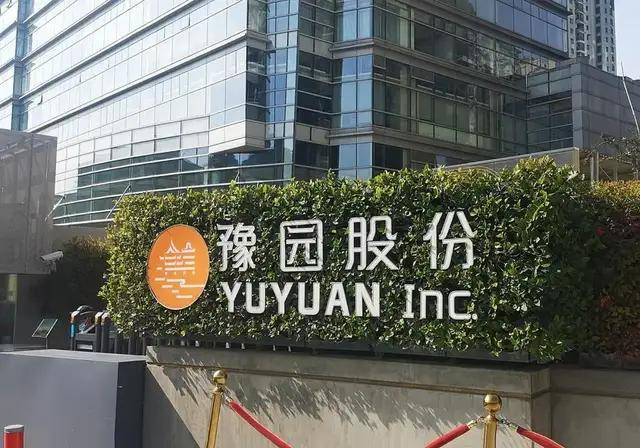
Core Viewpoint - Yuyuan Group (豫园股份) is facing its first annual loss in 34 years since its listing in 1992, with a projected negative net profit for 2025, indicating a significant decline in profitability and operational challenges across its core businesses [2][3]. Group 1: Financial Performance - The company reported a loss of 488 million yuan in the first three quarters of 2025, with a non-recurring net profit loss expanding to 953 million yuan, and a revenue decline of 21.3% [2]. - Net profit has drastically decreased from 3.769 billion yuan in 2021 to 125 million yuan in 2024, leading to a complete deficit in 2025 [2]. Group 2: Business Segment Challenges - The jewelry segment, historically a stable profit source, saw a revenue decline of 31.86% in 2025, attributed to fluctuating international gold prices and a failure to adapt to changing consumer preferences [3]. - The restaurant segment, including the well-known "Nanxiang Steamed Bun," experienced a revenue drop of 30.06%, significantly exceeding the industry average decline, due to weak chain operation capabilities [4]. - The cosmetics and resort businesses also faced setbacks, with overseas cosmetics revenue down 18.67% due to supply chain disruptions, and the sale of a Japanese resort indicating a contraction in international high-end tourism [4]. Group 3: Asset Disposal Strategy - Since 2022, the company has engaged in a series of asset sales to raise cash, including selling stakes in Jinhuijiu, Taikang Insurance, and other assets, totaling over 10 billion yuan [5][7]. - Despite raising over 10 billion yuan through asset disposals, the strategy has not addressed the underlying issues of declining core business performance [7]. Group 4: Management and Governance Issues - The company has seen over 10 senior executives leave since 2024, including key positions such as the rotating president and CFO, highlighting governance challenges [8]. - The major shareholder, Fosun Group, has reduced its stake from 70.8% to 68.17% between September 2022 and April 2024, raising concerns about the shareholder's commitment [9]. Group 5: Strategic Misalignment - The company's "Oriental Lifestyle Aesthetics" strategy, aimed at integrating various business lines, has struggled to create a cohesive consumer experience, leading to a disconnect between branding and actual consumer behavior [10]. - In a market where consumer spending is shifting towards practicality and value, the company's focus on cultural and aesthetic branding without tangible benefits risks alienating potential customers [10][11].

城楼网|房地产政策双轮驱动促转型 融资与供给协同发力稳市场
Sou Hu Cai Jing· 2026-01-26 02:20
责编:李霞 编审:莫 非 监制:张立果 出品:城楼网/城楼财经 在融资端,专项债与"白名单"机制形成关键支撑。2025年地方政府专项债限额增至4.4万亿元,增幅为近六年最 高,重点投向土地收储、存量房收购等领域,助力化解库存压力。同时,房地产融资协调机制持续发力,"白名 单"项目累计贷款超7万亿元,保障近2000万套住房交付,对企业资金的支持作用显著。 1月26日,克而瑞研究发文探讨地产行业发展。该机构认为,我国房地产行业正深化从"规模扩张"向"高质量发 展"的战略转型。随着城镇化进入稳定发展期,政策重心已转向建立"人、房、地、钱"要素联动机制,通过融资精 准纾困与供给结构优化双轮驱动,促进市场平稳健康发展。 供给端则持续推动"控量提质"。2025年住宅新开工面积仅为同期成交面积的68%,供小于求态势延续。土地成交 向优质宅地倾斜,平均溢价率有所回升。存量盘活同步推进,全年多地公告回购存量闲置项目涉及土地2.2亿平方 米,有望减轻库存压力,并通过规划调整转化为市场有效供给。 当前,行业库存压力仍存,房价处于调整期。但随着政策协同发力,供需关系逐步改善,核心城市房价有望逐步 企稳。未来,以要素联动为核心、融资与 ...

郭基煇建言广东产业生态:优化首店服务、强化总部支撑
Zhong Guo Xin Wen Wang· 2026-01-26 01:46
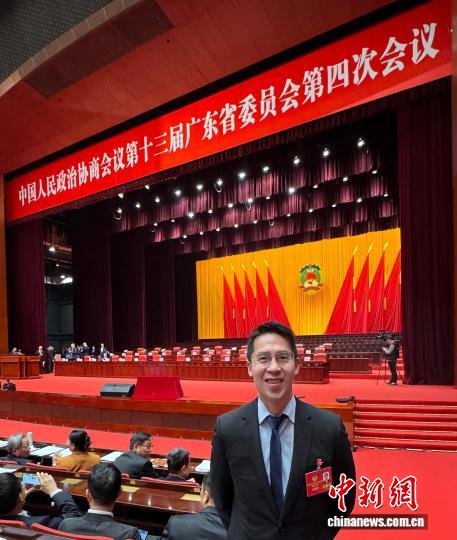
郭基煇建言广东产业生态:优化首店服务、强化总部支撑 中新网广州1月26日电 (记者 蔡敏婕)政协第十三届广东省委员会第四次会议25日在广州开幕。广东省政 协常委、新鸿基地产执行董事郭基煇当天在联组会议上,建议以首发经济和总部经济为抓手,将广东建 成全球消费新品首发地、总部经济枢纽区。 广东省政协常委、新鸿基地产执行董事郭基煇。受访者 供图 郭基煇指出,广东正加快建设具有国际竞争力的现代化产业体系,近期开展的"广货行天下"活动,为全 省消费升级注入动力。他提到,广东省"十五五"规划建议在"大力提振消费"专栏中明确"发展首发经 济,以广州、深圳等城市为重点,推进新品首发、渠道首店、活动首秀首展",并在另一专栏提出"培育 总部经济,推动服务业高端化发展"。 "''广货行天下'关键在于'广店'能不能'引天下'。因此,做好首发经济和总部经济,必将有力激活内需、 促进国内国际双循环。"郭基煇说。 三是实施弹性安保与补贴政策,根据活动规模对安保要求提出弹性安排,减轻首发活动主办商的成本压 力,以吸引更多品牌落户天河路、白鹅潭等核心区域。 而在总部经济方面,郭基煇表示,广州、深圳已培育和吸引华为、腾讯、小鹏、比亚迪、顺丰等一 ...

摩通私银:香港房地产信贷提供具吸引力机会,首选配置投资级信贷
Jin Rong Jie· 2026-01-26 01:29
摩根大通私人 银行亚洲固定收益信贷策略主管李子隽表示,香港 房地产似乎正由危机时期逐步迈向初 步复苏的迹象,对于专注优质资产的投资者而言,香港房地产信贷在市场转角之际提供了具吸引力的机 会。投资策略方面,虽对香港房地产信贷的看法愈来愈正面,但仍维持审慎、专注质素的投资取向。他 表示,首选配置投资级信贷,BBB级以上的发展商可提供约5%收益率;在优质发行人的有评级永久债 中看到策略性机会;至于无评级债券,则保持高度审慎。 ...
广发策略:从不买就跑输到买了就跑输——再看南下定价权
智通财经网· 2026-01-25 23:38
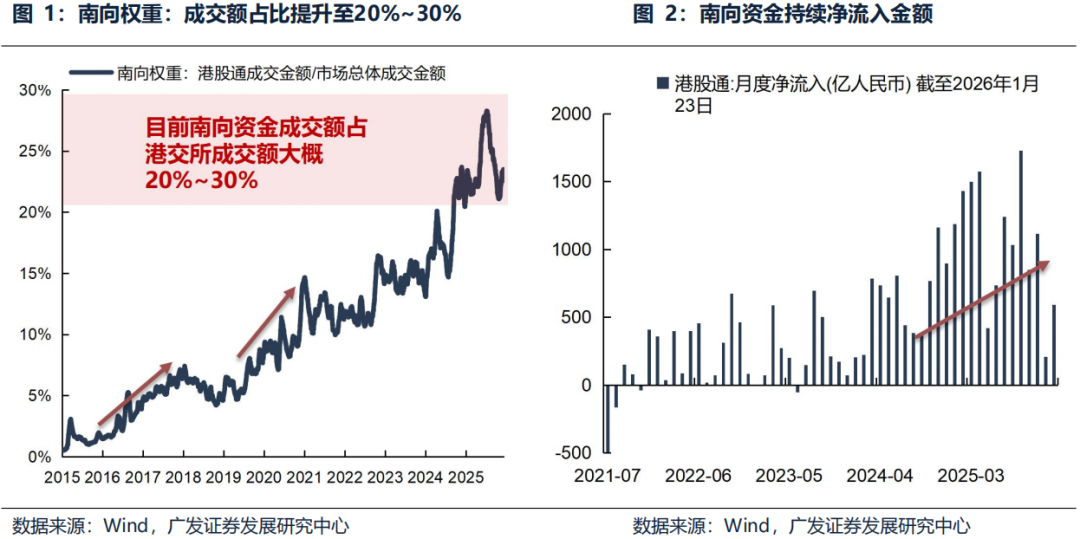
Group 1 - Since September 2024, the proportion of southbound capital transactions has rapidly increased to 20%-30%, nearly doubling compared to before 2024 [2][5] - In 2025, both active and passive foreign capital have become synchronous indicators of the Hong Kong stock market, showing no leading characteristics [2][5] - During sharp declines or corrections in the Hong Kong stock market, southbound capital tends to buy against the trend [2][5] Group 2 - Each round of pricing power competition typically begins with the optimization of the Stock Connect policy or the influx of incremental capital, which usually flows into dividend and scarce assets [5] - Net outflows of southbound capital often occur in response to adverse industry policies or external macroeconomic environments, particularly in sectors where foreign capital pricing power is increasing, such as software services, hardware equipment, consumer services, and discretionary retail [5][12] - Industries less likely to experience significant net outflows include those favored by long-term capital, such as banking, telecommunications, and public utilities, unless there are clear adverse policies affecting the sector [5][12] Group 3 - The proportion of medium to long-term capital in the current round of southbound capital inflow into Hong Kong stocks has increased, with insurance capital making 41 stakes, 35 of which are in H-shares, marking the highest record in the past decade [8] - Key industries for increased holdings include discretionary retail, finance (banking, insurance), innovative pharmaceuticals, software services, and hardware equipment [8] Group 4 - Current industries with pricing power for southbound capital and Chinese capital include semiconductors and dividend stocks, while industries lacking pricing power include internet, hardware equipment, software services, home appliances, and media [11][12] - Active management public funds have low pricing power in the Hong Kong stock market, focusing heavily on AI-related CSP giants, electronics, and innovative pharmaceuticals [16]