
教育

Search documents
豆神教育:截至2025年6月30日公司股东总数为93397户
Zheng Quan Ri Bao Wang· 2025-09-02 13:14
Group 1 - The company, Dou Shen Education, reported that as of June 30, 2025, the total number of shareholders is 93,397 [1]

库克、俞敏洪等纷纷打卡,我也来一探究竟→
Jin Rong Shi Bao· 2025-09-02 12:41
Group 1 - The "Night Tour of Jinjiang" has become a new landmark for nighttime tourism in Chengdu, featuring a 20-kilometer waterway and 10 major docks that connect various commercial, cultural, and tourism activities [1] - The project has attracted significant attention, with over 1.5 million viewers participating in a live-streamed tour led by prominent figures, showcasing its popularity and cultural significance [1] - Since its launch, the project has received approximately 2.9 million visitors and generated revenue of about 24.88 million yuan, indicating strong consumer interest and engagement [1] Group 2 - The Tiexiang Temple Water Street in Chengdu has emerged as another new landmark for cultural tourism, designed as a social and artistic space that integrates traditional architectural styles with local cultural elements [2] - The water street has attracted 92 well-known brands across various sectors, contributing to a diverse consumer landscape and enhancing local leisure consumption [2] - Financial institutions in Sichuan are actively promoting consumption through innovative initiatives, such as offering discounts and incentives, which have significantly boosted consumer spending [2]
学大教育(000526):2025H1个性化教育主业稳步扩张,归母净利率再创新高
Guoxin Securities· 2025-09-02 11:49
Investment Rating - The investment rating for the company is "Outperform the Market" [5][3]. Core Views - The company's core personalized education business benefits from the rigid demand in the high school stage and the clearing of supply-side issues in the industry, maintaining a high level of prosperity [3][21]. - The company achieved a net profit of 230 million yuan in the first half of 2025, representing a year-on-year growth of 42%, with total revenue of 1.92 billion yuan, up 18% [1][8]. - The company has accelerated its network expansion and teacher reserve since the second half of 2024, contributing to rapid growth in revenue and profit in the first half of 2025 [21][3]. Financial Performance - In the first half of 2025, the company's net profit margin reached 12.0%, an increase of 2.02 percentage points year-on-year, while the gross profit margin was 36.3%, up 0.26 percentage points [2][17]. - The company reported a cash collection from sales of 1.629 billion yuan, a year-on-year increase of 9.9%, with a contract liability balance of 597 million yuan, up 3.7% [13][1]. - The company has initiated a share repurchase plan in January 2025, intending to buy back shares at a price not exceeding 66.8 yuan per share, demonstrating management's confidence in the company's future development [21][2]. Earnings Forecast - The company forecasts net profits of 251 million yuan, 301 million yuan, and 363 million yuan for 2025, 2026, and 2027 respectively, with corresponding EPS of 2.04 yuan, 2.44 yuan, and 2.95 yuan [4][3]. - The projected revenue for 2025 is 3.409 billion yuan, reflecting a growth rate of 22.4% [4][3].

“人工智能+”地方路线图陆续出炉 制造、教育、医疗率先部署
2 1 Shi Ji Jing Ji Bao Dao· 2025-09-02 11:47
Core Insights - The article discusses the rapid implementation of the "Artificial Intelligence +" initiative across various regions in China, emphasizing the collaboration between industry applications and foundational capabilities to promote AI integration into economic and social sectors [1][2][3]. Group 1: Government Initiatives - The "Artificial Intelligence +" initiative was included in the 2024 government work report, with multiple regions like Tianjin, Anhui, Sichuan, and others developing their action plans [2][3]. - Shanghai has initiated the 2025 "Artificial Intelligence +" project application process, focusing on six key actions and eight foundational capabilities [1][2]. Group 2: Industry Focus Areas - Key sectors for AI deployment include education, manufacturing, and healthcare, with local governments actively promoting AI integration in these areas [2][6][8]. - The integration of AI in education aims to cultivate multi-disciplinary talents and enhance national competitiveness, shifting from traditional teaching methods to personalized learning experiences [9]. Group 3: Regional Development Goals - Various regions have set specific targets for AI industry growth, such as Liaoning aiming to cultivate over 300 AI enterprises and achieve a core industry scale of 100 billion yuan by 2027 [4]. - Tianjin plans to develop 30 benchmark AI application scenarios and achieve a revenue of over 100 billion yuan for core AI enterprises by 2027 [4][5]. Group 4: Manufacturing Sector - Regions like Shanghai and Guangxi have introduced plans to enhance AI applications in manufacturing, with Shanghai targeting the intelligent transformation of 3,000 manufacturing enterprises and the establishment of 10 benchmark smart factories [6][7]. - The article highlights the need for deeper integration of AI technologies in manufacturing processes to unlock their full potential [7]. Group 5: Healthcare Applications - Beijing's plan for "Artificial Intelligence + Healthcare" aims to create an influential ecosystem by 2027, focusing on the application of AI in drug development and healthcare services [8]. - Zhejiang's action plan emphasizes AI's role in public health, clinical medicine, and medical research [8]. Group 6: Collaborative Innovation - The article notes that local governments are encouraged to adopt tailored strategies based on regional characteristics and existing policies to foster collaborative innovation in AI [3][7].
教育板块9月2日跌2.7%,国脉科技领跌,主力资金净流出4.01亿元
Zheng Xing Xing Ye Ri Bao· 2025-09-02 08:59
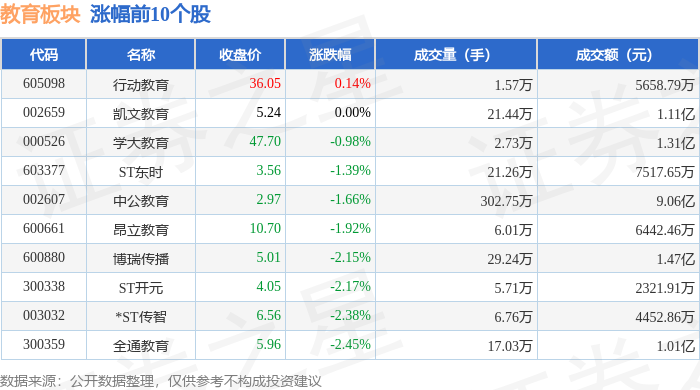
Market Overview - The education sector experienced a decline of 2.7% on September 2, with Guomai Technology leading the drop [1] - The Shanghai Composite Index closed at 3858.13, down 0.45%, while the Shenzhen Component Index closed at 12553.84, down 2.14% [1] Individual Stock Performance - Action Education (605098) closed at 36.05, with a slight increase of 0.14% and a trading volume of 15,700 shares [1] - Kevin Education (002659) remained unchanged at 5.24, with a trading volume of 214,400 shares [1] - Xueda Education (000526) fell by 0.98% to 47.70, with a trading volume of 27,300 shares [1] - ST Dongshi (603377) decreased by 1.39% to 3.56, with a trading volume of 212,600 shares [1] - Zhonggong Education (002607) dropped 1.66% to 2.97, with a trading volume of 3,027,500 shares [1] - Angli Education (600661) fell by 1.92% to 10.70, with a trading volume of 60,100 shares [1] - Borui Communication (600880) decreased by 2.15% to 5.01, with a trading volume of 292,400 shares [1] - ST Kaiyuan (300338) fell by 2.17% to 4.05, with a trading volume of 57,100 shares [1] - ST Chuan Zhi (003032) decreased by 2.38% to 6.56, with a trading volume of 67,600 shares [1] - Quantu Education (300359) fell by 2.45% to 5.96, with a trading volume of 170,300 shares [1] Capital Flow Analysis - The education sector saw a net outflow of 401 million yuan from institutional investors, while retail investors experienced a net inflow of 307 million yuan [2] - The net inflow from speculative funds was 93.74 million yuan [2] Detailed Capital Flow for Selected Stocks - Kevin Education (002659) had a net inflow of 8.16 million yuan from institutional investors, while speculative funds saw a net outflow of 4.64 million yuan [3] - Action Education (605098) experienced a net inflow of 6.19 million yuan from institutional investors, with a net outflow of 3.53 million yuan from speculative funds [3] - Xueda Education (000526) had a minimal net inflow of 143,500 yuan from institutional investors, with a net outflow of 3.46 million yuan from speculative funds [3] - Kede Education (300192) saw a slight net outflow of 187,300 yuan from institutional investors, with a significant net outflow of 24.17 million yuan from speculative funds [3] - ST Kaiyuan (300338) experienced a net outflow of 3.39 million yuan from institutional investors, while speculative funds had a net inflow of 711,800 yuan [3] - ST Chuan Zhi (003032) had a net outflow of 6.13 million yuan from institutional investors, with a net inflow of 890,700 yuan from speculative funds [3] - Angli Education (600661) saw a net outflow of 8.87 million yuan from institutional investors, while retail investors had a net inflow of 9.28 million yuan [3] - ST Dongshi (603377) experienced a net outflow of 12.71 million yuan from institutional investors, with a net inflow of 9.10 million yuan from retail investors [3] - Quantu Education (300359) had a net outflow of 12.94 million yuan from institutional investors, while retail investors saw a net inflow of 7.30 million yuan [3]





AIAgent投资图谱:产业赛道与主题投资风向标
Tianfeng Securities· 2025-09-02 08:43
Core Insights - The report emphasizes the rapid development and potential of AI Agents across various industries, highlighting their ability to enhance efficiency and automate tasks in sectors such as gaming, healthcare, marketing, education, finance, and office work [2][15][27][31][41][47]. Market Review - The A-share market saw a 1.9% increase during the week of August 25-29, with significant activity in sectors like optical modules and GPUs. The average daily trading volume reached 29.82 billion yuan, up by 3.975 billion yuan from the previous week [3][50]. - The report notes a decrease in the number of stocks rising daily, with 2,317 stocks up on average, down by 806 from the previous week. The number of stocks hitting the daily limit fell from 92 to 73, indicating a weakening profit effect [3][50]. Policy Dynamics - The State Council issued an opinion on the implementation of "Artificial Intelligence+" actions, aiming for widespread integration of AI in six key areas by 2027, with a target application penetration rate exceeding 70% for new intelligent terminals and agents [4][27]. - The Ministry of Industry and Information Technology released guidelines to promote the development of the satellite communication industry, supporting telecom operators in exploring high-orbit satellite applications [4][27]. Industry Trends - The report highlights the World Robot Conference and the approval of the "special edition" Blackwell AI chip for sale in China, indicating advancements in AI technology and robotics [5]. - In the AI gaming sector, AI is primarily focused on efficiency improvements, with future developments expected to introduce more native AI gameplay. A survey indicated that around 80% of game developers believe AI can enhance project efficiency by over 20% [25][26]. - The AI healthcare market is projected to grow from 97.3 billion yuan in 2023 to 159.8 billion yuan by 2028, with a compound annual growth rate of 10.5% [27][28]. AI Applications - AI in marketing addresses challenges such as customer insight and personalized marketing, with content generation being a prominent application. The report notes that young consumers increasingly value personalized experiences [31][32]. - In education, policies are actively promoting the integration of generative AI, with a focus on transforming teaching methods and environments [37][40]. - The financial sector is seeing continuous penetration of AI across various functions, particularly in risk management and compliance, with a shift towards edge deployment of AI models for enhanced data security [41][42]. AI Agent Investment Landscape - The global AI Agent market is expected to grow from $5.25 billion in 2024 to $52.62 billion by 2030, with a compound annual growth rate exceeding 40% [15]. - AI Agents are particularly suited for high-frequency, repetitive tasks, significantly reducing manual intervention and improving efficiency in structured data environments [15][19].






国家砸下城市发展“新规矩”!房地产不扛旗了,你家门口要变样?
Sou Hu Cai Jing· 2025-09-02 01:45
Core Viewpoint - The recent national policy marks a significant shift in China's urban development paradigm, moving away from real estate as the main driver of growth towards a focus on enhancing quality of life, convenience, and resilience for citizens [1][5][40]. Group 1: Policy Shift - The document titled "Opinions on Promoting High-Quality Urban Development" emphasizes a transition from a material-centric approach to a people-centric one, prioritizing education, healthcare, and social welfare over real estate and land finance [5][31]. - The real estate sector is being repositioned as a tool for social welfare rather than a profit-driven industry, indicating a fundamental change in its role within the economy [7][9]. Group 2: Urban Development Focus - The new urban development strategy aims to create a "15-minute living circle," ensuring essential services like markets, schools, and healthcare facilities are within a short walking distance from residents' homes [15][17]. - The policy encourages community participation in urban renewal and emphasizes the importance of improving urban resilience, including infrastructure upgrades to prevent flooding and enhance emergency response [19][21]. Group 3: Evaluation Metrics - New assessment criteria for urban governance will focus on residents' happiness, convenience, community service quality, and population inflow, moving away from traditional metrics like GDP and land sales [25][40]. - The document highlights the need for a balanced distribution of educational and healthcare resources to alleviate issues like "school seat grabbing" and improve overall community well-being [23][31]. Group 4: International Comparison - The policy document contrasts Western capital-driven urban models and Hong Kong's high-turnover real estate approach, advocating for a unique Chinese path that prioritizes human investment over speculative real estate practices [27][29]. - This comparison serves as a reminder for China to avoid pitfalls seen in other urban models, focusing instead on sustainable and inclusive urban development [29][40]. Group 5: Implementation Challenges - The transition to this new urban model faces challenges, including local government capacity to execute the central government's vision and potential conflicts arising from urban renewal processes [38][40]. - The shift from a growth-at-all-costs mentality to a more sustainable approach reflects a commitment to long-term urban quality and livability [38][42].


时报观察|着力真实需求方能扩大服务消费
证券时报· 2025-09-02 00:05
Core Viewpoint - The Ministry of Commerce plans to introduce several policies to expand service consumption this month, reflecting a shift in macroeconomic policy focus towards balancing goods and service consumption [1] Group 1: Service Consumption Trends - There is a high income elasticity in service consumption, meaning changes in residents' income expectations and growth significantly impact this sector [1] - Recent consumption trends indicate that demand and spending in the service sector are not lacking; rather, there is a need to match evolving consumer preferences with appropriate scenarios and quality supply [1] - The youth consumer group, particularly Generation Z, is willing to spend on interests and emotional value, as seen in the phenomenon of "LABUBU," while also seeking high cost-performance ratios, demonstrating a preference for spending wisely [1] Group 2: Policy Recommendations - To address the shortage of quality service supply, the focus should be on "opening up externally and loosening restrictions internally," which includes expanding pilot programs in telecommunications, healthcare, and education to attract mature and high-quality services [1] - Additionally, reducing domestic market restrictions, such as easing market access and optimizing regulatory models, is essential to stimulate market competition and enrich service supply [1] Group 3: Short-term and Long-term Measures - The proposed measures for "opening up externally and loosening restrictions internally" are more aligned with long-term reforms aimed at fundamentally improving the service consumption cycle [2] - Short-term counter-cyclical adjustment policies are also necessary to provide immediate visibility of the government's commitment to boosting consumption, exemplified by the recent "dual subsidy" policy from the Ministry of Finance, which aims to lower financing costs for consumers and operators [2] - Both long-term reforms and short-term adjustments must continuously address real consumer needs to translate policy effectiveness into tangible benefits for consumers [2]

着力真实需求方能扩大服务消费
Sou Hu Cai Jing· 2025-09-01 22:17
Core Viewpoint - The Ministry of Commerce plans to introduce policies to expand service consumption this month, reflecting a shift in macroeconomic policy focus towards balancing goods and service consumption [1] Group 1: Service Consumption Trends - Service consumption has higher income elasticity, meaning changes in residents' income expectations and growth rates significantly impact it [1] - Recent consumption trends indicate that there is demand in the service sector, but it requires appropriate scenarios and high-quality supply to match evolving consumer concepts [1] - The youth consumer group, particularly Generation Z, is willing to spend on interests and emotional value, as seen in the popularity of the phenomenon "LABUBU" [1] Group 2: Policy Recommendations - To address the shortage of high-quality service supply, the focus should be on "opening up externally and loosening restrictions internally," which includes expanding pilot programs in telecommunications, healthcare, and education [1] - Reducing domestic market restrictions, such as easing market access and optimizing regulatory models, is essential to stimulate market competition and enrich service supply [1] Group 3: Short-term and Long-term Policy Measures - The "opening up externally and loosening restrictions internally" measures are more aligned with long-term reforms aimed at fundamentally improving the service consumption cycle [2] - Short-term counter-cyclical adjustment policies are also necessary to demonstrate the government's commitment to boosting consumption, such as the recent "dual interest subsidy" policy [2] - The coordination between fiscal resources and financial resources is crucial to lower financing costs for consumers and operators, guiding financial resources towards the consumption sector [2]
教育板块9月1日涨0.2%,中国高科领涨,主力资金净流出2.41亿元
Zheng Xing Xing Ye Ri Bao· 2025-09-01 08:46
Group 1 - The education sector increased by 0.2% on September 1, with China Gaoke leading the gains [1] - The Shanghai Composite Index closed at 3875.53, up 0.46%, while the Shenzhen Component Index closed at 12828.95, up 1.05% [1] - The table of individual stocks in the education sector shows various performance metrics, including closing prices and percentage changes [1] Group 2 - The main funds in the education sector experienced a net outflow of 241 million yuan, while retail investors saw a net inflow of 147 million yuan [1] - The table detailing fund flows indicates the movement of capital among different stocks within the education sector [1]


