
保险

Search documents
非银行金融行业研究三大交易所对再融资规则优化,25年险资股票+基金+长股投增长近2万亿
SINOLINK SECURITIES· 2026-02-24 00:30
Investment Rating - The industry investment rating is positive, with recommendations to buy or hold based on expected performance exceeding market averages [49]. Core Insights - The report highlights the introduction of a package of refinancing optimization measures by the Shanghai, Shenzhen, and Beijing stock exchanges aimed at improving market efficiency and supporting technology innovation companies [38]. - It emphasizes the importance of quality companies and technology firms in attracting liquidity and enhancing capital market structure, aligning with a healthy market trend [2][38]. - The report suggests focusing on three main investment lines: undervalued quality brokerages, companies benefiting from technology sector listings, and firms with strong performance in diversified finance [3]. Summary by Sections Market Review - The A-share market showed a slight increase with the CSI 300 index up by 0.4%, while the non-bank financial sector underperformed, declining by 1.6% [11]. Data Tracking - Brokerage firms reported a decrease in average daily trading volume to 21,111 billion yuan, down 12.3% week-on-week [19]. - The report notes significant growth in new equity fund issuance, with a total of 812 million shares issued in January 2026, up 186.9% year-on-year [19]. - The total asset management scale for public non-monetary funds reached 22.2 trillion yuan, with a slight decrease of 1.9% from the previous month [19]. Industry Dynamics - The report discusses the refinancing measures aimed at supporting quality listed companies and enhancing the efficiency of the refinancing process [38]. - It also mentions the ongoing trend of insurance funds increasing their stakes in various companies, with a total of 52 companies being targeted for increased holdings in 2024 [33].
富卫集团(01828)股东将股票存入香港上海汇丰银行 存仓市值27.31亿港元
智通财经网· 2026-02-24 00:25
Group 1 - The core viewpoint of the article highlights that 富卫集团 (FWD Group) has seen significant shareholder activity, with shares valued at HKD 27.31 billion deposited at HSBC, representing 5.64% of the company [1] - Morgan Stanley has initiated coverage on FWD Group with an "Overweight" rating and a target price of HKD 50, which reflects a forecasted intrinsic value of 1.1 times for the fiscal year 2027 [1] - The new business value for FWD Group is projected to reach USD 1.1 billion for the fiscal year 2027, comparable to AIA's new business value of USD 1.2 billion in December 2012 [1] Group 2 - The current stock price of FWD Group is trading at a discount to its reported intrinsic value, indicating that the stock is considered undervalued by Morgan Stanley [1]
节后A股投资主线有哪些?十大券商来了!
Ge Long Hui· 2026-02-24 00:10
Market Overview - The A-share market is set to resume normal trading after the Spring Festival holiday, with the Shanghai Composite Index having fallen 1.26% to below 4100 points before the holiday [2] - Key upcoming events include Trump's State of the Union address, the implementation of a 15% global tariff on February 24, and a visit from German Chancellor Merz to China [2] Investment Strategies - **Guangfa Strategy**: The A-share market is expected to enter a "spring rally" phase, with historical data showing a 100% probability of small-cap indices rising between the Spring Festival and the Two Sessions [4] - **CITIC Strategy**: Price increases remain a core theme for the first quarter, focusing on sectors like chemicals, non-ferrous metals, and renewable energy, while also increasing exposure to undervalued insurance and brokerage stocks [5] - **Tianfeng Strategy**: Investment opportunities are identified in AI-related sectors, emphasizing the importance of AI applications and the potential for cyclical stocks to perform well as the economy recovers [6] - **CITIC Jiantou Strategy**: The market is expected to start a new upward trend post-holiday, focusing on technology and resource sectors, particularly AI, humanoid robots, and innovative pharmaceuticals [7][8] - **Xingzheng Strategy**: The market is anticipated to enter a high-probability window for gains, supported by external factors like U.S. tariff policies and domestic macroeconomic catalysts [9] - **Galaxy Strategy**: The market is likely to experience a volatile upward trend, with policy catalysts expected to drive investment themes and sector rotations [9] - **Shenwan Hongyuan Strategy**: The global asset price trends during the holiday included rising oil prices and a rebound in gold and silver, with technology sectors showing structural strengths [10] - **Guojin Strategy**: The market's core themes are shifting towards broader economic recovery and the impact of monetary policy, with a focus on the revaluation of Chinese assets [11] - **Zhaoshang Strategy**: The market is expected to maintain an upward trend, driven by cyclical price increases and the expansion of AI-related investments, with significant infrastructure projects anticipated to stabilize investment expectations [12] - **Huaxi Strategy**: The "red envelope market" is anticipated post-holiday, driven by external uncertainties and strong performance in technology sectors, particularly in AI and robotics [13]
十大券商一周策略:A股将迎“春季躁动”胜率最高阶段,涨价仍是核心配置线索,重视关税税率下降后出口链修复机会
Jin Rong Jie· 2026-02-24 00:10
Group 1 - The core investment theme post-Spring Festival revolves around "price increases" and "revaluation of physical assets," particularly in resource, chemical, and midstream manufacturing sectors, leveraging China's pricing power amid global uncertainties [1][2] - The technology sector, particularly driven by AI, remains a key focus, with sub-sectors like computing power, applications, and robotics expected to remain active due to industrial catalysts [1][2] - The recovery of export chains, non-bank financials, and certain consumer and real estate chains are seen as important supplements to market trends under the backdrop of internal and external demand recovery [1] Group 2 - CITIC Securities emphasizes that price increases are a core configuration clue for Q1, with a focus on sectors like chemicals, non-ferrous metals, power equipment, and new energy, while also increasing exposure to undervalued insurance and brokerage stocks [2] - Historical data indicates that February and the period around the Spring Festival are strong for market movements, with small-cap stocks showing a 100% probability of rising from the Spring Festival to the Two Sessions [3] - Guojin Securities highlights the importance of balancing global physical assets against Chinese assets, recommending commodities like copper, aluminum, and oil, as well as sectors with global comparative advantages like equipment exports and domestic manufacturing [4] Group 3 - Industrial sectors experiencing structural price increases due to supply-demand gaps are primarily in midstream materials and manufacturing, with a focus on chemicals, steel, and high-end manufacturing [5] - The potential for recovery in the export chain is noted, particularly in industries with significant exposure to the U.S. market that will benefit from reduced tariffs [5] - The policy uncertainty surrounding tariffs and trade is expected to favor gold as a risk hedge, with market participants anticipating potential shifts in U.S. trade policy [6] Group 4 - Attention is drawn to the post-holiday inventory replenishment in commodities, with a continued positive outlook on technology applications, particularly in semiconductors and AI [7] - Quantum technology is highlighted as a sector receiving dual catalysts from policy and technological advancements, with significant developments in quantum key distribution networks [8] - The AI industry revolution is identified as a key investment theme, focusing on computing power, storage, and applications, with a strong emphasis on the performance of high-growth sectors [9] Group 5 - Localized opportunities are expected in AI applications linked to overseas trends and robotics associated with the Spring Festival, with a cautious approach to market movements anticipated [10] - The current bull market logic remains intact, with a recommendation for investors to maintain confidence despite short-term volatility, focusing on sectors with high securities ratios [11]
东吴证券晨会纪要2026年1月-20260224
Soochow Securities· 2026-02-23 23:30
Macro Strategy - The January labor report indicates a resilient labor market in the US, with unemployment rates and employment data better than expected, driven by a combination of fiscal and monetary easing, as well as seasonal factors [1][9][10] - Despite the strong headline figure of 130,000 new non-farm jobs, the underlying structure is concerning, with 124,000 jobs coming from the healthcare sector, suggesting a lack of broad-based job growth [1][9] - The expectation is for the US economy to continue outperforming in Q1, with a focus on upcoming core CPI data and potential market reactions to Trump's visit to China in April [1][9] Fixed Income - The report discusses the evolution of bond financing paths for technology companies, particularly in the AI sector, highlighting the importance of a diversified financing system to support high-growth tech firms [2][11] - It emphasizes the need for private tech companies to leverage the bond market for long-term capital needs, as current bond market structures are heavily skewed towards state-owned enterprises [2][11] - The report reviews case studies of major tech firms like Oracle, Nebius, Alphabet, and Meta, illustrating how they have utilized bond financing to support growth and strategic initiatives [2][11][12][13] Company Analysis Jingchen Co., Ltd. (688099) - The company achieved a record revenue of 6.793 billion yuan in 2025, with a year-on-year growth of 14.63%, and expects a revenue growth of 25%-45% in 2026 [5][15] - The company’s gross margin improved significantly to 40.46% in Q4 2025, reflecting operational efficiency [5][15] - Multiple new products are set to launch in 2026, including high-performance chips, which are expected to drive further revenue growth [5][15] China Pacific Insurance (601601) - The company is projected to have a steady increase in embedded value, with estimates of 607.4 billion yuan, 657.6 billion yuan, and 718.2 billion yuan for 2025-2027, reflecting a growth rate of 8.1%-9.2% [6][18][19] - The insurance business is expected to benefit from the implementation of the "North Star Plan" and a strong growth in the bancassurance channel [6][18][19] Shaanxi Tourism (603402) - The company is positioned as a leader in service consumption, leveraging its core assets in performance and cable car operations, with projected net profits of 3.9 billion yuan, 5.1 billion yuan, and 5.9 billion yuan for 2025-2027 [7][19] - The operational efficiency of its core projects is expected to drive revenue growth, supported by favorable policies for the tourism industry [7][19] Zhongtung High-tech (000657) - The company is recognized as a global leader in tungsten products, with a focus on integrating its operations across the entire value chain, enhancing its growth potential [8][20] - Recent asset acquisitions are expected to significantly improve financial metrics, with gross margins rising to 21.8% and net profit margins to 7.3% [8][20]
EverQuote(EVER) - 2025 Q4 - Earnings Call Transcript
2026-02-23 22:32
Financial Data and Key Metrics Changes - EverQuote achieved a total revenue growth of 38% year-over-year, reaching $692.5 million for the full year 2025, with Q4 revenue growing 32% year-over-year to $195.3 million [10][11] - Adjusted EBITDA increased by 62% year-over-year to $94.6 million for the full year, with Q4 Adjusted EBITDA growing 32% to $25.1 million, representing a 12.8% margin [10][14] - GAAP net income for Q4 was $57.8 million, significantly up from $12.3 million in the prior year, while full year GAAP net income rose to $99.3 million from $32.2 million [13][14] Business Line Data and Key Metrics Changes - Revenue from the auto insurance vertical increased to $179.9 million in Q4, up over 32% year-over-year, with full year auto insurance revenue growing 41% to $629.8 million [11] - Home insurance revenue in Q4 was $15.4 million, up 37% year-over-year, with full year revenue growing 20% to $62.7 million [11] Market Data and Key Metrics Changes - Consumer shopping levels for insurance remain elevated, supported by profitable carrier underwriting and increased carrier spending, which was up 39% year-over-year [10][11][17] - The company noted a favorable industry environment for 2026, with carrier partners indicating a focus on profitable policy growth after a period of rate restoration [17][19] Company Strategy and Development Direction - EverQuote aims to achieve $1 billion in revenue within the next two to three years, focusing on becoming the leading growth partner for P&C insurance providers while expanding cash generation [6][20] - The company is committed to an AI-first future, enhancing operations and customer offerings through AI technologies, including Smart Campaigns and generative AI applications [8][19] Management's Comments on Operating Environment and Future Outlook - Management expressed confidence in the 2026 outlook, citing a stable P&C insurance market and strong execution in 2025, which exceeded expectations [6][19] - The company anticipates a disciplined approach from carriers in Q1 2026, with expectations for growth to be measured throughout the year [17][56] Other Important Information - EverQuote ended 2025 with no debt and cash and cash equivalents of $171.4 million, alongside a $50 million share repurchase program [16][80] - The company has been investing in AI capabilities and new traffic channels, which are expected to drive future growth [12][19] Q&A Session Summary Question: Can you provide directional color on growth trajectory for 2026 based on carrier conversations? - Management indicated that 2026 is expected to be a growth year for carriers, focusing on profitable policy growth after a period of rate adequacy [28][29] Question: Can you elaborate on traffic investments in Q4 and their impact on Q1? - Management noted that investments in new traffic channels in Q4 are expected to normalize margins in Q1, with ongoing efforts to expand traffic volume [38][39] Question: What is the update on new products and AI bidding initiatives? - Management reported significant progress in rolling out Smart Campaigns and expanding product offerings to local agents, aiming to become a one-stop growth partner [50][51] Question: How does the company view the impact of AI agents on its business model? - Management believes that while AI agents may evolve the shopping experience, EverQuote's proprietary data and distribution relationships provide a competitive advantage that cannot be easily replicated [62][63] Question: What are the expectations for VMM margin progression throughout the year? - Management expects VMM margins to remain in the high 20s, with fluctuations based on advertising costs and efficiency in acquiring traffic [67][69]

个人信息5元500条 临近续保频遭推销车主隐私泄露屡禁不止为哪般
Xin Lang Cai Jing· 2026-02-23 21:43
Core Viewpoint - The article highlights the rampant issue of unsolicited insurance sales calls to car owners, raising concerns about personal information leakage and the lack of effective regulation in the insurance industry [1][2][4]. Group 1: Consumer Experience - Car owners report receiving multiple insurance sales calls, with some receiving up to five calls in a single day, causing significant disruption to their daily lives [2]. - Many consumers express frustration over misleading marketing tactics, such as false quotes and promises of discounts that are not honored by official insurance channels [2]. Group 2: Information Leakage - The leakage of personal information occurs at various stages, including vehicle purchase and insurance registration, often due to unauthorized sharing and poor data management practices by insurance companies and related businesses [3][4]. - The complexity of the information leakage chain makes it difficult to trace the source of data breaches, with reports of individuals selling car insurance customer data online [5]. Group 3: Regulatory Challenges - The insurance industry faces significant challenges in managing personal information securely, with internal management flaws and performance pressures leading to excessive marketing practices [4][6]. - Current legal frameworks are insufficiently enforced, resulting in low penalties for violations, which perpetuates the cycle of intrusive marketing and data mishandling [5][6]. Group 4: Proposed Solutions - Industry experts suggest enhancing customer information management practices, utilizing technology such as AI and big data to prevent information leakage and reduce unnecessary marketing calls [7][8]. - A collaborative regulatory approach involving multiple stakeholders, including insurance companies, industry associations, and regulatory bodies, is recommended to create a more effective oversight mechanism [7][8].
中国人民保险集团(01339.HK):2月23日南向资金增持1307.2万股
Sou Hu Cai Jing· 2026-02-23 19:29
Group 1 - The core point of the article highlights that southbound funds increased their holdings in China People's Insurance Group (01339.HK) by 13.072 million shares on February 23 [1] - Over the past five trading days, there were three days of net reductions in southbound fund holdings, totaling a net decrease of 2.9123 million shares [1] - In the last twenty trading days, there were sixteen days of net reductions, with a cumulative net decrease of 45.4118 million shares [1] Group 2 - As of now, southbound funds hold 2.512 billion shares of China People's Insurance Group, accounting for 28.77% of the company's total issued ordinary shares [1] - China People's Insurance Group is a holding company primarily providing insurance products, including property insurance, health insurance, life insurance, reinsurance, Hong Kong insurance, and pension insurance [1] - The property insurance business includes products for both companies and individuals, such as motor vehicle insurance, agricultural insurance, property insurance, and liability insurance [1]


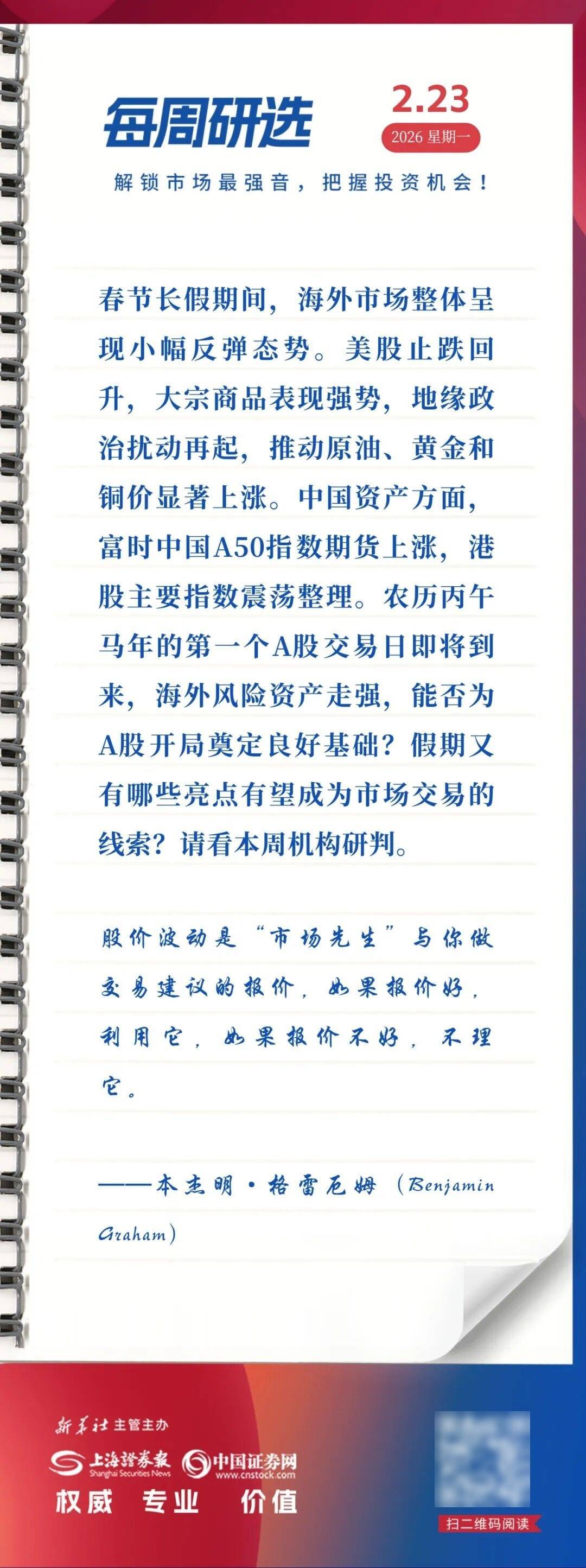
马年A股如何开局? | 每周研选
Sou Hu Cai Jing· 2026-02-23 16:46
Core Viewpoint - The overseas markets showed a slight rebound during the Spring Festival holiday, with U.S. stocks recovering and commodities performing strongly, driven by geopolitical disturbances that significantly increased the prices of oil, gold, and copper. The performance of Chinese assets, particularly the FTSE China A50 index futures, also indicated a positive trend, suggesting a potentially favorable start for the A-share market in the Year of the Horse [2][4]. Group 1: Market Performance and Trends - The overseas non-U.S. assets maintained a strong performance during the holiday, indicating a high risk appetite among overseas investors, which is expected to benefit the A-share market post-holiday [5]. - The inflow of funds into the market remains unchanged, with a notable decrease in household deposits and an increase in non-bank financial institution deposits, suggesting a shift towards equity markets [6]. - Historical data shows that the A-share market typically performs well in the 20 trading days following the Spring Festival, with a 75% probability of the CSI All A Index rising during this period [9]. Group 2: Sector Focus and Investment Opportunities - The focus for investment should be on sectors benefiting from AI and resource commodities, with a particular emphasis on the robotics and AI technology applications showcased during the Spring Festival [13][14]. - The traditional sectors such as real estate and liquor are expected to see a recovery as their valuations are at historical lows, supported by improving fundamentals and policy catalysts [11]. - The "反内卷" (anti-involution) policy is anticipated to enhance the supply dynamics of resource commodities, making them attractive for investment [11]. Group 3: Strategic Recommendations - Investors are advised to focus on the technology sector, particularly in robotics and AI applications, as well as cyclical sectors like chemicals, construction materials, and machinery, which are expected to benefit from rising prices and improved demand [15]. - The market is entering a configuration phase where "technology + cyclical" remains the main theme, with technology sectors likely to respond first to market catalysts [15].
去年险资投资股票、基金余额增加约1.6万亿元
Zheng Quan Ri Bao· 2026-02-23 16:43
Core Viewpoint - The insurance industry in China is experiencing a significant increase in equity asset allocation, with expectations for continued growth due to favorable market conditions and regulatory support [1][3][4]. Group 1: Overall Asset Allocation - As of the end of last year, the total asset allocation of insurance companies reached approximately 38.5 trillion yuan, representing a year-on-year growth of 15.7% [1]. - The proportion of equity assets (stocks, securities investment funds, and long-term equity investments) has significantly increased, reaching a new high since the second quarter of 2022 [1][2]. - The bond assets continue to serve as the "basic plate" of insurance companies' asset allocation, but the increase in equity asset allocation has drawn industry attention [2]. Group 2: Equity Asset Allocation Details - By the end of last year, the total balance of stocks and securities investment funds for life and property insurance companies was approximately 5.7 trillion yuan, an increase of about 1.6 trillion yuan, or 38.9% year-on-year [2]. - The stock allocation balance was about 3.73 trillion yuan, accounting for 9.7% of total assets, marking a near four-year high [2]. - Life insurance companies had a bond investment balance of approximately 17.7 trillion yuan (51.11%), while property insurance companies had a bond investment balance of 981.3 billion yuan (40.63%) [2]. Group 3: Market Expectations and Regulatory Environment - The positive outlook for the capital market, combined with declining interest rates, has led insurance companies to increase their equity asset allocation [3]. - Regulatory measures have been implemented to optimize solvency supervision and encourage state-owned insurance companies to invest a portion of incremental funds into A-shares [3]. - The equity asset allocation ratio for insurance companies is still below regulatory limits, indicating potential for further increases [4]. Group 4: Investment Strategies and Confidence - A survey by the China Banking and Insurance Asset Management Association indicated a rise in confidence for equity investments, with a confidence index of 67.55 for Q1 2026, up from 58.04 in the previous year [5]. - The core logic supporting the "slow bull" market remains intact, with a shift from valuation-driven to profit-driven market dynamics expected [6]. - Insurance institutions are focusing on asset-liability management and volatility control in their investment strategies [6].