基金

Search documents
标准股份股价连续4天下跌累计跌幅8.13%,中信保诚基金旗下1只基金持133.14万股,浮亏损失149.12万元
Xin Lang Cai Jing· 2026-02-11 07:10
Group 1 - Standard Shares experienced a decline of 3.21% on February 11, with a stock price of 12.66 CNY per share, a trading volume of 162 million CNY, a turnover rate of 3.65%, and a total market capitalization of 4.38 billion CNY [1] - The stock price of Standard Shares has fallen for four consecutive days, with a cumulative decline of 8.13% during this period [1] - Xi'an Standard Industrial Co., Ltd. was established on May 28, 1999, and listed on December 13, 2000, primarily engaged in the research, production, and sales of sewing equipment, with 96.62% of its revenue coming from sewing machinery products [1] Group 2 - CITIC Prudential Fund has a fund that ranks among the top ten circulating shareholders of Standard Shares, specifically the CITIC Prudential Multi-Strategy Mixed (LOF) A (165531), which entered the top ten in the third quarter with 1.3314 million shares, representing 0.38% of circulating shares [2] - The estimated floating loss for CITIC Prudential Multi-Strategy Mixed (LOF) A during the four-day decline is approximately 149.12 thousand CNY, with a current floating loss of about 55.92 thousand CNY [2] - The fund was established on June 16, 2017, with a latest scale of 996 million CNY, and has achieved a year-to-date return of 11.94%, ranking 966 out of 8,884 in its category [2]

新年大吉,“红”运当头!节前轮动加速,如何跨市场构建一个攻守有道的红利组合?
Sou Hu Cai Jing· 2026-02-11 06:54
Core Viewpoint - The article emphasizes the importance of dividend strategies as a stable investment approach amidst market volatility, highlighting the "Dividend Triad" as a key framework for long-term investment planning [1]. Group 1: Dividend Strategies - The "Dividend Triad" represents a diversified investment strategy focusing on high-quality assets that provide stable growth and cash flow [1][17]. - The article suggests that dividends serve as a "ballast" in turbulent markets, allowing investors to concentrate on quality assets and pursue steady growth [1]. Group 2: Index Performance - The CSI Dividend Quality Index is characterized as an "offensive" dividend index that emphasizes dividend yield while also considering quality factors like ROE and earnings stability [3]. - The CSI Dividend Quality Index has shown superior performance compared to mainstream dividend and broad-based indices, with an annualized return of 17.97% since inception [4][10]. - The CSI Dividend All-Return Index has increased by 76.35% since its base period, with an annualized return exceeding 10%, outperforming both the CSI 300 and CSI 500 indices [11]. Group 3: Sector Distribution - The top sectors represented in the CSI Dividend Quality Index include Food & Beverage (13.8%), Pharmaceutical & Biological (10.1%), and Media (6.4%) [3]. - The index excludes banking stocks, focusing instead on sectors like non-ferrous metals, food and beverage, and pharmaceuticals, which are seen as "value growth" representatives [3]. Group 4: Comparison with Other Indices - The Hang Seng High Dividend Low Volatility Index offers a higher dividend yield (6.83%) and lower valuation (P/E of 7.46) compared to the CSI Dividend Index (5.07% yield, P/E of 8.55) [14][13]. - Since early 2020, the Hang Seng High Dividend Low Volatility Index has achieved a cumulative increase of 65.48% with an annualized return of 9.31%, indicating a favorable risk-return profile [12][13].


新疆天业股价涨5.06%,南方基金旗下1只基金位居十大流通股东,持有935.46万股浮盈赚取299.35万元
Xin Lang Cai Jing· 2026-02-11 06:52
Group 1 - Xinjiang Tianye's stock price increased by 5.06% on February 11, reaching 6.65 CNY per share, with a trading volume of 273 million CNY and a turnover rate of 2.44%, resulting in a total market capitalization of 11.354 billion CNY [1] - The stock has risen for three consecutive days, with a cumulative increase of 7.47% during this period [1] - Xinjiang Tianye Co., Ltd. is located in Shihezi City, Xinjiang, and was established on June 9, 1997, with its listing date on June 17, 1997. The company operates in the chlor-alkali chemical and plastic water-saving equipment sectors [1] Group 2 - The main business revenue composition of Xinjiang Tianye includes chemical products (89.72%), cement products (7.15%), other (1.82%), highway transportation (1.23%), and packaging materials (0.08%) [1] - Among the top ten circulating shareholders of Xinjiang Tianye, a fund under Southern Fund holds a position. The Southern CSI 1000 ETF (512100) reduced its holdings by 120,900 shares in the third quarter, now holding 9.3546 million shares, which accounts for 0.55% of the circulating shares [2] - The Southern CSI 1000 ETF (512100) has a current scale of 78.996 billion CNY and has achieved a return of 8.61% this year, ranking 1564 out of 5569 in its category [2]

股票ETF资金净流出超百亿元
Zhong Guo Ji Jin Bao· 2026-02-11 06:26
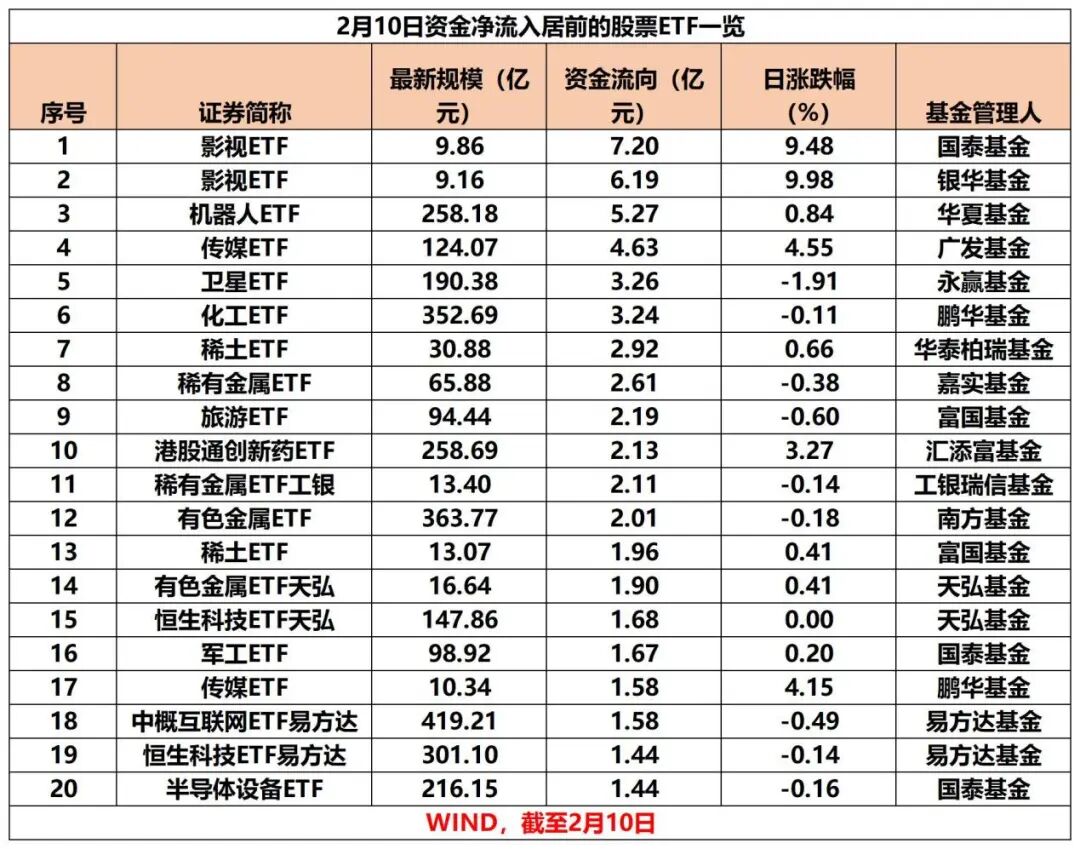
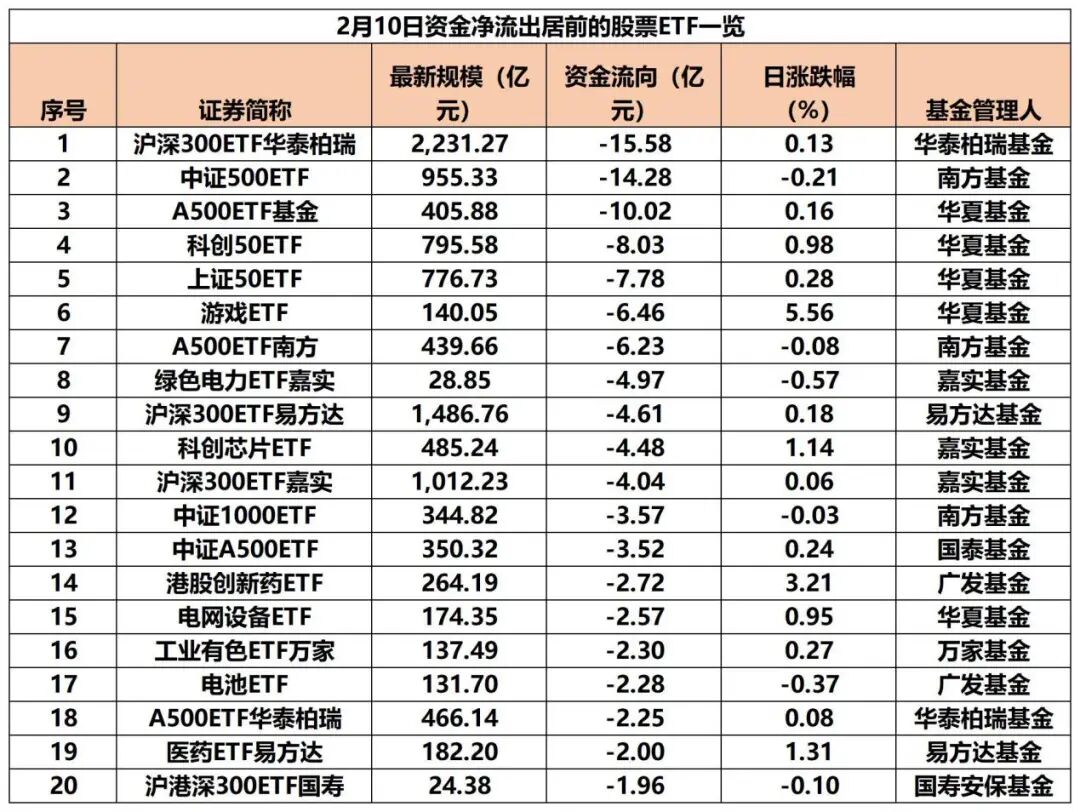
Core Viewpoint - The A-share market experienced a narrow fluctuation on February 10, with significant capital outflows from stock ETFs exceeding 10.26 billion yuan, while sectors like media and humanoid robots showed active performance [1][2]. Group 1: Market Performance - On February 10, the three major A-share indices showed mixed results: the Shanghai Composite Index rose by 0.13%, the Shenzhen Component Index increased by 0.02%, while the ChiNext Index fell by 0.37% [2]. - The overall market saw a net outflow of 102.59 billion yuan from stock ETFs, including cross-border ETFs [2]. Group 2: ETF Capital Flows - The net inflow for the media-related ETFs was significant, with the film and television index-related ETFs seeing a net inflow of 13.39 billion yuan, while the CSI 300 index-related ETFs experienced a net outflow of 29.04 billion yuan [2]. - Over the past five days, the Hang Seng Technology Index-related ETFs attracted over 8.5 billion yuan, and the SGE Gold 9999 Index-related ETFs saw inflows exceeding 6.2 billion yuan [2]. Group 3: Fund Company Insights - E Fund's ETF had a latest scale of 661.58 billion yuan, with a net inflow of 1.05 billion yuan. The China concept internet ETF saw a net inflow of 158 million yuan, while the Hang Seng Technology ETF had a net inflow of 144 million yuan [2]. - Huaxia Fund's robot ETF and sci-tech semiconductor ETF had notable net inflows of 527 million yuan and 117 million yuan, respectively, with their latest scales reaching 25.818 billion yuan and 8.196 billion yuan [3]. Group 4: Notable ETFs - The top ETFs by net inflow on February 10 included the film and television ETF with a net inflow of 720 million yuan, and the robot ETF with a net inflow of 527 million yuan [4]. - Conversely, the top ETFs by net outflow included the CSI 300 ETF with a net outflow of 1.558 billion yuan and the CSI 500 ETF with a net outflow of 1.428 billion yuan [5]. Group 5: Future Market Outlook - The investment focus may shift from January's credit and liquidity performance to macroeconomic and industrial clues as the market enters a relatively data-vacuum period post-Spring Festival [6]. - The media sector is expected to benefit from AI applications, particularly in gaming and film production, which could enhance content creation efficiency and reduce costs [6].
超百亿,“跑了”!
Zhong Guo Ji Jin Bao· 2026-02-11 06:17
Core Viewpoint - The stock ETF market experienced a net outflow of over 10.26 billion yuan on February 10, with significant movements in various thematic ETFs and broad-based ETFs [2][4][5]. Group 1: Market Overview - On February 10, the three major A-share indices showed mixed results, with the Shanghai Composite Index rising by 0.13%, the Shenzhen Component Index increasing by 0.02%, and the ChiNext Index declining by 0.37% [2]. - The overall market saw a net outflow of 10.26 billion yuan in stock ETFs, including cross-border ETFs [2]. Group 2: ETF Performance - The net inflow for the China Film Index-related ETFs was the highest, reaching 1.339 billion yuan, while the net outflow for the CSI 300 Index-related ETFs was the largest at 2.904 billion yuan [2]. - Over the past five days, the Hang Seng Technology Index-related ETFs saw inflows exceeding 8.5 billion yuan, and the SGE Gold 9999 Index-related ETFs attracted over 6.2 billion yuan [2]. Group 3: Fund Company Insights - E Fund's ETF had a latest scale of 661.58 billion yuan, with an increase of 1.05 billion yuan. The China Internet ETF from E Fund had a scale of 41.921 billion yuan, with a net inflow of 158 million yuan [2]. - Huaxia Fund's Robot ETF and Sci-Tech Semiconductor ETF had significant net inflows of 527 million yuan and 117 million yuan, respectively, with latest scales of 25.818 billion yuan and 8.196 billion yuan [3]. Group 4: Thematic ETF Trends - Popular thematic ETFs such as the Film ETF, Robot ETF, and Satellite ETF saw the highest net inflows, while broad-based ETFs like the CSI 300 ETF and CSI 500 ETF were the biggest losers in terms of net outflows [4][5]. - The Media ETF from GF Fund received the most net inflow, amounting to 460 million yuan, and has seen a year-to-date increase of over 26%, making it one of the top performers in the market [3]. Group 5: Future Market Outlook - The investment focus may shift from January's credit and liquidity performance to macroeconomic and industrial cues as the market enters a relatively quiet period for macro data [6]. - The core assets in the market are currently at historical median valuation levels, suggesting potential for valuation recovery, supported by stable profit expectations and a warming trend in foreign capital inflows [6].
中国证券投资基金业协会:中国证券投资基金业年报(2025)
Sou Hu Cai Jing· 2026-02-11 06:11
Core Insights - The report highlights the steady growth of China's securities investment fund industry in 2024, with a total scale reaching 72.83 trillion yuan, marking an 8.2% year-on-year increase [11] - Public funds showed remarkable performance, with a scale of 32.83 trillion yuan, up 18.9% year-on-year, while private funds experienced a slight decline [11] - The report emphasizes the importance of the fund industry in stabilizing the capital market and supporting the real economy, particularly through pension fund management and private equity investments [10][12] Group 1: Industry Overview - The total scale of the fund industry reached 72.83 trillion yuan in 2024, with public funds at 32.83 trillion yuan and private funds at 19.93 trillion yuan [11] - The number of public fund managers increased to 163, managing a total of 12,400 funds, which is a 7.05% increase from the previous year [32] - Public funds accounted for 24.34% of the GDP, highlighting their significant role in the macroeconomic landscape [34] Group 2: Public Fund Performance - Public funds' net asset scale reached 32.83 trillion yuan, with a year-on-year growth of 18.9% [11] - The asset allocation of public funds includes 24% in equity funds, 41% in money market funds, and 21% in bond funds, indicating a diversified investment strategy [2] - The sales channels for public funds are primarily through commercial banks and independent fund sales institutions, accounting for 39.43% and 38.44% of subscription amounts, respectively [2] Group 3: Private Fund Insights - Private fund scale was 19.93 trillion yuan, showing a slight decline of 3.3%, but venture capital funds reached a record high of 3.37 trillion yuan, up 3.97% [11] - Private equity funds have invested in over 208,000 equity projects, demonstrating their strong penetration in newly listed companies on the Sci-Tech Innovation Board and other exchanges [12] - The private asset management business of securities and futures institutions reached 12.17 trillion yuan, with asset securitization products totaling 2.07 trillion yuan, reflecting the industry's resilience [11] Group 4: Pension Fund Management - The fund industry managed a total of 5.94 trillion yuan in various pension assets, with a year-on-year growth of 21.6% [11] - The number of pension target funds reached 269, with a total scale of 599.58 billion yuan, indicating a growing focus on retirement planning [2] - The personal pension fund Y-share class reached 285 funds, with a scale of 91.43 billion yuan, contributing to a multi-tiered pension security system [2]

财新周刊-第6期2026
2026-02-11 05:58
Summary of Key Points from Conference Call This document is a summary based on the Caixin article [https://a.caixin.com/FA909Zlp](https://a.caixin.com/FA909Zlp). The summary may deviate from the original intent of the text and does not represent Caixin's views or positions. It is recommended to click the link for detailed comparison and verification. Industry Overview - The document discusses the recent volatility in the precious metals market, particularly focusing on gold and silver prices, which have experienced significant fluctuations in early 2026. Core Insights and Arguments 1. **Market Volatility**: In January 2026, gold and silver prices saw extreme volatility, with gold reaching approximately $5,600 per ounce before dropping to around $4,683 per ounce, marking a daily decline of 40%, the largest in 40 years [10][11][24]. 2. **Speculative Behavior**: The market is characterized by speculative trading, with significant price movements driven by investor sentiment rather than fundamental factors. This has led to a bubble-like state in the gold and silver markets [22][33]. 3. **Impact of External Factors**: Political events, such as actions taken by former President Trump, have been cited as catalysts for price increases in gold, indicating that geopolitical tensions can significantly influence market dynamics [22][39]. 4. **Central Bank Purchases**: Central banks have been increasing their gold reserves, viewing gold as a hedge against currency risk, which has contributed to the upward pressure on gold prices [38][39]. 5. **Investment Strategies**: Investors are advised to adopt long-term holding strategies for gold and to avoid leveraging due to the current market volatility. It is suggested that gold should be treated as a safe-haven asset within a diversified portfolio [30][31][32]. Additional Important Content 1. **Regulatory Responses**: In response to market volatility, exchanges have increased trading costs and adjusted margin requirements to mitigate risks associated with excessive speculation [23][24]. 2. **Market Sentiment**: The sentiment among investors is mixed, with some looking to capitalize on price dips while others remain cautious due to the high volatility [30][31]. 3. **Supply Chain Concerns**: The document highlights potential supply chain disruptions for silver due to new tariffs and regulations, which could further impact market liquidity and pricing [41]. 4. **Long-term Outlook**: Despite short-term fluctuations, the long-term outlook for gold remains positive, driven by ongoing geopolitical uncertainties and the potential for continued central bank purchases [38][39]. This summary encapsulates the key points discussed in the conference call regarding the precious metals market, focusing on the dynamics of gold and silver prices, investor behavior, and the broader economic implications.
大量定期存款到期,“固收+”再迎爆发式增长?
Jing Ji Guan Cha Wang· 2026-02-11 05:39
Core Viewpoint - The upcoming maturity of a significant amount of residential time deposits in 2026, estimated at approximately 75 trillion yuan, is expected to drive funds towards "fixed income +" products, as traditional deposit rates decline below 1% [1][2]. Group 1: Market Context - In 2026, a large volume of three-year and five-year time deposits will be repriced, with an estimated 67 trillion yuan of one-year and above deposits maturing, which is higher than the market's estimate of around 50 trillion yuan [1]. - The growth in maturing deposits compared to 2025 is projected to be 12% for all deposits and 17% for one-year and above deposits, translating to an increase of 8 trillion yuan and 10 trillion yuan respectively [1]. - The current weak consumer sentiment and limited real estate demand suggest that a significant portion of these funds may flow into investment areas, indicating a market consensus on "deposit migration" [1]. Group 2: Product Development - The "fixed income +" products have evolved over more than a decade, entering a new stage of development characterized by improved asset allocation and value discovery capabilities [1]. - The macroeconomic environment in 2026 is expected to show marginal improvement, with a "recovery growth" pattern, leading to a low-risk appetite among bank depositors who prioritize capital safety and stable returns [1][2]. Group 3: Regulatory Support - The China Securities Regulatory Commission (CSRC) has issued a plan to support the development of various fund products, emphasizing the creation of low-volatility and asset allocation products to meet diverse investor needs [2]. Group 4: Fund Performance - As of the end of 2025, the total market size of "fixed income +" funds reached a historical high of 2.735 trillion yuan, reflecting a growing acceptance among investors [3]. - Several "fixed income +" products from Bosera Fund have shown strong performance, with specific funds achieving notable net value growth rates significantly above their respective benchmarks [8][9].
管理10只基金规模超350亿元 天弘基金固收一姐姜晓丽官宣离职 “工作17年没休过长假,想彻底给自己放个假”
Xin Lang Cai Jing· 2026-02-11 05:25
MACD金叉信号形成,这些股涨势不错! 责任编辑:杨赐 专题:天弘基金"固收一姐"姜晓丽离职,350亿规模由10位基金经理共同接棒 MACD金叉信号形成,这些股涨势不错! 责任编辑:杨赐 专题:天弘基金"固收一姐"姜晓丽离职,350亿规模由10位基金经理共同接棒 ...
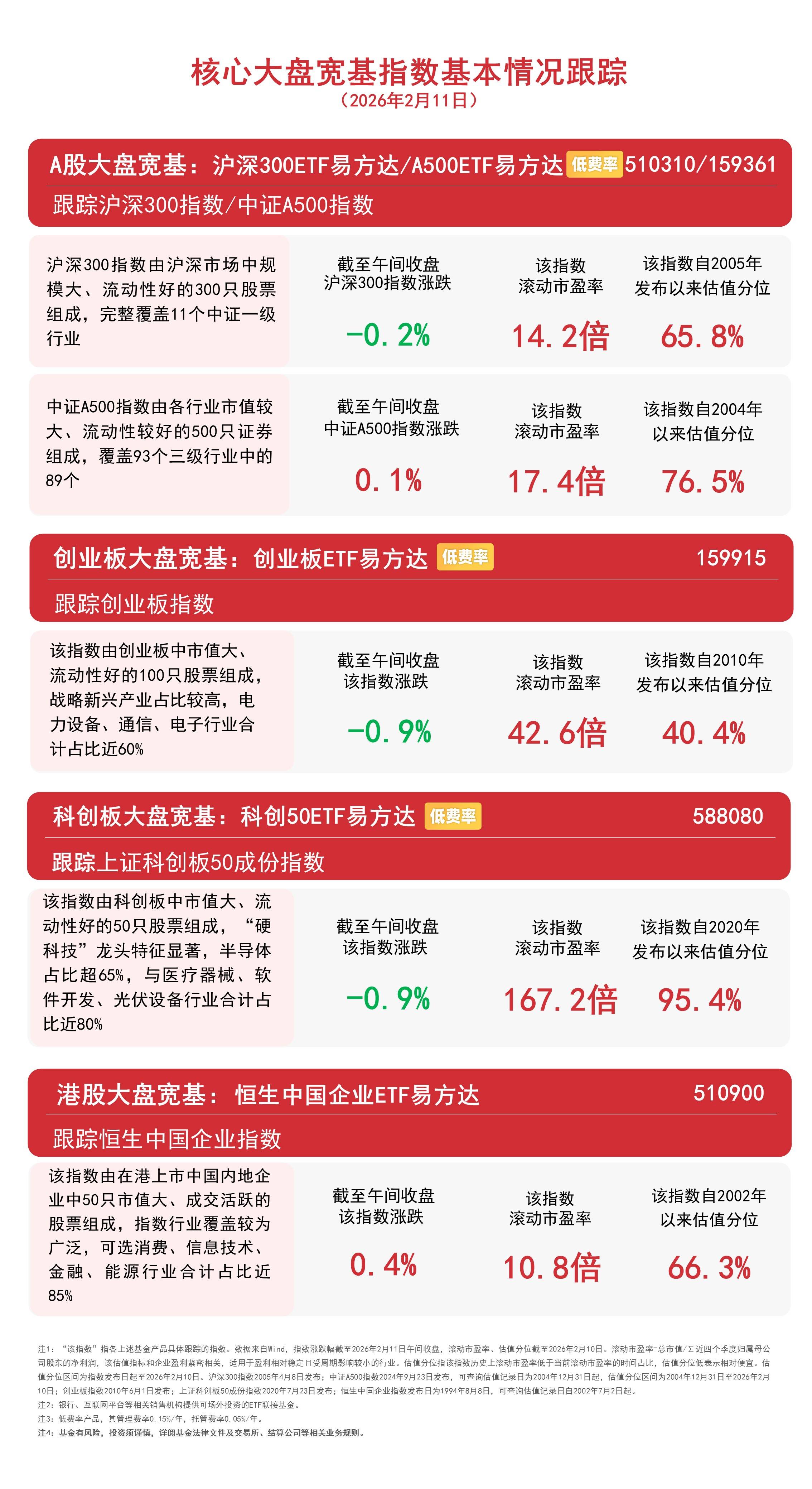
沪指低开高走冲击三连涨,A500ETF易方达(159361)、沪深300ETF易方达(510310)等助力布局核心资产
Sou Hu Cai Jing· 2026-02-11 05:04
Group 1 - The A-share market showed mixed performance with the Shanghai Composite Index rising by 0.22%, aiming for a third consecutive increase, while over 2,700 stocks in the market were in the green [1] - Key sectors that performed well included non-ferrous metals, rare earth permanent magnets, chemical fibers, dyes, oil and gas extraction and services, solid-state batteries, computing power leasing, steel, paper, and electricity [1] - Conversely, sectors that experienced declines included film and television, short drama games, education, CPO, copper cable high-speed connections, and photovoltaic equipment [1] Group 2 - The ChiNext Index, which tracks 100 stocks with high market capitalization and liquidity in the ChiNext market, has a significant proportion of strategic emerging industries, with electric equipment, communication, and electronics accounting for nearly 60% [4] - The STAR Market 50 Index, which tracks 50 stocks with high market capitalization and liquidity in the STAR Market, features a prominent "hard technology" characteristic, with semiconductors making up over 65% and combined with medical devices and software development accounting for nearly 80% [4]