
社会服务

Search documents
新股次新板块整体延续博弈走势,但局部亮点可能更为凸显
Huajin Securities· 2025-12-28 09:58
Group 1 - The new stock and newly listed sector continues to exhibit a speculative trend, with localized highlights becoming more pronounced. The current adjustment cycle has lasted nearly four months, and the negative impact from the failure to reach a bottom in early December is expected to have been digested over the past few weeks. A turning point for this adjustment cycle may be approaching [1][2][13] - The average increase in the new stock sector since the beginning of 2024 is approximately 1.2%, with about 60.1% of stocks achieving positive returns, indicating a recovery from the previous week’s average decline of -2.0% [1][13][28] - External catalysts are increasing, including the central bank's encouragement to raise long-term capital investment in A-shares, which may boost overall market risk appetite. Additionally, the Shanghai Stock Exchange's new listing standards for commercial aerospace companies may enhance trading enthusiasm in current popular themes [2][13] Group 2 - The focus remains on technology sectors, particularly in areas such as AI computing power, robotics, and commercial aerospace, which have significant long-term growth potential. Continuous attention and active search for emerging hotspots within these sectors are recommended [3][13] - For sectors that are currently popular, it is advised to manage the rhythm of adjustments and consider rotational investments, including innovative pharmaceuticals, new energy, new consumption, and non-ferrous chemicals [3][13] Group 3 - Upcoming new stocks include Qiangyi Co., Yufan Technology, Shuangxin Environmental Protection, and Hengdong Light [4][33] - Last week, three new stocks were available for online subscription, with an average issuance price-earnings ratio of 18.7X and an average subscription success rate of 0.0210% [5][21] - The average first-day increase for newly listed stocks last week was approximately 265%, indicating sustained high trading enthusiasm, although this was a slight decrease from the previous week’s average of 343% [5][25][26]
商业行业2026年度策略报告:把握多元需求,服务消费释放潜力-20251228
CMS· 2025-12-28 09:04
Group 1: Macro Retail and Service Consumption - Retail data shows that essential goods maintain resilience while optional goods exhibit differentiated performance, with social retail growth slightly slowing down due to high base effects from government subsidies [10][16] - Service retail continues to show strong growth, with a year-on-year increase of 5.4% from January to November 2025, outpacing overall social retail growth [10][18] - Travel demand is steadily releasing, with domestic tourism numbers reaching 4.85 trillion yuan, a year-on-year increase of 11.5% [18][20] Group 2: E-commerce Sector - E-commerce maintains a steady growth rate, with online retail sales of physical goods increasing by 5.7% year-on-year, surpassing the overall social retail growth [13][25] - The penetration rate of e-commerce continues to rise, reaching 25.9% of total social retail sales by November 2025, an increase of 3.6 percentage points since the beginning of the year [13][25] - The competitive landscape in e-commerce is easing, with platforms like Taobao and JD.com focusing on maintaining stable growth rather than aggressive price competition [28][36] Group 3: Retail Focus on Downstream Markets - The focus is on the resilience of consumption in lower-tier markets, with recommendations for bulk snack retailers and the "锅圈" brand, which excels in the home dining sector [5][31] - The bulk snack market is characterized by low prices and high turnover, effectively meeting consumer demand for snacks [5][31] - "锅圈" is positioned as a leader in the home dining market, leveraging its multi-channel advantages and strong supply chain [5][31] Group 4: Service Sector Recovery - The hotel industry is stabilizing with a recovery in demand, and recommendations include Huazhu Group and Atour Hotel [5][31] - The OTA sector is experiencing stronger leisure demand compared to business travel, with international business continuing to grow rapidly [5][31] - Policies aimed at boosting service consumption are expected to further stimulate demand in the travel and hospitality sectors [23][24] Group 5: Investment Recommendations - Recommended companies include Alibaba, Meituan, Pinduoduo, JD.com, and Didi Chuxing for their strong fundamentals and low valuations [2][3] - The report highlights the potential for growth in the e-commerce and service sectors, driven by favorable policies and market dynamics [5][23]

光大证券:多重支撑护航 春季行情行稳致远
Xin Lang Cai Jing· 2025-12-28 08:12
Group 1 - A-shares showed strong performance this week, with major indices generally rising, particularly the CSI 500, ChiNext Index, and the Small and Medium 100, while the Shanghai Composite and CSI 300 had smaller gains [1][6] - The current valuation of the Sci-Tech 50 and Wind All A indices is relatively high, with their PE (TTM) percentile exceeding 85% since 2010, as of December 26, 2025 [1][6] - Small-cap growth style outperformed this week, with significant gains in sectors such as non-ferrous metals and defense, while sectors like beauty care and social services saw declines [1][6] Group 2 - The A-share market is expected to continue its upward trend, supported by favorable policies and increased capital inflows, with historical patterns indicating a "spring rally" [3][8] - The trading volume has increased, surpassing 2 trillion yuan on Friday, with a total weekly turnover of 9.83 trillion yuan, marking a six-week high [3][8] - Policy support is anticipated to boost market confidence and attract various types of capital, with a focus on growth and consumption sectors, particularly TMT and advanced manufacturing during the "spring rally" [4][9] Group 3 - Recent policy developments include the People's Bank of China announcing a one-time credit repair policy, and the housing and urban-rural development meeting outlining real estate priorities for 2026 [2][7] - The issuance of L3 level autonomous driving vehicle licenses in Beijing marks a significant step in the automotive industry, alongside the 2025 Computing Power Internet Conference held in Chengdu [2][7] - The EU has extended economic sanctions against Russia for six months until July 31, 2026, and Japan has finalized its budget for the 2026 fiscal year, setting a new historical high [2][7]

看懂这些,把握跨年行情
私募排排网· 2025-12-28 00:00
Group 1 - The core viewpoint of the article emphasizes that the "cross-year market" period is characterized by significant industry rotation and style switching rather than a straightforward market trend, with historical patterns indicating mixed performance across indices [2][4]. - Over the past decade, major broad-based indices have shown an average decline during the cross-year period, with the average returns for the CSI 500, CSI 1000, and National 2000 indices in January being -4.71%, -6.67%, and -6.68% respectively, indicating a win rate below 50% [2][4]. - The Shanghai Composite 50 and CSI 300 indices have shown average returns of -0.72% and -1.54% in January, with a win rate of 50% over the last ten years, suggesting a relatively stronger performance compared to smaller indices [2][4]. Group 2 - The article highlights that the characteristics of the cross-year market are not indicative of a general beta market trend, but rather a "defensive December and strong differentiation in January" structure, with defensive sectors performing better in December [7][12]. - In January, the banking sector has consistently outperformed other sectors, maintaining a position among the top five in terms of monthly returns, except for 2020 and 2023 [7][12]. - The average returns for most sectors in January have been negative, with many sectors showing win rates of only 30-40%, indicating a lack of broad-based gains and a tendency for performance differentiation [7][12]. Group 3 - Historical statistics suggest that the cross-year phase is not a favorable period for quantitative long strategies to achieve excess returns, but rather exposes differences in strategy concentration, drawdown control, and volatility adaptation [12]. - For investors holding quantitative long private equity funds, the focus during the cross-year period should be on assessing the ability of their products to maintain net value stability in a volatile and differentiated environment [12]. - From an asset allocation perspective, it is advisable to consider complementary configurations of styles and assets to smooth out portfolio volatility, particularly given the banking sector's relative strength in January [12].


招商证券首席策略分析师张夏:市场驱动力切换 布局顺周期与科技自立双主线
Mei Ri Jing Ji Xin Wen· 2025-12-25 17:40
Core Viewpoint - The year 2026 will mark a critical turning point for the A-share market, transitioning from liquidity-driven to profit-driven growth, driven by a rebound in PPI and a dual focus on domestic demand recovery and technological self-reliance [1] Group 1: Macroeconomic Environment - The growth model reliant on real estate and infrastructure credit expansion has weakened, with government spending becoming the core marginal force for total demand fluctuations since 2022 [2] - The "14th Five-Year Plan" is expected to maintain an expansionary fiscal policy, with infrastructure and major projects driving investment and countering export decline [2] - The year 2026 coincides with the U.S. midterm elections, historically leading to expansionary fiscal and monetary policies in the U.S., which will resonate with China's policies, potentially boosting global demand for industrial metals [2] Group 2: Market Transition - The A-share market is transitioning from a liquidity-driven phase to a profit-driven phase, with PPI recovery being a key variable indicating substantial improvement in corporate profits [4] - Historical patterns show that industries like oil, non-ferrous metals, coal, and basic chemicals are highly correlated with PPI and commodity prices [4] - The market is expected to enter a profit-driven phase, with small-cap growth stocks likely to outperform as PPI improves [4] Group 3: Investment Opportunities - Investment strategies should focus on the dual drivers of domestic demand recovery and technological self-reliance, particularly in the domestic computing power industry [5] - The recovery of the consumer services sector is anticipated to be driven by multiple factors, including policy goals to enhance consumer spending and structural trends like aging populations and the rise of younger consumers [6] - The domestic AI chip market is expected to gain historical market share against foreign competitors, with key areas including integrated circuits and foundational software [6] Group 4: Industry Focus - Recommended sectors for investment include cyclical industries, technology innovation, and consumer recovery, with a focus on non-ferrous metals, machinery, power equipment, electronics, media, and social services [6]

兴业证券:哪些行业股价与人民币汇率相关性较强?
智通财经网· 2025-12-25 12:13
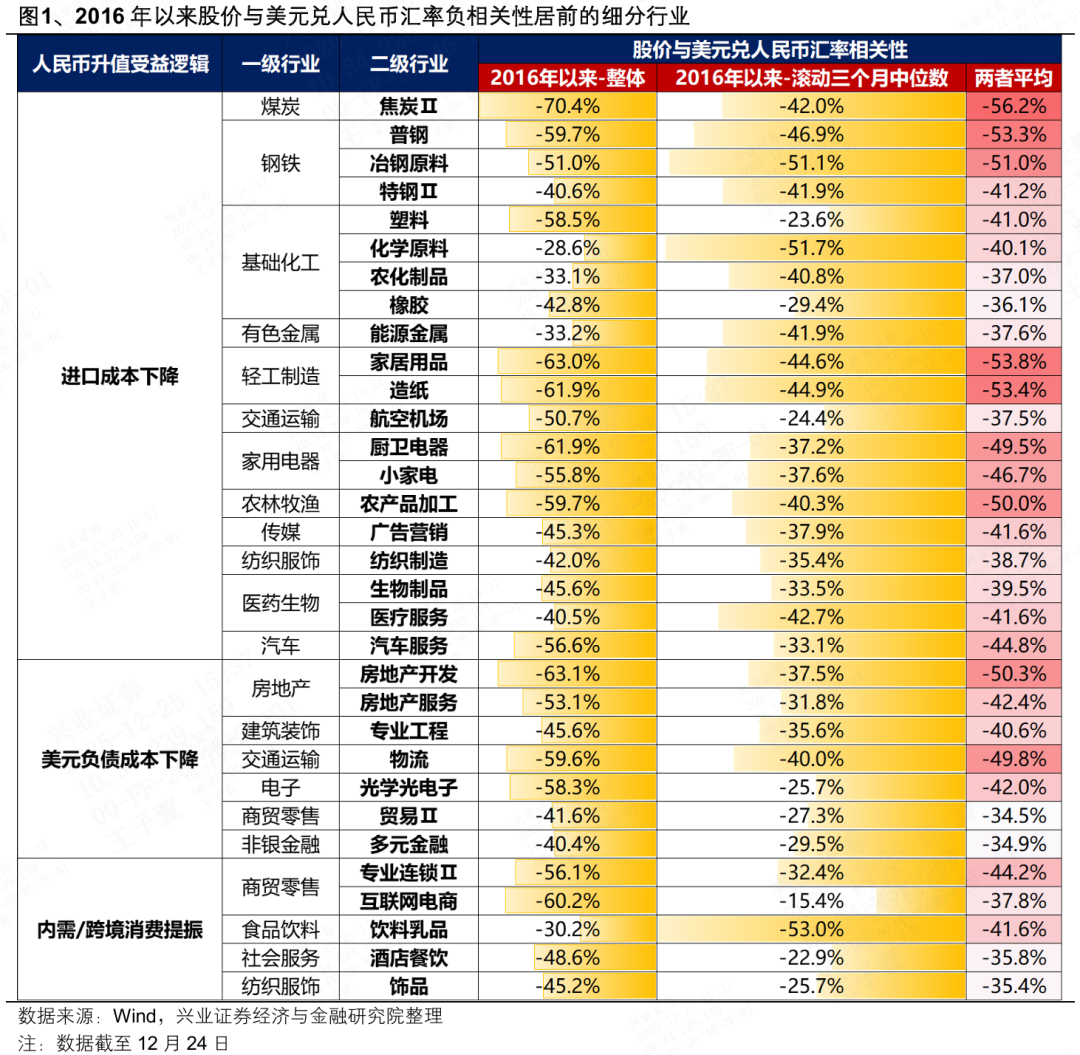
Core Viewpoint - The report from Industrial Securities highlights the negative correlation between stock prices and the USD/CNY exchange rate since 2016, indicating that a stronger RMB tends to drive stock prices higher across various sectors [1] Group 1: Industries Benefiting from RMB Appreciation - Industries with high reliance on imported raw materials benefit from RMB appreciation, leading to reduced import costs. Key sectors include coke, steel, certain chemicals (plastics, chemical raw materials, agricultural chemicals, rubber), energy metals, paper, airport operations, and agricultural product processing [1] - The construction and real estate sectors, which have high USD-denominated debt, see a decrease in financing costs due to RMB appreciation. This includes real estate development, real estate services, and specialized engineering [1] - The service and high-end consumption sectors, such as cross-border e-commerce, hotel and catering services, and jewelry, benefit from increased domestic demand and cross-border consumption driven by enhanced RMB purchasing power [1] Group 2: Correlation Data - The median negative correlation between stock prices and the USD/CNY exchange rate since 2016 shows significant figures for various sectors: - Coke: -70.4% overall, -42.0% rolling three months - Steel: -59.7% overall, -46.9% rolling three months - Basic chemicals: -58.5% overall, -23.6% rolling three months - Transportation (airports): -50.7% overall, -24.4% rolling three months - Real estate development: -63.1% overall, -37.5% rolling three months [2] Group 3: Impact on Financing Costs - Industries with high USD debt benefit from RMB appreciation, leading to lower financing costs. This includes logistics, optical electronics, trade, and diversified finance sectors [1] - Specific correlations include: - Logistics: -59.6% overall, -40.0% rolling three months - Optical electronics: -58.3% overall, -25.7% rolling three months - Trade: -41.6% overall, -27.3% rolling three months [2] Group 4: Domestic Demand and Cross-Border Consumption - The sectors benefiting from increased domestic demand and cross-border consumption include: - Food and beverage (dairy products): -30.2% overall, -53.0% rolling three months - Hospitality (hotels and restaurants): -48.6% overall, -22.9% rolling three months - Textiles (jewelry): -45.2% overall, -25.7% rolling three months [2]

主力资金丨尾盘大幅加仓股出炉
Zheng Quan Shi Bao Wang· 2025-12-24 11:21
Group 1 - The electronic industry saw a net inflow of 4.916 billion yuan, leading the market [1] - The A-share market indices collectively rose, with the Shanghai Composite Index achieving six consecutive days of gains [1] - Among the 13 industries with net inflows, the power equipment and defense industries also saw significant inflows of 2.217 billion yuan and 1.233 billion yuan, respectively [1] Group 2 - A total of 45 stocks experienced net inflows exceeding 200 million yuan, with 15 stocks seeing inflows over 400 million yuan [2] - Demingli topped the list with a net inflow of 955 million yuan, driven by increasing data storage demand influenced by AI [2] - Tianji Co. reached a trading limit with a net inflow of 885 million yuan, focusing on the industrialization of lithium sulfide material preparation [2] Group 3 - At the market close, there was a net inflow of 129 million yuan, with the communication sector leading with over 500 million yuan in inflows [3] - Individual stocks such as Zhongji Xuchuang and Qingshan Paper experienced net inflows exceeding 200 million yuan [3] Group 4 - Beijing Junzheng and Wolong Electric Drive saw net outflows exceeding 100 million yuan at the market close [4] - Companies like Midea Group and Sihua Intelligent Control had net outflows exceeding 70 million yuan [5]



港股本周圣诞提前休市!港股红利ETF基金(513820)溢价走阔达0.73%,资金连续17日涌入超6亿元!跌出性价比?中信建投:开启中期配置窗口
Sou Hu Cai Jing· 2025-12-24 08:57
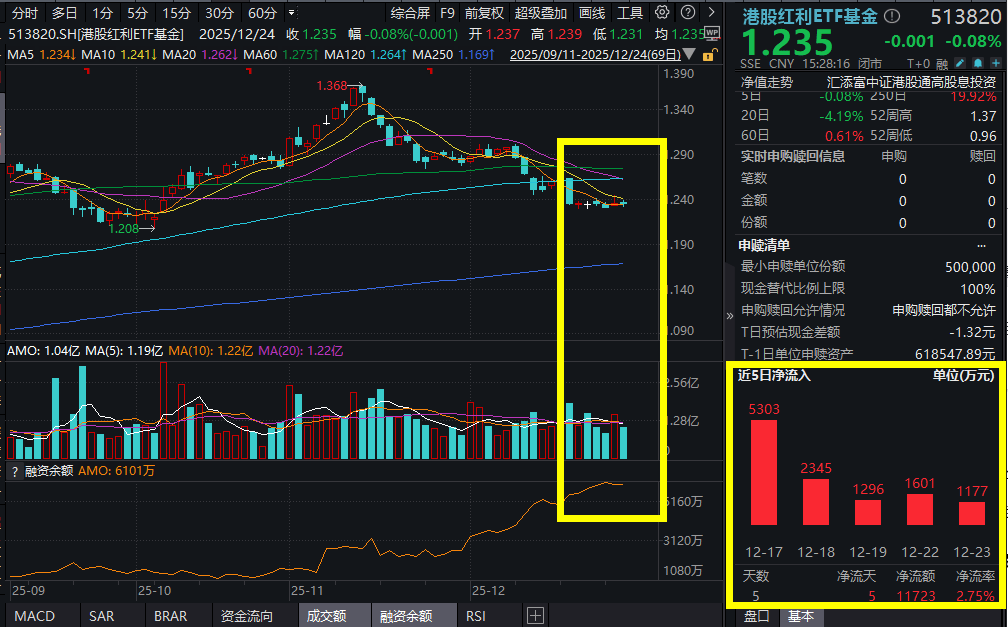
Core Viewpoint - The Hong Kong stock market is experiencing a mixed performance, with the high dividend ETF fund (513820) showing resilience and attracting significant capital inflows, indicating strong investor interest in dividend-yielding assets [1][5]. Group 1: Market Performance - The Hong Kong stock market showed a mixed trend in early trading on December 24, with the CSI Hong Kong Stock Connect High Dividend Index down by 0.42% [1]. - The Hong Kong Dividend ETF fund (513820) recorded a slight decline of 0.08%, with a premium widening to 0.73% by the end of the trading session, reflecting active buying interest [1][3]. - The fund has seen a strong inflow of over 600 million yuan for 17 consecutive days, bringing its total size to over 4.3 billion yuan, significantly outperforming other ETFs in the same index [1][5]. Group 2: Fund Composition and Performance - The majority of the constituent stocks of the Hong Kong Dividend ETF fund (513820) experienced declines, with notable exceptions like HSBC Holdings, which rose over 1% [3][4]. - The top ten constituent stocks of the fund include China Pacific Insurance, China Telecom, and Agricultural Bank of China, with varying performance among them [4]. - The fund's index has a dividend yield of 7.25%, which is higher than similar indices in both Hong Kong and A-shares, establishing it as a leading choice for dividend investors [8][9]. Group 3: Investment Strategy and Outlook - Multiple factors are contributing to the opening of a mid-term trading window for Hong Kong stocks, including a market adjustment that has increased safety margins and a continued net inflow of southbound funds [5]. - The current environment suggests a focus on high-quality dividend stocks with sustainable payouts and stable earnings, as the defensive attributes of dividend investments may weaken in a rising interest rate environment [6]. - The Hong Kong Dividend ETF fund (513820) is positioned as a "pure high dividend" strategy, which is expected to perform well in the current market conditions, especially as institutional demand for dividend assets increases [10][11].

商社美护行业周报:海南自贸港正式封关,服务零售增速环比提速-20251224
Guoyuan Securities· 2025-12-24 08:16
Investment Rating - The industry maintains a "Recommended" rating, focusing on new consumption sectors such as beauty care, IP derivatives, and gold jewelry [5][28]. Core Insights - The market performance for the week of December 15-20, 2025, showed significant gains in the retail, social services, and beauty care sectors, outperforming the overall market with increases of +6.66%, +2.66%, and +2.87% respectively [2][14]. - The total retail sales of consumer goods from January to November 2025 reached 45.61 trillion yuan, a year-on-year increase of 4%. In November alone, retail sales totaled 4.39 trillion yuan, growing by 1.3% year-on-year, which was below market expectations [3][22]. - The service consumption growth rate outpaced that of goods retail, with service retail sales increasing by 5.4% year-on-year from January to November 2025 [3][22]. Summary by Sections Market Performance - The beauty care, retail, and social services sectors ranked first, fourth, and third among 31 primary industries, respectively, during the week [2][14]. - Specific sub-sectors such as general retail, hotel and catering, and professional chains saw notable increases of +9.67%, +8.40%, and +5.06% [15]. Key Industry Data and News - The retail sales of consumer goods in November 2025 showed a modest increase, with categories like communication equipment and jewelry performing well, while automotive and home appliances faced challenges due to high base effects and subsidy reductions [3][22]. - The Ministry of Commerce initiated a two-year pilot program for new consumption models in 50 cities, aiming to stimulate consumption through various innovative approaches [3][22]. Investment Recommendations - The report suggests focusing on companies in the beauty care and new consumption sectors, recommending specific stocks such as Shangmei Co., Juzhi Biotechnology, and Marubi Biotechnology [5][28].


每日投资策略-20251224
Zhao Yin Guo Ji· 2025-12-24 03:33
Market Performance - Hang Seng Index closed at 25,774, down 0.11% for the day but up 28.49% year-to-date[1] - Shanghai Composite Index closed at 3,920, up 0.07% for the day and 16.95% year-to-date[1] - US Dow Jones closed at 48,442, up 0.16% for the day and 13.86% year-to-date[1] Sector Performance - Hang Seng Financial Index at 49,069, up 0.58% for the day and 39.65% year-to-date[2] - Hang Seng Industrial Index at 13,970, down 0.55% for the day and up 24.18% year-to-date[2] - Hang Seng Real Estate Index at 17,858, up 0.56% for the day and 19.75% year-to-date[2] Capital Flows and Market Trends - Southbound capital net inflow of HKD 611 million, with Alibaba, Meituan, and Zijin Mining as top net buys[3] - A-shares in social services, beauty care, and retail saw the largest declines, while power equipment, building materials, and electronics led gains[3] - Anticipation of a spring market in early 2024, with technology and consumer sectors expected to outperform[3] Economic Indicators - US GDP growth at an annualized rate of 4.3% in Q3, the highest in two years[3] - Core PCE inflation at 2.9%, indicating persistent inflationary pressures[3] - Consumer confidence index declined for the fifth consecutive month, while the job market shows improvement[3]