
银行理财

Search documents
广银理财管理层调整:总裁回归广发银行 外调两位副总
Xin Lang Cai Jing· 2026-01-09 09:27
Core Viewpoint - The management changes at Guangyin Wealth Management reflect a strategic alignment with China Life's "333 strategy," aimed at enhancing the company's market competitiveness and resource allocation [4][14]. Group 1: Management Changes - Li Yu, the current president of Guangyin Wealth Management, will return to Guangfa Bank as the vice president of the Shanghai branch [10][11]. - Two new vice presidents will be appointed from China Life's subsidiaries: Li Wei from China Life Pension and Zhang Li from China Life Asset Management [4][14]. - The management changes are part of a broader trend where executives from Guangyin Wealth Management often transition to roles within Guangfa Bank or China Life [10][11]. Group 2: Company Background - Guangyin Wealth Management was established on December 1, 2021, with a registered capital of 5 billion RMB, headquartered in Shanghai [10]. - The company is a wholly-owned subsidiary of Guangfa Bank, which is part of China Life Insurance [10][14]. Group 3: Financial Performance - In 2024, Guangyin Wealth Management achieved an operating income of 512 million RMB, a year-on-year increase of 19.63%, and a net profit of 279 million RMB, up 26.24% [5][14]. - As of the end of 2024, the total assets of Guangyin Wealth Management were 5.944 billion RMB, with total liabilities of 96 million RMB and owner’s equity of 5.848 billion RMB [5][14]. Group 4: Asset Management Scale - As of the end of 2024, the scale of existing products at Guangyin Wealth Management was 182.368 billion RMB, ranking 23rd among 31 operating bank wealth management subsidiaries [6][15]. - By June 30, 2025, the scale of existing products decreased to 174.311 billion RMB, with fixed income products accounting for 93.26% of the total [6][15]. Group 5: Product Offerings - Guangyin Wealth Management reported a total of 546 products as of June 30, 2025, with public offerings making up 72.34% and private offerings 27.66% [16]. - The company has launched over 400 distinctive products, aiming to provide comprehensive wealth solutions [16]. Group 6: Risk Management - Guangyin Wealth Management is developing a comprehensive risk management system that covers various dimensions, including strategic, market, operational, financial, and reputational risks [8][17]. - In August 2025, the company faced penalties totaling 11.5988 million RMB due to non-compliance in investment operations and data management [8][17].


年化最高超20%!“黄金+”理财全年收益出炉,购买指南请收好
2 1 Shi Ji Jing Ji Bao Dao· 2026-01-09 08:46
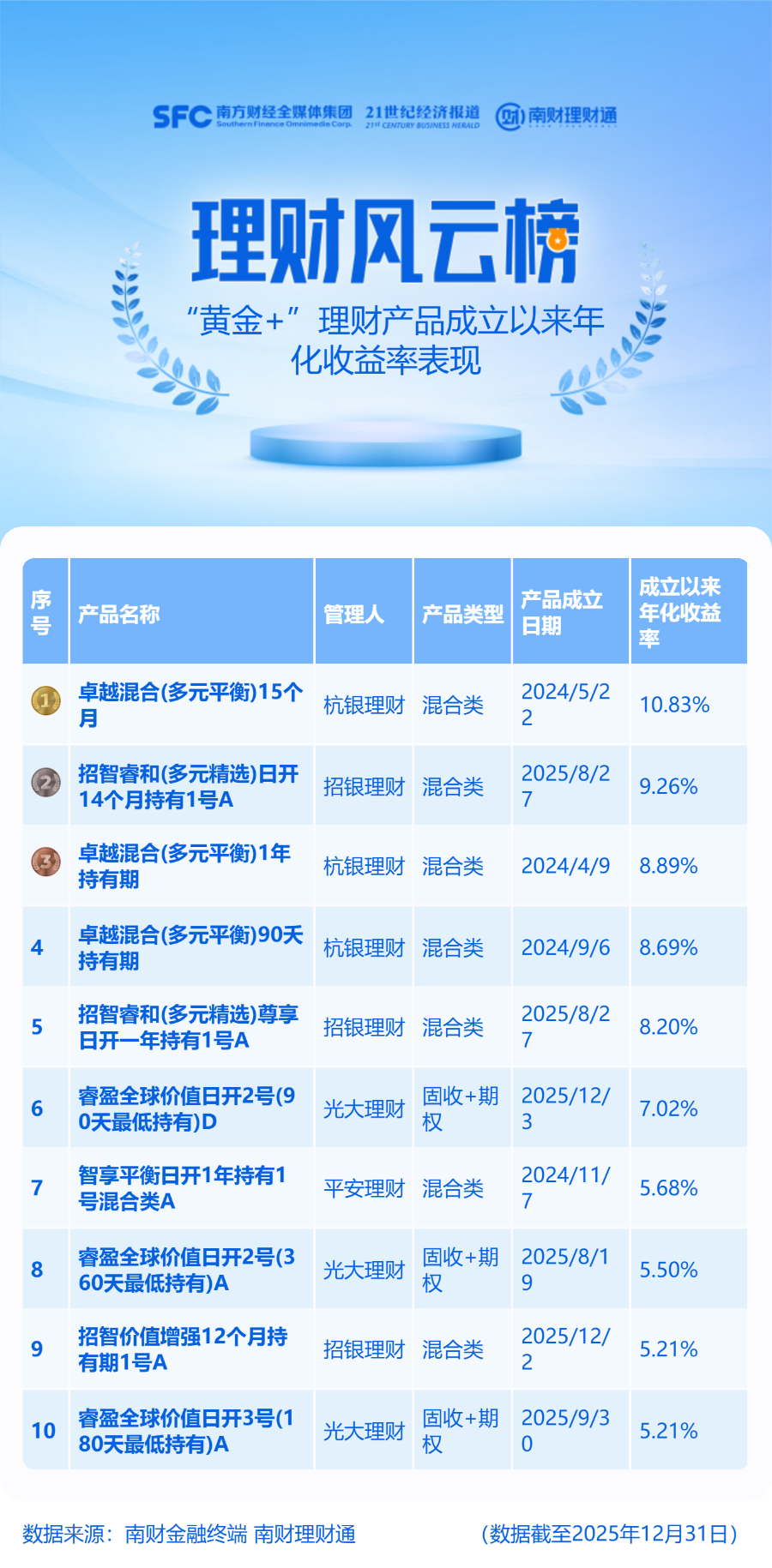
Group 1 - The core viewpoint of the article highlights the significant bull market in the precious metals sector in 2025, with gold prices reaching a peak of $4,550 per ounce and an annual increase of nearly 70% [1] - Central banks globally have been the main drivers of gold purchases, with China's gold reserves increasing to 74.15 million ounces by the end of December 2025, marking the 14th consecutive month of gold accumulation by the People's Bank of China [1] - The World Gold Council reported that in October 2025, central banks net purchased 53 tons of gold, a month-on-month increase of 36%, indicating the highest monthly demand of the year [1] Group 2 - "Gold+" wealth management products are defined as investment products issued by banks that combine gold-related assets with other stable assets, allowing investors to benefit from rising gold prices while mitigating risks [3] - In 2025, there was a high issuance of "Gold+" wealth management products, with 61 new products launched by various financial institutions, including 47 "fixed income + options" products and 14 mixed products [4] - As of December 31, 2025, there were 50 active gold-themed wealth management products, with 52% rated as level two (medium-low risk) and 46% rated as level three (medium risk) [4] Group 3 - The average annualized return for "Gold+" wealth management products in 2025 reached 8.6%, with three products exceeding a 10% annualized return [5] - The top-performing product, "Zhaozhi Hongrui Multi-Asset FOF Progress Day Open No. 1," achieved an annualized return of 22.23% in 2025, despite having a long-term annualized return of only 0.17% since its inception [5] - The performance of "Gold+" wealth management products has been notably strong, with several products showing annualized returns over 5% since inception [5] Group 4 - There are two main types of "Gold+" wealth management products: "fixed income + gold" products that primarily invest in fixed income assets with a small portion in gold-related assets, and structured wealth management products that use derivatives to capture gold price movements [7] - The structured products are designed to provide flexibility in capturing gold opportunities while minimizing the impact of gold price volatility on the product's net value [7] Group 5 - Ordinary investors are encouraged to consider "Gold+" wealth management products as a quality option for participating in gold investments, as they lower the barriers and risks associated with direct gold investment while allowing for potential gains from gold market trends [11] - Investors should be aware of the volatility in gold prices and the importance of long-term holding to avoid losses from short-term fluctuations [11]
中金:看好保险、固收+、私募基金的资金流向增量
Ge Long Hui· 2026-01-08 00:40
Group 1 - The report from CICC indicates a positive outlook on insurance demand growth, particularly from the bancassurance channel, with the characteristics of participating insurance providing stable returns becoming increasingly rare. The transformation of bank wealth management is expected to drive product growth, and the trend of increased insurance premium income since the beginning of the year is already evident [1] - The banking wealth management sector has a clear positioning advantage, but attention is needed on the net value fluctuation pressure following the smoothing of valuation adjustments. Some investors still have unrealistic expectations regarding the actual risks of wealth management products, with a projected growth rate of 8-12% for wealth management in 2026 [1] - In a low interest rate environment, the deepening of capital market reforms is expected to enhance the cost-effectiveness of fixed income plus products. The formal draft of the fund sales fee reform also ensures liquidity for individual holders of bond funds (7-day no redemption) [1] Group 2 - In the mid-to-high risk investment category, there is optimism about the continued prosperity of private equity funds, primarily benefiting from weakened real investment driving the business climate of private equity and the profitability of quantitative private equity. However, the direct flow of funds from deposit migration into the stock market and allocation to actively managed mixed equity funds requires support from household balance sheets [1] - With the reduction of liquidity compensation for time deposits, the demand for allocation in money market funds is also expected to continue [1]
银行理财打榜逻辑催生套利秘籍:投资者定闹钟蹲守“爆金币”
Zhong Guo Zheng Quan Bao· 2026-01-07 20:50
Core Viewpoint - The article discusses the emerging trend of "exploding gold coins" in bank wealth management products, where investors exploit short-term high returns during performance-driven periods, but this practice may soon end due to new regulatory measures aimed at curbing misleading marketing tactics by financial institutions [1][4]. Group 1: Investor Behavior - Investors are increasingly using strategies to capitalize on newly issued, small-scale wealth management products to achieve excess returns, akin to gaming mechanics [1]. - Some investors, like Wu Xin, have developed methods to identify potential high-return products, achieving annualized returns of 5% to 8% through strategic buying and selling [2][3]. Group 2: Institutional Practices - Financial institutions are known to issue small-scale products to artificially inflate short-term returns, which can lead to misleading performance displays [3][4]. - Common tactics used by institutions to boost short-term yields include investing in high-yield preferred stocks and adjusting the timing of bond profit releases [3][4]. Group 3: Regulatory Changes - The Financial Regulatory Authority has introduced the "Financial Institutions Product Appropriateness Management Measures," effective February 1, 2026, which prohibits misleading marketing practices [1][4]. - This regulatory shift aims to eliminate information asymmetry and promote a healthier competitive environment within the wealth management industry [5]. Group 4: Future Industry Trends - Following regulatory changes, the bank wealth management sector is expected to transition towards a "Net Value 3.0" era, characterized by more realistic product net value fluctuations and a focus on high-quality development [5]. - The industry will likely see a shift towards low-volatility, high-liquidity asset allocations, with bonds remaining a foundational component [5].
银行理财打榜逻辑催生套利秘籍: 投资者定闹钟蹲守“爆金币”
Zhong Guo Zheng Quan Bao· 2026-01-07 20:48
Core Viewpoint - The article discusses the emerging trend of "exploding gold coins" in bank wealth management products, where investors exploit short-term high returns from newly issued, small-scale products, but this practice may soon end due to regulatory changes aimed at preventing misleading marketing tactics by financial institutions [1][6]. Group 1: Investor Behavior - Investors are increasingly using strategies to capitalize on short-term high returns from new wealth management products, often referred to as "exploding gold coins" [1]. - Some investors, like Wu Xin, have developed methods to identify which products are likely to yield high returns based on their issuance date and distribution channels, achieving annualized returns of 5% to 8% [2][3]. - Social media influencers are actively sharing insights and strategies for selecting wealth management products, creating lists of recommended and avoided products based on their performance [3]. Group 2: Institutional Practices - Financial institutions are known to issue small-scale wealth management products to easily achieve high returns, which helps them climb recommendation rankings on banking platforms [4]. - Common practices among institutions to boost short-term returns include investing in high-yield preferred stocks and adjusting the timing of bond profit releases [4][5]. - Some institutions manipulate product performance metrics to attract investors, only to later reduce returns once the products gain traction [4]. Group 3: Regulatory Changes - The Financial Regulatory Authority has introduced the "Financial Institutions Product Appropriateness Management Measures," effective February 1, 2026, which prohibits misleading marketing practices by financial institutions [6]. - This regulatory shift aims to eliminate market distortions caused by information asymmetry and promote a return to fundamental asset management principles [6]. - Experts predict that the banking wealth management industry will transition to a "Net Value 3.0" era, characterized by more accurate net value fluctuations and a focus on high-quality development [6][7].
下调!多家银行理财管理费降至0%
中国基金报· 2026-01-07 15:11
Core Viewpoint - Multiple bank wealth management subsidiaries are initiating a "fee reduction wave" to enhance product attractiveness and competitiveness in the market [2]. Group 1: Fee Adjustments by Banks - Nan Yin Wealth Management announced a reduction in fixed management fees from 0.4% to 0.01% and sales fees from 0.3% to 0.01% for certain products, effective from January 14, 2026 [4][5]. - Jianxin Wealth Management is also offering fee reductions, with some products' management fees adjusted to 0.01% per year [6]. - Ning Yin Wealth Management has implemented fee reductions across multiple products, with sales service fees for 12 products dropping from 0.3% to 0.0% [8]. Group 2: Market Trends and Implications - The past year has seen numerous wealth management companies announce multiple rounds of fee reductions, leading to a significant decrease in fee levels compared to previous periods [8]. - The ongoing decline in deposit rates is widening the "scissor difference" with wealth management yields, prompting a shift of funds from deposits to wealth management products [9]. - The "fixed income +" products are expected to experience substantial growth in 2026, with an anticipated increase in scale exceeding 1 trillion yuan, becoming a key driver in the wealth management market [9].
理财产品“爆金币”!背后有何门道
Zhong Guo Zheng Quan Bao· 2026-01-07 14:25
"定好闹钟,测好网速,在理财产品开售的前30秒就进产品页面,千万别卡点!"说起抢购能"爆金币"的 银行理财产品秘诀,投资者小西头头是道。 小西口中的"爆金币",是指投资者通过抢购新发行、小规模的理财产品,利用理财机构打榜冲业绩的窗 口,博取超额收益,宛如游戏中的"打怪爆金币"。 摸索理财产品"爆金币"规律 某城商行理财公司人士告诉记者,部分理财机构会新发一些小规模的理财产品,因规模小所以易于做高 收益,继而凭借亮眼业绩登上银行渠道推荐榜,吸引资金涌入。但高收益难以持续,一段时间后就会回 落。 "有些理财机构在银行App上的产品展示收益都是专门做出来的。在产品规模小的时候做高收益,吸引 眼球,投资者进来后,业绩就变脸了。甚至有些理财公司的渠道部门鼓励投资部门这么做,为的就是好 宣传。要想在别的渠道'上量',就只能随大流。"某银行理财公司投资经理向记者表示。 如何短期做高收益?业内人士告诉记者,常见手法包括配置高息优先股、临到期的高收益存款与信用 债,来拉高理财产品收益率。此外,理财机构会在债券这个投资品种上,人为调节浮盈释放节奏来做高 收益。 上海金融与发展实验室首席专家、主任曾刚向记者表示,部分新发理财产品收 ...
【银行理财】公募销售新规正式落地,理财子深化推进新直联系统上线——银行理财周度跟踪(2025.12.29-2026.1.4)
华宝财富魔方· 2026-01-07 09:41
Regulatory and Industry Dynamics - On December 31, the China Securities Regulatory Commission officially released the "Regulations on the Management of Sales Fees for Publicly Raised Securities Investment Funds," effective from January 1, 2026, marking the full implementation of the third phase of fee reform in the public fund industry aimed at standardizing sales order, reducing investor costs, and promoting long-term investment concepts [3][7] - The new regulations significantly relax the redemption fee arrangements for bond funds, allowing individual investors to redeem index and bond funds after holding them for 7 days, and institutional investors after 30 days, alleviating liquidity concerns in the bond market [7][8] - The launch of the new direct connection system by CCB Wealth Management on December 29 enhances the standardization of the industry, with a focus on automating and standardizing data reporting, thereby improving accuracy and timeliness [10][11] Yield Performance - For the week of December 29, 2025, to January 4, 2026, cash management products recorded an annualized yield of 1.35%, up 5 basis points, while money market funds saw a decline to 1.19%, down 2 basis points, resulting in a yield spread of 0.16% [4][13] - The bond market exhibited a volatile trend, with the yield on 10-year government bonds remaining stable at 1.84% and the yield on 30-year bonds rising by 3 basis points to 2.25% [4][15] - The overall sentiment in the bond market is expected to remain subdued, influenced by factors such as mixed expectations on monetary policy, significant supply pressure from long-term government bonds, and the ongoing "stock-bond seesaw" effect impacting fund flows [5][15] Net Value Tracking - The net value ratio of bank wealth management products was 0.86%, a decrease of 0.15 percentage points, while credit spreads widened by 4.12 basis points [5][17] - The relationship between net value ratios and credit spreads is generally positive, with significant movements in either potentially indicating redemption pressures on wealth management products [17]

银行理财投资A股踟蹰不前 监管部门多线调研听取业界声音
Zheng Quan Shi Bao· 2026-01-06 18:27
Group 1 - The core viewpoint emphasizes the importance of facilitating long-term capital market entry, as highlighted by the recent regulatory focus on gathering industry feedback to enhance investment and financing coordination in the capital market [1][2][3] - Regulatory bodies have conducted surveys with wealth management companies to identify barriers to increasing A-share investments and to gather insights on policy optimization for the next five years [2][3] - The surveys reflect a keen interest in understanding the effectiveness of existing policies and the experiences of wealth management firms, particularly regarding the impact of previous guidelines on long-term capital market participation [3] Group 2 - Wealth management firms are exploring various methods to increase equity asset allocation, including a significant rise in index-based investment products, with 98 non-structured products containing "index" as of January 6, 2026, compared to only 11, 12, and 17 in previous years [4] - The new IPO underwriting regulations set to be implemented in 2025 are expected to provide substantial policy benefits for wealth management companies participating in new stock subscriptions, with recent participation in several A-share IPOs [4][5] - Despite the ongoing exploration of equity investments, the proportion of equity assets in wealth management remains low, with only 2.1% of total investment assets allocated to equity as of Q3 2025 [7] Group 3 - The total market size of wealth management products reached 32.13 trillion yuan, with mixed products accounting for 0.83 trillion yuan (2.58%), and equity products only 0.07 trillion yuan (0.22%) [7] - The primary investment focus of wealth management products is still on fixed-income assets, with significant allocations to bonds, cash, and bank deposits, indicating a conservative investment approach [7] - Analysts believe that with regulatory support, wealth management firms are likely to further explore equity products and asset allocation, potentially evolving into long-term patient capital [8]
打通入市堵点!监管问计理财公司 聚焦A股投资障碍与政策期待
Zheng Quan Shi Bao· 2026-01-06 13:25
Core Viewpoint - The regulatory authorities are actively seeking to facilitate the entry of medium- and long-term funds into the market, as highlighted in the "14th Five-Year Plan" which emphasizes the need for a coordinated capital market function [1][3]. Group 1: Regulatory Actions and Industry Feedback - Regulatory bodies have conducted surveys with wealth management companies to identify barriers to increasing bank wealth management investments in A-shares and to gather expectations for future policies [1][3]. - The focus of the surveys includes evaluating the effectiveness of existing policies and learning from mature overseas markets [2][3]. Group 2: Current Market Conditions - As of the end of Q3 2025, the total scale of wealth management products in the market is 32.13 trillion yuan, with mixed products accounting for only 2.58% and equity products at a mere 0.22% [3][4]. - The asset allocation of wealth management products is predominantly in fixed income, with equity assets only making up 2.1% of total investments [3][4]. Group 3: Challenges in Wealth Management - The limited investment in equity assets is attributed to constraints on the liability side of bank wealth management, low client risk appetite, and the need for improved investment research capabilities [4][7]. - The market is characterized by a "low volatility" orientation, which slows the pace of increasing equity asset allocations [4][7]. Group 4: Innovations in Investment Strategies - Despite the challenges, banks are exploring new avenues for equity asset allocation, including increased research on A-share listed companies and a significant rise in index-based investment products [4][5]. - As of January 6, 2026, there are 154 index-based wealth management products, with a notable increase in issuance over the past few years [4][5]. Group 5: Participation in IPOs - The new IPO underwriting regulations effective in 2025 provide substantial policy support for wealth management companies to participate in new stock subscriptions [5][6]. - Wealth management companies have been actively involved in A-share and Hong Kong stock IPOs, with several firms successfully participating in multiple new stock offerings [6][7]. Group 6: Future Outlook - With regulatory support, there is optimism that bank wealth management can further explore equity products and asset allocation, aiming to evolve into a more patient capital source for the medium to long term [7].