证券业

Search documents
今年以来长债收益率持续下行 短期或维持区间震荡格局
Zheng Quan Ri Bao· 2025-08-08 07:28
Core Viewpoint - The continuous influx of funds into the bond market has led to a sustained decline in long-term government bond yields in China, with the 10-year government bond yield dropping from 2.5601% at the beginning of the year to 2.1547% by August 23, indicating a significant downward trend [1]. Group 1: Market Trends - The 10-year government bond yield has been fluctuating within a range of 2.1% to 2.3% since early August, with a low of 2.1277% on August 2 and a peak of 2.2508% on August 12, reflecting a state of "volume contraction and price stability" [1]. - The phenomenon of "asset shortage" in the financial market has contributed to the decline in yields, as deposit rates continue to decrease and the supply of interest-bearing bonds is insufficient, leading to a scarcity of attractive investment targets [1]. Group 2: Central Bank Actions - The People's Bank of China (PBOC) has expressed concern over long-term yields and has been conducting flexible open market operations to address potential financial risks, particularly regarding the mismatch of duration and interest rate risks held by non-bank entities [2]. - The PBOC's second-quarter monetary policy report indicated that the 10-year government bond yield had reached a 20-year low, deviating significantly from reasonable central levels, which has raised concerns about accumulating financial risks [2]. Group 3: Future Outlook - The bond market is expected to maintain a range-bound pattern, with a low probability of a unilateral decline in government bond yields, as the market awaits changes in supply and demand dynamics [3]. - In the short term, increased volatility in the bond market is anticipated, but a balanced supply-demand structure is expected to emerge in the long term, supported by steady economic recovery and effective policy implementation [3].
央行八项政策举措增强金融资源配置能力
Zhong Guo Zheng Quan Bao· 2025-08-08 07:21
Group 1 - The People's Bank of China announced eight policy measures to enhance Shanghai's status as an international financial center, focusing on financial innovation and internationalization [1][2] - Establishing a digital RMB international operation center aims to improve the RMB's position in the international monetary system and facilitate cross-border trade [2][3] - The pilot program for offshore trade finance services in the Shanghai Lingang New Area reflects China's emphasis on international trade and offshore finance, aiming to broaden financing channels [3][4] Group 2 - The introduction of structural monetary policy tools in Shanghai includes innovative pilot projects such as blockchain credit refinancing and cross-border trade refinancing [4][5] - The collaboration with the China Securities Regulatory Commission to promote RMB foreign exchange futures trading is expected to enhance risk management for financial institutions and enterprises [5][6] - The development of a diverse foreign exchange market product suite is anticipated to attract international investors and improve market liquidity [6]
灵活运用数量、价格、结构工具 货币政策多维发力稳增长
Zhong Guo Zheng Quan Bao· 2025-08-08 07:20
Monetary Policy Overview - The People's Bank of China (PBOC) has maintained a supportive monetary policy stance in 2023, implementing various measures to support economic recovery and financial market stability [1][2] - Experts anticipate that monetary policy will continue to be moderately accommodative in the second half of the year, with a focus on boosting domestic demand and supporting foreign trade [1][2] Quantity-Based Tools - In May, the PBOC lowered the reserve requirement ratio by 0.5 percentage points, injecting approximately 1 trillion yuan of long-term liquidity into the market [1] - From March to June, the PBOC conducted four consecutive months of excess renewals of Medium-term Lending Facility (MLF) and utilized reverse repos to manage liquidity effectively [1] - Data from the PBOC indicates that in May, the growth rates of social financing, broad money (M2), and RMB loans were significantly higher than the nominal GDP growth rate, indicating robust support for the real economy [1] Price-Based Tools - The PBOC reduced the policy interest rate by 0.1 percentage points in May, leading to a corresponding decrease in the Loan Prime Rate (LPR) [3] - The average interest rate for newly issued corporate loans was approximately 3.2% in May, down about 50 basis points year-on-year, while the average rate for personal housing loans was around 3.1%, down about 55 basis points year-on-year [3] - Experts believe that further reductions in policy interest rates may occur to stimulate domestic demand and promote high-quality economic development [3][4] Structural Tools - The PBOC has increased the quotas for re-lending to support agriculture and small enterprises by 300 billion yuan each, and established a 500 billion yuan re-lending facility for service consumption and elderly care [6] - The central bank is expected to continue enhancing structural monetary policy tools to support key sectors such as technology innovation, consumption, and inclusive finance [6] - Analysts suggest that the focus will remain on diversifying the types of structural tools available, with potential new tools being introduced to align with fiscal and industrial policies [6][7]
国际投行上演“空翻多”,大幅上调金价预期,3500美元才是目标!
Huan Qiu Wang· 2025-08-08 02:13
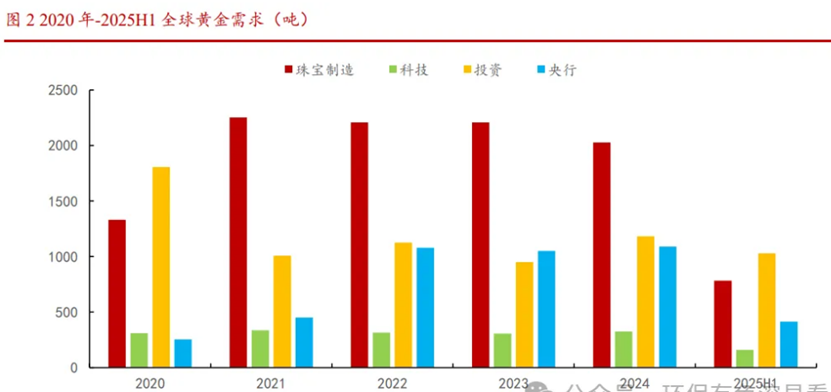
【环球网财经综合报道】北京时间8月8日凌晨,国际贵金属期货普遍收涨,COMEX黄金期货涨1.44%报3482.70美元/ 盎司,COMEX白银期货涨1.66%报38.53美元/盎司。 对此有市场分析人士表示,美联储官员对利率政策分歧加剧,美国对瑞士加征关税及墨西哥央行降息增加市场不确定 性,英国央行第五次降息强化宽松预期等因素,共同支撑了黄金价格的持续坚挺。 在此背景下,多家国际机构针对黄金价格的后期走势表达了乐观预期,渣打银行明确提出,未来3个月金价有望触及 3400美元/盎司,未来12个月的金价预估值仍维持在3500美元/盎司。 素有"黄金空头"之称的花旗银行,态度也较此前发生了方向性变化,做出了"空翻多"的分析预判。具体来看,花旗此 前在6月份发布报告,预测金价在2026年可能跌至每盎司2500至2700美元的水平;但日前则对此预判进行了大幅修 正,将未来三个月目标价从3300美元/盎司提至3500美元/盎司。 支撑黄金价格持续坚挺的市场因素则体现在黄金购买需求方面,世界黄金协会数据显示,2025年二季度全球黄金需求 总量达1249吨、同比增长3%,其中ETF投资流入170吨,亚洲地区贡献70吨,上半年 ...

新发国债等债券利息收入恢复征收增值税 对险资大类资产配置影响几何?
Zheng Quan Ri Bao· 2025-08-07 23:41
Core Viewpoint - The restoration of value-added tax (VAT) on interest income from newly issued government bonds and other bonds starting from August 8 is expected to have a limited static impact on the net profits of insurance companies, but it may influence their asset allocation strategies, potentially leading to an increased allocation in equity assets as a partial substitute for bonds [1][2][4]. Summary by Sections Policy Changes - As of August 8, 2023, interest income from newly issued government bonds, local government bonds, and financial bonds will be subject to VAT, while those issued before this date will remain exempt until maturity [2]. Impact on Insurance Companies - The overall impact on insurance companies' net profits is estimated to be around 1%, with some firms potentially adjusting their asset allocation towards higher-yielding assets or older bonds to mitigate the effects of the new tax policy [3][4]. - According to estimates from major insurance companies, the impact of the new policy on their net profits is projected to range from 0.26% to 1.77%, indicating a relatively minor effect [3]. Asset Allocation Trends - Despite the slight decrease in actual interest income, bonds will maintain their status as the "ballast" in insurance asset allocation. However, some insurance firms may increase their allocation to equity assets in response to the changing market conditions [4][5]. - Data shows that as of the end of Q1 2023, insurance funds had a bond investment balance of approximately 16.97 trillion yuan, accounting for about 48.58% of total investments, with life insurance companies having an even higher allocation of 51.18% [2]. Future Outlook - Analysts suggest that insurance funds will continue to focus on long-duration bonds, especially in a declining interest rate environment, while also considering high-dividend stocks to enhance overall investment returns [5]. - The potential for increased allocation to high-dividend stocks and growth stocks is anticipated as insurance companies seek to balance short-term volatility with long-term gains, especially as the macroeconomic environment stabilizes [5].
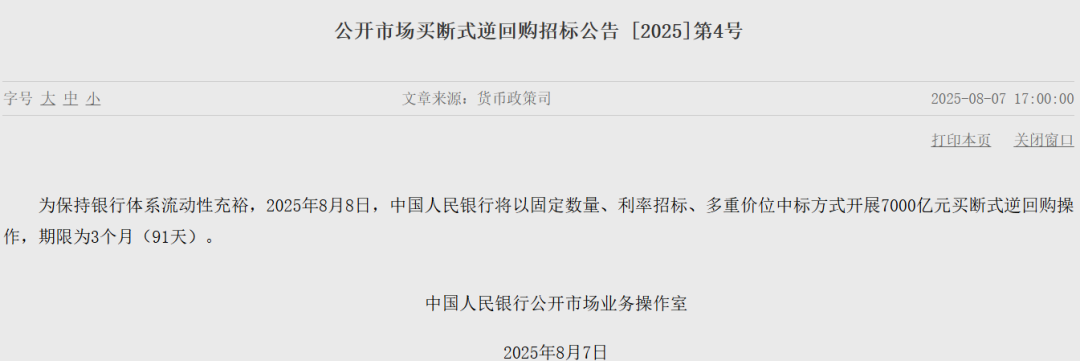
每日债市速递 | 央行将开展7000亿买断式逆回购
Wind万得· 2025-08-07 22:38
Group 1: Monetary Policy and Market Operations - The central bank conducted a 7-day reverse repurchase operation on August 7, with a fixed rate of 1.40% and a total amount of 160.7 billion yuan, resulting in a net withdrawal of 122.5 billion yuan for the day [1][3] - On August 8, the central bank plans to conduct a 700 billion yuan buyout reverse repurchase operation with a term of 3 months to maintain liquidity in the banking system [15] Group 2: Financial Market Conditions - The interbank market liquidity remains stable and slightly loose, with the overnight repo weighted average rate (DR001) slightly decreasing to around 1.31% [3] - The latest overnight financing rate in the U.S. is reported at 4.34% [3] Group 3: Trade and Economic Indicators - In the first seven months, China's total goods trade value reached 25.7 trillion yuan, a year-on-year increase of 3.5%, with exports at 15.31 trillion yuan (up 7.3%) and imports at 10.39 trillion yuan (down 1.6%) [15] - ASEAN remains China's largest trading partner, with a total trade value of 4.29 trillion yuan, while trade with the U.S. decreased by 11.1% to 2.42 trillion yuan, accounting for 9.4% of China's total foreign trade [15] Group 4: Credit Ratings and Economic Outlook - S&P Global Ratings has maintained China's sovereign credit rating at "A+" with a stable outlook, reflecting confidence in China's economic resilience and debt management [16] Group 5: Bond Market Overview - The yields on major interbank bonds have shown slight increases, with the 30-year, 10-year, and 5-year contracts rising by 0.03% and 0.05%, respectively, while the 2-year contract remained unchanged [14]

黄金定价逻辑生变?央行连续出手,华尔街巨头转向
Wind万得· 2025-08-07 22:38
Central Bank Actions - The People's Bank of China has increased its gold reserves to 7.396 million ounces as of the end of July, marking a month-on-month increase of 60,000 ounces and continuing a trend of nine consecutive months of accumulation, aligning with a global central bank gold buying spree [3][5] - The World Gold Council reported that global central bank gold purchases in the first half of 2024 exceeded the ten-year average by 40%, highlighting the importance of central bank demand for gold [3] ETF Inflows - As of August 6, the lowest fee gold ETF (518660) saw a net inflow of 98 million yuan over five days, with a total market size of 3.59 billion yuan and a year-to-date share growth rate of 182%, making it a preferred choice for investors [7] - The World Gold Council forecasts that global gold demand will reach 1,249 tons by the second quarter of 2025, with ETF investments contributing 170 tons, and the first half of 2024 recorded the highest ETF demand since 2020 at 397 tons [7] Changing Price Expectations - Citibank, known for its bearish stance on gold, has revised its price forecast upward, increasing the three-month target price from $3,300 to $3,500 per ounce, with a trading range of $3,300 to $3,600 per ounce [9] - The shift in Citibank's outlook is attributed to increasing risks of "stagflation" in the U.S. economy, with July non-farm payrolls increasing by only 73,000 and the unemployment rate rising to 4.1%, leading to heightened expectations for aggressive rate cuts by the Federal Reserve [10] Market Sentiment and Risks - Standard Chartered maintains an optimistic view, predicting gold prices could reach $3,400 per ounce in the next three months and remain at $3,500 per ounce over the next 12 months [11] - However, there are concerns about short-term upward momentum for gold prices, with risks of overheating in the market, as noted by招商证券, which suggests focusing on structural opportunities rather than broad bets on rising gold prices [12][13] - Key risk factors identified include potential policy reversals by the Federal Reserve, technical overbought conditions, competition from alternative assets like Bitcoin, and the possibility of reduced geopolitical premiums due to easing trade tensions [13]

央行将开展7000亿元买断式逆回购操作 8月流动性投放力度有望持续加码
Shang Hai Zheng Quan Bao· 2025-08-07 18:28
Core Viewpoint - The People's Bank of China (PBOC) announced a 700 billion yuan three-month reverse repurchase operation to maintain liquidity in the banking system, indicating a proactive approach to manage liquidity amid fiscal tax peaks and potential quarter-end pressures [1][2][3]. Group 1: Reverse Repo Operations - The PBOC will conduct a 700 billion yuan reverse repurchase operation on August 8, with a three-month term, to ensure ample liquidity in the banking system [1]. - This operation is strategically timed to cover the fiscal tax peak in August and the quarter-end assessment period at the end of September, reflecting the central bank's liquidity management strategy [2][3]. - Analysts expect a second reverse repo operation in August, considering the upcoming maturity of 4 billion yuan in three-month and 5 billion yuan in six-month reverse repos, totaling 9 billion yuan [3][4]. Group 2: Liquidity Management - The central bank is likely to continue using various monetary policy tools, including MLF and reverse repos, to stabilize market expectations and promote credit expansion amid a slowing economic growth backdrop [5][6]. - There is a consensus among analysts that the PBOC may implement further reverse repo operations to address liquidity needs related to government bond issuances and to maintain a stable liquidity environment [4][5]. - The PBOC's approach is characterized by a focus on medium-term liquidity adjustments, with expectations of potential reserve requirement ratio (RRR) cuts to inject long-term liquidity into the market [6].
央行预告:明日 7000亿元
Shang Hai Zheng Quan Bao· 2025-08-07 14:17
为平滑财政缴税高峰、提前对冲季末流动性压力,央行将于8月8日开展7000亿元3个月期买断式逆回购 操作。 业内人士判断,央行将继续通过逆回购、买断式逆回购、中期借贷便利(MLF)等多种货币政策工 具,加强对中短期流动性的调节,保持流动性充裕,进一步实施好适度宽松的货币政策。不排除下半年 通过适时降准向市场投放长期流动性的可能。 月内或有第二次买断式逆回购操作 央行8月7日公告,为保持银行体系流动性充裕,8月8日,将以固定数量、利率招标、多重价位中标方式 开展7000亿元买断式逆回购操作,期限为3个月(91天)。 此次操作不仅将覆盖季度末关键时点,也引发了市场对后续流动性操作节奏的关注。 一个月内开展两次买断式逆回购操作已有先例。比如,今年6月,央行分别在月初和月中两次开展买断 式逆回购操作并提前公开操作信息,加强对市场预期和信心的引导提振。 "2024年10月,央行宣布在公开市场操作中启用买断式逆回购工具。买断式逆回购的推出,使央行可以 更加及时、精准地调节市场流动性,从而更好地维护金融市场稳定,促进经济回升向好。"董希淼说。 中国邮政储蓄银行研究员娄飞鹏认为,8月为财政缴税高峰,市场流动性或阶段性趋紧。此次 ...
7000亿元!央行出手!
Zheng Quan Shi Bao· 2025-08-07 11:59
Core Viewpoint - The People's Bank of China (PBOC) is taking measures to maintain liquidity in the banking system by conducting a 700 billion yuan reverse repurchase operation with a three-month term on August 8, 2023 [1] Group 1: Reverse Repo Operations - The PBOC plans to conduct a reverse repurchase operation of 700 billion yuan with a three-month term, using a fixed quantity and multi-price bidding method [1] - Despite the upcoming reverse repo operation, the total amount maturing in August exceeds this operation, indicating a proactive approach to liquidity management [4] - Analysts expect an additional six-month reverse repo operation to be conducted within August, which would result in a total operation scale exceeding the maturing amounts for the month [5] Group 2: Market Expectations and Economic Context - The market anticipates that local government bonds will continue to be issued at an accelerated pace in August, which may disrupt liquidity in the banking system [4] - The PBOC has maintained a trend of increasing medium-term lending facility (MLF) operations since March, with expectations for further increases in August [5] - The central bank's recent meetings have emphasized the continuation of a moderately accommodative monetary policy, aiming to keep liquidity ample [5]